Archive for category online tools
My Pinterest Boards (and why I’m bothering to make some)
Posted by kmcg2375 in education, learning community, online tools, social media, university on July 16, 2012
For the first half of this year it seemed like all anyone was asking me was ‘do you have Pinterest?’
All throughout semester one, when I asked students about Twitter or Facebook or Tumblr, I was guaranteed to get a few voices around the room crying ‘Pinterest!’
It sounded like a cool tool. A virtual pinboard – just make a board on a topic or ‘interest’ (ahhhh… pin + interest = ‘pinterest’!), then add images and videos to it. Always a fan of putting posters on my bedroom wall, covering my school folder with pictures under contact paper, and putting stickers on random bits of stuff, this highly visual curation tool has always sounded promising to me.
I had made the decision in semester one, however, to steer clear of Pinterest. This choice was purely motivated by my fear of taking up another addictive web tool … the first semester of this year was just too busy already to attempt trying new things.
Some questions have also flown around over time about the ethics and copyright implications of re-pinning images without permission, and I confess this made me wary.
THIS SEMESTER, however, I am pinning!
My most promising board so far is the one I have made to collect links for the unit ‘Culture studies: Indigenous education’ (EDB007):

http://pinterest.com/kmcg2375/indigenous-studies/
I hope to engage students in my two tutorials by sharing the board with them and inviting them to explore the links I’ve collected/curated.
Of course, I could have chosen to share my links in other ways, but they all have their drawbacks:
- on a handout (which is not hyperlinked)
- in a Blackboard/LMS post (students hate and avoid Blackboard)
- using social bookmark sharing e.g. delicious (so far unsuccessful; students don’t use/engage)
My hope is that the visual nature of Pinterest, and the ability to browse it socially and on mobile devices, will entice a few students to explore the links I’ve found.
As far as the image copyright issue is concerned, I think I’ll just wait and see if any of these organisations complains, eh? I have done my best to attribute the images, that’s all I can say.
Last word:
This slide presentation by Joe Murphy (@libraryfuture) was really helpful for me:
Joe makes this observation:
“Pinterest succeeds at the juncture of the major online and content trends of:
- self curation
- image engagement and sharing
- visual search/discovery
- and social discovery”
In addition, points made in these slides about the potential of Pinterest to expand community engagement and open up services to diverse clients made me even more eager to try using this service as a teaching resource.
Here’s hoping my bid to invoke some ‘cool’ in my classroom pays off!
Pecha kucha at the first #TMBrisbane
Posted by kmcg2375 in conferences, education, learning community, online tools, social media on March 2, 2012

I really enjoyed meeting new people and hearing them share their work yesterday at the first TeachMeet in Brisbane.
Steve Box (@wholeboxndice) hosted the TeachMeet at Moreton Bay Boys College (thanks Steve!):

TeachMeet Brisbane
I presented a 7 minute pecha kucha on how to construct ‘fair’ assessment when using project-based learning (PBL).
My presentation included shout-outs to @BiancaH80 @malynmawby @Vormamim and @benpaddlesjones who are some of the wonderful people that have tweeted around ideas with me on my PBL journey. It was the first time I presented a pecha kucha and adhered strictly to all the rules! Making cards to help me stick to the topic helped a lot (something I haven’t done since school tbh):
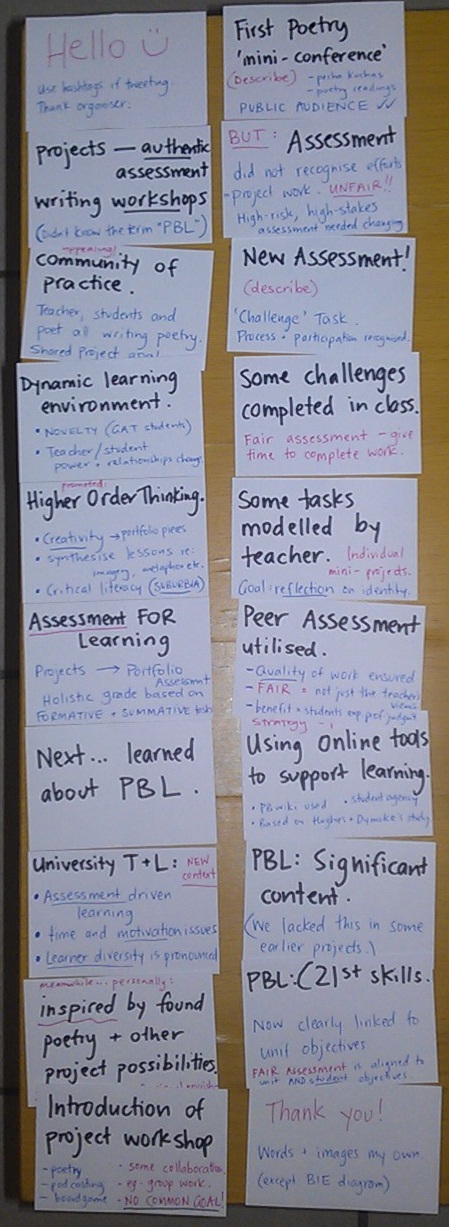
Actual palm cards - old school!
If you’d like to check them out I’ve put the slides up on slideshare. I hope that showing these resources helps future TeachMeeters plan their Pecha Kuchas – I loved the mode of presenting and highly recommend it!
Congratulations to TeachMeet Sydney on their WORLD RECORD ATTEMPT tonight! I hope the next #TMBrisbane event at the State Library of Queensland will be able to be video streamed online like #TMSydney was tonight, I had a ball watching along and tweeting with everyone from home 🙂
Quick and dirty Eddies
Posted by kmcg2375 in education, learning community, online tools on December 2, 2011
Very conscious that the Edublog Award nominations are closing tonight, but stuck in a hotel with no WiFi and slighly tempremental devices…
Still, my moby is playing nice enough to let me post these – my three best favourite blogs, and a free tool that should be getting more Edu-love, imo:
Best School Administrator blog
Darcy Moore’s Blog
http://darcymoore.net/
Darcy continually puts forward ideas and resources that are either immediately of interest to me, or make their way into my orbit months (or years) later. Progressive, responsive and visionary Darcy – I’m sure i won’t be the only blogger to nominate him 🙂
Best teacher blog
Bianca Hewes
http://biancahewes.wordpress.com/
For her edupunk ethos, and her uber reflective practice, Bianca always gets my vote. Now she’s started an MEd. in edu research, making this a hot blog to watch for all things Project-based.
PBL ftw!
Best individual blog
Dean Groom
http://deangroom.wordpress.com/
Dean is doing some really sexy Games-based learning work. He shares on his blog, among other things, his powerful use of Minecraft to connect kids AND their parentals to meaningful and fun learning online. His posts always give me something to think about – sometimes to disagree with – and his generosity with knowledge and resources is an important factor in the growth of interst in GBL in Sydney and beyond.
Best free web tool
Polyvore
http://www.polyvore.com/#
At first glance this looks like a fashion website. But dig past the front page and you’ll discover a collage making tool with a vibrant community of users and a rich collection of ‘sets’ covering a wide range of highly creative art, literature and even interior design sets. Easy to use, highly addictive, 100% recommendable (as long as you can forgive the fashionista links to retail items…which any good critical user should be able to manage 😉 )
Now, off to submit my post link. I hope I made it in time!
Thank-you to every blogger i have read this year. While i was finishing my thesis I did fall a little out of the loop; i hope to be a better reader, and commenter, in 2012.
Good luck to my peeps, and may the odds be ever in your favour!
A transformative digital literacies pedagogy: Thomas (2011)
Posted by kmcg2375 in education, learning community, Lit_Review, online tools, research, social media, technology, university on November 17, 2011
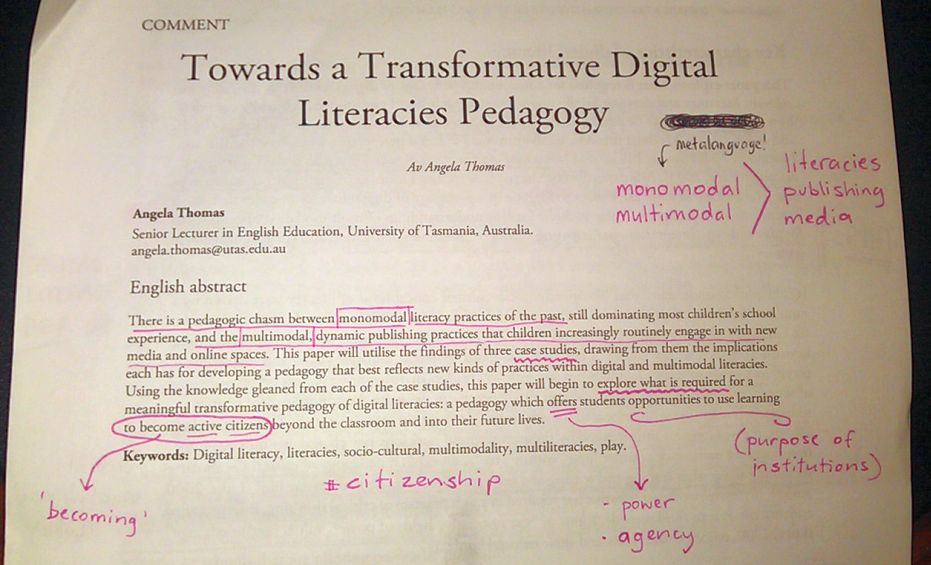
Thanks to @malynmawby @benpaddlejones and @Vormamim for engaging in tweety-chat today about play-based learning and transformational play.
There was an article that I wanted to post the full reference to – this one by Angela Thomas (@anyaixchel)
Thomas, A. (2011) Towards a transformational digital literacies pedagogy. Nordic Journal of Digital Literacy. Vol. 6 pp. 89-101
You can see the abstract for the paper with my own annotations, above.
In it she argues that there are:
a number of significant characteristics of digital literacy that are imperative to include in a pedagogy of digital literacy in order to make it a transformational pedagogy. These include: explicit understandings of multimodality, opportunities for play and experimentation, participating within communities of practice, and critical engagement with text.
I had picked this article up to read Angela’s findings about digital pedagogy, but it was a timely read. I am a big fan of the work of Paulo Freire, and of his work to empower communities through literacy. By bringing in Freire’s notion of ‘transformative pedagogies’ this article reaffirmed the need for critical, participatory and dialogic practices to be woven into the digital learning landscape.
I’d love to hear of other readings and resources along these lines, if you know of any…?
Use #etaq21c to ask me things tomorrow!
Posted by kmcg2375 in conferences, education, english, learning community, online tools, personal, social media, technology on August 19, 2011
More specifically, use #etaq21c to ask me questions about Digital Literacy and electronic text practices in English curriculum. The conference theme says it all: “English and Generation Next”
ETAQ’s Annual State Conference will be held atLourdes Hill College on Saturday 20 August. The theme is “English and Generation Next”.
The program will feature a keynote address by Professor Peter Holbrook from the University of Queensland’s School of English, Media Studies and Art History, a Q & A style panel session [that’s where I’m presenting!!], and a range of supporting workshops. Professor Holbrook’s address is entitled “Literature, Literacy, the Imagination, Freedom”.
So, if you are an English teacher, or if you are interested in digital texts and the future of the book, please, shoot some questions our way! You can post them here as a comment, but if you use Twitter then posting a comment or question there with the hashtag #etaq21c would Really Make My Day 🙂
I am soooo looking forward to this panel presentation! The full list of people in the panel session are:
- Professor Catherine Beavis (Griffith University and ETAQ Patron)
- Professor Peter Holbrook (University of Queensland)
- Kelli McGraw (Lecturer, QUT)
- Janina Drazek (Executive Director, Teaching and Learning, Education Queensland)
I’ll be talking about ‘acts of reading and writing’ and ‘digital pedagogy’.
JOLT: Balancing Quality and Workload in Asynchronous Online Discussions
Posted by kmcg2375 in education, learning community, Lit_Review, online tools, research, social media, technology, university on August 17, 2011
Of interest to teachers struggling to keep up with online discussions with their students!
Goldman, Zvi (2011) ‘Balancing Quality and Workload in Asynchronous Online Discussions: A Win-Win Approach for Students and Instructors’. Journal of Online Learning and Teaching. 7:2 pp.313-323
ABSTRACT: The challenge addressed in this article is how to achieve a win-win balance between quality and workload for students and instructors participating in asynchronous online discussions. A Discussion Guideline document including minimum requirements and best practices was developed to address this need. The approach covers three phases: design and development, setting up expectations, and launch and management. The goals of the approach, based on a commitment shared by all full time and adjunct faculty, are high quality of education as well as retention of both students and qualified instructors.
Further explanation of the research challenge from the introduction: “When discussions are regarded as critical components of learning, and administered as such, they impose a significant workload on both students and instructors. In applicable programs targeting practitioner adults, discussion sessions, during which much of the evidence-based learning and experience sharing occur, can easily consume half the course workload (Goldman, 2010). The reality is that neither students nor instructors can afford to dedicate an unlimited amount of time to fulfill course requirements or teach a course. Therefore, as a matter of practicality, discussion sessions should be carefully implemented to balance pedagogic quality and workload for students and instructors alike.”
Foucault THAT.
Posted by kmcg2375 in books, education, english, learning community, Lit_Review, online tools, politics, reflections, research, social media, technology, university on July 28, 2011
I have a confession to make.
Lately, I’ve been cheating on my blog. (In a good way, I promise!)
A colleague at my university, Clare O’Farrell, has an established Ning that is home to members of the Poststructuralist Theory ‘Special Interest Group’ of AARE. Established it so well, in fact, that it is one of the few Nings I know of (along with the English Companion) that continued to have happy users after stupid-Ning made its stupid-serivce un-free. Hmph.
Anyway, I use my space and profile on the ‘Ed Theory Ning’ to brain-vomit about (on?) theory that I don’t understand yet.
And it’s proven #very illuminating.
Increasing my activity in various groups on the Ning has also proven fruitful. Particularly in the ‘Daily Writing Club’ (we have to do exactly as it says…!) and now also from browsing the ‘Foucault reading group’.
That’s where I was reminded to check out Clare’s actual blog, Refracted Input, which I hadn’t done for ages. This month she is discussing a quote by Foucault about ‘race and colonialism’, and in it I can see a relationship to contemporary discourses around changing technologies.
The term ‘folklore’ is nothing but a hypocrisy of the ‘civilised’ who won’t take part in the game, and who want to hide their refusal to make contact under the mantle of respect for the picturesque…
Man is irrevocably a stranger to dawn. It needed our colonial way of thinking to believe that man could have remained faithful to his beginnings and that there was any place in the world where he could encounter the essence of the ‘primitive’. (trans. Clare O’Farrell)Michel Foucault, (1994) [1963] ‘Veilleur de la nuit des hommes’ In Dits et Ecrits vol. I. Paris: Gallimard, p. 232.

You see, I’ve been worrying about the ethics of what could be seen as meddling with teachers or students who are comfotable in their print-material ways, trying to prod them along to explore new technologies. I have wondered, ‘am I being selfish?’, ‘what if they have it right?’, ‘what if I’m destroying something important?’, and ‘am I wrong to advocate for my view, should I just wait and see what happens instead?’. But then, Clare’s wise words:
One cannot buy into the romanticism of the primitive – which is assumed to be so much closer to pure truth and ‘nature’. Conversely one cannot make the colonial assumption that one civilisation or one period of history (now) is more advanced and more evolved than another.
That’s right. I don’t need to worry about whether I’ll ‘wreck’ anything, unless I’m thinking of the people I’m meddling with as OTHER. And I was using pronouns to construct myself in opposition to other through all those damn self-doubts. I don’t need to do that. FOUCAULT THAT!
*Sigh of relief*
NB: Clare also curates a website on Michel Foucault, which includes a glossary of KEY CONCEPTS and other wonderful gems (thanks Clare!).
Google+ by Molly Rocketboom
Posted by kmcg2375 in education, learning community, online tools, social media, technology on July 26, 2011
If you’re still not sure how Google+ fits into your existing world of Facebook and/or Twitter, let Molly of Rocketboom break it down for you. Approx 4.5 mins:
Me and my iPad: building new literacies
Posted by kmcg2375 in books, education, english, online tools, technology, university on July 23, 2011
I have to say, after just 10 days of owning an iPad, I am noticing some significant changes to my literacy practices – and being confronted by a range of literacy challenges!
I’ve solved the ‘where is Word’? problem – you can download apps, such as Pages, which costs about $10. I haven’t bought that yet because I want to try and do as much on free apps as I can before I get frustrated and am forced to buy (that’s what a school teacher on a tight budget would have to do).
Literacy lesson #1: There are no obvious ‘windows’ in this operating system. There is also no obvious place where you can see a directory of all your ‘files’. There are apps that are always on and you can look in on them any time.
But…how do I ‘save’ my work then? –> LITERACY OF STORING/SAVING AND BACKING UP DATA IN DIFFERENT PLATFORMS/OPERATING SYSTEMS?
Literacy lesson #2: Google docs can be used as a free word processing tool. I just open it in the web browser (Safari) and work from there.
But…when I’m not online I can’t access Google Docs. –> LITERACY OF ENSURING YOU CAN ACCESS YOUR MATERIALS AT POINT OF NEED?
Literacy lesson #3: I am LOVING using ‘Notes’. It’s an app that comes with the iPad. It works even when you are not online. The ‘what should I use to take notes in class/meetings?’ problem to me is solved with this. And because the only formatting available is the ability to leave empty lines and use capital letters, all of my focus is going into getting the ideas onto the page. None (at least much, much less) of my energy is going into design considerations. I never realised until formatting was taken away from me just how much thought I give to the design of a word document.
So…is that the difference between ‘writing’ and ‘word processing’? Or between ‘scribing’ and ‘writing’? or ‘notes’ and ‘documentation’? –> LITERACY OF WRITING FOR YOURSELF VERSUS FOR OTHERS? LITERACY OF FIRST DRAFTS (maybe “no Mary Jane, you can’t just do your draft in Word, because that’s your publishing platform and I don’t want you thinking about formatting your writing yet”. hmmm…)
Food for thought.
I should say, I have also wondered how much of this thinking is coming from using th iPad per se, or if it is the cumulation of being exposed to many new tools recently – a notebook computer, my Playstation and my Kindle had already got me thinking, but now it’s just all come to a head.
I’m thinking about this faster than I can write in-depth posts about it, but I hope these ideas and questions can launch some discussion!
A new iPad 2 in the house!
Posted by kmcg2375 in online tools, research, technology, university on July 13, 2011
I was so excited yesterday to pick up my brand new iPad 2 from the school office:


…very rarely am I alone when I get to open exciting packages like this…


…I was surprised that it was white (should I have been?). It’s so Mac-like!
 …I have no idea how to work it…
…so I take it home and work it out there 🙂

And the verdict, so far…
What is great about the iPad:
- I can make it work by touching the screen; like my phone, but the screen is BIG! It makes such a difference.
- I’ve got wireless and 3G but so far it has just been running on wireless through my home connection. At lightning speed. So awesome.
- Checking my Tumblr stream…the pictures are massive and it looks so good.
- Using Muro on Deviantart.com to draw. Wow! Tablets ROCK!
- The iView app (recent ABC shows anytime)
- (oh. my. god. I can’t believe I haven’t tried making a collage in polyvore yet!!!)
What is weird about the iPad:
- Where is Word?
- Where do I save my files?
- Why can’t I upload the pictures I take with it?
- Why doesn’t Facebook have an official app?
-
You are currently browsing the archives for the online tools category.
Nominated!

- Australian English Teachers
 9 members
A group for English teachers in Australia to discuss the books they are reading, and the books th...
Books we've read
View this group on Goodreads »
Share book reviews and ratings with Australian English Teachers, and even join a book club on Goodreads.
 Kelli McGraw
Recent Comments