Posts Tagged twitter
My PLN: working with Bianca
Posted by kmcg2375 in education, online tools, personal, social media on February 21, 2011
Part of the re-vamp I’m undertaking of English Curriculum Studies 1 to ‘make it my own’ is to use the first tutorial as time to:
- get to know each other and form reading groups, and
- start the students building their online PLN, or personal learning network
I have also been picking the brain of my friend and colleague Bianca Hewes as I prepare materials on project based learning, or PBL.
Bianca is a key node in my personal learning network, and her thoughts, arguments and resource links pervade my personal learning environment – we follow each other on Twitter, read each others blogs and are connected as friends on Facebook. For me this illustrates two important elements I have found to be instrumental in building my PLN
- that learning happens everywhere (even in ‘personal’ spaces like Facebook)
- that a good learning environment is ‘personal’ in a very literal sense – friendly, generous and warm
It’s worth recording some of the building blocks of our collaboration thus far. I’ll pick up the thread where I saw Bianca’s tweeting away while she prepared English lessons for Term 1 at the end of the summer holiday and started asking questions, to which she replied:

I had heard about PBL, but hadn’t used it well so far myself. So I asked Bianca for some help because…well, that’s one of the lessons of this story really. She’s in my PLN. I know she’ll send me what she can, when she can. As a learner, I’ve had an opportunity to personally ask her though about what it is I want to know. And because I want to teach PBL, I know I need to learn more about it, and draw on the expertise of others:


SUCCESS! A willing expert!
To maximise Bianca’s willingness to let me pick her brain, I emailed her some more specific questions about what I wanted to learn:

Now Bianca is back at school and has preparing materials for her ‘Innovator’s Workshop’, while I’ve been busy working away on thesis corrections and planning the learning sequence for my English Curriculum Studies Unit CLB018. This has included making a blogging ‘hub’ for the tutorial groups to compliment the QUT Blackboard resources and a twitter account for unit related tweets. She’s created a Prezi with the information she would like to share about PBL with my class (yesss!) and now even if we don’t get a video interview or link of some sort as I had originally envisaged, I feel like I have enough material to move forward and teach this concept to my pre-service teachers.

Bianca’s Prezi includes a Common Craft video about personal learning networks, which links to the website for bie.org , so now I also have two killer links to refer people on to who are new to PBL. Are you? Why not watch the common craft video now, you’ve come this far:
So, THAT is the story of how having a PLN that you love and put energy into building pays back in spades.
If nothing else I hope that giving my students this path and these tools for expanding their personal learning environments will encourage them to look forward to learning again. If they read this post they will see that learning done well doesn’t limit itself to one space, one person, or one network. I won’t be able to teach them everything I think is important about English Curriculum in nine weeks, and that’s why equipping them with the motivation and capability to keep learning beyond week 9 is priority number one.
Thanks Bianca for being in my PLN and for being part of this story 🙂
What I Teach
Posted by kmcg2375 in online tools, university on January 26, 2011
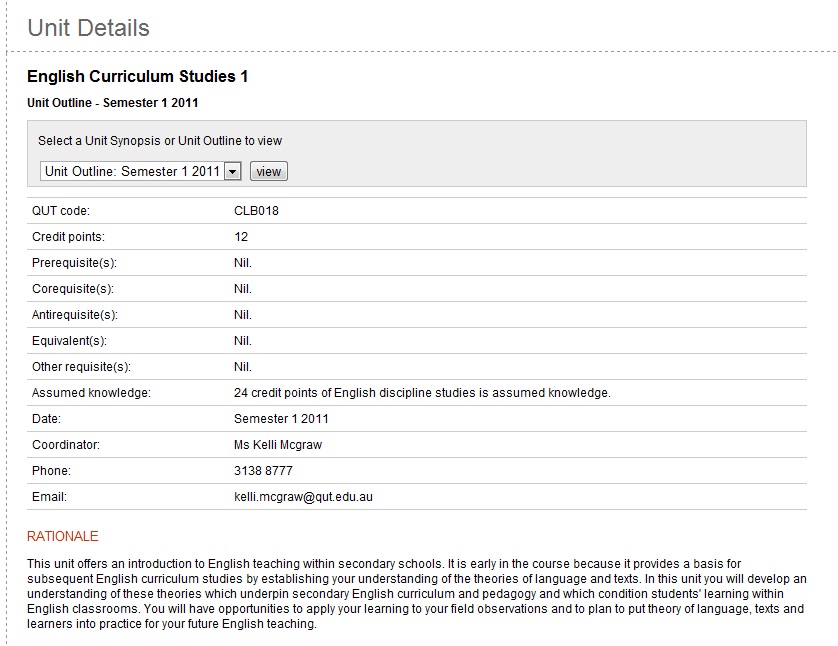
Cheering because my name is now on the website for English Curriculum Studies 1 in the Faculty of Education at QUT:
(click to enlarge)
What advice can you offer my preservice teachers for productive/generative tweeting? Or advice for me, for using it in the classroom?
(Pictures of The Blender to come!)

Brain fry
Posted by kmcg2375 in personal, reflections on January 20, 2011

Ever get that soupy brain kind of feeling?
I usually come to the end of leave (hmmm, telling – I used to call it ‘holidays’) feeling focussed and refreshed. Not always ready to end the holiday mind you, but at least with my head together.
2011 on the other hand has arrived with a distinctly where is my mind vibe.
A few months ago, Darcy left me thinking with a post asking about what we think our individual future holds. It struck me that submitting my PhD and starting an awesome job at QUT looks distinctly like already being in my future. Exciting, of course, but the prospect of now having to be in it and of having to *shudder* set new goals is apparently more daunting than I gave it credit for.
I need a meme or something to solve this problem.
Should we have a safety word that you can use if my posts get too boring/navel-gazey?
The HSC again. and again.
Posted by kmcg2375 in education, HSC, reflections, school on December 16, 2010
In NSW yesterday Year 12 school leavers got their HSC results back. And again, we reflect.
so-and-so got x amount of Band 6s this year…should I teach more like them?
my kids didn’t go as well as they had hoped…did I fail them?
there were some great successes at our school…what pressures will this bring next year?
The dizzying heights…the devastating lows.





I’m sure this post / these tweets should have some ‘IMHO’s peppered through them, but stuff it – the HSC is an evil device.
I’m so proud of every HSC student who got through the year, and was beyond excited for my ex-students who got the results they sought (I always will be). Motivation, goals, mastery, achievement, I believe in them all. But the HSC provides them too sparingly, for students and their teachers.
And now it’s time for recovery. again.
Congratulations one and all – bring on 2011…
Insubordination
Posted by kmcg2375 in education, reflections on August 11, 2010
This tweet caught my eye today:
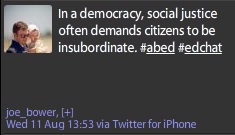
It caught my eye because I have been musing on this observation made by Jan, a high school Principal on Twitter last week:
We work within a system. Of course there are systemic priorities. That is the reality of any workplace IMHO.
I wanted to flag this because I think both of these tweets are right, but this is a problematic standpoint as ‘working within a system’ and ‘being insubordinate’ are tricky agendas to keep in balance.
There has been much promotion recently amongst NSW DET leaders of adopting a ‘Tight-Loose-Tight’ model of working in schools. It’s a model I support, and I think it provides a really terrific framework for teachers and school leaders (and system bureaucrats) to work on common ground without constantly arguing about, say, NAPLAN. By accepting policy and product requirements we can get on with developing the ‘Loose’ area – the bit where we actually teach in the classroom using different and divergent strategies that are relevant and engaging and meet the needs of our personal teaching style, our individual students and our local school context.
However, recently I have definitely felt that critical comments made by teachers about ‘the system’ are being taken personally by leaders who are higher up the chain and see this as either a personal attack or an undermining of their innovative work in planning their school. A few weeks ago I wondered if the answer is that we need a more realistic paradigm for collaborating with the people who ultimately are our ‘boss’. But to tell you the truth, I find that idea quite dispiriting. I hate having to mind my p’s and q’s…it’s why I decided NOT to go into politics!
I don’t have much to say about this today, but perhaps you do?
How can we show our leaders the love (and our commitment to common goals) while maintaining a healthy level of insubordination?
NB: I’m talking very NSWDET here, but I’ve found a similar conundrum working with people on development of the National Curriculum…it’s tough to authentically engage in developing something so prescribed-from-above when your gut reaction is to kick against the pricks. Conversely, it’s tough to promote engagement with the resulting best-case-scenario product to people that I in turn lead when they want to fight against it too!
How Real Media Misses The Point Of Social Media
Posted by kmcg2375 in online tools, reflections, social media, technology on July 11, 2010
As you could glean from my last post, I’ve become a little sensitive to social media zealots who seem determined to paint everyone who is wary/concerned/resistant to social media as merely being scared, whimpy individuals.
This is not to say that very good points do not continue to be made in favour of using social media.
Consider this article reproduced for Business Insider: How “Real” Media Misses the Point of Social Media written by Lisa Barone from Outspoken Media.
Barone makes a point that many of us using social media tools would make:
“The risks to exposing yourself to your customers and community aren’t nearly as severe as you may think; and the rewards are huge.”
However, she also sums up one of the best pieces of advice I would give about using social media:
“If you’re going to be a big boy and swim, and benefit from, these waters you have to be able to take it.”
These two mantras pretty much sum up the bulk of what I have seen going around in terms of the pros and cons of harnessing social media (in my context, to develop my PLN, as opposed to using it as a marketing tool etc.) However, the rhetoric that I often see invoked when a social media convert comes across a social media resistor is that the resistor is just ‘too old-fashioned’, ‘afraid of computers’, ‘non-reflective’, ‘too scared to share’ (and by extension, even ‘selfish’), or ‘a luddite’.
In my last post I suggested some other issues that, in my mind, are not currently being considered in enough depth, and which the ‘social media resistors’ are perhaps finding it hard to articulate because of their lack of familiarity with the technology. Interestingly, most people I would have expected to drop a comment were nowhere to be found…although it is school holidays, to be fair 😉
I suspect that discussions around how power is wielded within an identity-rich online PLE (Personal Learning Environment, consisting in part of social networking spaces like Twitter and Facebook) are difficult to have without putting noses out of joint. However, I also think that being open about how we construct and project our identities will be a test of whether we are ‘for real’ about connecting and collaborating in a democratic and generative way.
We can’t afford to be blind to reproductions of unhealthy practice in this brave new (connected, public) world.
Hit Refresh!
Posted by kmcg2375 in conferences, english, online tools, social media, technology on December 4, 2009
Last weekend I attended the English Teachers’ Association Annual Conference in NSW, which was held at the University of NSW on Friday 27th and Saturday 28th of November. The conference theme was ‘Hit Refresh!’, so it was apt that this was the first conference we have run that had an officially constructed online aspect, using both Ning and Twitter to engage presenters and participants in discussion and networking before, after, and behind the scenes of the conference.
This (longish) post is a report I wrote on the success of these online tools at the conference.

Many educators by now have heard of ‘blogs’, ‘wikis’, and learning management systems such as Moodle, and hopefully we are fast approaching a time where the these strange names and terms are accepted as useful (rather than childish) jargon. In the meantime, jokes about the ‘Ning-nang-nong’ and Twitter users being ‘twits’ will abound. But while these tools might sound goofy, they are anything but.
Ning.com is an online tool that is fast gaining popularity with educators. It combines many other features for writing and connecting online – such as being able to have a personal profile page, make ‘friends’ with other members of the Ning, write blog entries, add to discussion forums, and join sub-groups – and for that reason the term Ning was coined to describe the NetworkING that occurs on the site. For our conference we created a Ning a few months ahead of the conference (http://etaconf09.ning.com/), set up all of our conference workshops, presentation, keynotes and plenaries as ‘events’, invited presenters (first, then later, people who had registered for the conference)…and waited.
The response was slow but sure. Before the conference had even started we had 70 people who had joined as members of the Ning. ETA committee members and presenters who were keen to explore the Ning started adding discussions and material right away. New presenters felt welcomed and included in the lead up to conference, and could ask questions and establish contacts with others before arriving on the big day. On the Thursday before the conference, the number of members had grown to 130. Many more joined up during and following the conference, and the count currently stands at 230 members. Some presenters used the Ning directly in their workshops, getting participants to add their own questions, ideas and resources. Many people were glad to have an easy way of contacting and keeping in contact with other members, and as many people did upload information about themselves, including a photo to their profile, there was a definite sense of familiarity and closeness at the ‘real life’ conference between Ning users.
As well as establishing a conference Ning, the micro-blogging service Twitter.com was used to ‘tweet’ short, 140 character updates from the conference, in particular from the Saturday morning panel on National Curriculum. This allowed attendees to create a ‘backchannel’ at the conference, communicating with others from around the globe, as well as other members at the conference, about events as they happened. Before the conference I blogged a description of a backchannel, which was used at the conference to explain the concept.
As this was our first attempt at using a backchannel, we decided not to display the tweets live on a big screen behind the speakers – though this is something that is occurring frequently now at many conferences that use a backchannel. For our own, and the speakers’ peace of mind, Darcy Moore and I fielded questions and comments that came in via Twitter at the same time as chairing the panel and the real-life questions from bodies inside the auditorium, and integrated these into the plenary. The response was very positive, and people (speakers included) only seemed disappointed that we didn’t display the tweets on the big screen!
So, next year we are bound to do this again, with the screen on live display. Using technology this way can be risky of course, as there is far less control being exercised when members can publish their unfettered thoughts for all to see. But the benefits of this far outweigh the risk, and the message from members was ‘bring it on!’
Increasingly, educators are connecting online in very powerful ways. This includes English teachers. As online tools become easier to use to connect, communicate and collaborate with colleagues they are being seen as more of a joy (and a time saver) than a chore. I heartily encourage other professional associations to consider adopting online elements for future conferences and events, and would be happy to share ideas and advice with anyone who is going in that direction.
Anyone else care to share their experiences or tips?
ETA Conference: The Backchannel
Posted by kmcg2375 in conferences, english, online tools, social media, technology on November 26, 2009
Friday morning will see Darcy and I braving the stage prior to the opening of the annual English Teachers’ Association conference ‘Hit Refresh‘.
Why?
Because for this ETA conference, for the first time, the conference is going web 2.0 – we’re stepping up the interaction, participation, and networking by providing some seriously cool online spaces for teachers to wet their toes in, and hopefully also dive right in to! So, we’ll be getting up (in our awesome Twitter t-shirts 😉 ) to show the folks at the conference how to get involved in communicating with others, and how to use the backchannel.
What is a ‘backchannel’?
You know when you’re sitting, watching a keynote or presentation, and if you know the person in the next seat you might make the odd remark in their ear? Well, a backchannel is like doing this on a mass scale – it’s like having a silent ‘channel’ on in the background for anyone who wants to make comments or ask questions that the rest of the audience can see, and if they want, silently respond to.
It’s like passing notes for grown-ups. Ones that you know the teacher can read too if they so choose (so you can be critical, but must also be polite!)
From wikipedia:
The term “backchannel” generally refers to online conversation about the topic or the speaker
…it is the practice of using networked computers to maintain a real-time online conversation alongside live spoken remarks.
What are we using?
The most effective way of paticipating in a live backchannel during the conference is to join Twitter, and post short 140-character messages called ‘tweets’. Anyone who ‘follows’ you can see your comment or question – and some people might also respond.
Do I have to have a lot of followers for this to work?
(or ‘yikes! but I’m not that famous yet!’)
If you are new to Twitter, never fear. If you tag your tweet with the ‘hashtag‘ ETAConf09, then the comment that you tweet will also be seen by anyone who has searched for that tag – not just the people who follow you. This means that even if you have NO FOLLOWERS, you can add to the backchannel discussion, and people can tweet responses to you. Here is an example:
Wow! I thought Kelli and Darcy did a great job explaining the backchannel! #ETAConf09
To which another user might reply:
Does anyone know where I can find the video they showed at the start? #ETAConf09
You see the potential here? And it’s easy!
What’s this I hear about a conference ‘Ning’?
‘Ning’ is the cute name that the people over at Ning.com made up to describe their online site that is used for NetworkING. It’s a very easy site to use, and a great way to introduce yourself to online learning if you haven’t already.
ETA members (all of you – whether you are physically at the conference or not) can join the ETA conference Ning and add comments and questions there too. Darcy and I will be monitoring the Ning as well, and it is another place that a kind of backchannel will likely spring up. It’s probably less likely that this will happen during the sessions though. I imagine a lot of people will be logging into our Ning on Friday and Saturday night, and for awhile after the conference, to send comments to friends, colleagues and presenters, and to share ideas and resources.
For the most effective participation in a LIVE backchannel, I seriously recommend you use Twitter.
Any questions?
If you have any questions, you can post them here as a comment, or ask them on Twitter. You can find and follow me at http://twitter.com/kmcg2375, or Darcy at http://twitter.com/Darcy1968
See you in the Twitterverse!
NSW Laptop Tweets
Posted by kmcg2375 in technology on July 6, 2009
For those of you out there who are about to receive (or are lucky enough to have already received!) one of the NSW DET issue Lenovo Laptops, this list of Twitter contacts may help you build your Personal Learning Network.
The following is a list of Twitter users that wove their hands about with great enthusiasm when asked who wanted to discuss and share resources for teaching with the new laptops:
- @kmcg2375 – Kelli McGraw (that’s me! English teacher, South West Sydney)
- @TroyM7 – Troy Martin (English teacher, Hunter/Central Coast)
- @pryorcommitment – Roger Pryor (S.E.D., Hunter/Central Coast)
- @piphowell – Pip Howell (NSW DET, Hunter/Central Coast)
- @SimonBorgert – Simon Borgert (Head Teacher Maths, North Coast)
- @simonjob – Simon Job (Maths teacher, Western Sydney)
- @melissagiddins – Melissa Giddins (Head Teacher English, Sydney)
- @stuhasic – Stu Hasic (DET tech. advisor, Sydney)
- @Lofts1964 – Denise Lofts (Deputy Principal, Sydney)
- @paulwils7 – Paul Wilson (Technology teacher, North Sydney)
- @vmarchant – V Marchant (eLearning facilitator, Illawarra/South Coast)
- @lyntiernan – Lyn Tiernan (Head Teacher English, Casino HS)
- @liamalexander – Stephen Alexander (Technology Teacher, Sydney)
You can join Twitter and start following these excellent people at http://twitter.com/
If you’d like to be added to this expanding list, add a comment with your twitter username and some info about your role and region. There seems to be a lot happening in the Hunter/Central Coast region, surely the rest of us can give them a run for their money 😉
Also let us all know if there are networks springing up in other spaces – for example, English teachers can now join the Teaching English with Laptops ‘Ning’, a site specifically focussed on using the laptops in the English classroom.
The Twitter Experiment
Posted by kmcg2375 in online tools, social media, technology on May 12, 2009
This five-minute video gives an impression of what it is like using Twitter as a backchannel in a large classroom.
I am already a HUGE fan of Twitter as a tool for extending my PLN. Logistically, I’m unsure how tweet-ing would work in a NSW high school context at the moment (leaving aside the fact that it is blocked by the web filter) – can anyone out there share a success story?
Vodpod videos no longer available.
Nominated!

- Australian English Teachers
 9 members
A group for English teachers in Australia to discuss the books they are reading, and the books th...
Books we've read
View this group on Goodreads »
Share book reviews and ratings with Australian English Teachers, and even join a book club on Goodreads.
 Kelli McGraw
Recent Comments