Archive for category university
A transformative digital literacies pedagogy: Thomas (2011)
Posted by kmcg2375 in education, learning community, Lit_Review, online tools, research, social media, technology, university on November 17, 2011
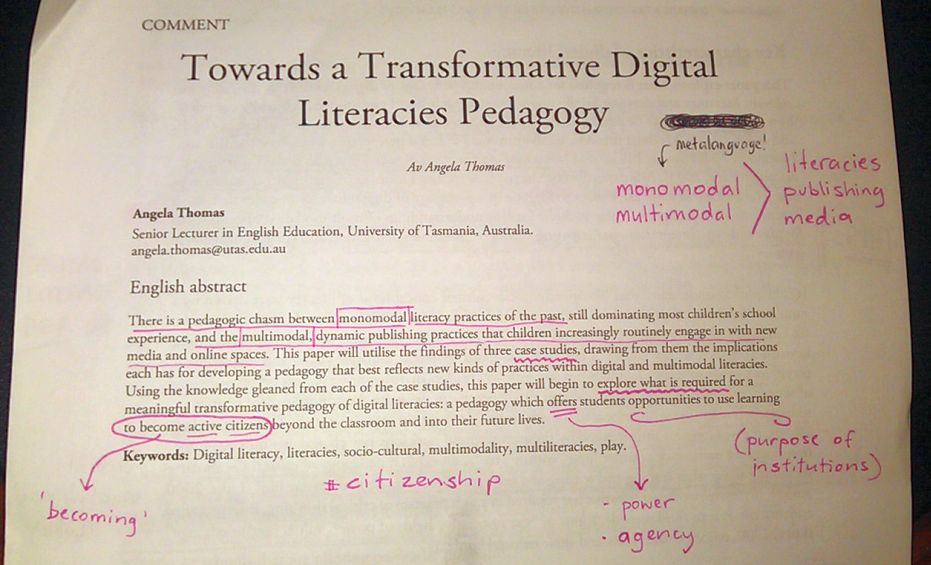
Thanks to @malynmawby @benpaddlejones and @Vormamim for engaging in tweety-chat today about play-based learning and transformational play.
There was an article that I wanted to post the full reference to – this one by Angela Thomas (@anyaixchel)
Thomas, A. (2011) Towards a transformational digital literacies pedagogy. Nordic Journal of Digital Literacy. Vol. 6 pp. 89-101
You can see the abstract for the paper with my own annotations, above.
In it she argues that there are:
a number of significant characteristics of digital literacy that are imperative to include in a pedagogy of digital literacy in order to make it a transformational pedagogy. These include: explicit understandings of multimodality, opportunities for play and experimentation, participating within communities of practice, and critical engagement with text.
I had picked this article up to read Angela’s findings about digital pedagogy, but it was a timely read. I am a big fan of the work of Paulo Freire, and of his work to empower communities through literacy. By bringing in Freire’s notion of ‘transformative pedagogies’ this article reaffirmed the need for critical, participatory and dialogic practices to be woven into the digital learning landscape.
I’d love to hear of other readings and resources along these lines, if you know of any…?
Next Stop: AERA! and AARE, and AATE…
Posted by kmcg2375 in conferences, education, english, learning community, research, university on October 31, 2011
When you have a research paper to present, choosing the right conference to take it to is important.
I have long been affiliated with the Australian Association for Research in Education (AARE). When I first started out as a postgrad student, I used to go to their conferences to present papers, and I even was elected as student rep. to the Executive Committee. I also had one of those awful experiences of being a small fish in a giant pond, and having only three people turn up for me to deliver my paper to. Devo’d…In the end I ultimately stopped being involved in AARE because I needed to narrow my focus and concentrate on English curriculum teaching and scholarship.
Since then I’ve been going to the annual conference of the Australian Association for Teachers of English (AATE) – every year since 2004! And this year is no exception – I’ll be in Melbourne for the AATE conference in December (will you?). Only, for the first time in awhile, I’ll be heading to the AARE conference too, in Hobart the week before. With more skills in networking under my belt, and a clearer direction for engaging with the ‘special interest groups’, I’m feeling really positive about reconnecting with AARE and sharing my PhD findings there.
For me though, as far as big, generalist conferences go, AARE was always plenty big enough – and having developed an instinct to narrow my scope rather than broaden it, I didn’t think I would ever attend the EVEN BIGGER, EVEN BROADER, international ‘annual meeting’ of the American Educational Research Association (AERA)…
But, attend it I am!
Both the paper and group session I submitted have been accepted to AERA 2012, which will be held in Vancouver in April next year:
Curriculum Change and Resistance: Challenges Identified During the Implementation of An Expansive State English Curriculum.
This paper presents the findings of a doctoral study that undertook a content analysis of a corpus of curriculum texts, news reports and case interviews with teachers during a period of curriculum change in the Australian state of New South Wales.
Producing the young citizen in texts of families, neighbourhoods and nations
This session critically analyses popular fiction, nonfiction and television texts for children and young people focusing on sexuality, sexual safety, bullying and heroism. Each of the selected texts can be understood as a pedagogical apparatus that works to instantiate children and young people as particular subjects and objects of knowledge. (with Gannon, Lampert, Bethune and Gonick)
So, let’s count ’em up: AATE and AARE in December; I already went to ALEA and IFTE earlier in the year; AERA in 2012.
That’s FIVE amazing conferences in 12 months!
And one BUSY girl 
Totally worth it 🙂
(By the way…’what’s with all the four letter acronyms starting with A’, I hear you ask? Tell me about it! Took the first year of my research degree to decipher this shiz! And the kind of ugly websites of AERA and AARE…you can tell all of their energy goes into research!)
Pedagogy or assessment – what comes first in PBL?
Posted by kmcg2375 in education, reflections, research, university on September 5, 2011
So many things to blog about at the moment…transmedia and transliteracy, the Gonski review of school funding…but in the thick of Semester 2 teaching I find myself inexorably drawn back to curriculum studies.
And goddess, please bless Bianca for coming through with a new blog post about Project Based Learning (PBL) to stimulate my thinking this week!
I have been trying to work out how to formally incorporate PBL into the structure of my unit English Curriculum Studies 1. This week I think I have a solution, which I’ll outline below. But first, to answer Bianca’s question: when I proposed this structure in a comment on her blog she asked:
Did you design the assessments or the pedagogy first?
And that question, RIGHT THERE, is our chicken and egg, am I right?
 Because, as Bianca rightly points out, school teachers find it very challenging to engage in “inherent ‘assessment for learning’ within the rigid ‘assessment of learning’ framework already in place”. So, while it might seem logical that your pedagogy will determine your assessment, the ‘reality’ of teaching and learning puts this possibility beyond reach for most.
For some schools their ‘rigid assessment of learning framework’ is tied to NAPLAN exams, for others it is focussed more on Year 12 exit credentials. And in schools that claim not to be driven by external assessments, rigid assessment frameworks can still be constructed by Heads of Department (or others) who seek to place multiple additional constraints on teachers’ planning (e.g. “you MUST have a half yearly exam!”, “every Year 9 class must write an essay in term 1”)
The curriculum places constraints on assessment and pedagogy too, and I could start talking about the Australian Curriculum here. Instead I’ll show you what I built for the university semester context, and try to answer Bianca’s question from there.
Here is the draft outline for my unit in 2012:
- Weeks 1-4 focus: Inquiry based learning (assessment = critical/reflective essay) assessment as learning
- Weeks 5-7 focus: Project based learning (assessment = project + review of pedagogy used in class project) assessment for learning
- Weeks 8-9 focus: Challenge based learning (assessment = make lesson plans for English) assessment of learning
I can safely say that for this unit, I started with the assessment. Literally, I have adopted an existing unit with existing assessment pieces that take at least 6 months to get formally changed. So, while I have been tweaking each assessment piece each semester, I’ve been teaching it for 18 months now and a full overhaul of the structure is now needed to fully incorporate PBL and other constructivist approaches.
Beyond that initial point of departure though, I have oscillated between a pedagogy focus and an assessment focus each time I plan and change something in the unit.
I would say my major points of development around pedagogy and assessment were:
- Reviewing the balance of assessment FOR learning and OF learning in the existing unit. In the university context it is only possible to mandate summative assessment…so I had to reconsider my approach to build a learning environment where the learning process was valued.
- Reviewing the first summative assessment, which was a critical essay, gave me the idea to make the relevance or ‘connectedness’ of the opening weeks of the unit more apparent. Students now do a range of inquiry-based activities to help them engage in the scholarly material, motivated by the need to interrogate their own perspective.
- Activities planned for the first few weeks of the unit were redesigned around a new assessment that focussed on the students personal teaching philosophy. This increased the potential of the assessment to be FOR learning, I thought.
- Teaching the new opening to the unit was really affirming, but showed up the weaknesses in the pedagogy of weeks 5-7. A PBL approach was therefore introduced to ‘liven up’ this part of the unit. This coincides with the time in semester when students begin having heaps of assignments due, and I felt they needed a pedagogical experience that was less ‘intense’, and enjoyable enough to get them through the ‘hump weeks’!
- The PBL appraoch worked really well, but the students put a lot of work in that wasn’t rewarded in assignment grades. So I am now redesigning assignment 2 to include ‘project participation’ criteria so students can get their work on this counted in their final grade.
- aaand…MOST recently: because the final assessment of creating alesson plans really has proven a ‘challenge’, I’m going to use this to explore Challenge based learning. I see this as being the same as Project based learning, but where the outcome does not have to be presentation to an audience. Instead, the project outcome must ‘meet the challenge’. Think Mythbusters 🙂
You can see how thinking about assessment and pedagogy are totally bound together – thinking about one always raises questions for the other. Or, it should!
I’m still searching for material that can explain the realtionship between Inquiry, Project and Challenge based learning. I’ve tried to use them here in a complementary way, but tbh it’s been tough to find sources that relate the approaches to one another. I started off this process thinking they were slightly interchangable. Now I can see that each one is informed by a respect for ‘learning by doing’, but has its own unique flavour. But are these three the only three? Do they sit in a hierarchy of some kind? Are there other ‘Something-B-Ls’ out there that I don’t know about??
Who knows.
If you do, please add a comment! (I hope this helps someone out there!)
EXCURSION!
Posted by kmcg2375 in education, english, learning community, university on August 22, 2011
I’m planning my first University excursion 😀
With my small class of six students studying their Grad. Dip. in Education (secondary English), I will be heading into Brisbane city to attend events that are part of the Global Poetics Tour:

Slam poets Jive, Ken and Mahogany will be slamming into Brisbane for the Australian Poetry Slam competition, which has its second Brisbane Heat on Friday 9th September. I think that’s the event we’ll be going to…although the Sunday event also looks pretty appealing: Black Star Tribute ‘Words or Whatever’ at the Black Star Cafe in West End.
I wonder what event my students will choose for the excursion – we make the selection in tomorrow’s tutorial!

JOLT: Balancing Quality and Workload in Asynchronous Online Discussions
Posted by kmcg2375 in education, learning community, Lit_Review, online tools, research, social media, technology, university on August 17, 2011
Of interest to teachers struggling to keep up with online discussions with their students!
Goldman, Zvi (2011) ‘Balancing Quality and Workload in Asynchronous Online Discussions: A Win-Win Approach for Students and Instructors’. Journal of Online Learning and Teaching. 7:2 pp.313-323
ABSTRACT: The challenge addressed in this article is how to achieve a win-win balance between quality and workload for students and instructors participating in asynchronous online discussions. A Discussion Guideline document including minimum requirements and best practices was developed to address this need. The approach covers three phases: design and development, setting up expectations, and launch and management. The goals of the approach, based on a commitment shared by all full time and adjunct faculty, are high quality of education as well as retention of both students and qualified instructors.
Further explanation of the research challenge from the introduction: “When discussions are regarded as critical components of learning, and administered as such, they impose a significant workload on both students and instructors. In applicable programs targeting practitioner adults, discussion sessions, during which much of the evidence-based learning and experience sharing occur, can easily consume half the course workload (Goldman, 2010). The reality is that neither students nor instructors can afford to dedicate an unlimited amount of time to fulfill course requirements or teach a course. Therefore, as a matter of practicality, discussion sessions should be carefully implemented to balance pedagogic quality and workload for students and instructors alike.”
Foucault THAT.
Posted by kmcg2375 in books, education, english, learning community, Lit_Review, online tools, politics, reflections, research, social media, technology, university on July 28, 2011
I have a confession to make.
Lately, I’ve been cheating on my blog. (In a good way, I promise!)
A colleague at my university, Clare O’Farrell, has an established Ning that is home to members of the Poststructuralist Theory ‘Special Interest Group’ of AARE. Established it so well, in fact, that it is one of the few Nings I know of (along with the English Companion) that continued to have happy users after stupid-Ning made its stupid-serivce un-free. Hmph.
Anyway, I use my space and profile on the ‘Ed Theory Ning’ to brain-vomit about (on?) theory that I don’t understand yet.
And it’s proven #very illuminating.
Increasing my activity in various groups on the Ning has also proven fruitful. Particularly in the ‘Daily Writing Club’ (we have to do exactly as it says…!) and now also from browsing the ‘Foucault reading group’.
That’s where I was reminded to check out Clare’s actual blog, Refracted Input, which I hadn’t done for ages. This month she is discussing a quote by Foucault about ‘race and colonialism’, and in it I can see a relationship to contemporary discourses around changing technologies.
The term ‘folklore’ is nothing but a hypocrisy of the ‘civilised’ who won’t take part in the game, and who want to hide their refusal to make contact under the mantle of respect for the picturesque…
Man is irrevocably a stranger to dawn. It needed our colonial way of thinking to believe that man could have remained faithful to his beginnings and that there was any place in the world where he could encounter the essence of the ‘primitive’. (trans. Clare O’Farrell)Michel Foucault, (1994) [1963] ‘Veilleur de la nuit des hommes’ In Dits et Ecrits vol. I. Paris: Gallimard, p. 232.

You see, I’ve been worrying about the ethics of what could be seen as meddling with teachers or students who are comfotable in their print-material ways, trying to prod them along to explore new technologies. I have wondered, ‘am I being selfish?’, ‘what if they have it right?’, ‘what if I’m destroying something important?’, and ‘am I wrong to advocate for my view, should I just wait and see what happens instead?’. But then, Clare’s wise words:
One cannot buy into the romanticism of the primitive – which is assumed to be so much closer to pure truth and ‘nature’. Conversely one cannot make the colonial assumption that one civilisation or one period of history (now) is more advanced and more evolved than another.
That’s right. I don’t need to worry about whether I’ll ‘wreck’ anything, unless I’m thinking of the people I’m meddling with as OTHER. And I was using pronouns to construct myself in opposition to other through all those damn self-doubts. I don’t need to do that. FOUCAULT THAT!
*Sigh of relief*
NB: Clare also curates a website on Michel Foucault, which includes a glossary of KEY CONCEPTS and other wonderful gems (thanks Clare!).
Me and my iPad: building new literacies
Posted by kmcg2375 in books, education, english, online tools, technology, university on July 23, 2011
I have to say, after just 10 days of owning an iPad, I am noticing some significant changes to my literacy practices – and being confronted by a range of literacy challenges!
I’ve solved the ‘where is Word’? problem – you can download apps, such as Pages, which costs about $10. I haven’t bought that yet because I want to try and do as much on free apps as I can before I get frustrated and am forced to buy (that’s what a school teacher on a tight budget would have to do).
Literacy lesson #1: There are no obvious ‘windows’ in this operating system. There is also no obvious place where you can see a directory of all your ‘files’. There are apps that are always on and you can look in on them any time.
But…how do I ‘save’ my work then? –> LITERACY OF STORING/SAVING AND BACKING UP DATA IN DIFFERENT PLATFORMS/OPERATING SYSTEMS?
Literacy lesson #2: Google docs can be used as a free word processing tool. I just open it in the web browser (Safari) and work from there.
But…when I’m not online I can’t access Google Docs. –> LITERACY OF ENSURING YOU CAN ACCESS YOUR MATERIALS AT POINT OF NEED?
Literacy lesson #3: I am LOVING using ‘Notes’. It’s an app that comes with the iPad. It works even when you are not online. The ‘what should I use to take notes in class/meetings?’ problem to me is solved with this. And because the only formatting available is the ability to leave empty lines and use capital letters, all of my focus is going into getting the ideas onto the page. None (at least much, much less) of my energy is going into design considerations. I never realised until formatting was taken away from me just how much thought I give to the design of a word document.
So…is that the difference between ‘writing’ and ‘word processing’? Or between ‘scribing’ and ‘writing’? or ‘notes’ and ‘documentation’? –> LITERACY OF WRITING FOR YOURSELF VERSUS FOR OTHERS? LITERACY OF FIRST DRAFTS (maybe “no Mary Jane, you can’t just do your draft in Word, because that’s your publishing platform and I don’t want you thinking about formatting your writing yet”. hmmm…)
Food for thought.
I should say, I have also wondered how much of this thinking is coming from using th iPad per se, or if it is the cumulation of being exposed to many new tools recently – a notebook computer, my Playstation and my Kindle had already got me thinking, but now it’s just all come to a head.
I’m thinking about this faster than I can write in-depth posts about it, but I hope these ideas and questions can launch some discussion!
Call for Papers: English in Australia 46.3
Posted by kmcg2375 in education, english, Lit_Review, research, university on July 17, 2011
CALL FOR PAPERS: THEMED ISSUE OF ENGLISH IN AUSTRALIA

A new English? More of the same? Or something still unknown? Past, present and future reflections on English teaching and new technologies
This special guest-edited issue is an opportunity to look back at the way English teachers have responded to the many iterations of ‘new’ media and to also grapple with how English teaching might respond to the here and now of our students’ increasingly digitally mediated lives, as well as looking forward to imagine the possibilities for English education. What are the challenges and opportunities presented by various forms of ‘new’ (and ‘old’) media, and by various ways of understanding the ‘new’? What things might need to change? What might be best left as it is? How might English teachers best respond to new and emerging digital texts and contexts?
We ask for contributions that share ways forward for powerful practice in English education, both in terms of the texts that might be studied and the curriculum work English teachers might do. Submissions might explore students’ relationship with multimodal texts and practices or examine digital learning environments and their connections with ‘traditional’ classroom spaces. They might explore new conceptual and theoretical ground or they may address issues of long concern for English teachers such as creativity, engagement and social justice. We are keen to receive classroom-based accounts and action or practitioner research or any other relevant studies conducted within professional contexts or as part of higher education research degrees.
Guest editors: Kelli McGraw (QUT) & Scott Bulfin (Monash)
Download the Call for Papers and guidelines for contributors.
A new iPad 2 in the house!
Posted by kmcg2375 in online tools, research, technology, university on July 13, 2011
I was so excited yesterday to pick up my brand new iPad 2 from the school office:


…very rarely am I alone when I get to open exciting packages like this…


…I was surprised that it was white (should I have been?). It’s so Mac-like!
 …I have no idea how to work it…
…so I take it home and work it out there 🙂

And the verdict, so far…
What is great about the iPad:
- I can make it work by touching the screen; like my phone, but the screen is BIG! It makes such a difference.
- I’ve got wireless and 3G but so far it has just been running on wireless through my home connection. At lightning speed. So awesome.
- Checking my Tumblr stream…the pictures are massive and it looks so good.
- Using Muro on Deviantart.com to draw. Wow! Tablets ROCK!
- The iView app (recent ABC shows anytime)
- (oh. my. god. I can’t believe I haven’t tried making a collage in polyvore yet!!!)
What is weird about the iPad:
- Where is Word?
- Where do I save my files?
- Why can’t I upload the pictures I take with it?
- Why doesn’t Facebook have an official app?
Challenges to developing a blended learning course
Posted by kmcg2375 in education, Lit_Review, online tools, research, social media, technology, university on June 17, 2011
This extract is from the article Development and Implementation of a “Blended” Teaching Course Environment in the most recent issue of JOLT:
Roadblocks/challenges to Developing a Blended Course
One of the biggest stumbling blocks to developing a blended course is the student fear factor. Many individuals in my class had never crafted a PowerPoint presentation, much less navigated in an online
discussion. Despite their familiarity with Web 2.0 tools like Facebook, MySpace, and instant messaging, the thought of being graded for online participation was somewhat threatening and intimidating. It was also difficult initially for students to understand the rationale for some assignments (such as Second Life). In future classes, more emphasis on business necessity, future usage, and SL current applications will be incorporated into the course pedagogy. Because there were many different types of assignments in this course (including group work, both on and off line), some students also expressed dissatisfaction with having to rely on team members. Use of the Team Agreement did however help to coalesce groups, and to give members a framework for expected behavior. Instructor feedback on the Team Agreement is essential in providing guidance regarding conflict resolution, assignment schedule, and interpersonal interaction among members.The blended model is a student-centered approach that allows the instructor to behave as a coach, a facilitator, and a cheerleader for his/her students. It is a way to let students lead in an environment in which they’re guided to success. In the words of Singh (2002, p. 476), “To be successful, blended [teaching]… needs to focus on combining the right delivery technologies to match the individual learning
objectives and transfer the appropriate knowledge and skills to the learner at the right time.”by Jacqueline Gilbert and Ricardo Flores-Zambada
Development and Implementation of a “Blended” Teaching Course Environment
Journal of Online Learning and Teaching, Vol. 7, No. 2, June 2011 pp. 244-260
This interests me because I have been considering including an assessment of online PLN participation in my unit next semester.
Given that this study found that “the thought of being graded for online participation was somewhat threatening and intimidating” for students, I’m going to avoid actually grading their participation per se. Rather, I’ve decided that students must show (in an assignment appendix) participation in their online PLN for the unit to achieve a Distinction (Grade ‘6’) or High Distinction (Grade ‘7’). That way, they either do it, or they don’t. They don’t have to feel anxious about quality.
Has anyone else done something similar to this? Making students demonstrate their PLN building? How can I do it – get them to attach a screen shot of three blog comments and five tweets? Would that suffice? Hmm…
-
You are currently browsing the archives for the university category.
Nominated!

- Australian English Teachers
 9 members
A group for English teachers in Australia to discuss the books they are reading, and the books th...
Books we've read
View this group on Goodreads »
Share book reviews and ratings with Australian English Teachers, and even join a book club on Goodreads.
 Kelli McGraw
Recent Comments