Archive for category technology
NSW Laptop Tweets
Posted by kmcg2375 in technology on July 6, 2009
For those of you out there who are about to receive (or are lucky enough to have already received!) one of the NSW DET issue Lenovo Laptops, this list of Twitter contacts may help you build your Personal Learning Network.
The following is a list of Twitter users that wove their hands about with great enthusiasm when asked who wanted to discuss and share resources for teaching with the new laptops:
- @kmcg2375 – Kelli McGraw (that’s me! English teacher, South West Sydney)
- @TroyM7 – Troy Martin (English teacher, Hunter/Central Coast)
- @pryorcommitment – Roger Pryor (S.E.D., Hunter/Central Coast)
- @piphowell – Pip Howell (NSW DET, Hunter/Central Coast)
- @SimonBorgert – Simon Borgert (Head Teacher Maths, North Coast)
- @simonjob – Simon Job (Maths teacher, Western Sydney)
- @melissagiddins – Melissa Giddins (Head Teacher English, Sydney)
- @stuhasic – Stu Hasic (DET tech. advisor, Sydney)
- @Lofts1964 – Denise Lofts (Deputy Principal, Sydney)
- @paulwils7 – Paul Wilson (Technology teacher, North Sydney)
- @vmarchant – V Marchant (eLearning facilitator, Illawarra/South Coast)
- @lyntiernan – Lyn Tiernan (Head Teacher English, Casino HS)
- @liamalexander – Stephen Alexander (Technology Teacher, Sydney)
You can join Twitter and start following these excellent people at http://twitter.com/
If you’d like to be added to this expanding list, add a comment with your twitter username and some info about your role and region. There seems to be a lot happening in the Hunter/Central Coast region, surely the rest of us can give them a run for their money 😉
Also let us all know if there are networks springing up in other spaces – for example, English teachers can now join the Teaching English with Laptops ‘Ning’, a site specifically focussed on using the laptops in the English classroom.
Great expectations
Posted by kmcg2375 in school, technology on June 30, 2009
As I wait with baited breath to receive my new laptop courtesy of the NSW DET, an invigorating post by Melissa Giddins has got me planning how to introduce change to my faculty. Only where Melissa as Head Teacher has the authority to set the pace of change in her faculty (laptops used in some way every lesson for the first few weeks, then moving to every second lesson on average – I love it!), as a rank-and-file classroom teacher I can only lobby for such change.
My major strategy will be resource sharing at our faculty meetings – a new teaching idea each fortnight, starting with using features of Word to annotate texts (using formatting, comment, track changes etc.) and moving through to more time consuming activities such as making a digital story. Luckily the teachers in my faculty are all quite excited about the arrival of the laptops, though some will need more tech (and moral!) support than others.
Download my handout on using comments in Word
Download my handout on tracking changes in Word
During these meetings I’ll also be able to model some key pieces of software starting with Audacity (for making podcasts), Adobe Premier Elements (for movie making – most staff are familiar with MovieMaker…), and taking a look at where to find things in Word 2007 (most still working on 97-03 versions).
Another important strategy is to share work samples from my own classes and discuss what worked, and what didn’t work. For teachers to feel confident in explaining a task or activity to student, I think they have to have a picture in their mind’s eye of what the product will look like.
All very ‘lead a horse to water…’, I know. So far though, so good – I’ve been doing this kind of thing (without the software modelling) all this year, and the mood in the faculty is feeling far more positive these days.
But…what could people a bit higher up than me initiate that may bring about change more rapidly? How about:
- Head Teachers set high expectations for their faculty – laptops to be used in some way every lesson for the first few weeks, then moving to every second lesson on average, sounds good to me
- Paper based ‘Daily Notices’ and ‘Staff Bulletins’ be sent electronically – ensures that teachers check email daily/weekly to retrieve these
- Form a Technology Leadership team, with representatives from each faculty, to meet regularly to share ideas/resources and take ideas back to the faculty level
- Add links to resources for teaching with laptops to school intranet homepage (e.g. TaLe, Curriculum Support)
I’m sure there’s loads more. What can you think of, or what have you been doing already, in whatever role you are in at your school?
Clay Shirky on Twitter and the internet #TED
Posted by kmcg2375 in online tools, social media, technology on June 21, 2009
A message that many of us are becoming increasingly familiar with, but which is expressed so elegantly in this TED Talk by Clay Shirky: How cellphones, Twitter and Facebook can make history.
Clay explains how the 20th cebtury media landscape – made up of the printing press, telegraph and telephone, recorded media suach as photos and movies, and broadcast media such as radio and television – is slipping away. The media landscape that we knew, where professionals broadcast messages to amateurs, is changing in a world where media is ‘global, social, ubiquitous and cheap’. By using the internet to form groups as well as support conversation, former audiences are increasingly full participants.
With some great examples of how the internet is used (and restrained), this 17 minute talk is well worth watching and sharing:
Narrative Unit: Texts
Posted by kmcg2375 in digital storytelling, english, school, technology on May 19, 2009
An update on how things are coming together for my unit of work on Narrative, which combined more mainstream print and visual texts with ‘new technology’ texts.
The texts I have selected to study are:
- The Raven – Edgar Allen Poe (poem)
- And antoher thing – Anthony Dennis (Sunday Life opinion article)
- The Curious Incident of the Dog in the Night-time – Mark Haddon (novel)
- Fairytale and fable selection, possibly using a webquest
- Fox – Margaret Wild (picture book)
- Inanimate Alice (multimedia)
- and, if time permits, The Castle – Working Dog / Sitch (film)
After/while studying these texts, students will be creating their own narrative compostions:
- An individual digital story on the theme ‘Dreams and Nightmares’ (term 2)
- A group drama enacting a fairytale of students own choosing (term 2)
- A short story using hypertext to link to flashbacks in the story (term 3 – using new laptops)
I’m loving teaching this unit – so far we’ve looked at the poem and the magazine article, and are now reading Curious Incident…if we finish looking at the book by the end of week 5, that will leave plenty of time to look at the other texts (not a ‘close study’ – just exploring select aspects of narrative) and do some work on the assessment projects.
More updates to come!
ICT Cross Curriculum Content
Posted by kmcg2375 in school, technology on May 17, 2009
A comment by Pixeltoy on an earlier post about the Laptops for Learning Forum got me thinking: although I do believe much work will have to be done to ensure authentic integration of ICT resources into all subject, I’m not sure that syllabus change is the answer.
NSW syllabuses already have cross-curriculum content embedded into each syllabus. One of the content areas is Information and Communication Technologies (ICT). The ICT cross-curriculum content in the English 7-10 syllabus is worth quoting here at length:
Information and Communication Technologies (ICT) content in English enables students to develop and apply skills, knowledge and understanding of ICT in their composing, responding and presenting, and as part of the imaginative and critical thinking they undertake in English. The ICT content has been incorporated into the content of this syllabus to ensure that all students have the opportunity to become competent, discriminating and creative users of ICT and are better able to demonstrate the syllabus outcomes of English through the effective use of ICT.
In their study of English, students are able to apply their existing knowledge of word processing, multimedia, ways of formatting and presenting texts, simulation software, graphics and electronic communication and further develop their skills, knowledge and understanding of these technologies. They learn about the ethics of information communication through technology.
At Stage 4, students use specified tools and functions of word processing for composing. They learn to import images and graphics into folders and documents. In formatting documents they learn to desktop publish using graphics in a multimedia presentation or webpage, evaluating appropriate layout and design principles for a specific audience.
At Stage 5, students use more advanced specified tools and functions of word processing for composing. They learn to create, import and manipulate graphics. They learn about advanced forms of digital communication such as video conferencing.
So, what is it that’s already letting us down? What is it we are missing in our professional learning to be able to implement this content, which already appears in our syllabus documents?
Tribes #TED
Posted by kmcg2375 in random, technology on May 12, 2009
Seth Godin talks to TED 2009 about how, rather than homogonising everyone, then internet has instead lead us to form TRIBES. He explains how:
- People on the fringes can now find each other, connect and go somewhere.
- It is tribes, not money or factories, that can change our world…that can align large numbers of people.
- What we do now for a living in today’s society is: find something worth changing, then assemble tribes, which assemble other tribes etc. until it becomes something bigger than us – a movement.
- Leaders challenge the status quo, and build a culture and a community to connect people to a cause.
What are you changing?
Who are you connecting with?
Who are you leading?
The Twitter Experiment
Posted by kmcg2375 in online tools, social media, technology on May 12, 2009
This five-minute video gives an impression of what it is like using Twitter as a backchannel in a large classroom.
I am already a HUGE fan of Twitter as a tool for extending my PLN. Logistically, I’m unsure how tweet-ing would work in a NSW high school context at the moment (leaving aside the fact that it is blocked by the web filter) – can anyone out there share a success story?
Vodpod videos no longer available.
Laptops 4 Learning
Posted by kmcg2375 in school, technology on May 7, 2009
Wanted to get down some of the big ideas (and fast facts) that have come up over the past two days at the Laptops 4 Learning Forum. There is so much I could say – and will say, in some more blog posts over the coming week. For now…
Big Ideas:
- Schools should work toward developing a ‘digital culture’ by using technologyas a tool, rather than scheduling technology events. The laptops should become part of the learning environment, like pens, papers and whiteboards.
- Laptop use in schools has the potential to make classes and projects more student-centred. The increased capacity for project-based learning through connectivity (and nifty software) can mean that the technology can have a positive impact on pedagogy.
- Teachers will need to develop their skills in classroom management to accomodate problems with the technology…but this is no reason to give up or shy away. We already do this when the photocopier breaks, or the OHP bulb blows!
- Laptops are exciting, and the potential for student engagement is huge. Rather than facing their work and asking “why do I have to do it?”, this will get them asking “can I do it this way?” (This great point from Steven Plummer, who is leading the English KLA project)
- Barbara Bober gave us a great metaphor – some teachers will be like Formula 1 drivers with the technology; most will ordinary, but competent and perhaps even excited drivers or smaller vehicles (to extend the metaphor for those who worry about teachers losing control in laptop lessons – in this metaphor, the teacher is still the driver!)
- When planning, we should consider how the laptops will impact on the students, the teachers, the pedagogy, and classroom management. All are important factors
- There isn’t a need to re-invent the wheel. As well as imagining new and foreign possibilities, we should be looking at current curriculum and pedagogy and asking: what can be enriched?
- Ken Olah explained that feedback to kids has the largest correlation (1.4) with increased student learning. Imagine the opportunities for feedback that constant access to personal laptop creates!
- It will be a bit messy to start off with…but it is worth it.
Students Talk:
In one panel discussion two students talked about what they saw as the benefits of having and using laptops. They suggested:
- Being able to do bits of work ‘here and there’, rather than only being able to access desktop computers at certain times will relieve some stress around homework and assignmetns
- Homework etc. will be more easily recorded in a school diary or calendar on the laptops
- Work can be saved, and easily shared – no more lost sheets or notes if you are away
- Having computer access at school. Students reported often having trouble getting into a computer lab or finding a free computer in the library
- Assiting group work outside of school hours
- Better access to whole school information – they suggested school notices being distributed electronically.
Fast Facts:
- Students will get their laptops in Term 3. Teachers will get theirs before students do, probably in July.
- Wireless is getting installed in April, and this is bound to be a bit disruptive. Libraries plus one classroom will get it first.
- Every school will get one full-time technical officer to support laptop use. There is a 4 year funding commitment from federal governemt for this, and this person is employed regardless of whether your school already has ‘an IT person’ – their sole job is to support the laptops
- Schools will have spare batteries and laptops for students to use if they don’t have their laptops (and policies will be in place to curtail repeat offenders)
- Students are expected to charge their laptops overnight and bring them charges to school.
- Operating system is Windows XP
- Software installed is Microsoft Office 7 (standard suite plus One Note) and Adobe (Connect, Presenter, Captivate, Photoshop Elements, Premier Elements, Dreamweaver, Flash and Acrobat Professional)
- Disk size is 160 GB, but about 50 GB of this is used up with the software
- The Lenovo laptops have two USB ports, an Ethernet port, Bluetooth an SD memory card reader, and an inbuilt webcam
As I said, there is so much more information to come. In the meantime, enjoy a peek at the new laptop 🙂
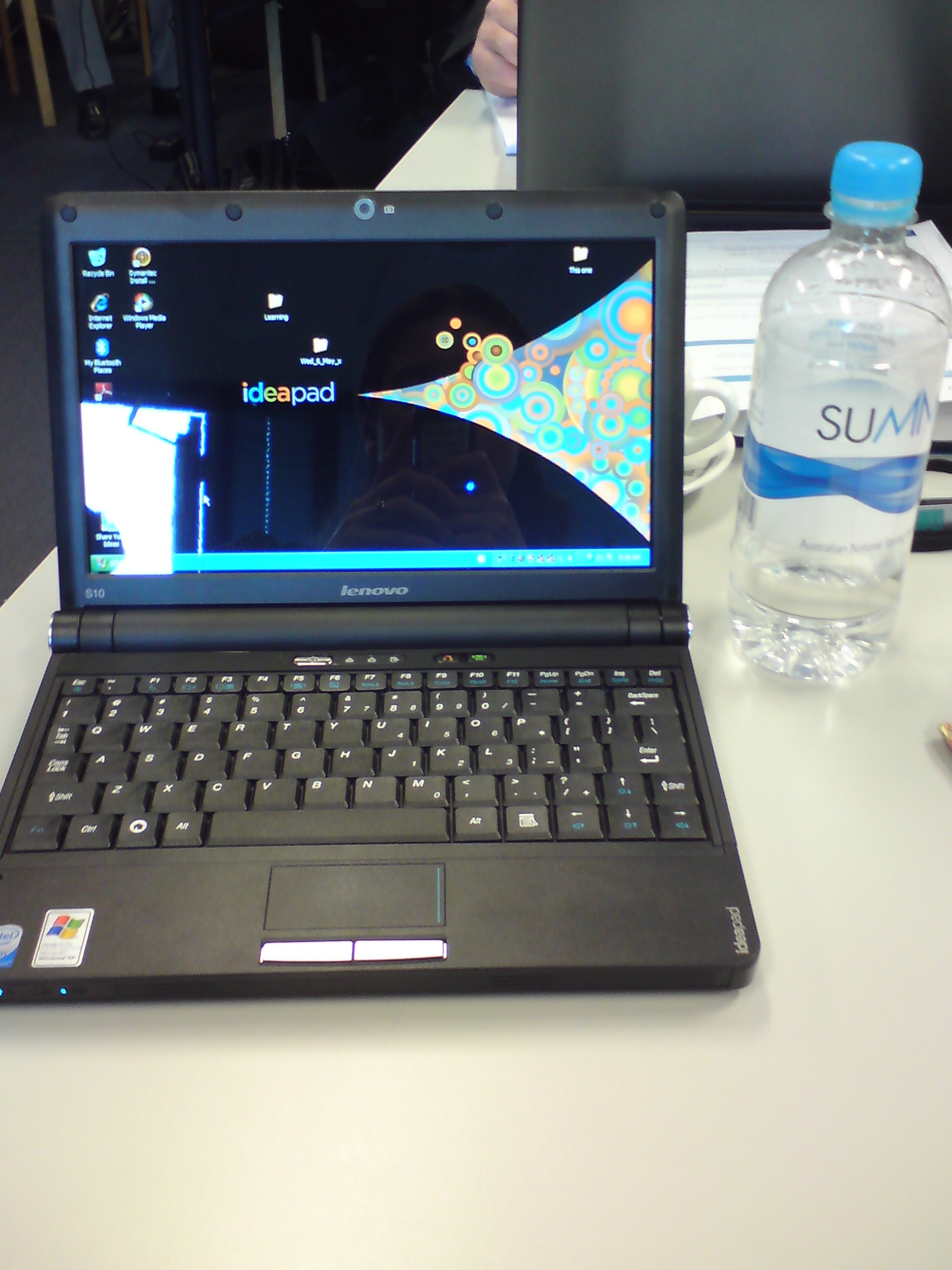

Save the Net – sign the petition
Posted by kmcg2375 in technology on April 14, 2009
The Federal Government is planning to force all Australian servers to filter internet traffic and block any material the Government deems ‘inappropriate’. Under the plan, the Government can add any ‘unwanted’ site to a secret blacklist.
Testing has already begun on systems that will slow our internet by up to 87%, make it more expensive, miss the vast majority of inappropriate content and accidentally block up to 1 in 12 legitimate sites. Our children deserve better protection – and that won’t be achieved by wasting millions on this deeply flawed system.
Twitter #TED
Posted by kmcg2375 in online tools, school, social media, technology on April 2, 2009
Recently for some reason unknown to me I have found myself often amongst students and colleagues hating on Twitter. The thing is…they haven’t tried it.
Of course, people are allowed to have opinions, even when they are not based on any real knowledge or experience. But I have been a bit surprised by how quickly, and with what venom, people are ready to leap into attack mode when someone mentions Twitter.
Wow, some people must really think they are important – as if anyone cares about your sad life.
Don’t people have anything better to do?
Who could be bothered checking to see if someone posted some random note.
As if I want to hear about the boring details of someone else’s life!
It’s a place where sad-cases can find out what P. Diddy is doing every minute of everyday.
Narcissists!
Yesterday a penny dropped for me, and I realised a big reason why I find these comments so unsettling: Why are people so determined to express how much they DON’T care about anyone else’s world? Sure, meeting in person is a ‘nicer’ way to be closer to people you know, but these comments don’t smack of pro-embodied-socialising; they just reek of tall poppy syndrome and a bunch of I-don’t-care.
I’m hoping some teachers on our school technology committee will start dabbling in Twitter soon, so I can start making the rich professional connections in school that I currently need to seek out of school. I found this TED Talk on Twitter very interesting, and I’ll pass it on to my colleagues soon:
-
You are currently browsing the archives for the technology category.
Nominated!

- Australian English Teachers
 9 members
A group for English teachers in Australia to discuss the books they are reading, and the books th...
Books we've read
View this group on Goodreads »
Share book reviews and ratings with Australian English Teachers, and even join a book club on Goodreads.
 Kelli McGraw
Recent Comments