Archive for category technology
TeachMeet Brisbane
Posted by kmcg2375 in conferences, education, learning community, social media, technology on January 23, 2012
During 2011 a range of TeachMeets were held throughout Sydney. A central wiki was set up to coordinate the events and the hashtag #TMSydney ran hot during the meets.
The events were great successes, described by participants as welcoming, supporting and positive. This is not surprising, when you consider that the ethos behind the event is that it is strictly free professional development run ‘for teachers, by teachers’. What I thought was most attractive about the TeachMeet structure was the short presentations – either a 2 minute ‘nano-presentation or a 7 minute micro-presentation (or Pecha Kucha). It sounds like an ideal way to hear a little bit from a lot of people.
You can therefore imagine how stoked I was to hear that someone was organising the first ever TeachMeet in BRISBANE!
#TMBrisbane
TEACHMEET BRISBANE will be held from 4-6pm at Moreton Bay Boys’ College on Thursday 1st March 2012.
If you would like to register or get more information, you can visit and join the TMBrisbane wiki: http://tmbrisbane.wikispaces.com/
Of course, I was so excited to see the event come to Brissie that I had to volunteer to present. It will also be a great chance for me to refine my pecha kucha style!
(I also look forward to the #TMBrisbane hastag drawing together more of the Brisbane edu-community)
Pass it on
If you would like to be involved in TeachMeet Brisbane, or to support the event, take a look at the flyer available for download on the wiki.
In the Twittershpere you can participate in the backchannel from anywhere (not just Brisbane!) on March 1st by adding #TMBrisbane to your tweets.
Finally, this video about TeachMeets made for Sydney West is a great one to pass around to folk who are new to the TeachMeet concept…enjoy!
A transformative digital literacies pedagogy: Thomas (2011)
Posted by kmcg2375 in education, learning community, Lit_Review, online tools, research, social media, technology, university on November 17, 2011
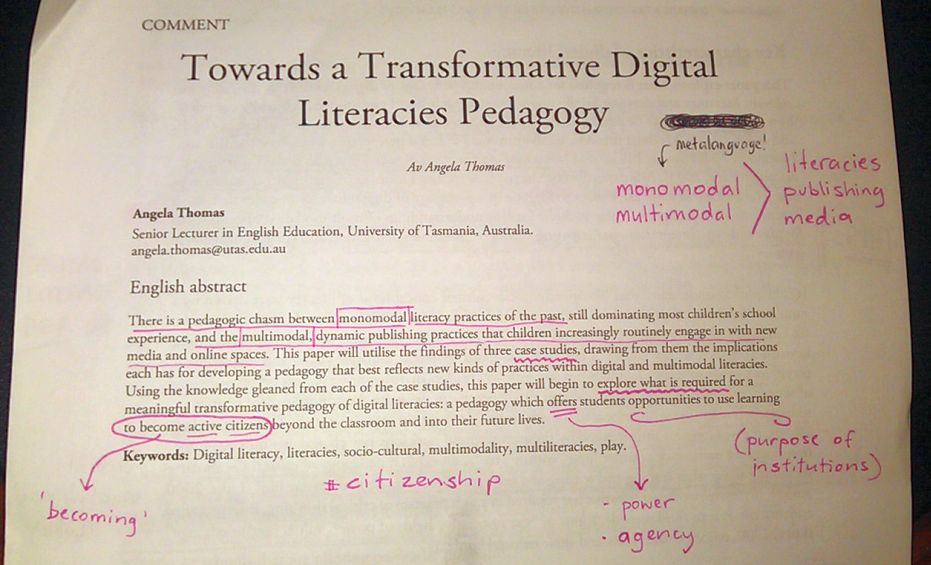
Thanks to @malynmawby @benpaddlejones and @Vormamim for engaging in tweety-chat today about play-based learning and transformational play.
There was an article that I wanted to post the full reference to – this one by Angela Thomas (@anyaixchel)
Thomas, A. (2011) Towards a transformational digital literacies pedagogy. Nordic Journal of Digital Literacy. Vol. 6 pp. 89-101
You can see the abstract for the paper with my own annotations, above.
In it she argues that there are:
a number of significant characteristics of digital literacy that are imperative to include in a pedagogy of digital literacy in order to make it a transformational pedagogy. These include: explicit understandings of multimodality, opportunities for play and experimentation, participating within communities of practice, and critical engagement with text.
I had picked this article up to read Angela’s findings about digital pedagogy, but it was a timely read. I am a big fan of the work of Paulo Freire, and of his work to empower communities through literacy. By bringing in Freire’s notion of ‘transformative pedagogies’ this article reaffirmed the need for critical, participatory and dialogic practices to be woven into the digital learning landscape.
I’d love to hear of other readings and resources along these lines, if you know of any…?
Use #etaq21c to ask me things tomorrow!
Posted by kmcg2375 in conferences, education, english, learning community, online tools, personal, social media, technology on August 19, 2011
More specifically, use #etaq21c to ask me questions about Digital Literacy and electronic text practices in English curriculum. The conference theme says it all: “English and Generation Next”
ETAQ’s Annual State Conference will be held atLourdes Hill College on Saturday 20 August. The theme is “English and Generation Next”.
The program will feature a keynote address by Professor Peter Holbrook from the University of Queensland’s School of English, Media Studies and Art History, a Q & A style panel session [that’s where I’m presenting!!], and a range of supporting workshops. Professor Holbrook’s address is entitled “Literature, Literacy, the Imagination, Freedom”.
So, if you are an English teacher, or if you are interested in digital texts and the future of the book, please, shoot some questions our way! You can post them here as a comment, but if you use Twitter then posting a comment or question there with the hashtag #etaq21c would Really Make My Day 🙂
I am soooo looking forward to this panel presentation! The full list of people in the panel session are:
- Professor Catherine Beavis (Griffith University and ETAQ Patron)
- Professor Peter Holbrook (University of Queensland)
- Kelli McGraw (Lecturer, QUT)
- Janina Drazek (Executive Director, Teaching and Learning, Education Queensland)
I’ll be talking about ‘acts of reading and writing’ and ‘digital pedagogy’.
JOLT: Balancing Quality and Workload in Asynchronous Online Discussions
Posted by kmcg2375 in education, learning community, Lit_Review, online tools, research, social media, technology, university on August 17, 2011
Of interest to teachers struggling to keep up with online discussions with their students!
Goldman, Zvi (2011) ‘Balancing Quality and Workload in Asynchronous Online Discussions: A Win-Win Approach for Students and Instructors’. Journal of Online Learning and Teaching. 7:2 pp.313-323
ABSTRACT: The challenge addressed in this article is how to achieve a win-win balance between quality and workload for students and instructors participating in asynchronous online discussions. A Discussion Guideline document including minimum requirements and best practices was developed to address this need. The approach covers three phases: design and development, setting up expectations, and launch and management. The goals of the approach, based on a commitment shared by all full time and adjunct faculty, are high quality of education as well as retention of both students and qualified instructors.
Further explanation of the research challenge from the introduction: “When discussions are regarded as critical components of learning, and administered as such, they impose a significant workload on both students and instructors. In applicable programs targeting practitioner adults, discussion sessions, during which much of the evidence-based learning and experience sharing occur, can easily consume half the course workload (Goldman, 2010). The reality is that neither students nor instructors can afford to dedicate an unlimited amount of time to fulfill course requirements or teach a course. Therefore, as a matter of practicality, discussion sessions should be carefully implemented to balance pedagogic quality and workload for students and instructors alike.”
Gamification and Behaviourism
Posted by kmcg2375 in education, politics, research, technology, video games on August 12, 2011
I dig gamification. I also dig Games Based Learning (GBL).
But sometimes when I’m watching these concepts get promoted, big alarms go off in my head.
Take a look at this list of some key elements of gamification:
- Points
- Badges
- Levels
- Challenges
- Leaderboards
- Rewards
- Onboarding
Doesn’t this remind you of anything? Add that together with our enthusiastic embrace of digital and electronic teaching, and the ‘games & machines’ motif becomes really familiar. I’m thinking Skinner, and Behaviourism, and Pavlov’s dog…which means that we need to think about the ethics of gamification, stat.
Foucault THAT.
Posted by kmcg2375 in books, education, english, learning community, Lit_Review, online tools, politics, reflections, research, social media, technology, university on July 28, 2011
I have a confession to make.
Lately, I’ve been cheating on my blog. (In a good way, I promise!)
A colleague at my university, Clare O’Farrell, has an established Ning that is home to members of the Poststructuralist Theory ‘Special Interest Group’ of AARE. Established it so well, in fact, that it is one of the few Nings I know of (along with the English Companion) that continued to have happy users after stupid-Ning made its stupid-serivce un-free. Hmph.
Anyway, I use my space and profile on the ‘Ed Theory Ning’ to brain-vomit about (on?) theory that I don’t understand yet.
And it’s proven #very illuminating.
Increasing my activity in various groups on the Ning has also proven fruitful. Particularly in the ‘Daily Writing Club’ (we have to do exactly as it says…!) and now also from browsing the ‘Foucault reading group’.
That’s where I was reminded to check out Clare’s actual blog, Refracted Input, which I hadn’t done for ages. This month she is discussing a quote by Foucault about ‘race and colonialism’, and in it I can see a relationship to contemporary discourses around changing technologies.
The term ‘folklore’ is nothing but a hypocrisy of the ‘civilised’ who won’t take part in the game, and who want to hide their refusal to make contact under the mantle of respect for the picturesque…
Man is irrevocably a stranger to dawn. It needed our colonial way of thinking to believe that man could have remained faithful to his beginnings and that there was any place in the world where he could encounter the essence of the ‘primitive’. (trans. Clare O’Farrell)Michel Foucault, (1994) [1963] ‘Veilleur de la nuit des hommes’ In Dits et Ecrits vol. I. Paris: Gallimard, p. 232.

You see, I’ve been worrying about the ethics of what could be seen as meddling with teachers or students who are comfotable in their print-material ways, trying to prod them along to explore new technologies. I have wondered, ‘am I being selfish?’, ‘what if they have it right?’, ‘what if I’m destroying something important?’, and ‘am I wrong to advocate for my view, should I just wait and see what happens instead?’. But then, Clare’s wise words:
One cannot buy into the romanticism of the primitive – which is assumed to be so much closer to pure truth and ‘nature’. Conversely one cannot make the colonial assumption that one civilisation or one period of history (now) is more advanced and more evolved than another.
That’s right. I don’t need to worry about whether I’ll ‘wreck’ anything, unless I’m thinking of the people I’m meddling with as OTHER. And I was using pronouns to construct myself in opposition to other through all those damn self-doubts. I don’t need to do that. FOUCAULT THAT!
*Sigh of relief*
NB: Clare also curates a website on Michel Foucault, which includes a glossary of KEY CONCEPTS and other wonderful gems (thanks Clare!).
Google+ by Molly Rocketboom
Posted by kmcg2375 in education, learning community, online tools, social media, technology on July 26, 2011
If you’re still not sure how Google+ fits into your existing world of Facebook and/or Twitter, let Molly of Rocketboom break it down for you. Approx 4.5 mins:
Me and my iPad: building new literacies
Posted by kmcg2375 in books, education, english, online tools, technology, university on July 23, 2011
I have to say, after just 10 days of owning an iPad, I am noticing some significant changes to my literacy practices – and being confronted by a range of literacy challenges!
I’ve solved the ‘where is Word’? problem – you can download apps, such as Pages, which costs about $10. I haven’t bought that yet because I want to try and do as much on free apps as I can before I get frustrated and am forced to buy (that’s what a school teacher on a tight budget would have to do).
Literacy lesson #1: There are no obvious ‘windows’ in this operating system. There is also no obvious place where you can see a directory of all your ‘files’. There are apps that are always on and you can look in on them any time.
But…how do I ‘save’ my work then? –> LITERACY OF STORING/SAVING AND BACKING UP DATA IN DIFFERENT PLATFORMS/OPERATING SYSTEMS?
Literacy lesson #2: Google docs can be used as a free word processing tool. I just open it in the web browser (Safari) and work from there.
But…when I’m not online I can’t access Google Docs. –> LITERACY OF ENSURING YOU CAN ACCESS YOUR MATERIALS AT POINT OF NEED?
Literacy lesson #3: I am LOVING using ‘Notes’. It’s an app that comes with the iPad. It works even when you are not online. The ‘what should I use to take notes in class/meetings?’ problem to me is solved with this. And because the only formatting available is the ability to leave empty lines and use capital letters, all of my focus is going into getting the ideas onto the page. None (at least much, much less) of my energy is going into design considerations. I never realised until formatting was taken away from me just how much thought I give to the design of a word document.
So…is that the difference between ‘writing’ and ‘word processing’? Or between ‘scribing’ and ‘writing’? or ‘notes’ and ‘documentation’? –> LITERACY OF WRITING FOR YOURSELF VERSUS FOR OTHERS? LITERACY OF FIRST DRAFTS (maybe “no Mary Jane, you can’t just do your draft in Word, because that’s your publishing platform and I don’t want you thinking about formatting your writing yet”. hmmm…)
Food for thought.
I should say, I have also wondered how much of this thinking is coming from using th iPad per se, or if it is the cumulation of being exposed to many new tools recently – a notebook computer, my Playstation and my Kindle had already got me thinking, but now it’s just all come to a head.
I’m thinking about this faster than I can write in-depth posts about it, but I hope these ideas and questions can launch some discussion!
A new iPad 2 in the house!
Posted by kmcg2375 in online tools, research, technology, university on July 13, 2011
I was so excited yesterday to pick up my brand new iPad 2 from the school office:


…very rarely am I alone when I get to open exciting packages like this…


…I was surprised that it was white (should I have been?). It’s so Mac-like!
 …I have no idea how to work it…
…so I take it home and work it out there 🙂

And the verdict, so far…
What is great about the iPad:
- I can make it work by touching the screen; like my phone, but the screen is BIG! It makes such a difference.
- I’ve got wireless and 3G but so far it has just been running on wireless through my home connection. At lightning speed. So awesome.
- Checking my Tumblr stream…the pictures are massive and it looks so good.
- Using Muro on Deviantart.com to draw. Wow! Tablets ROCK!
- The iView app (recent ABC shows anytime)
- (oh. my. god. I can’t believe I haven’t tried making a collage in polyvore yet!!!)
What is weird about the iPad:
- Where is Word?
- Where do I save my files?
- Why can’t I upload the pictures I take with it?
- Why doesn’t Facebook have an official app?
The medium is the message
Posted by kmcg2375 in books, digital storytelling, education, english, Lit_Review, research, technology on June 30, 2011
“The medium is the message” is a phrase coined by Marshall McLuhan meaning that the form of a medium embeds itself in the message, creating a symbiotic relationship by which the medium influences how the message is perceived. (from Wikipedia)
The more I think about this issue of medium, the more unsatisfied I am with the way that medium of production is dealt with in the English curriculum.
While English teachers continue to be led by debate over the definition and role of Literature in English, and over the best way to teach language, questions of medium have been significantly sidelined.




It also seems clearer to me now why subjects like Drama and Media (content areas that technically sit under the umbrella of English, if you accept that English is a study of how meaning is made through language and texts) go off and take up their own space in many curriculum. It’s not just because those fields have their own traditions and pedagogies that need space, or because they have industries that create an economic drive for the subjects to continue. It’s also because those field require keen attention to production elements, including issues of medium.
Little wonder that Drama, which often deals with live performance of language, dies a slow death in English classrooms where the curriculum is still dominated by print literacy.
Little wonder that we still can reconcile the gulf between ‘literary’ and ‘digital/electronic’ texts in the Australian curriculum (medium is not a genre!)
To move anywhere with this line of thinking will require some careful thought about the overlap between the words:
- media as-in-the-artisitic-means-of-production and
- Media as-in-the-field-of-media-studies.
Thanks to carolyn for stimulating my thinking on this. Connecting the concept of medium back to the concept of narrative helped the penny drop today!
-
You are currently browsing the archives for the technology category.
Nominated!

- Australian English Teachers
 9 members
A group for English teachers in Australia to discuss the books they are reading, and the books th...
Books we've read
View this group on Goodreads »
Share book reviews and ratings with Australian English Teachers, and even join a book club on Goodreads.
 Kelli McGraw
Recent Comments