Posts Tagged CLB_018
Sociolinguistics: language and cultures
Posted by kmcg2375 in books, education, english, Lit_Review on May 12, 2011

I found this excellent set of definitions in the text Language and Literacy in the Early Years 0-7 by Marian Whitehead. Thought it worth posting here.
My hope is that this post marks the start of a new category on this blog – ‘Lit_Review‘ – for posts that contain material of the kind you just know you’re going to want to find again later when you’re doing that review of research literature…
Language Variety – Summary
- Language variety is reflected in the different language of the world but it is also a feature within apparently uniform language communities.
- Two major aspects of variety within a language are accent and dialect. Accent refers solely to differences in pronunciation – the sounds of a spoken language. Dialect is a variety of a language with distinctive variations in syntax and vocabulary, as well as pronunciation.
- Standard English is the high-status dialect of English that is used in the written form of the language. It is also used widely in business and professional circles, the media, education and the teaching of English as a foreign language. Standard English dialect may be spoken with any accent.
- Received Pronunciation is a prestigious non-regional accent associated with higher education and, traditionally, the private school system in the UK and Oxford and Cambridge universities (Oxbridge).
- Variety is also found within every individual’s linguistic repertoire because we all switch registers, changing the degrees of formality in our language, according to the social context. Individuals use a variety of other forms, including other dialects, slang and jargon. We all develop a unique idiolect that makes our voices and language styles instantly recognisable.
Whitehead, M. (2010) Language and Literacy in the Early Years 0-7 (4th Ed.) Sage Publication: London. p.25
Neat summary eh? Pass it on!
Put your money where your mouth is
Posted by kmcg2375 in education, english, university on March 26, 2011
Stepping it up this week a bit in the ‘modelling-best-practice’ stakes…
It occured to me that as I am advocating the importance of studying texts and their traditions to…well basically, the development of human society as we know it, that I’m not doing enough of this in my own university classes.
Last week I got a real buzz relating the theoretical material in this unit to contemporary texts and practices, namely to the story of Terminator II and to the ‘Pirates vs Ninjas’ meme. So this week I am using another text as a way to relate to theory, this time going into even more depth.
I have chosen the film Pleasantville. I am going to use this film to explore ‘critical literacy’ and interrogate the resistance to critical reading of text in secondary English.
Yes I am.
Now, to construct the learning experiences.
In the lecture I am going to focus in on metalanguage, showing students how historical paradigms of English curriculum (skills, cultural heritage, personal growth, critical-cultural) have been revisioned in two more recent literacy frameworks that have had significant influence on contemporary English curriculum – Luke and Freebody’s ‘Four Resources’ model, and Green’s ‘Three Dimensions’ of literacy (which we have already been using at length). I’m also going to rock their world by showing them how subject-specific pedagogy relates to more general theories of pedagogy, such as the ‘Productive Pedagogies’ that are used here in QLD, as well as to theories of learning such as Bloom’s Revised Taxonomy.
The two hour tutorial though. Hmmm.
My message in the coming weeks will be to embrace ‘workshops’ as well as individual and group ‘project based learning’ as alternative approaches to lesson organisation. I want them to start thinking about how we traditionally do “class” and what learning experiences are encouraged there. As I’m electing to ‘put my money where my mouth is’ this week I suppose I should give them a taste of this too…but what to do?
Perhaps I will split the two hours into a ‘workshop’ and a ‘project’. Will I have time for both? I’d like to also screen the first ~20 minutes of the film in class, giving me 30 minutes for the rest of the workshop.
That leaves ~50 minutes for students to complete a seperate project. But what?
I’ve been watching Bianca do this – I know I need to start with a driving question or challenge…
…
…and thus I am away to make coffee and have a think about this.
Ideas welcome x
Motivation and Participation in Asynchronous Online Discussions
Posted by kmcg2375 in education, online tools, research, social media, technology, university on March 24, 2011
I was very interested to read the findings of Xie, Durrington and Yen (2011) published in the recently released issue of the Journal of Online Learning and Teaching. Given my current use of Twitter in my own university unit for preservice teachers, I was glad to read that others were also observing a relationship between participation in online asynchronous discussions and students’ level of motivation. I have reproduced their abstract here:
This study investigated the relationship between students’ motivation and their participation in asynchronous online discussions during a 16-week online course. Fifty-six students participated in
online discussion activities as a normal part of their classes. Their motivation for participating in online discussions was self-reported three times throughout the semester. The findings continue to
indicate that students’ motivation has a significant relationship with their participation in online discussion activities at time two and time three. Students’ perceived value, autonomy, competence,
and relatedness have different levels of impact on their online discussion behavior. This study also found that students’ intrinsic motivation and their perceived value of online discussions remained at a moderate-high level over time, although the perceived value had a significant drop from the midpoint to the end of the semester.Keywords: Asynchronous Online Discussion, Motivation, Distance Learning, Collaborative
Learning, Learning Community
Reading this article has motivated me to collect my own data in the next week of classes, to gather some initial responses from my own students. I look forward to hearing their views!
Hunting for twits
Posted by kmcg2375 in education, online tools, social media, technology, university on March 23, 2011
Of the roughly 85 students in my English Curriculum Studies unit, currently about 62 are following our class twitter account @CLB_018
No mean feat considering it is only week 4.
However, it is week 4 of a 9 week unit, meaning we’re almost half way done (eek! I still have so much to SAY!)
Aaaand, I’m aware that a small handful of those followers may be spamish.
So today I am embarking on a twit hunt – hunting through my list of followers to see who has not tweeted anything (many only joined for class and only follow the class profile). I’m going to DM each of them individually and privately to encourage them to participate.
Am I going overboard in doing this?
On one hand this looks exactly like the kind of time-consuming ‘tech monitoring’ that teachers often tell me they don’t like about teaching online.
On the other hand, I see it as analogous to checking students’ workbooks a few weeks in to term and pointing out their missing work. Is this something that University teachers see as beyond the scope of their ‘job’? I don’t.
But please – please – tell me if you think this is too much, or if this seems like a good strategy to you. Especially if you do something similar – did it work?
Change agents – Pirates vs Ninjas
Posted by kmcg2375 in education, social media, technology, university on March 22, 2011
I was prompted by Binaca today to look for an old post of mine on giving feedback to students. In my search I was delighted to find it had been almost exactly one year since I wrote this post about the tension caused by curriculum change, especially in regards to integrating ICTs:
Let’s make sure we’re applying the ‘too much is too much’ rule across the board, and not just as an excuse/a reason for neglecting the new. If what we mean is ‘we haven’t had enough PD to use this right’ then by all means say that. But there are some things that would be good to drop out of our current practice to make room for the new. One thing that we know about teaching is that no matter what you are taught to do, as a teacher you will instinctively model your practice on the teaching you received at school. Fighting against this instinct takes concentration, and learning about new practices and tools takes a lot of work. Because of this, teachers who are embracing technology are feeling increasingly overloaded and burnt out – this is the real problem that needs managing.
In a later post I tried to be more generative than reflective by reframing the process of change, suggesting that:
…as educational leaders, if we want to help people come to terms with change and embrace it, then we need to recognise and validate their desire to stick with ‘the known’…Recognising that people are resisting change because they feel disempowered helps us to employ methods that give power back.
These lines of thinking manifested in the lecture I gave today to preservice English teachers on how to navigate change amidst all of the ‘theories of text and response’ that they had learned so far.
You may be pleased (dismayed?) to watch how I liken the characteristics of change agents to either the NINJA or PIRATE side of the popular theoretical battle, Pirates vs Ninjas 😀
I think I am mostly pirate!
What I Teach
Posted by kmcg2375 in online tools, university on January 26, 2011
Cheering because my name is now on the website for English Curriculum Studies 1 in the Faculty of Education at QUT:
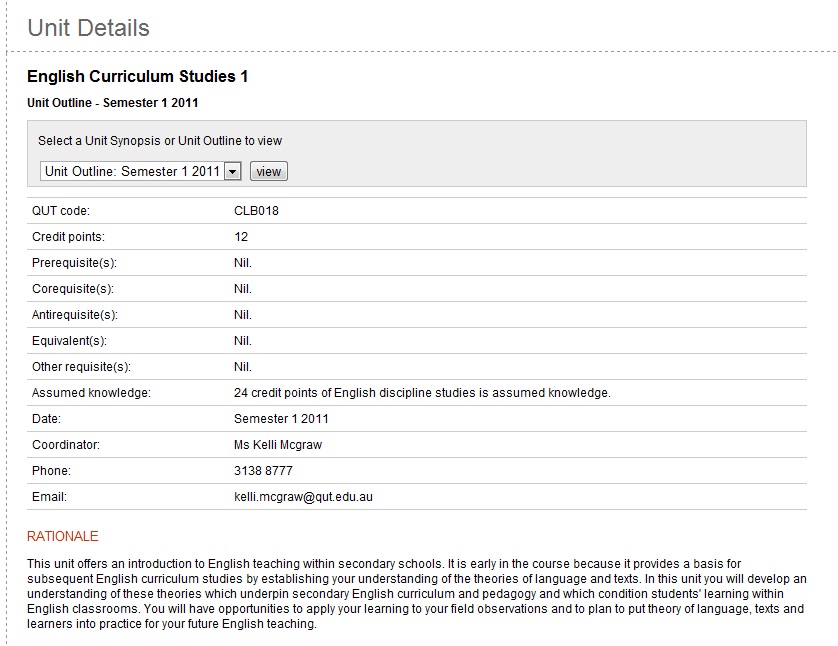
(click to enlarge)
What advice can you offer my preservice teachers for productive/generative tweeting? Or advice for me, for using it in the classroom?
(Pictures of The Blender to come!)

Nominated!

- Australian English Teachers
 9 members
A group for English teachers in Australia to discuss the books they are reading, and the books th...
Books we've read
View this group on Goodreads »
Share book reviews and ratings with Australian English Teachers, and even join a book club on Goodreads.
 Kelli McGraw
Recent Comments