Evaluating the HSC: An interview
Posted by kmcg2375 in education, HSC, personal, reflections on November 27, 2012
Last year I was interviewed by Melissa Wilson, a Journalism student from the University of Newcastle, about my views on the Higher School Certificate (HSC).
Melissa was in contact again recently, and this prompted me to ask if I could reproduce the interview here on my blog. She kindly obliged, and so here it is!
I was careful to read back over my answers, to make sure I still felt the same way about these issues. I do. I wish I could say that things were vastly different up here in Queensland. They’re not. When a Queenslander tells you there is no external exam for Year 12 in their state, they’re misleading you at best. Here is a bit of information from the QSA website about the Queensland Core Skills (QCS) test:
Preparing for the test
The Common Curriculum Elements are generic skills that students work with across their subjects; therefore the real preparation for the test goes on all the time and in every subject. The QSA also makes available a variety of test preparation resources, including Retrospectives and past testpapers (see QCS Test publications and Retrospectives and MC response sheets). Most schools provide some focused preparation for the test.
Hmm, sounds familiar.
But, I digress…
Here are my responses to the interview by Melissa Wilson:
Interview answers for Melissa Wilson (University of Newcastle, 2011)
Interviewee: Kelli McGraw (Lecturer, QUT)
- How do you feel about how the HSC is structured in 2011?
When I think about the HSC structure in 2011, the main things that leap to mind are the fact that studying English is mandatory, that half of the student assessment is based on a timetabled external examinations, and that a no more than of 30% of your school assessment is supposed to be ‘exam-type’. I think it’s really important for English to remain compulsory right up to the end of school, but I’d like to see more room for students to choose electives within the course, not just different levels i.e. Standard or Advanced English. At the moment I think the HSC is still structured in a way that is too rigid for students to feel like they have a lot of choice over their learning.
- Many people say that the HSC is focused on teaching students a whole lot of information that isn’t exactly relevant to them later in life – but instead they just regurgitate it in an exam and then discard it – how do you feel about that statement?
Personally, I can think of countless things that I learned in my HSC year (1998). In those days the emphasis on exams was just as great, but I am often surprised by the things I remember from senior high school and have found a lot of what I learned to be very relevant in life. Having to finish ‘major works’ for Visual Art and Drama also taught me valuable lessons about project management and self-directed learning, which I didn’t get from participating in written exams, so in that sense I guess I was lucky to be an ‘art-sy’ student.
I think the real problem with exams is not that students have to cram ‘irrelevant’ information – I think that all learning can be made relevant, depending on what you choose to do in life. The problem I find is that the examination system has too much of an effect on what happens inside the classroom. The constant pressure to cover content is a strain on students and teachers, and even though school-based assessment is supposed to involve deep learning and reflection, many schools I know of set far more than 30% of their assessments in an exam style in order to condition students in preparation for the external exam. So I think there is a ‘hidden curriculum’ in the HSC, which can dilute learning experiences based on the official subject syllabuses.
- And from this, what would you personally change about the HSC?
I think that the only assessment that students should have to do under exam conditions is the Trial. If more student work was assessed through project work, or using collaborative group tasks, or using portfolios, I think that students would feel more connected to the learning, and be motivated to achieve. Even though the HSC now uses criteria-based assessment, students are acutely aware that the HSC places them in competition with one another as in-class assessment ranks still play a role in determining a student’s final subject results, and the year culminates for most students in receiving a ranked national placement through the UAI. With only about 30% of students moving from school to university after Year 12, it seems like we compromise a lot of educational values for the sake of a privileged minority.
- How do you feel about the pressure and emotional stress that students endure throughout their HSC?
When I think about the stories that students have told me over the years – about how they feel inadequate, or like a failure in the face of HSC assessment tasks – it makes me really upset. I have seen a lot of students in Year 12 lose a lot of weight, with girls in particular showing signs of early and advanced eating disorders. Senior school is also a time when increased numbers of students pick up casual and part-time employment, in many cases out of a necessity to contribute to household finances. I think the HSC creates an environment where students are given too many adult responsibilities without being given the corresponding rights.
While schools play a vital role in developing students’ resilience and capacity for work, the emotional stress endured during the HSC year is too much, in my opinion. I read a study awhile back where Year 11 and 12 students reported symptoms of anxiety, depression and stress that fell outside the ‘normal’ range. We know that when this happens, students stop focussing on ‘mastering’ the material, instead focussing on performance; they stop believing in themselves, stop seeing the learning as a worthwhile goal, and switch to performance-oriented goals. Some of my own school friends took years to recover from the emotional damage of the HSC year, especially those whose final results didn’t meet expectations.

Good riddance to my English notes. Flickr image by Jean-Rene Vauzelle CC-BY-2.0
Coming up for air
Posted by kmcg2375 in education, personal, reflections, research, university on November 26, 2012
Hi folks – it’s been a bit quiet here on the blog, I know.
All I can say is … omg MARKING!
I have always had an interest in assessment, but this semester has made really clear to me how dire the situation is with our current practices.
I don’t want to ‘buy out’ my marking (i.e.pay someone else to do it for me) but I feel like I am wasting so much of my time at the grindstone, like a machine, writing the same lines over and over in delightful pink pen in the margins of my students’ work.
“Check the APA style guide for rules about how to format this”
“Formal essays require shorter paragraphs than this”
“Avoid rhetorical questions – make strong statements instead”
“Use your introduction to tell me what your main points will actually be, not to explain the structure of your work”
“Don’t use a quote as a sentence on it’s own – introduce it i.e. ‘Sawyer (year) explains that…'”
“You have not included reference to any unit readings in this rationale”
I worry about RSI. I worry about carpal tunnel! Marking more tasks electronically next semester will hopefully fix the hand ache, but what about the mind ache??
I’m not alone – every teacher reading this knows what I mean.
What are we going to do about it?

Portland Oregon & VA exam 46 – CC-BY-2.0 Flickr image by Parker Knight
Student blog posts – please comment on one if you can!
Posted by kmcg2375 in education, learning community, online tools, social media, university on October 11, 2012

CC-licensed Flickr image by mrsdkrebs
This semester I have been leading a group of future Teacher Librarians through the Masters of Ed. unit ‘Youth, popular culture and texts‘.
For their second assignment they have to contribute to a group learning blog.
Here are links to blog posts from each of the SIX student blog groups that I will be charged with assessing at the end of October:
- Group M: http://jeanetteki.edublogs.org/2012/10/01/tv-shows-i-loved-growing-up-by-gina-mcpherson/
- Group C: http://cln647groupc.edublogs.org/sample-page/
- Group G: http://shellnye.edublogs.org/2012/09/16/successfully-logged-in-to-blog/
- Group R: http://whatishotandwhatisnot.edublogs.org/2012/10/10/gaming-as-learning/
- Group A: http://kpak.edublogs.org/2012/10/03/putting-the-social-into-reading/
- Group W: http://walwoowar.edublogs.org/2012/09/13/is-this-popular-culture-text/
I would be really grateful if folks could click through to any of these and drop a comment!
For many students in this unit it is their first attempt at adding to a blog like this – an extra comment here and there will make a big difference to their experience.
Thanks in advance 🙂
This is why more English teachers should write a blog!
Posted by kmcg2375 in conferences, education, english, learning community, online tools, reflections, social media on October 7, 2012
English teachers who blog
I’ve just come home from the AATE 2012 national conference in Sydney. It was exceptionally energising to spend two whole days and nights talking face-to-face with people in my PLN, as well as getting to know my colleagues better and meet new people.
One of the sessions that I spoke in was a panel discussion on being a teacher that blogs. Here is a piccie of me with the other panellists @Darcy1968 and @BiancaH80 with our chair @melanne_k:
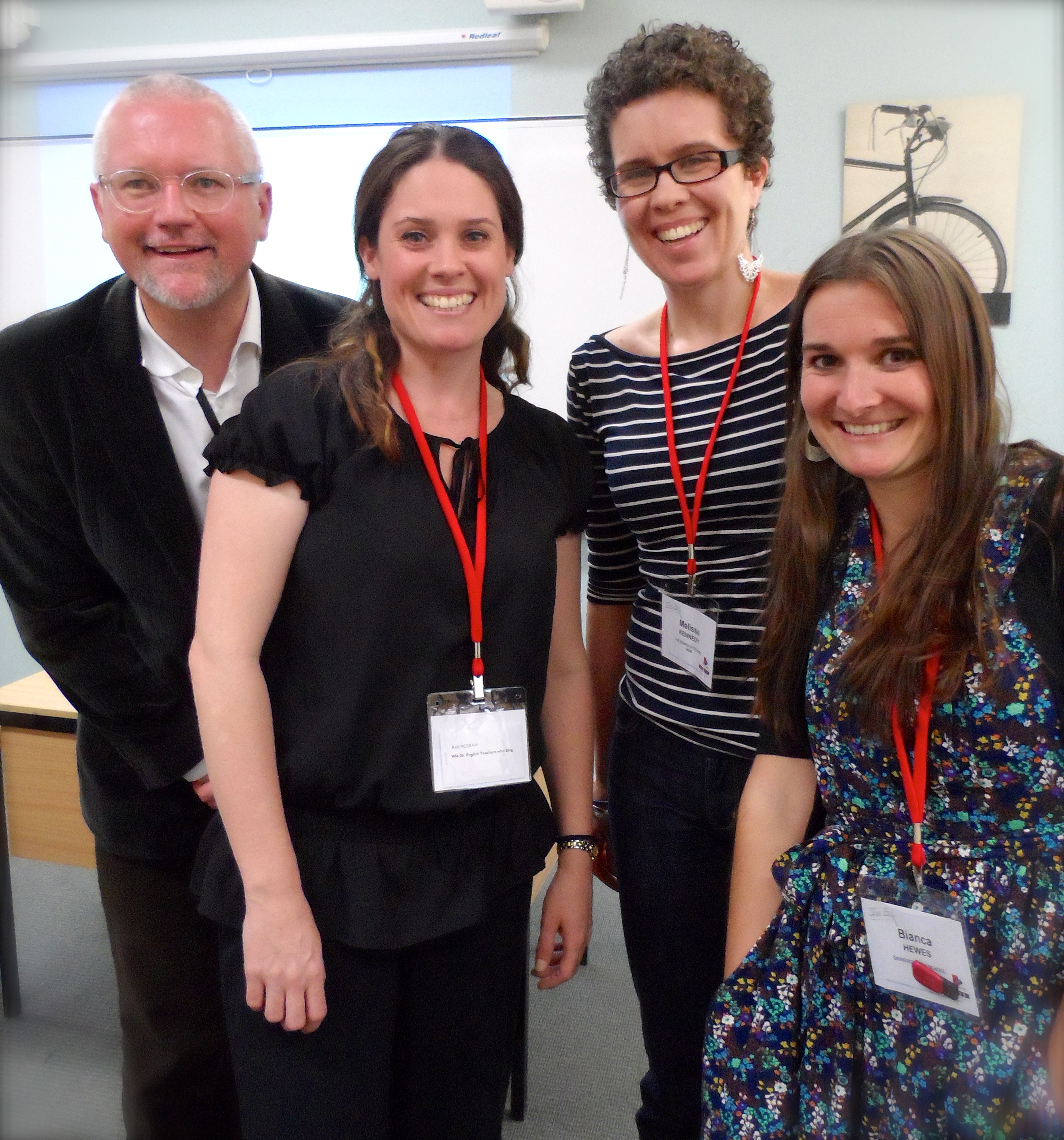
Darcy, Kelli, Melissa and Bianca
Why we need more voices online
There are so many things I would love to write a blog post about, based on ideas I heard or conversations I had at the AATE conference. BUT – I know I won’t get a chance to write about them all! So, the first reason that more teachers need to blog is to literally get more of these ideas recorded:
- Andrew Burn outlined a ‘3Cs’ model of media literacy – Cultural, Critical, Creative. How does this differ to other models of literacy (e.g. Green’s 3D model, Luke & Freebody’s 4 Resources model)?
- Bianca’s presentation on Project Based Learning emphasised the role of assessment. I have also found this to be very important, have others?
- Gillian Whitlock from UQ presented some really interesting ideas about humanitarian perspectives on literature and children’s writing. She showed refugee writing from Australia and artwork that had been created to memorialise the refugee journey. Definitely someone in Queensland to talk to or hear from again!
- The hashtag #5bells was used pretty successfully as a conference backchannel, I thought! What can we learn from this and how can we improve the experience for 2013 in Brisbane?
- Vivian (@vivimat78) did us all a big favour by collecting many of the #5bells tweets via storify…this is super helpful and valued, as hashtags are no longer searchable, after a time period, and we don’t want to lose all that great sharing!
- Vivian also coordinates the #ozengchat twitter chat and edmodo group. What relationship might exist in the future between AATE and #ozengchat? How can/do they support each other?
- We got to say so much to each other in real life (IRL)! Talking uses up soooo many characters! Face-to-face conversations are fun 🙂
- Hip Hop – OMG Adam Bradley was convincing. All the copies of his ‘anthology’ book sold out, and so many people left the keynote ready to exchange their cardigans for hoodies… In response I’ve started a Twitter list: trust-me-i-m-cool for teachers looking for Aussie Hip Hop links. One love!
- I found the closing keynote by Bill Green and Jane Mills to be quite problematic. I understand their point to be that linguistic frameworks have taken over the analysis of ‘the visual’, and that ‘cinephiles’ understand film in a much more ‘visceral’ way. I don’t agree. I think this contrast is weird, given the way I cry like a baby when reading some books, and (I believe) can successfully understand the moving image, thank-you-very-much. I usually love Bill’s stuff, but would rather have heard about his theories on ‘spatial literacy’ than be told English teachers are inadequate at teaching film…wrong crowd for that idea bill and jane, wrong crowd indeed.
I’m sure there is more, but these are the big ideas that I would ideally tackle in the next couple of months. Who will help me? (Will it be you?)
Don’t do it for me, do it for you!
In the panel that we did, quite a few people wanted to talk about how to get more people commenting on their posts. This is a good question, and our suggestions included:
- Comment on other people’s posts so that they come and visit your blog
- Let people know you have written a post by putting the URL up on Twitter (you’ll need an account)
- Use categories and tags wisely to help search engines find your post
However, I really do believe in the power of reflective writing for learning, and I encourage any new blogger to write posts for themselves as much as for an imaginary audience. It’s OK to talk to yourself here!
Think about it – how many times have you tried to convince a student to do a piece of reflective writing for homework, because you know the benefits it will have for their learning? Writing up your experiences on a blog can have the same benefit for you! The mere process of deciding “what will I publish information about this time?” will put you more in touch with the successes and obstacles in your practice, I really do believe this.
So that’s the second big reason. Start a blog for yourself, because if you haven’t yet, then I think you need to.
If you think you “can’t find time to write anything, ever”, then making time to do this will hopefully help you see ways to make time for other things too. And don’t worry – the blogging police aren’t going to arrest you if you don’t add anything for 3 months!
And because all good things come in threes…
The third reason why more English teachers should start a blog is because teachers who blog and share their resources are usually friendly, generous and just plain fun to hang out with.
And the more we share our work and resources, hopefully the more time we can put back in to spending quality time with our students, friends and families x
Coming to Voice
Posted by kmcg2375 in digital storytelling, education, english, technology on September 23, 2012
Looks like the theme for this blog at the moment is VOICE!
A little while ago I was alerted to this excellent production of student work from South Western Sydney, and I’d like to share it with everyone here on the blog.
Coming to Voice is a collection of ‘literary videos’ from students at Sir Joseph Banks High School. The video production by Westside is 5 minutes long, and showcases an innovative layering of student stories, voices, and animation:
Coming to Voice from BYDS on Vimeo.
From the press release:
Thirteen students from year 7 worked with the Chief Editor of Westside Publications, Michael Mohammed Ahmad, to develop writing that was then animated by 2012 SHORTCUTS film festival winner Vinh Nguyen.
The literary video, called ‘Coming to Voice’ will be screened at an assembly at Sir Joseph Banks High School and will also be launched on the BYDS website as a new web series on August 23rd.
Digital stories, literary videos etc.
BYDS (Bankstown Youth Development Services) seems to have a range of resources relating to the local community on their website: http://www.byds.org.au/ including oral history and photomedia materials. I’m so glad that these kinds of digital arts-based resources are flourishing!
When I talk about ‘digital stories’ or ‘digital narrative’ with teachers, it can be hard to explain the possibilities for the genre. There is of course the Daniel Meadows school of thought that advocates for 2 minute, 12 frame, voice-only digital biographies. The digital storytelling project at QUT uses a similar form.
I think the folks at BYDS have cleverly carved out a different kind of genre here for what they’ve produced – a “literary video”. As the students are reading their POETRY, the production is not quite of STORYTELLING. Could they have called them “digital poems”? Perhaps. But that might distract from the multimedia nature of the production, and the way that animation and video shots add meaning to the piece.
Literary videos… I like it! Thanks for sharing Mariam!
Voices from Elsewhere…
Posted by kmcg2375 in books, english, social media on August 31, 2012
I was recently directed to the Wheeler Centre website to take a look at the speeches and talks they had available to view and download.
Finding out about the Wheeler Centre was very interesting…did you know that Melbourne is one of UNESCO’s ‘Cities of Literature’? The Wheeler Centre was established to celebrate this:
Melbourne has a new kind of cultural institution. The Wheeler Centre – a centre dedicated to the discussion and practice of writing and ideas. Through a year-round programme of talks and lectures, readings and debates, we invite you to join the conversation.
Their slogan is ‘Books. Writing. Ideas.’
Isn’t that wonderful?
It wasn’t long before I found a resource that drew me straight in – I am a big fan of Nam Le’s collected short stories in The Boat and even set the book on our ETAQ Book Club list this year!
If you also like books, writing and ideas, please enjoy this 10 minute talk by Nam Le, on the theme ‘Voices from elsewhere’:

Why English teachers join professional associations
Posted by kmcg2375 in education, english, learning community, social media on August 26, 2012
In 2010 the English Teachers Association (NSW, Australia) celebrated 50 years of operation and service to members.
A DVD was released to members, with reflections from past and present ETA leaders. It is an excellent record of the history of the association and provides invaluable insights for new teachers!
I was surfing YouTube when I found that the ETA had uploaded the first section from the DVD onto the web. Here it is, roughly 8 minutes, on a range of teachers’ first involvement with the ETA:
Literature v literature
I always spell literature with a lower case ‘l’. Unless having to use title case forces me to do otherwise, and even then I only do it grudgingly, preferring to write the whole word in CAPS. ‘Literature’ is not a proper noun, no more than the words ‘music’ or ‘drama’ or ‘visual art’ or ‘sociology’ are. No, ‘literature’ is a field of study, as vulnerable to attack, redundancy and dissolution as any other. ‘Literature’ is not like ‘The Bible’, it is not one definable thing. It is not like ‘Shakespeare’, it does not have a personality nor is it an old friend. It is a field, a part of the landscape that is identifiable, but that can also shift and erode or be crowded out, given enough time. It is important, oh yes, like an atomic bomb, or a legacy – but it is not a proper noun.
My Pinterest Boards (and why I’m bothering to make some)
Posted by kmcg2375 in education, learning community, online tools, social media, university on July 16, 2012
For the first half of this year it seemed like all anyone was asking me was ‘do you have Pinterest?’
All throughout semester one, when I asked students about Twitter or Facebook or Tumblr, I was guaranteed to get a few voices around the room crying ‘Pinterest!’
It sounded like a cool tool. A virtual pinboard – just make a board on a topic or ‘interest’ (ahhhh… pin + interest = ‘pinterest’!), then add images and videos to it. Always a fan of putting posters on my bedroom wall, covering my school folder with pictures under contact paper, and putting stickers on random bits of stuff, this highly visual curation tool has always sounded promising to me.
I had made the decision in semester one, however, to steer clear of Pinterest. This choice was purely motivated by my fear of taking up another addictive web tool … the first semester of this year was just too busy already to attempt trying new things.
Some questions have also flown around over time about the ethics and copyright implications of re-pinning images without permission, and I confess this made me wary.
THIS SEMESTER, however, I am pinning!
My most promising board so far is the one I have made to collect links for the unit ‘Culture studies: Indigenous education’ (EDB007):

http://pinterest.com/kmcg2375/indigenous-studies/
I hope to engage students in my two tutorials by sharing the board with them and inviting them to explore the links I’ve collected/curated.
Of course, I could have chosen to share my links in other ways, but they all have their drawbacks:
- on a handout (which is not hyperlinked)
- in a Blackboard/LMS post (students hate and avoid Blackboard)
- using social bookmark sharing e.g. delicious (so far unsuccessful; students don’t use/engage)
My hope is that the visual nature of Pinterest, and the ability to browse it socially and on mobile devices, will entice a few students to explore the links I’ve found.
As far as the image copyright issue is concerned, I think I’ll just wait and see if any of these organisations complains, eh? I have done my best to attribute the images, that’s all I can say.
Last word:
This slide presentation by Joe Murphy (@libraryfuture) was really helpful for me:
Joe makes this observation:
“Pinterest succeeds at the juncture of the major online and content trends of:
- self curation
- image engagement and sharing
- visual search/discovery
- and social discovery”
In addition, points made in these slides about the potential of Pinterest to expand community engagement and open up services to diverse clients made me even more eager to try using this service as a teaching resource.
Here’s hoping my bid to invoke some ‘cool’ in my classroom pays off!
I give a Gonski
The Federal Government commissioned David Gonski to conduct a comprehensive review of school funding in Australia – the final report was released in February 2012.
I wanted to post here the series of tweets that I sent out yesterday, when Peter Garrett was in Brisbane:

What comments would you make in relation to the Gonski recommendations?
Are you a public school supporter? A public school teacher?
What do you think it will take to close the gap?
Nominated!

- Australian English Teachers
 9 members
A group for English teachers in Australia to discuss the books they are reading, and the books th...
Books we've read
View this group on Goodreads »
Share book reviews and ratings with Australian English Teachers, and even join a book club on Goodreads.
 Kelli McGraw
Recent Comments