Storify – ACARA Senior English subject drafts #ozengchat
On 19th June I shared the role of leader/discussant with @vivimat in the 8.30-9.30pm Tuesday #ozengchat stream that takes place on Twitter.
The topic: the draft Senior English subjects proposed by ACARA.
You can check out the ‘Storify’ made by Vivian to see all of the tweets from the discussion that night collected in one place:

If you haven’t yet found where to download the draft curriculum documents from, here is the URL: http://www.acara.edu.au/curriculum/draft_senior_secondary_australian_curriculum.html
Consultation on these documents ends on 20th July, 2012 (THAT’S SOON!) You can contact your professional association to ask if you can add comments to their response, or lodge your own response at the ACARA consultation website: http://consultation.australiancurriculum.edu.au/ (you will need to register first).
Some interesting comments made during the #ozengchat were:
- That an ‘English Literature’ (EL) course would flow nicely into university study
- That the EL course did not look significantly more difficult than the ‘English’ (E) course
- That the assumption is that in NSW, the current Standard course aligns with ‘English’ while the current Advanced course aligns with ‘English Literature’ – but this is not at all the case
- That bridging the gap between Year 10 and Year 11 & 12 needs a stronger focus
- That the proposal to organise Senior English into semester-long units seems to align with what currently happens in Western Australia…but we’re not sure where else (?)
- That the local state/territory bodies would still be responsible for assessment and examination; i.e. many did not realise that the NSW BOS would still be responsible for setting the HSC reading list
- That English Studies as exists in NSW (non-ATAR course) filled a big gap – the hope is that ‘Essential English’ (EE) turns out to be like English Studies (or English Communication, a similar course in QLD)
- That English would likely remain mandatory in NSW, and people wondered why it was not so in other states/territories
There is so much more to talk about when it comes to the proposed Senior English subjects!
I hope to have a new post up soon with some of my personal thoughts about the drafts. In the meantime, if you’ve been thinking about (or wondering about) the curriculum ACARA has proposed, drop a comment here – let’s chat about it!
AATE / ALEA 2013 National Conference
Posted by kmcg2375 in conferences, education, english, learning community on June 18, 2012
This year in Sydney, as with last year in Melbourne, AATE and ALEA are holding separate national conferences.
Despite promises to myself earlier this year to go to less conferences, I’ll be heading along to both 🙂
The ALEA National Conference, which is about to be held in Sydney from 6-9 July, has already sold out all available places (Well done to Lisa Kervin, the conference convenor!) I’ll be sticking my head in on the last day of this conference to hand out promotional material our conference in Brisbane…it’s hand over time, baby!
The AATE National Conference will be held a little later this year, from 3-4 October. I’ll be there with Five Bells on, presenting a workshop with Bianca Hewes on ‘Success, obstacles and ethics in online teaching’ as well as on a panel about teacher blogging. I’ll be joined on the panel by the likes of Bianca, Troy and Darcy, so you know it’s going to be a power-session; not to be missed!
Once these two conferences are wrapped up, it’s next stop: Brisbane 2013!
Our website won’t go live until after the hand over in July, but there is a Facebook page you can like and Twitter profile you can follow:
Facebook: http://www.facebook.com/englishliteracyconference
Twitter: https://twitter.com/#!/EngLit2013
We’re working like crazy to get the Call for Papers and everything else ready for the launch, but here’s a sneak preview of things to come:

…will I see you in Brisbane in 2013?
My 12 favourite TED Talks
Posted by kmcg2375 in digital storytelling, education on May 15, 2012
Many people have already discovered TED Talks, or have seen some footage of one. A conference scene that involves short presentations on ‘ideas worth spreading’ in the field of technology, entertainment and design, TED provides freely viewable recordings of select talks on their site (and through their app).
One of the most famous TED Talks amongst educators would have to be Sir Ken Robinson’s 2006 talk on how schools kill creativity. If you’ve never gotten around to seeing this video, I highly recommend it – I even set it as a ‘reading’ in the opening weeks of my curriculum studies unit. With almost 10.5 million views to date, the talk was such a hit that Sir Ken was invited to follow it up in 2010 with a second talk, Bring on the learning revolution!
But what’s there in TED for an English teacher, besides Sir Ken?
This topic came up a few weeks ago on the #ozengchat Tuesday night stream and I had a few suggestions ready to go. One of my favourite talks of all time is one of the first I saw – by David Griffin onhow photography connects us.I love to show it to classes that are about to start a unit on digital storytelling, or picture books 🙂
I have quite a few favourite TED Talks, and looking at the collection of downloaded talks on my iPad, I thought it would be good to post my collection (so far) up here on the blog. I’d love to hear about which ones you’ve seen and liked, or which ones you would recommend. Here’s my list:

TED talks ipad screenshot
LINKS TO MY TOP 12 TED TALKS:
Sherry Turkle (2012): Connected, but alone?
Seth Priebatsch (2010): The game layer on top of the world
Sarah Kay (2011): If I should have a daughter
Rives (2006): Rives controls the internet
Jonathan Harris (2007): Jonathan Harris collects stories
Joe Sabia (2011): The technology of storytelling
Geoff Mulgan (2011): A short intro to the studio school
Erin McKean (2007): Erin McKean redefines the dictionary
Emily Pilloton (2010): Teaching design for change
David Griffin (2008): On how photography connects us
Chip Kidd (2012): Designing books is no laughing matter. OK, it is.
QWC: Letter Writing Club
Posted by kmcg2375 in learning community, random on May 8, 2012
In my search this semester to find local resources to support English teachers, I came across the Queensland Writers Centre (http://www.qwc.asn.au/).
Truth told, I had already come across the QWC last year, when I was learning about IF:Book Australia (http://www.futureofthebook.org.au/). Finding out more about the QWC was something I had been meaning to do for awhile!
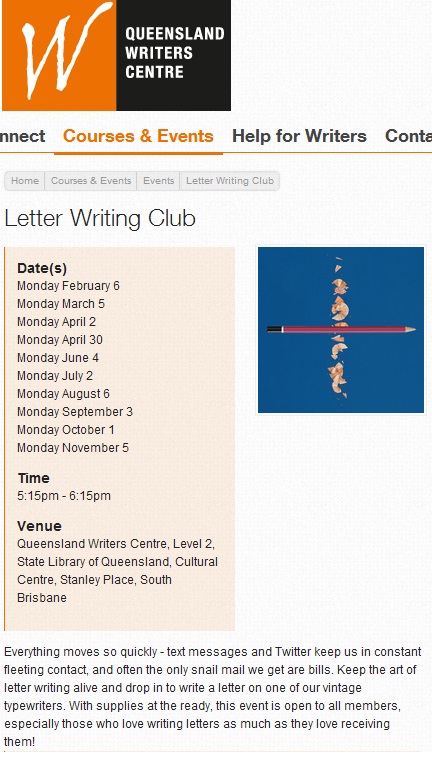
So it was serendipitous that I came across a notice about the ‘Letter Writing Club’ that is being run throughout 2012 by the Queensland Writers Centre. On the first Monday of most months, members of the public can participate in the club for free. Paper, quills, old typewriters and other devices are made available for people to write letters … this is the whole point of the club.
Isn’t that great?
Here is the information from their website – I hope to get along to at least one of these!
My schmick new assessment design!
Posted by kmcg2375 in education, research, university on April 26, 2012
Teaching at university can be tricky, mostly due to the emphasis on summative assessment.
Since starting this position in 2010 I have been attempting to infuse the unit I coordinate with greater amounts of project-based learning. However, in a context where students have little time or incentive to engage with classwork that isn’t formally assessed, it has been hard to reward things like student project work.
After three semesters of teaching English Curriculum Studies 1 I decided that a radically new assignment was in order.
Background:
Students used to do:
- Assignment 1 – Personal teaching philosophy statement and resource analysis
- Assignment 2 – Report on video lessons and learner needs observed
- Assignment 3 – Junior secondary English lesson plans
All of these assessment pieces were completed individually – no collaboration was required and no public audience was utilised.
From this semester onward, students now do:
- Assignment 1 – Personal teaching philosophy statement and resource analysis (same as before)
- Assignment 2 – Junior secondary English lesson plans (now completed in small groups of 2 or 3)
- Assignment 3 – A range of CHALLENGE TASKS published in a portfolio <– SCHMICK NEW TASK!
The New Task:
Many of the key ideas about inquiry-based and cooperative learning that I am working with can be found in a book extract provided by Edutopia: Teaching for Meaningful Learning by Brigid Barron & Linda Darling-Hammond.
Here is a brief extract – some words about project-based learning:
“Project-based learning involves completing complex tasks that typically result in a realistic product, event, or presentation to an audience. Thomas (2000) identifies five key components of effective project-based learning. It is: central to the curriculum, organized around driving questions that lead students to encounter central concepts or principles, focused on a constructive investigation that involves inquiry and knowledge building, student-driven (students are responsible for designing and managing their work), and authentic, focusing on problems that occur in the real world and that people care about.” (Barron & Darling-Hammond, 2008, p. 3; my emphasis)
What I’ve done in my new task is to create a poetry ‘project’ as one of 10 ‘challenges’ that students need to complete.
After trialling a poetry project last semester, I know that students see value in, and engage with this kind of learning. But, at the end of the day, students felt let down because the work they put into their projects didn’t ‘count’ towards their final grade.
Once I started messing around with a new assignment that gave them credit for their project work, it was too hard not to design a whole suite of ‘challenges’ that they could choose to take up! So, that’s what I’ve done – students decide what grade they want to get, and complete the number of challenges needed to obtain it.
‘Challenge-based learning‘ as a term has not gained as much traction as ‘project-based learning’, but I think there is something to be said for the difference in terminology. In my teaching context, students are completing a ‘project’, but there is a minimum standard they have to reach to be able to ‘pass’ the assessment. Also, there is less focus on a ‘driving question’ than a PBL task would have – more of an emphasis on the products needing to be made. Hence my use of the term ‘challenge’ in the overall task.
The Challenges:
OK, the easiest way to show you the assignment is to share copies of my assignment sheets:
CLB018-CLP408 challenge portfolio task
A matrix of challenge tasks is provided for students to choose from in assignment 3.
Students will receive a grade for Assignment 3 based on the number of challenges completed:
- 4 CHALLENGES COMPLETED = PASS
- 6 CHALLENGES COMPLETED = CREDIT
- 8 CHALLENGES COMPLETED = DISTINCTION
- 10 CHALLENGES COMPLETED = HIGH DISTINCTION!
CHALLENGE TASK peer assessment sheet
Note the peer assessment component of this task. This is something I am especially proud of, for a number of reasons! Not only am I hoping that this will result in a more sustainable marking practice for me (I will be checking/validating the peer marking, but no re-doing it), but it is also a strategy for getting the students to learn how to share their work and act as ‘critical friends’. I also think that having anopther preservice teacher assess your work in this context can be seen as providing an ‘authentic audience’ for student work.
Reflecting:
The student portfolios for this task are due next Friday, so I’ve yet to see how this new assessment plays out in real life.
One idea I have bubbling away about the teaching methods chosen is that ‘project-based’ learning can perhaps be broken down further as being either ‘inquiry-driven’ or ‘challenge-driven’ (and maybe even a third category, ‘play-driven’). But that’s a hierarchy that I’m still thinking through…
There is a lot going on here, I realise. But I’d seriously LOVE to hear feedback from my critical friends, including any students that end up reading this post 🙂
If you have any questions to ask, shoot them at me too! Obviously I’m quite proud of what I’ve constructed here, but in a few weeks it will be time to reflect again on how to improve for semester 2, so as they say…bring it!
What Giroux said…
Posted by kmcg2375 in conferences, education, politics on April 16, 2012
…in his address at the launch of the Werklund Foundation Center for Youth Leadership Education in Calgary.
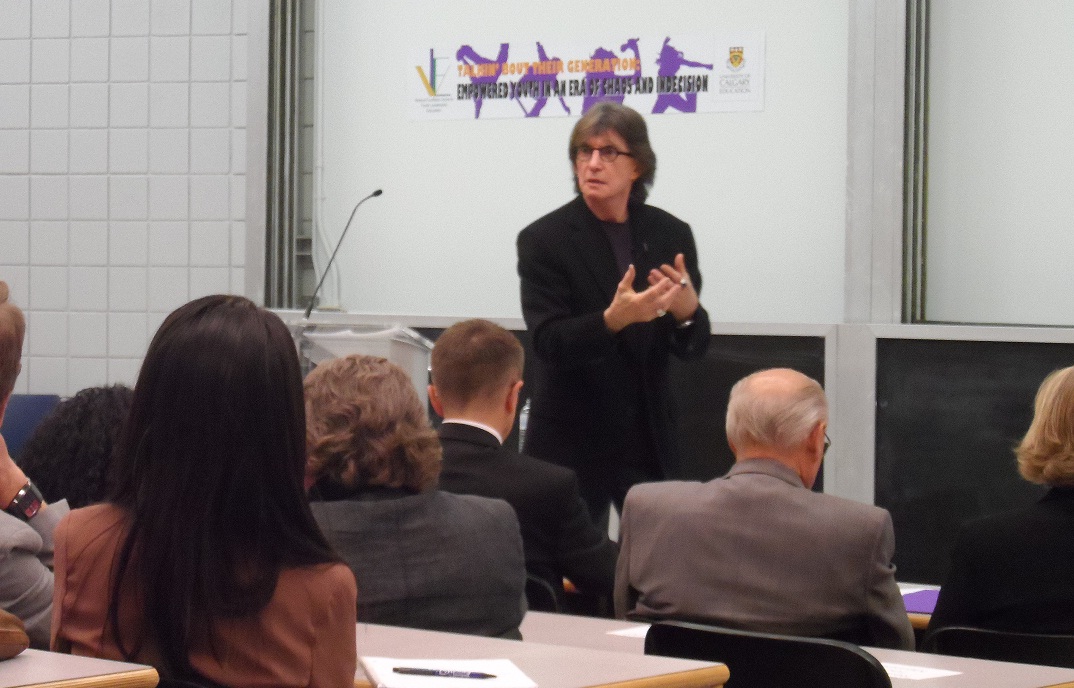
Before coming to the 2012 AERA conference I had the absolute pleasure of attending the Inaugural International Youth Studies Congress at the University of Calgary.
As well as hearing from distinguishes scholars, teachers and students on issues relating to youth studies, the major highlight for me (and tbh, the carrot that helped me decide to attend in the first place), was the keynote address by Henry Giroux.
#whatgirouxlookslike
If you consider yourself a ‘radical’ educator and have not yet read Giroux’s work, I highly recommend it! He is doubly awesome in my book, given his commitment to getting his scholarly thoughts out into the wider-read public domain. I thought it very fitting, therefore, that I should tweet the ideas from his talk that stood out most for me.
You can read the gist of his talk in this op-ed article: The ‘Suicidal State’ and the War on Youth.
(NB: I accidentally tweeted the term ‘suicide state’ instead of ‘suicidal state’. Oops…)
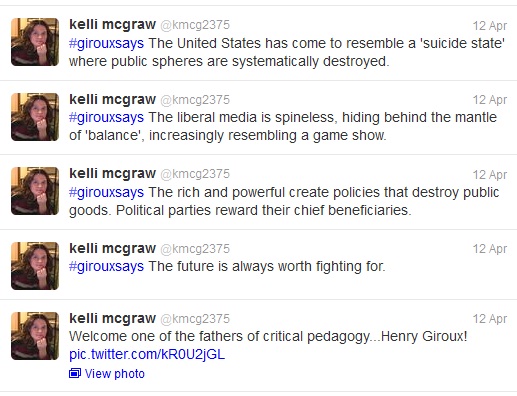
I used the hashtag #girouxsays to mark the tweets…given the fickle, temporal life cycle of hashtag searches, I’ve collected them all here for y/our convenience and later reference:


A big shout out to Shirley Steinberg, the Werklund Foundation Chair in Youth Leadership Education, for hosting this inaugural event. She’s kind of a big deal in the fields of #radical_education #freire_project #critical_pedagogy – loved hearing more about this work! (my radical itch was in need of a scratch…)
Finding my Threshold Concepts
Posted by kmcg2375 in education, learning community, reflections, research, university on April 4, 2012
This semester I have been engaing in the final cycle of my teaching and learning action research project – part of what I do here at QUT as an ‘Early Career Academic’.
‘Constructing a community of practice in English Curriculum Studies 1 – online and offline’
Action research cycle:
- Planning and fact-finding: 2010, semester 2
- Phase 1 action: 2011, semester 1
- Phase 2 action: 2011, semester 2
- Phase 3 action: 2012, semester 1
- Report findings: 2012, semester 2
The buzz term for how to ‘do’ curriculum planning here at uni is constructive alignment. Anyone else having to use this term?
Basically, constructive alignment is what you do when you make sure your assessment tasks match your learning objectives, and that your lesson materials feed into this productively. (OK, so I slipped the word ‘productively’ in just there…can you tell I’m living in Queensland? Productive pedagogies, anyone?)
So, the first two phases of my action research have been all about getting the assessments to work for me and my unit, English Curriculum Studies 1. I inherited a bunch of learning objectives when I took on coordination of this unit, but in the end I found that the assessment tasks weren’t engaging students in the ways I knew could happen. In the ways I was sure could happen, anyway. All of the assessment pieces have now been modified or replaced (not allowed to change the learning objectives) and things are aligning much more constructively…
The last piece in the puzzle that I was really hoping to nut out in this third cycle is the establishment of threshold concepts for this unit.
A ‘threshold concept’ is the kind of concept that, once learned, cannot be unlearned. Once we grasp a piece of threshold knowledge, we pass over a barrier into new territory, where everything is seen anew with different eyes.
In the (bazillion) Powerpoint presentations I sat through last year as a new academic, I picked up the importance of using a few well-chosen threshold concepts to drive a unit of work. For teachers like me that prefer to use project-based and inquiry-based learning approaches, having a set of threshold concepts in mind that you want students to ‘get’ by the end of the experience looks to be an excellent anchor for lesson planning. Although these concepts are related to the official learning objectives of the unit, they do serve a different kind of function…and I really want to settle on what mine are!
Until this week I was still struggling to come up with suitable concepts.
But now, I struggle NO MORE!
I have been working on a summary video for students to watch at the half-way point in semester, while I am away at a conference. In the video I want to recap the main points learned from weeks 1-5 of the unit. The process of trying to identify what the ‘big ideas’ were amongst all of the super important stuff we learned wasn’t easy. But the process of having to present the ideas to my students (not just to my academic review panel at the end of this year…!) has really helped.
Which I guess just goes to show that even teachers need an authentic audience for their work.
Trying to keep the video short (under 5 minutes) also forced my hand – left to my own devices, I’m sure I could find plenty of threshold concepts, but you only need a few. The wording of what I’ve chosen isn’t quite right yet, but these are the six big points I have chosen:
- Your personal teacher identity is unique and reflects your personal experience, but will inevitably draw on many established philosophies and practices.
- In ‘English’ we study: semiotics, text and context.
- Language codes and conventions are socially constructed.
- Verbal/linguistic language is just one semiotic ‘code’; we also learn/teach audio, visual, spatial and gestural language.
- Literacy involves more than code breaking – we also make meaning, use texts functionally, and critique texts.
- Multiliteracies pedagogies are currently favoured in English curriculum theory.
I suspect this is still too many for 6 weeks, but there you go. We’ll see. Once I’ve finished the video I’ll post it up here on the blog. I still have to add the narration, but most of the images are in. I’m using Movie Maker and Audacity as my tools of the trade…I hope the students have time to watch the bloody thing! But even if they don’t, I’m glad I went through this process and am happy that I’ve found some threshold concepts to settle on, for now. And, with any luck, a shiny new resource at the end I can be proud of. Fingers crossed!
Tell me why (I don’t like writing)
Posted by kmcg2375 in personal, reflections on March 26, 2012
Obviously this is not an ideal situation for an academic to find themselves in.
However, I suspect it might be true.
I think it was my PhD thesis that killed it for me…I think…I don’t like writing.
I tried to rejoin my Daily Writing Group but this time it didn’t help. I did co-write an Editorial for a journal = big success story! (Editing other people’s writing was much easier than writing my own work.)
*le sigh
Luckily it is teaching time now, less expectation to write. Brief, brief reprieve.
Definitely time to make good friends with my blog again. I like it here best. And people tell me they read it! (I hope people will be glad to know that they are not the only ones who don’t like writing.)
Other things I have been doing instead of writing:
- reading fiction
- organising multiple conference papers
- answering emails
- playing MW3
All worthy occupations!
Maybe I’m just in thesis ‘recovery’. I mean, surely.
Just have to find the right motivation…
Pecha kucha at the first #TMBrisbane
Posted by kmcg2375 in conferences, education, learning community, online tools, social media on March 2, 2012

I really enjoyed meeting new people and hearing them share their work yesterday at the first TeachMeet in Brisbane.
Steve Box (@wholeboxndice) hosted the TeachMeet at Moreton Bay Boys College (thanks Steve!):

TeachMeet Brisbane
I presented a 7 minute pecha kucha on how to construct ‘fair’ assessment when using project-based learning (PBL).
My presentation included shout-outs to @BiancaH80 @malynmawby @Vormamim and @benpaddlesjones who are some of the wonderful people that have tweeted around ideas with me on my PBL journey. It was the first time I presented a pecha kucha and adhered strictly to all the rules! Making cards to help me stick to the topic helped a lot (something I haven’t done since school tbh):
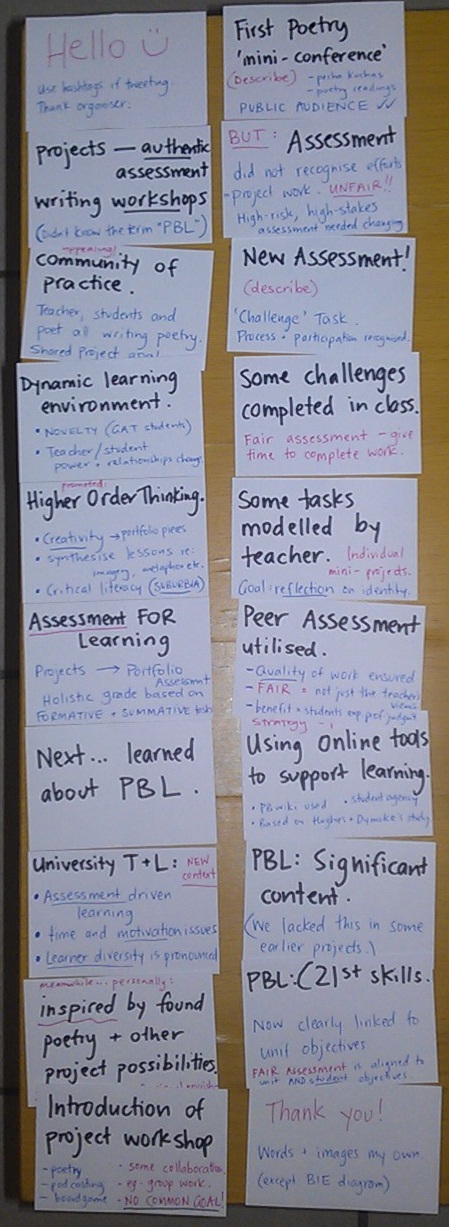
Actual palm cards - old school!
If you’d like to check them out I’ve put the slides up on slideshare. I hope that showing these resources helps future TeachMeeters plan their Pecha Kuchas – I loved the mode of presenting and highly recommend it!
Congratulations to TeachMeet Sydney on their WORLD RECORD ATTEMPT tonight! I hope the next #TMBrisbane event at the State Library of Queensland will be able to be video streamed online like #TMSydney was tonight, I had a ball watching along and tweeting with everyone from home 🙂
TeachMeet Brisbane
Posted by kmcg2375 in conferences, education, learning community, social media, technology on January 23, 2012
During 2011 a range of TeachMeets were held throughout Sydney. A central wiki was set up to coordinate the events and the hashtag #TMSydney ran hot during the meets.
The events were great successes, described by participants as welcoming, supporting and positive. This is not surprising, when you consider that the ethos behind the event is that it is strictly free professional development run ‘for teachers, by teachers’. What I thought was most attractive about the TeachMeet structure was the short presentations – either a 2 minute ‘nano-presentation or a 7 minute micro-presentation (or Pecha Kucha). It sounds like an ideal way to hear a little bit from a lot of people.
You can therefore imagine how stoked I was to hear that someone was organising the first ever TeachMeet in BRISBANE!
#TMBrisbane
TEACHMEET BRISBANE will be held from 4-6pm at Moreton Bay Boys’ College on Thursday 1st March 2012.
If you would like to register or get more information, you can visit and join the TMBrisbane wiki: http://tmbrisbane.wikispaces.com/
Of course, I was so excited to see the event come to Brissie that I had to volunteer to present. It will also be a great chance for me to refine my pecha kucha style!
(I also look forward to the #TMBrisbane hastag drawing together more of the Brisbane edu-community)
Pass it on
If you would like to be involved in TeachMeet Brisbane, or to support the event, take a look at the flyer available for download on the wiki.
In the Twittershpere you can participate in the backchannel from anywhere (not just Brisbane!) on March 1st by adding #TMBrisbane to your tweets.
Finally, this video about TeachMeets made for Sydney West is a great one to pass around to folk who are new to the TeachMeet concept…enjoy!
Nominated!

- Australian English Teachers
 9 members
A group for English teachers in Australia to discuss the books they are reading, and the books th...
Books we've read
View this group on Goodreads »
Share book reviews and ratings with Australian English Teachers, and even join a book club on Goodreads.
 Kelli McGraw
Recent Comments