ICT Cross Curriculum Content
Posted by kmcg2375 in school, technology on May 17, 2009
A comment by Pixeltoy on an earlier post about the Laptops for Learning Forum got me thinking: although I do believe much work will have to be done to ensure authentic integration of ICT resources into all subject, I’m not sure that syllabus change is the answer.
NSW syllabuses already have cross-curriculum content embedded into each syllabus. One of the content areas is Information and Communication Technologies (ICT). The ICT cross-curriculum content in the English 7-10 syllabus is worth quoting here at length:
Information and Communication Technologies (ICT) content in English enables students to develop and apply skills, knowledge and understanding of ICT in their composing, responding and presenting, and as part of the imaginative and critical thinking they undertake in English. The ICT content has been incorporated into the content of this syllabus to ensure that all students have the opportunity to become competent, discriminating and creative users of ICT and are better able to demonstrate the syllabus outcomes of English through the effective use of ICT.
In their study of English, students are able to apply their existing knowledge of word processing, multimedia, ways of formatting and presenting texts, simulation software, graphics and electronic communication and further develop their skills, knowledge and understanding of these technologies. They learn about the ethics of information communication through technology.
At Stage 4, students use specified tools and functions of word processing for composing. They learn to import images and graphics into folders and documents. In formatting documents they learn to desktop publish using graphics in a multimedia presentation or webpage, evaluating appropriate layout and design principles for a specific audience.
At Stage 5, students use more advanced specified tools and functions of word processing for composing. They learn to create, import and manipulate graphics. They learn about advanced forms of digital communication such as video conferencing.
So, what is it that’s already letting us down? What is it we are missing in our professional learning to be able to implement this content, which already appears in our syllabus documents?
Tribes #TED
Posted by kmcg2375 in random, technology on May 12, 2009
Seth Godin talks to TED 2009 about how, rather than homogonising everyone, then internet has instead lead us to form TRIBES. He explains how:
- People on the fringes can now find each other, connect and go somewhere.
- It is tribes, not money or factories, that can change our world…that can align large numbers of people.
- What we do now for a living in today’s society is: find something worth changing, then assemble tribes, which assemble other tribes etc. until it becomes something bigger than us – a movement.
- Leaders challenge the status quo, and build a culture and a community to connect people to a cause.
What are you changing?
Who are you connecting with?
Who are you leading?
The Twitter Experiment
Posted by kmcg2375 in online tools, social media, technology on May 12, 2009
This five-minute video gives an impression of what it is like using Twitter as a backchannel in a large classroom.
I am already a HUGE fan of Twitter as a tool for extending my PLN. Logistically, I’m unsure how tweet-ing would work in a NSW high school context at the moment (leaving aside the fact that it is blocked by the web filter) – can anyone out there share a success story?
Vodpod videos no longer available.
Arts and Sciences not seperate #TED
In this TED talk Mae Jemison makes some very poetic and logical arguments for teaching the Arts and the Sciences in a more integrated way, and about the importance of promoting human creativity, which she explains is found in both the Arts and Sciences:
The talk was interesting in itself, but the reason why I found this Ted talk so appealing was that it again got me thinking about the inter-related nature of the acts of reading and writing, and of what our English syllabus in NSW calls responding (reading, listening and viewing) and composing (writing, speaking, and visually representing). You might already have spotted a problem with these divisions – although the syllabus names reading as an act of responding (because it involves thinking about and having a response to what is read), one can also write or speak a ‘response’, yet those acts are names as acts of composing. Do you follow? 😉
The distinction being made in the syllabus however, is not really between the acts of reading and writing (for example), but between acts that involve responsive or comprehensive thought processes, and acts that involve original or creative thought processes.
Jemison is critical of the way we have been taugh to regard ‘intuitive’ and ‘analytical’ thought processes as seperate – to see ourselves and others as ‘left-brained’ or ‘right-brained’; ‘artists’ or ‘scientists’; ‘destructors’ or ‘constructors’. While it may be handy for working out assessment task weightings to distinguish between acts such as listening and writing (although we will often test listening by getting kids to write down what they understood!), it is one way in which we reinforce the artificial binary of intuition and analysis.
One must be intuitive to be truly analytical. One may work very methodically to acheive originality or create art. Good English teachers understand this, and continue to promote creativity in all its forms.
Laptops 4 Learning
Posted by kmcg2375 in school, technology on May 7, 2009
Wanted to get down some of the big ideas (and fast facts) that have come up over the past two days at the Laptops 4 Learning Forum. There is so much I could say – and will say, in some more blog posts over the coming week. For now…
Big Ideas:
- Schools should work toward developing a ‘digital culture’ by using technologyas a tool, rather than scheduling technology events. The laptops should become part of the learning environment, like pens, papers and whiteboards.
- Laptop use in schools has the potential to make classes and projects more student-centred. The increased capacity for project-based learning through connectivity (and nifty software) can mean that the technology can have a positive impact on pedagogy.
- Teachers will need to develop their skills in classroom management to accomodate problems with the technology…but this is no reason to give up or shy away. We already do this when the photocopier breaks, or the OHP bulb blows!
- Laptops are exciting, and the potential for student engagement is huge. Rather than facing their work and asking “why do I have to do it?”, this will get them asking “can I do it this way?” (This great point from Steven Plummer, who is leading the English KLA project)
- Barbara Bober gave us a great metaphor – some teachers will be like Formula 1 drivers with the technology; most will ordinary, but competent and perhaps even excited drivers or smaller vehicles (to extend the metaphor for those who worry about teachers losing control in laptop lessons – in this metaphor, the teacher is still the driver!)
- When planning, we should consider how the laptops will impact on the students, the teachers, the pedagogy, and classroom management. All are important factors
- There isn’t a need to re-invent the wheel. As well as imagining new and foreign possibilities, we should be looking at current curriculum and pedagogy and asking: what can be enriched?
- Ken Olah explained that feedback to kids has the largest correlation (1.4) with increased student learning. Imagine the opportunities for feedback that constant access to personal laptop creates!
- It will be a bit messy to start off with…but it is worth it.
Students Talk:
In one panel discussion two students talked about what they saw as the benefits of having and using laptops. They suggested:
- Being able to do bits of work ‘here and there’, rather than only being able to access desktop computers at certain times will relieve some stress around homework and assignmetns
- Homework etc. will be more easily recorded in a school diary or calendar on the laptops
- Work can be saved, and easily shared – no more lost sheets or notes if you are away
- Having computer access at school. Students reported often having trouble getting into a computer lab or finding a free computer in the library
- Assiting group work outside of school hours
- Better access to whole school information – they suggested school notices being distributed electronically.
Fast Facts:
- Students will get their laptops in Term 3. Teachers will get theirs before students do, probably in July.
- Wireless is getting installed in April, and this is bound to be a bit disruptive. Libraries plus one classroom will get it first.
- Every school will get one full-time technical officer to support laptop use. There is a 4 year funding commitment from federal governemt for this, and this person is employed regardless of whether your school already has ‘an IT person’ – their sole job is to support the laptops
- Schools will have spare batteries and laptops for students to use if they don’t have their laptops (and policies will be in place to curtail repeat offenders)
- Students are expected to charge their laptops overnight and bring them charges to school.
- Operating system is Windows XP
- Software installed is Microsoft Office 7 (standard suite plus One Note) and Adobe (Connect, Presenter, Captivate, Photoshop Elements, Premier Elements, Dreamweaver, Flash and Acrobat Professional)
- Disk size is 160 GB, but about 50 GB of this is used up with the software
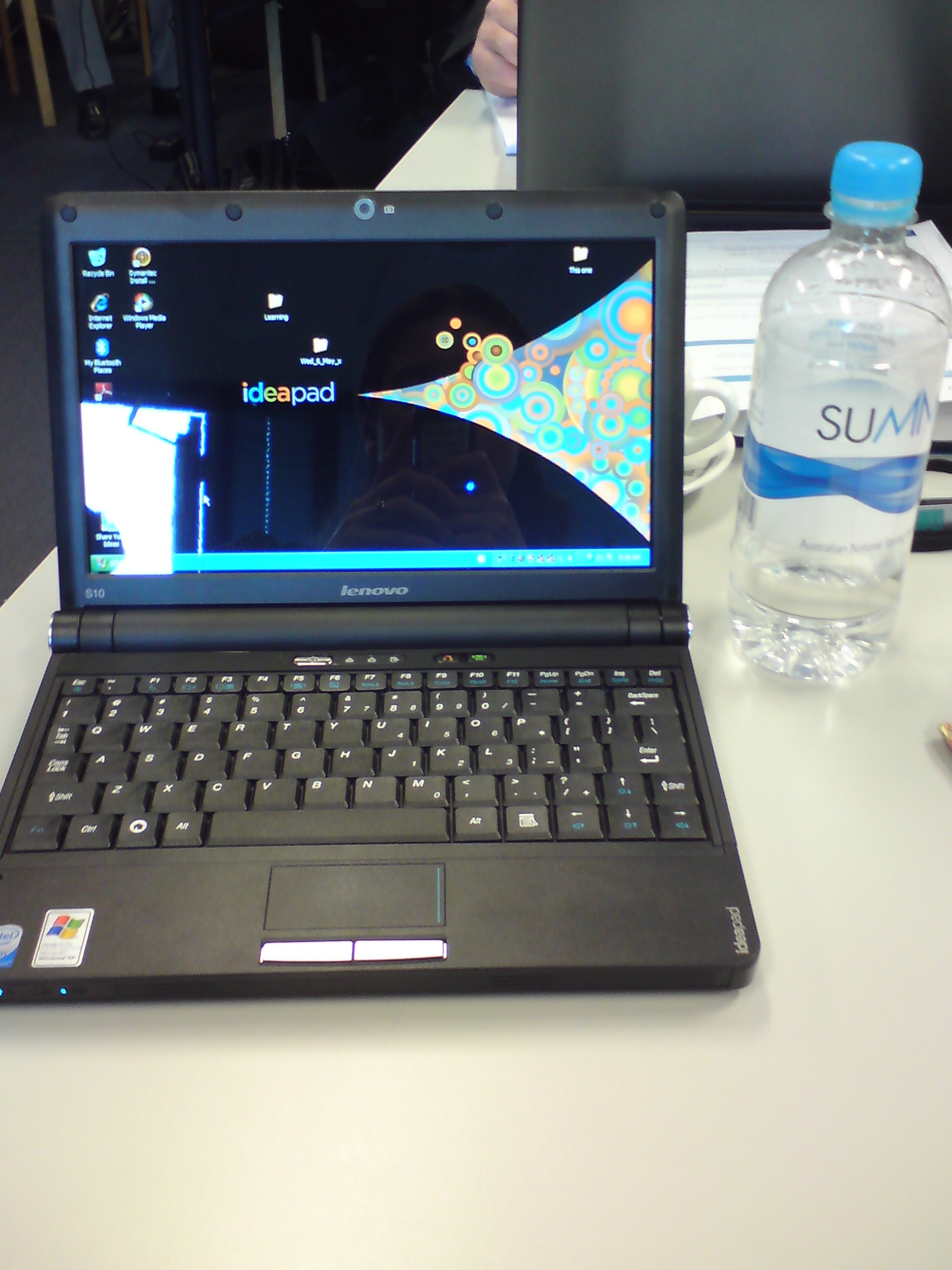
- The Lenovo laptops have two USB ports, an Ethernet port, Bluetooth an SD memory card reader, and an inbuilt webcam
As I said, there is so much more information to come. In the meantime, enjoy a peek at the new laptop 🙂

Marriage and Young People
Still reflecting on my wedding anniversary this week, I was interested to read an article published in the Sydney Morning Herald today, in which American researcher Mark Regnerus implores young people to “take the plunge” because “deferring marriage is un-healthy and unwealthy”.
I do see Regneruses point of view. He reports that his research on young adults’ relationships found that “many women report feeling peer pressure against seriously thinking of marriage until they are at least in their late 20s.” This is certainly the case for many people I know (women and men). When I look around at friends in their late 20s like me, it is only in the last year or two that some of us have started tying the knot; having kids is even rarer. And he hits the nail on the head when he argues that parental pressure to complete our education, to launch our careers and become financially independent before even contemplating marriage is a driving factor behind the increased average marriage age. Most people I know have certainly been given that advice.
But far from the picture that Regnerus paints of young people driven (by their parents or otherwise) to achieve experience, control and power in their lives before ‘settling down’ is another factor. Not once did his article mention the increase in divorce rates (which reached a peak in Australia in 2001) that my generation lived through. As a child of parents who divorced when I was 20 years old, I can testify to the devastating effect that divorce has on the kids’ sense of caution when it comes to signing themselves up to that life-long treaty which has the potential to end in the most bitter and destructive process imaginable. In fact, I wouldn’t be surprised if the increased caution leading up to marriage these days actually accounted for the decrease we are now seeing in divorce rates compared to the last two decades!
When I say that young people have an increased sense of ‘caution‘, however, I don’t just mean that we are worrying ourselves about choosing ‘the right one‘ – although for some who have seen the effects of choosing ‘the wrong one’, this no doubt remains a concern. Even if your parents aren’t divorced, these days the chances are that someone close to you has gone through the experience. Throughout high school I was acutely aware of the effects that divorce had on my closest friends. Everyone had their go – of seeing the counsellor, of acting out a little, of milking teachers for sympathy concessions…and of grieving. My feeling is that our generation is mostly cautious about being able to get their marriage off to ‘the right start‘, as a way of honouring their own marriage and distinguishing their marriage as one built on well-established trust and resilience. We feel we owe that to our future kids.
What Regnerus also fails to mention are the many couples who live in de facto relationships – who consider themselves as ‘married’ in the sense that they are emotionally, financially and even legally joined, permanently, but who for whatever reason haven’t been through the wedding process. Speaking from my own experience, although I do admit feeling a bit ‘different’ since being married, there were many years before the wedding that we considered ourselves married in every way bar officially, and yet the only categories of relationship listed by Regnerus besides ‘married’ were ‘single’ or ‘cohabitors’. A real de facto relationship is about much more than living together, or ‘cohabiting’, and in today’s increasingly secular society it is the real start of a ‘permanent’ relationship – the wedding is more of a celebration of it.
Which leads me to another factor that wasn’t accounted for in Regneruses article: the cost of a wedding, and the effect of the contemporary trend of couples paying for all or part of their own wedding. Maybe it is because our generation is marrying later, which makes them feel a bit silly as independent, wealth earning adults to ask thier parents to foot the bill. It is logical that young people need more time these days to save up for their wedding, especially given the pressure to engage in that other costly endeavour – entering the property market.
I must say I was a bit insulted by the last paragraph of the article, in which Regnerus praised a 23 year old student on her decision to get married, contrasting her to the “many young people [who] mark their days by hitting the clubs, incessantly checking Facebook, and obsessing about their poor job prospects”. This comment is a slap in the face to young people trying to relieve stress and maintain personal relationships to balance the extended education and training needed in this increasingly credentialised society, who now rightly worry about their job security in a declining global economy. It also wrongly (and somewhat disrespectfully) positions marriage as a kind of panacea to the ills of a misspent youth.
*sigh*
People are full of advice when it comes to what young people should do to have a better life. This is understandable; welcome and useful, even. But we do ask that you give us some credit, and don’t try to oversimplify the problems of this generation. It is not that we are so cynical and unromantic that we won’t settle for anything other than a “recipe for success”. I love my husband, and we knew we were meant for each other from a very young age. We took our time getting married because we were in no rush, plain and simple. I think that’s pretty ‘healthy’, really.
First Wedding Anniversary
A very self indulgent blog post today to share that today/Sunday was my first wedding anniversary 🙂
A lovely time was had by all – Mr K. and I like to celebrate things over whole weekends, giving us more excuses to eat out! After a lazy day shopping we ended up in Newtown for dinner on Saturday night. We had no reservations, and had braced for the dreaded King Street wander…eventually found a great restaurant called Twelve. They were full, but offered to call back in 15 minutes when a table was free – how nice! We had a rocket, parmesan and pear salad, and while hubby had a rump steak I had fig, basil and chilli linguine. So delicious! I highly recommend Twelve to anyone living in Sydney – it’s at the Marly-end of King Street, in between the Vintage Cellars (a lovely New Zealand Pinot Noir from there, thanks very much) and the 7 Eleven, across from Burgerlicious.
We thought we’d go for a drive down to the Rocks and under the bridge, but alas twas ANZAC day and much revelry had gotten the roads closed…so we ended up going for a very late coffee at Badde Manors in Glebe, where we were soothed by some jazz music and a very 50s feel. Two lattes and some carrot cake later, and the it was home for us.
Saturday celebrations really set us up well for a stress-free real-Anniversary on Sunday. Day consisted of a sleep in, a big bacon and egg breakfast, a little bit of laundry and a lot of general lazing around. A perfect day for someone on the brink of returning to school next week – one last holiday day. We were reliably informed that the gift de choix for first anniversaries is paper, and bought tickets to see The Grates on 8th May as a present to each other. So…more anniversary celebrations in two weeks 🙂
And…my thoughts on being married, one year on? Other than slightly amused at having a ‘first’ anniversary, after being together for 15 years 😉 Rather than try to find words for my own philosophy, I suggest that now more than ever I see the value of both of the following metaphors, taken from the readings we chose for our wedding ceremony. The first is from a poem by Kahlil Gibran:
…Give your hearts, but not into each other’s keeping,
And stand together, yet not too near together,
For the pillars of the temple stand apart,
And the oak tree and the cypress grow not in shadow.
The tree metaphor a little different in Captain Corelli’s Mandolin, by Louis de Bernieres :
You have to work out whether your roots have so entwined together that it is inconceivable that you should ever part.
Those that truly love have roots that grow towards each other underground, and when all the pretty blossoms have fallen from their branches, they find that they are one tree and not two.

Beautiful Math #TED
An absolutely excellent TED talk from Margaret Wertheim: The beautiful math that links coral, crochet and hyperbolic geometry.
This talk reminded me a lot of the intersection between mathematics, beauty and life that is explored in McBurney/Complicite’s play A Disappearing Number. From the production’s website:
Threaded through this pattern of stories and ideas are questions. About mathematics and beauty; imagination and the nature of infinity; about what is continuous and what permanent; how we are attached to the past and how we affect the future; how we create and how we love.
What a delightfully philospohical space to sit and think in! Enjoy.
Save the Net – sign the petition
Posted by kmcg2375 in technology on April 14, 2009
The Federal Government is planning to force all Australian servers to filter internet traffic and block any material the Government deems ‘inappropriate’. Under the plan, the Government can add any ‘unwanted’ site to a secret blacklist.
Testing has already begun on systems that will slow our internet by up to 87%, make it more expensive, miss the vast majority of inappropriate content and accidentally block up to 1 in 12 legitimate sites. Our children deserve better protection – and that won’t be achieved by wasting millions on this deeply flawed system.
Twitter #TED
Posted by kmcg2375 in online tools, school, social media, technology on April 2, 2009
Recently for some reason unknown to me I have found myself often amongst students and colleagues hating on Twitter. The thing is…they haven’t tried it.
Of course, people are allowed to have opinions, even when they are not based on any real knowledge or experience. But I have been a bit surprised by how quickly, and with what venom, people are ready to leap into attack mode when someone mentions Twitter.
Wow, some people must really think they are important – as if anyone cares about your sad life.
Don’t people have anything better to do?
Who could be bothered checking to see if someone posted some random note.
As if I want to hear about the boring details of someone else’s life!
It’s a place where sad-cases can find out what P. Diddy is doing every minute of everyday.
Narcissists!
Yesterday a penny dropped for me, and I realised a big reason why I find these comments so unsettling: Why are people so determined to express how much they DON’T care about anyone else’s world? Sure, meeting in person is a ‘nicer’ way to be closer to people you know, but these comments don’t smack of pro-embodied-socialising; they just reek of tall poppy syndrome and a bunch of I-don’t-care.
I’m hoping some teachers on our school technology committee will start dabbling in Twitter soon, so I can start making the rich professional connections in school that I currently need to seek out of school. I found this TED Talk on Twitter very interesting, and I’ll pass it on to my colleagues soon:
Nominated!

- Australian English Teachers
 9 members
A group for English teachers in Australia to discuss the books they are reading, and the books th...
Books we've read
View this group on Goodreads »
Share book reviews and ratings with Australian English Teachers, and even join a book club on Goodreads.
 Kelli McGraw
Recent Comments