Archive for category university
Classes start tomorrow!
Posted by kmcg2375 in education, learning community, reflections, research, university on February 26, 2013
The week we’ve all been waiting for, week one of the university semester, is finally here!
This semester, I will be focussing on the following areas of my English Curriculum Studies unit for development:
- Building in more support for student reflective writing. The design of my lesson planning assignment last year included a tutorial presentation of the key teaching strategies, but it didn’t really work that well. So I plan to change this element of the assessment to a written reflection, and add two targeted activities to tutorials in mid-semester to more constructively scaffold the task.
- Finding places to make connections between English curriculum studies content knowledge and other professional frameworks. In particular I want to ensure that students understand how the Australian Professional Standards for Teachers can be used to self-diagnose areas of strength and directions for further learning, and are knowledgable about the Productive Pedgagogies framework that is advocated by Education Queensland.
- Registration. After three years of running this unit it will be time to write up the final unit design, as well as a ‘scope and sequence’, so that the unit is ready to be passed on. At school we called this ‘registration’ – when the Head Teacher would check out your unit plans at the end of the semester and ensure you met your learning objectives. Here at uni there are other other mechanisms in place, but the Head Teacher check isn’t one of them. And official changes are made so sllllloooowwwlyyyy. So, for my own piece of mind, I’m going to put my own unit through a final tick-and-flick, then prepare my reflections and field notes for scholarly publication and sharing.
I’ve included below another classroom poster I’ve made, a visual resource to support my students’ engagement with the Productive Pedagogies – feel free to use and share (though note that the values/opinions expressed on it about alignment with ‘prac’ are only my own POV!).
Now…deep breath!
And once more into the breach!

Productive Pedagogies for Prac (image by Kelli, CC-BY-SA)
Making content posters for my classroom walls
Posted by kmcg2375 in education, technology, university on February 13, 2013
Over the years I have seen many creative and high utility wall displays in other people’s classrooms. Imelda Judge for example is wizard with cardboard and hot glue – sharing a classroom with her in 2009 was a wild apprenticeship in classroom decoration!
I say ‘other people’s classrooms’ because I haven’t had a lot of success with this kind of thing!
2008: One time, I thought I had made a pretty successful poster of quotes from King Lear for my Year 12s…but they never seemed to look at it:

2009: Far more successful displays have tended to come out of students’ own work being put up, such as this display of lines of poetry after a lesson with Year 10:

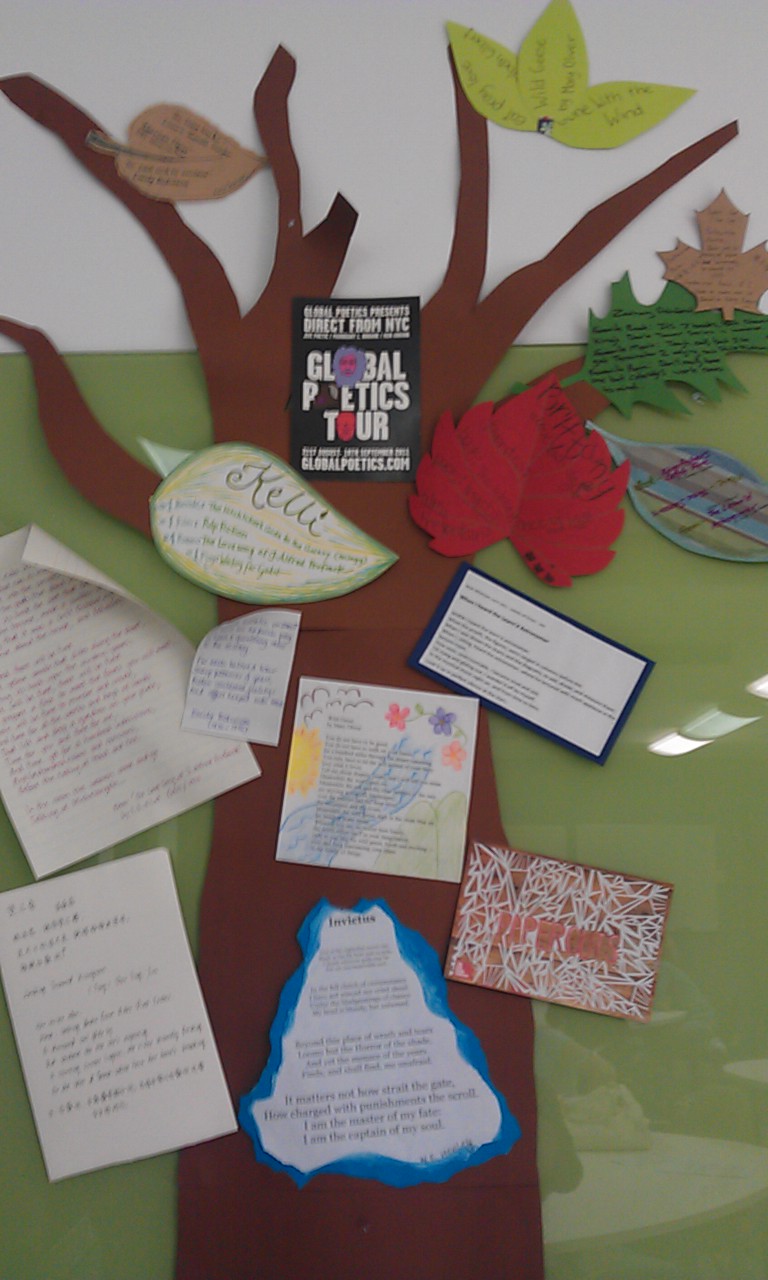
2011: And the ‘tree of knowledge’ inspired display I’ve had in my uni teaching for the past 18 months was wrongly positioned at the back of the room, and a little haphazard to boot:

Today: When I saw Bianca’s tweet today with a picture of her classroom wall painted with blackboard paint, I thought ‘how cool is that!?’
…which motivated me to start designing some posters to add to my classroom this semester.
I’m going for a digital look, rather than getting all crafty with the glitter and paint. I plan to print them out in colour A3 and get the students to decide where they think they should be put up in the room. Here is the first one – two of the key concepts I focus on in my English Curriculum Studies unit:

by me, Kelli McGraw (CC-BY-SA) free-to-use
Mind you, the room I teach in has been a blu-tak free zone for the past two years, because it got a new paint job. This has been severely limiting. While it’s lovely on one hand to teach in a clean and modern space, it’s hard to use a room when you can’t put things up where you want. Teachers who don’t have a ‘home room’ will know the feeling!
The display I have been using so far, however, has been taking up one of the big green write-on groupwork boards in the room (to avoid having to blu-tak the wall). I don’t think I can keep using that board – I need it in my class, and other teachers must too.
So walls, you’ve had two years…the blu-tak is now a-comin 😉
If anyone else has electronic copies of pedagogy-inspired posters that they would be happy to share, I would love to see some more designs. And if you have any ideas for what else you think I should be flagging for 2nd year preservice English teachers, tell me all about that too!
The cost of preparing for class
Posted by kmcg2375 in education, reflections, school, university on February 8, 2013
Each year before school goes back, teachers can be found out and about in stationery and bargain basement stores, stocking up on materials for the coming term or semester.
New diaries, pens, highlighters, stickers, desk organisers, poster cardboard, and more.
For most school teachers around Australia the first day back was a week ago, but being a university lecturer, my classes don’t start until the last week in February. This gives me a few more weeks up my sleeve to get to the shops and buy some new items to refresh my wall displays and writing workshop materials.
(By the way, awhile ago I read an article that said teachers, on average, spend about $350 per year on classroom supplies that aren’t provided by the school. Isn’t that heaps!! Did anyone see that article? I can’t find it again now…)
$10 spend
One thing I have to top up every semester is my store of paper and card that students use to make visual poetry in English Curriculum tutorials:

These can be picked up cheaply at most Bargain stores, Reject Shops etc. I got mine on sale in Kmart, which I guess means they’d be in Big W etc as well.
I’m thankful that I have access to most basic supplies for teaching at uni – plain paper, lead pencils, glue sticks and scissors are there for the ordering and taking. I still have to buy my own special stuff – black textas, wall fastenings, posters and craft paper – but in my public school teaching days, we weren’t even allowed to take spare A4 paper out of the cupboard for class! You also got just 4 whiteboard markers at the start of the year, and you had to make em last…
Gonski that!
$5 spend

Because I teach older students, you would think that most could be relied on to bring their own books and pens to class. Not so!
The $5 spend on spare books and pens for students that turn up to class without these things in week one is a habit that most teachers of disadvantaged students pick up in their career. I am no exception, and I can attest that even at university, some students are doing it financially tough.
(I can just hear the TV ad voiceover: “For just 32 cents, one of these exercise books will get a disorganised student off to the right start for a whole year…”)
I picked these up at Woolies on an impulse buy – I know 48 page exercise books can be picked up elsewhere for as little as 9 cents a book though.
What do you regularly buy for your classroom?
I won’t be rude and ask people to confirm or deny whether they think they spend the average $350 a year on their class. Partly because I can’t even be sure that figure is right…but also because I’d rather know WHAT you choose to spend on.
How about it – are you a crafty practitioner? Or perhaps your annual spend went toward a personal data projector, or other tecchy toys for your class. Did you have to pay to subscribe to a website for them to use? Do you personally shell out to get their assignments printed in the library?
And if not…why not?
RSA Animate ‘Drive’: Purpose, mastery, self-direction
Posted by kmcg2375 in education, university, video games on December 12, 2012
I just came across this excellent 10 minute clip from the RSA Animate series. It was put up in 2010 and has had over 9.6 million views on YouTube, so some of you may have seen it the first time around. The clip is called Drive: The surprising truth about what motivates us, and is an animation of a talk by Dan Pink.
I’ll be adding this clip to my English Curriculum Studies reading list next semester – a way to link with my students’ other studies in ed. psych.
I’ll also be making a bigger effort to bring in those concepts – mastery, purpose and self-direction – to explain the pedagogical strategies involved in project-based, play-based, inquiry-based and challenge-based learning. I’d be grateful for any insights about this that you folks care to drop as a comment here!
Enjoy the clip!
Building up my Pinterest resources
Posted by kmcg2375 in education, learning community, online tools, social media, university on December 8, 2012
I wrote a little while ago about my venturing into the world of Pinterest. My first board was a collection of images and links relating to ‘Indigenous Studies‘.
This post is just an update on what else I’ve been pinning that other teachers might like to check out.

English teaching – Pinterest board
On my board for English teaching I have links to professional associations, related groups and institutions, magazines and journals, classroom resources for English, and other stuff I think an English teacher might like.
Pinterest board – Learning
When I started finding resources for learning in general that weren’t specifically about English, I created this board for pins about Learning. There are some especially good things up to re-pin from Edutopia and Edudemic.

Pinterest board – Brisbane
Finally, so that this post isn’t ALL work and no play, here is a link to the board I use to collect links to cool things to see and do in Brisbane. This board is great for when people come up here to visit, it means we always have a good list of things to do and see 🙂
If you’ve never used Pinterest before…
- Don’t stress out about missing out. I don’t see it as one of those “you absolutely GOTTA have an account!” tools. Anyone can go and browse my Pinterest boards, which I’ve invested time in because I like to curate, and also because I think my students enjoy the visual layout of links they would otherwise ignore in a reading list.
- My ‘addiction’ (read – compulsion to add pins!) to this tool waned after about four weeks, but I still find myself coming back to it and liking it five months after signing up.
- If you do decide after reading this post to go and make some Pinterest pin boards, ENJOY! I’ve really dug finding new resources this way, as well as thinking more carefully about how an icon or image ‘pin’ can represent an idea, association or resource.
Coming up for air
Posted by kmcg2375 in education, personal, reflections, research, university on November 26, 2012
Hi folks – it’s been a bit quiet here on the blog, I know.
All I can say is … omg MARKING!
I have always had an interest in assessment, but this semester has made really clear to me how dire the situation is with our current practices.
I don’t want to ‘buy out’ my marking (i.e.pay someone else to do it for me) but I feel like I am wasting so much of my time at the grindstone, like a machine, writing the same lines over and over in delightful pink pen in the margins of my students’ work.
“Check the APA style guide for rules about how to format this”
“Formal essays require shorter paragraphs than this”
“Avoid rhetorical questions – make strong statements instead”
“Use your introduction to tell me what your main points will actually be, not to explain the structure of your work”
“Don’t use a quote as a sentence on it’s own – introduce it i.e. ‘Sawyer (year) explains that…'”
“You have not included reference to any unit readings in this rationale”
I worry about RSI. I worry about carpal tunnel! Marking more tasks electronically next semester will hopefully fix the hand ache, but what about the mind ache??
I’m not alone – every teacher reading this knows what I mean.
What are we going to do about it?

Portland Oregon & VA exam 46 – CC-BY-2.0 Flickr image by Parker Knight
Student blog posts – please comment on one if you can!
Posted by kmcg2375 in education, learning community, online tools, social media, university on October 11, 2012

CC-licensed Flickr image by mrsdkrebs
This semester I have been leading a group of future Teacher Librarians through the Masters of Ed. unit ‘Youth, popular culture and texts‘.
For their second assignment they have to contribute to a group learning blog.
Here are links to blog posts from each of the SIX student blog groups that I will be charged with assessing at the end of October:
- Group M: http://jeanetteki.edublogs.org/2012/10/01/tv-shows-i-loved-growing-up-by-gina-mcpherson/
- Group C: http://cln647groupc.edublogs.org/sample-page/
- Group G: http://shellnye.edublogs.org/2012/09/16/successfully-logged-in-to-blog/
- Group R: http://whatishotandwhatisnot.edublogs.org/2012/10/10/gaming-as-learning/
- Group A: http://kpak.edublogs.org/2012/10/03/putting-the-social-into-reading/
- Group W: http://walwoowar.edublogs.org/2012/09/13/is-this-popular-culture-text/
I would be really grateful if folks could click through to any of these and drop a comment!
For many students in this unit it is their first attempt at adding to a blog like this – an extra comment here and there will make a big difference to their experience.
Thanks in advance 🙂
My Pinterest Boards (and why I’m bothering to make some)
Posted by kmcg2375 in education, learning community, online tools, social media, university on July 16, 2012
For the first half of this year it seemed like all anyone was asking me was ‘do you have Pinterest?’
All throughout semester one, when I asked students about Twitter or Facebook or Tumblr, I was guaranteed to get a few voices around the room crying ‘Pinterest!’
It sounded like a cool tool. A virtual pinboard – just make a board on a topic or ‘interest’ (ahhhh… pin + interest = ‘pinterest’!), then add images and videos to it. Always a fan of putting posters on my bedroom wall, covering my school folder with pictures under contact paper, and putting stickers on random bits of stuff, this highly visual curation tool has always sounded promising to me.
I had made the decision in semester one, however, to steer clear of Pinterest. This choice was purely motivated by my fear of taking up another addictive web tool … the first semester of this year was just too busy already to attempt trying new things.
Some questions have also flown around over time about the ethics and copyright implications of re-pinning images without permission, and I confess this made me wary.
THIS SEMESTER, however, I am pinning!
My most promising board so far is the one I have made to collect links for the unit ‘Culture studies: Indigenous education’ (EDB007):

http://pinterest.com/kmcg2375/indigenous-studies/
I hope to engage students in my two tutorials by sharing the board with them and inviting them to explore the links I’ve collected/curated.
Of course, I could have chosen to share my links in other ways, but they all have their drawbacks:
- on a handout (which is not hyperlinked)
- in a Blackboard/LMS post (students hate and avoid Blackboard)
- using social bookmark sharing e.g. delicious (so far unsuccessful; students don’t use/engage)
My hope is that the visual nature of Pinterest, and the ability to browse it socially and on mobile devices, will entice a few students to explore the links I’ve found.
As far as the image copyright issue is concerned, I think I’ll just wait and see if any of these organisations complains, eh? I have done my best to attribute the images, that’s all I can say.
Last word:
This slide presentation by Joe Murphy (@libraryfuture) was really helpful for me:
Joe makes this observation:
“Pinterest succeeds at the juncture of the major online and content trends of:
- self curation
- image engagement and sharing
- visual search/discovery
- and social discovery”
In addition, points made in these slides about the potential of Pinterest to expand community engagement and open up services to diverse clients made me even more eager to try using this service as a teaching resource.
Here’s hoping my bid to invoke some ‘cool’ in my classroom pays off!
My schmick new assessment design!
Posted by kmcg2375 in education, research, university on April 26, 2012
Teaching at university can be tricky, mostly due to the emphasis on summative assessment.
Since starting this position in 2010 I have been attempting to infuse the unit I coordinate with greater amounts of project-based learning. However, in a context where students have little time or incentive to engage with classwork that isn’t formally assessed, it has been hard to reward things like student project work.
After three semesters of teaching English Curriculum Studies 1 I decided that a radically new assignment was in order.
Background:
Students used to do:
- Assignment 1 – Personal teaching philosophy statement and resource analysis
- Assignment 2 – Report on video lessons and learner needs observed
- Assignment 3 – Junior secondary English lesson plans
All of these assessment pieces were completed individually – no collaboration was required and no public audience was utilised.
From this semester onward, students now do:
- Assignment 1 – Personal teaching philosophy statement and resource analysis (same as before)
- Assignment 2 – Junior secondary English lesson plans (now completed in small groups of 2 or 3)
- Assignment 3 – A range of CHALLENGE TASKS published in a portfolio <– SCHMICK NEW TASK!
The New Task:
Many of the key ideas about inquiry-based and cooperative learning that I am working with can be found in a book extract provided by Edutopia: Teaching for Meaningful Learning by Brigid Barron & Linda Darling-Hammond.
Here is a brief extract – some words about project-based learning:
“Project-based learning involves completing complex tasks that typically result in a realistic product, event, or presentation to an audience. Thomas (2000) identifies five key components of effective project-based learning. It is: central to the curriculum, organized around driving questions that lead students to encounter central concepts or principles, focused on a constructive investigation that involves inquiry and knowledge building, student-driven (students are responsible for designing and managing their work), and authentic, focusing on problems that occur in the real world and that people care about.” (Barron & Darling-Hammond, 2008, p. 3; my emphasis)
What I’ve done in my new task is to create a poetry ‘project’ as one of 10 ‘challenges’ that students need to complete.
After trialling a poetry project last semester, I know that students see value in, and engage with this kind of learning. But, at the end of the day, students felt let down because the work they put into their projects didn’t ‘count’ towards their final grade.
Once I started messing around with a new assignment that gave them credit for their project work, it was too hard not to design a whole suite of ‘challenges’ that they could choose to take up! So, that’s what I’ve done – students decide what grade they want to get, and complete the number of challenges needed to obtain it.
‘Challenge-based learning‘ as a term has not gained as much traction as ‘project-based learning’, but I think there is something to be said for the difference in terminology. In my teaching context, students are completing a ‘project’, but there is a minimum standard they have to reach to be able to ‘pass’ the assessment. Also, there is less focus on a ‘driving question’ than a PBL task would have – more of an emphasis on the products needing to be made. Hence my use of the term ‘challenge’ in the overall task.
The Challenges:
OK, the easiest way to show you the assignment is to share copies of my assignment sheets:
CLB018-CLP408 challenge portfolio task
A matrix of challenge tasks is provided for students to choose from in assignment 3.
Students will receive a grade for Assignment 3 based on the number of challenges completed:
- 4 CHALLENGES COMPLETED = PASS
- 6 CHALLENGES COMPLETED = CREDIT
- 8 CHALLENGES COMPLETED = DISTINCTION
- 10 CHALLENGES COMPLETED = HIGH DISTINCTION!
CHALLENGE TASK peer assessment sheet
Note the peer assessment component of this task. This is something I am especially proud of, for a number of reasons! Not only am I hoping that this will result in a more sustainable marking practice for me (I will be checking/validating the peer marking, but no re-doing it), but it is also a strategy for getting the students to learn how to share their work and act as ‘critical friends’. I also think that having anopther preservice teacher assess your work in this context can be seen as providing an ‘authentic audience’ for student work.
Reflecting:
The student portfolios for this task are due next Friday, so I’ve yet to see how this new assessment plays out in real life.
One idea I have bubbling away about the teaching methods chosen is that ‘project-based’ learning can perhaps be broken down further as being either ‘inquiry-driven’ or ‘challenge-driven’ (and maybe even a third category, ‘play-driven’). But that’s a hierarchy that I’m still thinking through…
There is a lot going on here, I realise. But I’d seriously LOVE to hear feedback from my critical friends, including any students that end up reading this post 🙂
If you have any questions to ask, shoot them at me too! Obviously I’m quite proud of what I’ve constructed here, but in a few weeks it will be time to reflect again on how to improve for semester 2, so as they say…bring it!
Finding my Threshold Concepts
Posted by kmcg2375 in education, learning community, reflections, research, university on April 4, 2012
This semester I have been engaing in the final cycle of my teaching and learning action research project – part of what I do here at QUT as an ‘Early Career Academic’.
‘Constructing a community of practice in English Curriculum Studies 1 – online and offline’
Action research cycle:
- Planning and fact-finding: 2010, semester 2
- Phase 1 action: 2011, semester 1
- Phase 2 action: 2011, semester 2
- Phase 3 action: 2012, semester 1
- Report findings: 2012, semester 2
The buzz term for how to ‘do’ curriculum planning here at uni is constructive alignment. Anyone else having to use this term?
Basically, constructive alignment is what you do when you make sure your assessment tasks match your learning objectives, and that your lesson materials feed into this productively. (OK, so I slipped the word ‘productively’ in just there…can you tell I’m living in Queensland? Productive pedagogies, anyone?)
So, the first two phases of my action research have been all about getting the assessments to work for me and my unit, English Curriculum Studies 1. I inherited a bunch of learning objectives when I took on coordination of this unit, but in the end I found that the assessment tasks weren’t engaging students in the ways I knew could happen. In the ways I was sure could happen, anyway. All of the assessment pieces have now been modified or replaced (not allowed to change the learning objectives) and things are aligning much more constructively…
The last piece in the puzzle that I was really hoping to nut out in this third cycle is the establishment of threshold concepts for this unit.
A ‘threshold concept’ is the kind of concept that, once learned, cannot be unlearned. Once we grasp a piece of threshold knowledge, we pass over a barrier into new territory, where everything is seen anew with different eyes.
In the (bazillion) Powerpoint presentations I sat through last year as a new academic, I picked up the importance of using a few well-chosen threshold concepts to drive a unit of work. For teachers like me that prefer to use project-based and inquiry-based learning approaches, having a set of threshold concepts in mind that you want students to ‘get’ by the end of the experience looks to be an excellent anchor for lesson planning. Although these concepts are related to the official learning objectives of the unit, they do serve a different kind of function…and I really want to settle on what mine are!
Until this week I was still struggling to come up with suitable concepts.
But now, I struggle NO MORE!
I have been working on a summary video for students to watch at the half-way point in semester, while I am away at a conference. In the video I want to recap the main points learned from weeks 1-5 of the unit. The process of trying to identify what the ‘big ideas’ were amongst all of the super important stuff we learned wasn’t easy. But the process of having to present the ideas to my students (not just to my academic review panel at the end of this year…!) has really helped.
Which I guess just goes to show that even teachers need an authentic audience for their work.
Trying to keep the video short (under 5 minutes) also forced my hand – left to my own devices, I’m sure I could find plenty of threshold concepts, but you only need a few. The wording of what I’ve chosen isn’t quite right yet, but these are the six big points I have chosen:
- Your personal teacher identity is unique and reflects your personal experience, but will inevitably draw on many established philosophies and practices.
- In ‘English’ we study: semiotics, text and context.
- Language codes and conventions are socially constructed.
- Verbal/linguistic language is just one semiotic ‘code’; we also learn/teach audio, visual, spatial and gestural language.
- Literacy involves more than code breaking – we also make meaning, use texts functionally, and critique texts.
- Multiliteracies pedagogies are currently favoured in English curriculum theory.
I suspect this is still too many for 6 weeks, but there you go. We’ll see. Once I’ve finished the video I’ll post it up here on the blog. I still have to add the narration, but most of the images are in. I’m using Movie Maker and Audacity as my tools of the trade…I hope the students have time to watch the bloody thing! But even if they don’t, I’m glad I went through this process and am happy that I’ve found some threshold concepts to settle on, for now. And, with any luck, a shiny new resource at the end I can be proud of. Fingers crossed!
-
You are currently browsing the archives for the university category.
Nominated!

- Australian English Teachers
 9 members
A group for English teachers in Australia to discuss the books they are reading, and the books th...
Books we've read
View this group on Goodreads »
Share book reviews and ratings with Australian English Teachers, and even join a book club on Goodreads.
 Kelli McGraw
Recent Comments