Archive for category research
Some ‘big’ questions we might have to ask
Posted by kmcg2375 in online tools, reflections, research, social media, technology on July 2, 2010
Well, it is Friday afternoon, and for many teachers holidays are in session, so we might as well get this reflection party started eh?
Seriously, I have been having some possibly paradigm altering thoughts, about social networking in particular. If you dig this scene, please read on!
- Networks that are ‘free and open’ (i.e. Twitter, Facebook) seem democratic, because everyone can ‘have their say’. But what power plays are still at work? What NEW power plays are we constructing that we’re going to have to undo/amend/atone for later?
- Social networks enable fast and efficient communication. But if you can publish your thoughts too fast, without reflection, is the noise that this generates worth the pay off? We are evangelistic about the benefits…but are we ignoring the costs (the drain on our own limited energy and focus in particular as we act as information filters)?
- Networks are being constructed (thinking especially of the Facebook issue here…but anything with an avatar and a bio could be seen to go down this road) that invite identity construction. We post photos, preferences, ideas, affiliations…identity capital (?) But are we muddying the waters of constructing a generative PLN when our communications are so entwined with our personal identity construction?
- Are the ‘big players’ – the people with many followers – throwing around their identity capital? Or are they using a cutting edge technology to be leaders?
- Are ‘great minds’ being devoured as they try to stay on top of the network (with the best of intentions – wanting to share and be open with others) and lead others? At what point are we no longer ‘paying it forward’, and just ‘forwarding’…or, ‘paying it back’. My online PLN has helped me to develop in so many ways…am I indebted to it? Am I obliged to stay and lead it? How can I nourish my own development?
- As a reflective practitioner, am I generating too much out put, and not getting enough input? Am I making/hearing thoughts…or just noise?
Honestly folks, I don’t know where this is all going. But yes, after some consideration, I decided to write a blog post about it. Because no matter where this line of thinking ends up, I highly doubt it will dull my appreciation of irony.
*grins*
Happy holidays!
Thinking about ‘Transmedia’ and ‘Transliteracy’
Followers of this blog will have noticed recent posts about multimodality – about what it means, and about how ‘literature’ and ‘modality’ are being framed in the draft Australian Curriculum.
This post is part sharing with you, and part bookmarking for myself. My explorations of multimodal theory have lead me to looking further into TRANSLITERACY and TRANSMEDIA.
Kate Pullinger put me onto this term initially, inviting me to take a look at the website for the Transliteracy Research Group. The group proposes this working definition for transliteracy:
Transliteracy is the ability to read, write and interact across a range of platforms, tools and media from signing and orality through handwriting, print, TV, radio and film, to digital social networks.
As well as the TRG material, Christy Dena’s PhD thesis Transmedia Practice: Theorising the Practice of Expressing a Fictional World across Distinct Media and Environments is another source that I will be looking into further:
“In the past few years there have been a number of theories emerge in media, film,television, narrative and game studies that detail the rise of what has been variously described as transmedia, cross-media and distributed phenomena. Fundamentally, the phenomenon involves the employment of multiple media platforms for expressing a fictional world.” (Dena, 2009: Abstract)
With my PhD coming to a close, these tangled notions of literacy and textuality are interesting me more and more…much reading to be done!
AATE Annual Conference 2010
Posted by kmcg2375 in conferences, english, research on June 4, 2010
The full program for this years annual conference for English teachers in Australia can be found at:
http://www.englishliteracyconference.com.au/index.php?id=48&year=10
The conference is on this year in Perth from 4-7 July. I’ll be presenting a paper on the Monday about National Curriculum, based on my PhD research on curriculum change:
Getting comfy with the ‘new’: What we can expect to feel about curriculum change.
The National Curriculum will bring with it a host of challenges and problems that may leave us grieving for our familiar local curriculum. What can we expect to feel in this time of change? And what will the effects of this be on our beliefs, our pedagogy and our practice? How much of what we are already doing, really, are teachers expecting to be able to carry forward? It seems this point in curriculum history is an ideal spot for us to revisit and revise our curriculum philosophies, as well as our beliefs about the purpose and goal of teaching English.
Reflecting on the findings of my PhD research into the changes and innovations of the 1999 HSC English syllabus in NSW, in this paper I consider the processes by which teachers have coped with change. What is likely to make us uncomfortable in the National Curriculum for English? What have we already shown in NSW that we fear? The audience will be invited to consider their own philosophies, and begin preparing for change.
The 2011 conference will take place in Melbourne (in December), and the 2012 conference sees the conference returning to Sydney (in October).
What Teachers Want
What Teachers Want: Better Teacher Management (A Grattan Report)
Evaluating the work of teachers and developing their teaching skills is a key part of improving the quality of teaching. However, an OECD survey reveals that teacher evaluation and development in Australia is poor and amongst the worst in the developed world.
Watch this 2-minute video summary of the report, or read the full report in this PDF.
I am hopeful that regulatory bodies such as the NSW Institute of Teachers and Teaching Australia (now AITSL) can play a part in improving this situation.
Tell me about it.
This is spot on. The Alice quote tops it off beautifully:
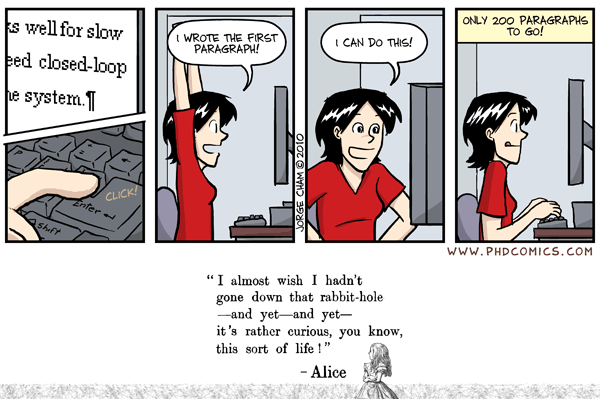
Link to PhD comics website (loving their work since two thousand and…let’s not go there)
Application for extension of candidature
Waiting today with bated breath to find out if I’ve been approved for another semester.
I just need three more months!

Collage made using polyvore.com
UPDATE 11.03.2010: APPROVED!!!
AGQTP Action Research
Posted by kmcg2375 in conferences, online tools, research, school on December 2, 2008
Today was the final day of our participation in this year’s AGQTP project – the end of year presentations in Sydney. The project focussed on linking our collegial support program to school-based action research in the area of Element 5 of the NSW Institute of Teachers Professional Standards.
Element 5: Teachers create and maintain safe and challenging learning environments through the use of classroom management skills.
I’ve uploaded my workshop slides on slideshare. If you were at my presentation, or have any questions about the project, please leave me a comment!
Back in the Saddle
Visitors to the blog may have noticed a new page addition – one for my PhD thesis.
When I created this blog, in an attempt to pin down the broad areas that I expected to post on, I added the subheading ‘teaching, research, and the rest’. I was inspired by Darcy’s blog, which proclaimed it would be about ‘education, technology, life’, to also make my blog a place where the professional and personal, the public and the private worlds could happily overlap. But, unsure I could commit to (the pressure of) saying anything much about ‘life’, I thought I would be better to clump anything that wasn’t related to teaching or research into a vague, and perhaps unpromising, ‘the rest’.
The teaching part was far more obvious – I’m an English teacher and I love sharing resources and reflecting on my practice. The ‘research’ category however, has been sorely neglected. In fact, it’s barely made a peep. And even though I have added plenty to the blog about the Gifted and Talented education action research I was involved in at school, even this is really more about teaching than research. The real research that I should be focussing on is my PhD thesis, which draws to a long awaited conclusion next March.
Well, after a semester away from uni I am indeed back in the saddle, and am hoping to add more to the blog about my PhD in the coming months. For now, I’ve dusted the shelves, bought a new bottle of multi-vitamins and paid off my library fines. Work is progressing…though not without a little procrastination, including a return to my favourite grad student comic strip, Piled Higher and Deeper:

Chores
Using Renzulli and Gagne together
In an earlier post I discussed the way in which our school uses the trait’s of giftedness as identified by Renzulli – we focus heavily on ensuring that students who possess above average ability also develop high levels of task commitment and creativity.
The NSW DET, however, does not feature Renzulli’s traits of giftedness in their Gifted and Talented Policy. Instead it uses Gagné’s (2003) Differentiated Model of Giftedness and Talent (DMGT), which states that:
Gifted students are those whose potential is distinctly above average in one or more of the following domains of human ability: intellectual, creative, social and physical.
Talented students are those whose skills are distinctly above average in one or more areas of human performance.
What I like about Gagne’s model is that it explicitly recognises that students may be gifted in a range of domains; it is not limited to intellectual giftedness, but also recognises creative, social and physical giftedness.
I also think it is very useful to conceptualise ‘giftedness’ as being potential for excellence, while ‘talentedness’ is actual performance at an above average level.
But I still am unclear about how our school uses these two theories together. Certainly they both bring something to the table, but are they supposed to work together in some way? Anyone have any ideas?
I wonder if Renzulli would tell Gagne that combining task commitment and creativity with high ability is the key to moving gifted students beyond potential to performance!
Gifted and Talented Action Research
Posted by kmcg2375 in english, research, school, video games on July 28, 2008
In my school I am part of a group of beginning teachers that are completing action research projects in their gifted and talented classes. Our school is half-selective, meaning half of the students had to sit an academic exam for entry. The rest of the school is made up of local students, but we also run a G&T class in years 9 & 10 of the local stream. The class I’m using for my action research is my Year 9 G&T class, and the unit I am studying is the videogame unit…fun research 🙂
In our school there is a focus on developing three traits of giftedness as identified by Renzulli:
- above average though not necessarily superior general ability;
- high level of task commitment or intrinsic motivation;
- and creativity
The students in my class certainly do display above average ability, and my aim is for my teaching units thie year to boost their levels of task commitment, intrinsic motivation and creativity. The videogame unit so far is proving successful in these areas – in today, the third lesson of the unit, students worked in their groups for the first time, taking turns at playing the games (Need For Speed: Carbon, and Street Fighter II) and at creating an account on our class wiki and making some new pages.
So far the level of task commitment and intrinsic motivation is sky high! The creativity is off to a slow start in some respects, but I think we did some important work today in laying the foundations for creativity. I spent a lot of times with the groups on the laptops today, making sure students were comfortable with their roles as writers/authors on the class wiki. This creating of information, along with activities in later weeks where students will create their own video game concept and characters, is all designed to lead students into higher order thinking.
-
You are currently browsing the archives for the research category.
Nominated!

- Australian English Teachers
 9 members
A group for English teachers in Australia to discuss the books they are reading, and the books th...
Books we've read
View this group on Goodreads »
Share book reviews and ratings with Australian English Teachers, and even join a book club on Goodreads.
 Kelli McGraw

Recent Comments