Archive for category reflections
New Years Resolutions – 2012
Posted by kmcg2375 in personal, reflections on January 17, 2012

By nigelhowe (CC BY 2.0)
OK, just a couple of weeks late for a post like this, but what can I say?
I feel the urge to make some plans.
- Go to less conferences: I loves me a good conference 🙂 But when you fill up every break you have with a work trip, you never actually have a break. Sounds reasonable enough, however I am already slated to attend the AERA annual meeting in April, the AATE conference in October, and the AARE-APERA conference in December. At least that’s one less than last year I suppose…
- Learn more names: 9 weeks to learn 80 names – by golly! Putting students into reading groups helped me to learn more names last semester. Next semester I think more students will be joining Twitter for their assessment task, so that will help a little more. But my big idea this semester is to use OneNote better for this kind of thing, giving each class its own folder and importing student photos where possible.
- Finish three academic papers: This is my year to publish, I’m sure. Thesis writing burnt me out for a long time in terms of wanting to write, but this year my resolve is firmly in this direction. I need to remember how to write and be happy.
It’s got to be dangerous to make more than three new years resolutions, so I’ll stop there!
I still have a month before university teaching starts again. Plenty of time to work on some writing. But also plenty of time to work on my blog, and on my unit outline, and a raft of other things.
At least this post is out of the way.
First posts of the year; they make me kinda nervous…
PhD COMPLETE!
Posted by kmcg2375 in personal, reflections, research on October 27, 2011
Ah, the sweet sound of completion…
You are now reading the blog of someone who has completed their PhD thesis – as well as someone who has waited for examiner’s results, completed the required emendations, and had those emendations accepted!
Next stop: GRADUATION!
Because it’s not polite to ask someone how long they have taken to complete, it’s not something that gets talked about a lot. I started mine in 2003, which means that despite many deferred and part-time enrolled semesters, I’ve essentially been a research student for just over eight years.
Yes, you’re supposed to complete within four years. And everyone who signs up for one of these damned things thinks they’ll be able to make it…but not everyone does. In fact, only about 40% of students really reach that goal. There are a lot of factors that influence this: the nature of the candidate, candidature, discipline and institution all come into play. My story was one of running out of money after a few years and not having had enough done by then to carry me through the tough times that followed.
TIP: Full time teaching is NOT conducive to timely completion of a research degree. Well, it wasn’t for me, anyway!
So, in the end, was it worth it?
If it really was such a slog, and the research indicates that my experience is not that unique, would I do it again?
Yes. Yes, I would.
In the end, it is really clear that writing a thesis (a PhD dissertation is generally 80,000 – 100,000 words long) is the ultimate ‘research apprenticeship’. You learn (sometimes the hard way) to manage your time, to overcome writer’s block, to situate yourself within a field of expertise, and to write for an academic audience. You learn to be rigorous in your chosen research methods, and you learn how to discern the quality of others’ work. You learn to cast off doubt about using your own voice, for better or worse.
You also end up with a major piece of research that you can stand by, and put forward as your own – this becomes part of your currency in the academic world.
There were times when I thought I wouldn’t last the distance…without the support of my friends and family, I’m not sure if I would have. There were times when I was so far in ‘the cave’ that I was sure everyone I knew had given up on me ever coming out again! But they were very nice about that, and patient, and kind, and that made all the difference.
So, THANK YOU! Especially to people who read this blog and keep in contact with me online through Twitter and Facebook and the rest. The process of public reflection, knowing that people would notice if I gave up, was something that always helped to keep me motivated. That, and the idea of writing this very post to tell you all that I am FINALLY DONE.
x Kelli

Pedagogy or assessment – what comes first in PBL?
Posted by kmcg2375 in education, reflections, research, university on September 5, 2011
So many things to blog about at the moment…transmedia and transliteracy, the Gonski review of school funding…but in the thick of Semester 2 teaching I find myself inexorably drawn back to curriculum studies.
And goddess, please bless Bianca for coming through with a new blog post about Project Based Learning (PBL) to stimulate my thinking this week!
I have been trying to work out how to formally incorporate PBL into the structure of my unit English Curriculum Studies 1. This week I think I have a solution, which I’ll outline below. But first, to answer Bianca’s question: when I proposed this structure in a comment on her blog she asked:
Did you design the assessments or the pedagogy first?
And that question, RIGHT THERE, is our chicken and egg, am I right?
 Because, as Bianca rightly points out, school teachers find it very challenging to engage in “inherent ‘assessment for learning’ within the rigid ‘assessment of learning’ framework already in place”. So, while it might seem logical that your pedagogy will determine your assessment, the ‘reality’ of teaching and learning puts this possibility beyond reach for most.
For some schools their ‘rigid assessment of learning framework’ is tied to NAPLAN exams, for others it is focussed more on Year 12 exit credentials. And in schools that claim not to be driven by external assessments, rigid assessment frameworks can still be constructed by Heads of Department (or others) who seek to place multiple additional constraints on teachers’ planning (e.g. “you MUST have a half yearly exam!”, “every Year 9 class must write an essay in term 1”)
The curriculum places constraints on assessment and pedagogy too, and I could start talking about the Australian Curriculum here. Instead I’ll show you what I built for the university semester context, and try to answer Bianca’s question from there.
Here is the draft outline for my unit in 2012:
- Weeks 1-4 focus: Inquiry based learning (assessment = critical/reflective essay) assessment as learning
- Weeks 5-7 focus: Project based learning (assessment = project + review of pedagogy used in class project) assessment for learning
- Weeks 8-9 focus: Challenge based learning (assessment = make lesson plans for English) assessment of learning
I can safely say that for this unit, I started with the assessment. Literally, I have adopted an existing unit with existing assessment pieces that take at least 6 months to get formally changed. So, while I have been tweaking each assessment piece each semester, I’ve been teaching it for 18 months now and a full overhaul of the structure is now needed to fully incorporate PBL and other constructivist approaches.
Beyond that initial point of departure though, I have oscillated between a pedagogy focus and an assessment focus each time I plan and change something in the unit.
I would say my major points of development around pedagogy and assessment were:
- Reviewing the balance of assessment FOR learning and OF learning in the existing unit. In the university context it is only possible to mandate summative assessment…so I had to reconsider my approach to build a learning environment where the learning process was valued.
- Reviewing the first summative assessment, which was a critical essay, gave me the idea to make the relevance or ‘connectedness’ of the opening weeks of the unit more apparent. Students now do a range of inquiry-based activities to help them engage in the scholarly material, motivated by the need to interrogate their own perspective.
- Activities planned for the first few weeks of the unit were redesigned around a new assessment that focussed on the students personal teaching philosophy. This increased the potential of the assessment to be FOR learning, I thought.
- Teaching the new opening to the unit was really affirming, but showed up the weaknesses in the pedagogy of weeks 5-7. A PBL approach was therefore introduced to ‘liven up’ this part of the unit. This coincides with the time in semester when students begin having heaps of assignments due, and I felt they needed a pedagogical experience that was less ‘intense’, and enjoyable enough to get them through the ‘hump weeks’!
- The PBL appraoch worked really well, but the students put a lot of work in that wasn’t rewarded in assignment grades. So I am now redesigning assignment 2 to include ‘project participation’ criteria so students can get their work on this counted in their final grade.
- aaand…MOST recently: because the final assessment of creating alesson plans really has proven a ‘challenge’, I’m going to use this to explore Challenge based learning. I see this as being the same as Project based learning, but where the outcome does not have to be presentation to an audience. Instead, the project outcome must ‘meet the challenge’. Think Mythbusters 🙂
You can see how thinking about assessment and pedagogy are totally bound together – thinking about one always raises questions for the other. Or, it should!
I’m still searching for material that can explain the realtionship between Inquiry, Project and Challenge based learning. I’ve tried to use them here in a complementary way, but tbh it’s been tough to find sources that relate the approaches to one another. I started off this process thinking they were slightly interchangable. Now I can see that each one is informed by a respect for ‘learning by doing’, but has its own unique flavour. But are these three the only three? Do they sit in a hierarchy of some kind? Are there other ‘Something-B-Ls’ out there that I don’t know about??
Who knows.
If you do, please add a comment! (I hope this helps someone out there!)
Foucault THAT.
Posted by kmcg2375 in books, education, english, learning community, Lit_Review, online tools, politics, reflections, research, social media, technology, university on July 28, 2011
I have a confession to make.
Lately, I’ve been cheating on my blog. (In a good way, I promise!)
A colleague at my university, Clare O’Farrell, has an established Ning that is home to members of the Poststructuralist Theory ‘Special Interest Group’ of AARE. Established it so well, in fact, that it is one of the few Nings I know of (along with the English Companion) that continued to have happy users after stupid-Ning made its stupid-serivce un-free. Hmph.
Anyway, I use my space and profile on the ‘Ed Theory Ning’ to brain-vomit about (on?) theory that I don’t understand yet.
And it’s proven #very illuminating.
Increasing my activity in various groups on the Ning has also proven fruitful. Particularly in the ‘Daily Writing Club’ (we have to do exactly as it says…!) and now also from browsing the ‘Foucault reading group’.
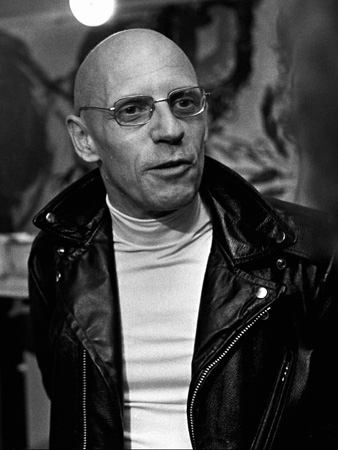
That’s where I was reminded to check out Clare’s actual blog, Refracted Input, which I hadn’t done for ages. This month she is discussing a quote by Foucault about ‘race and colonialism’, and in it I can see a relationship to contemporary discourses around changing technologies.
The term ‘folklore’ is nothing but a hypocrisy of the ‘civilised’ who won’t take part in the game, and who want to hide their refusal to make contact under the mantle of respect for the picturesque…
Man is irrevocably a stranger to dawn. It needed our colonial way of thinking to believe that man could have remained faithful to his beginnings and that there was any place in the world where he could encounter the essence of the ‘primitive’. (trans. Clare O’Farrell)Michel Foucault, (1994) [1963] ‘Veilleur de la nuit des hommes’ In Dits et Ecrits vol. I. Paris: Gallimard, p. 232.
You see, I’ve been worrying about the ethics of what could be seen as meddling with teachers or students who are comfotable in their print-material ways, trying to prod them along to explore new technologies. I have wondered, ‘am I being selfish?’, ‘what if they have it right?’, ‘what if I’m destroying something important?’, and ‘am I wrong to advocate for my view, should I just wait and see what happens instead?’. But then, Clare’s wise words:
One cannot buy into the romanticism of the primitive – which is assumed to be so much closer to pure truth and ‘nature’. Conversely one cannot make the colonial assumption that one civilisation or one period of history (now) is more advanced and more evolved than another.
That’s right. I don’t need to worry about whether I’ll ‘wreck’ anything, unless I’m thinking of the people I’m meddling with as OTHER. And I was using pronouns to construct myself in opposition to other through all those damn self-doubts. I don’t need to do that. FOUCAULT THAT!
*Sigh of relief*
NB: Clare also curates a website on Michel Foucault, which includes a glossary of KEY CONCEPTS and other wonderful gems (thanks Clare!).
…and community…another vital ‘C’!
Posted by kmcg2375 in education, english, reflections, university on April 4, 2011
So if we are to connect, collaborate and create in a way that
fosters social justice
then as well as adding ‘critical literacy’ to the C-list, ought not we also add
community?
The FOUR C’s
Posted by kmcg2375 in education, english, reflections, research, technology, university on March 30, 2011
We edu-tweeters often use the catchphrase ‘connect, collaborate, create’ to signal our pedagogical perspective.
But…what about this really important fourth C:
CRITICAL?
Surely this must become another essential C-word?
Stuff I believe
Posted by kmcg2375 in education, politics, reflections, social media on March 21, 2011
It was interesting to follow the tweets of @BiancaH80 and @durk94 tonight, as they discussed the school funding data available on the MySchool website.
To be honest, in the interests of keeping myself in a positive and generative work state of mind I’ve avoided looking at the new MySchool site at all (and no, I’m not going to hyperlink to it because I don’t think it deserves the traffic). Next week I’m going to have to though, so I can talk about it with my students in class.
ohmmmmmmm…
Even though I now work at a university, which involves striving for curriculum excellence in schools in every sector, I maintain my firm commitment to the social justice agenda of supporting public education.
However, government departments of education tend to be clunky, inefficient, wheel-reinventing institutions. I know, I used to work in one. And if I returned to teaching you’d find me back there.
But while funding and resource benchmarks are a large part of the problem, a widespread lack of willingness to consider radically shifting our models of curriculum ‘delivery’ prevents the construction of a meaningful way forward, in my opinion. The composition of the local student ‘community’ and its relationship to the related local ‘campus’ needs to be significantly rethought.
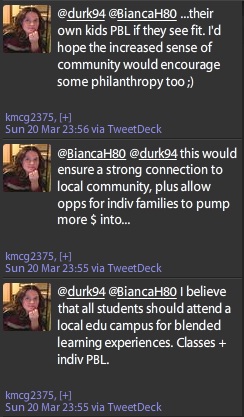
So I’m posting my tweets for tonight up here, just for the record. I’d be interested in hearing other people’s visions for the school campus of the future. Will there still be a distinction between ‘public’ and ‘private’?
I hope not.
Alain de Botton’s University of Twitter
Posted by kmcg2375 in books, education, personal, reflections, social media on March 20, 2011
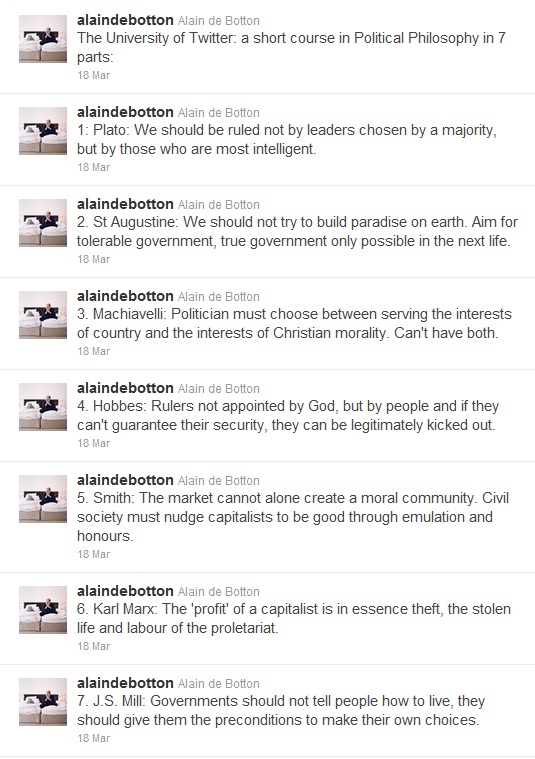
A delightful, insightful and helpful series of tweets on the 18th March from contemporary philosopher Alain de Botton.
I highly recommend his twitter feed, I find something helpful to me every time I visit. If you like that, you may want to check out the DVD or book of his series on Status Anxiety, another favourite of mine.
Brain fry
Posted by kmcg2375 in personal, reflections on January 20, 2011

Ever get that soupy brain kind of feeling?
I usually come to the end of leave (hmmm, telling – I used to call it ‘holidays’) feeling focussed and refreshed. Not always ready to end the holiday mind you, but at least with my head together.
2011 on the other hand has arrived with a distinctly where is my mind vibe.
A few months ago, Darcy left me thinking with a post asking about what we think our individual future holds. It struck me that submitting my PhD and starting an awesome job at QUT looks distinctly like already being in my future. Exciting, of course, but the prospect of now having to be in it and of having to *shudder* set new goals is apparently more daunting than I gave it credit for.
I need a meme or something to solve this problem.
Should we have a safety word that you can use if my posts get too boring/navel-gazey?
2010 in review
Posted by kmcg2375 in online tools, reflections, technology on January 19, 2011
I wonder if the popularity of my top five reflects audience interest in curriculum issues, or the hot-ness of topics such as ‘HSC’ and ‘multimodal’ (due to its appearance in the English National Curriculum)?
Either way, thanks for reading in 2010 😀
The stats helper monkeys at WordPress.com mulled over how this blog did in 2010, and here’s a high level summary of its overall blog health:

The Blog-Health-o-Meter™ reads Wow.
Crunchy numbers
A Boeing 747-400 passenger jet can hold 416 passengers. This blog was viewed about 12,000 times in 2010. That’s about 29 full 747s.
In 2010, there were 71 new posts, growing the total archive of this blog to 181 posts. There were 41 pictures uploaded, taking up a total of 16mb. That’s about 3 pictures per month.
The busiest day of the year was January 24th with 189 views. The most popular post that day was Choice based on what now?.
Where did they come from?
The top referring sites in 2010 were twitter.com, facebook.com, google.com.au, eduleader.org, and Google Reader.
Some visitors came searching, mostly for kelli mcgraw, julia gillard, multimodal text definition, multimodal, and multimodal texts definition.
Attractions in 2010
These are the posts and pages that got the most views in 2010.
Choice based on what now? January 2010
37 comments
Defining ‘multimodal’ May 2010
13 comments
The Australian Curriculum for English March 2010
10 comments
HSC English: Standard or Advanced? March 2010
11 comments
5 reasons why HSC and ATAR scores make the angels cry December 2009
12 comments
-
You are currently browsing the archives for the reflections category.
Nominated!

- Australian English Teachers
 9 members
A group for English teachers in Australia to discuss the books they are reading, and the books th...
Books we've read
View this group on Goodreads »
Share book reviews and ratings with Australian English Teachers, and even join a book club on Goodreads.
 Kelli McGraw
Recent Comments