Archive for category personal
Thesis complete!
Posted by kmcg2375 in personal, reflections, research on August 26, 2010

Today I took my finished PhD thesis to the printer to get bound for examination 😀
This is an awesome, wonderful, terrific day!
Big hugs and love to everyone who supported me in finishing the beast. I could never have done it alone xo
Thesis-ing (final days)
Posted by kmcg2375 in personal, reflections, research on August 24, 2010
I just want to put it out there, for anyone who was wondering:
Writing a PhD thesis is hard.
(like, seriously, fcuking hard.)
I have just 2 days left until I have to take this puppy to get printed and bound for examination.
I feel like my brain is going to explode.
Far out, I’d better turn out to be seriously smart after this!
See you on the dark side of the moon, people xx

Teach. Everywhere.
Posted by kmcg2375 in education, personal, university on July 22, 2010
And so ends my first week of full time University teaching.
Man, how I love teaching.
I mean, I love researching too. But nothing – nothing – beats the buzz that you get from that act of ‘luring people in’ to a new area of knowledge, getting them excited about it, showing them new ways of thinking.
Anyone who says that teaching isn’t an art form is dead wrong. This week, teaching again after about 9 months off, I felt like a rusty ballerina! There were some stumbles, and my fitness is down. But the dance…it’s addictive. And the vulnerability you feel when you do it is part of the buzz.
A big shout out to all the staff and students in the School of Cultural and Language Studies in Education at QUT who have helped me feel so welcome 🙂 You rock!
Jules Rules?
On 24 June 2010, the Hon Julia Gillard MP was sworn in as Prime Minister by the Governor-General, succeeding the Hon Kevin Rudd MP.
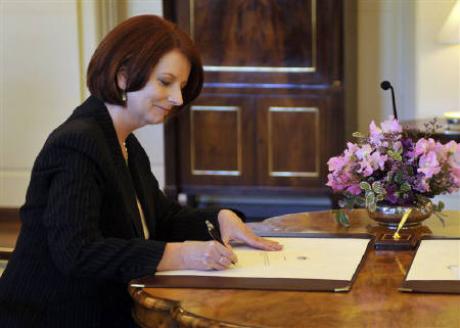
I have been eager to blog about this, but rather than attempt an analysis of the politics that have gone down this week, or of Gillard’s capacity as a leader, I wanted to hear from other young women about how they felt about the event. So, I sent out a message on Facebook to some of my ex-students asking them
as fine young women with the world at your feet, what are your thoughts on having a female Prime Minister?
What follows is a pastiche of my experiences, their thoughts, and my reaction to their thoughts on the promotion of a woman to the highest leadership post in the nation.
Where were you when…
The evening of Wednesday the 23rd was a fascinating time to be part of the Twittersphere as possible, then definite news of the leadership spill was tracked and commented on by everyone who happened to have their ear to the ground. The #spill hashtag was promptly applied, and we all joined the ruckus in what felt like an impromptu election night party!
I was giddy with excitement. A female Prime Minister! And all the talk pointed in one direction – it wasn’t just a challenge for the sake of it, it was a fait accompli.
Having spent the past few weeks staying up into the wee hours to write my thesis, there was little chance I’d be able to wake up at 9am for the leadership spill. So, an all-nighter was on the cards! (On the upside this also meant that I got to watch the Socceroos play their last World Cup match against Serbia live, which normally I cbf doing at all…it was great fun! It also meant that I felt a deep connection with journalists like Annabel Crabb who appeared on tele for news coverage in the morning after pulling all-nighters themselves…)
That’s what she said!
After sending out my Facebook message to the youngens, it became clear that their thoughts were of a certain, less excited flavour. Here’s some extracts from what they said:
It’s great that we have now have a female prime minister but to be brutally honest the fact that she was elected in a back room of the labor party rather than by the people doesn’t sit well with me. It almost gives women in general a message that the only way to get to the top is by going behind others backs and in todays soceity where women are already fighting within their ranks this only reinforces that it’s ok. This leadership doesn’t feel legitimate because we as the people didn’t have our say and in a democratic society thats kinda the main facet.
The belief that Gillard’s election was somehow undemocratic was a common theme:
My opinion is that it really doesn’t count, since she wasn’t democratically elected. Furthermore, I think it is a disgraceful way to become Prime Minister, that is, after backstabbing the former Prime Minister and taking his spot, despite being in the same party and undoubtedly having, if not encouraged, supported every decision he has made throughout his time as PM.
…along with the implications for how women are perceived as political operators:
The fact that she wasn’t elected by the public, I believe, reflects poorly on the fact that she is the FIRST female Prime Minister that wasn’t even elected democratically, which undermines the fact that a woman is finally Prime Minister of Australia; a position acheived through backstabbing and underhanded behaviour. A reflection of the ONLY way women can break through the glass ceiling? I personally don’t believe so.
…but this toughness in politics also received some admiration, and one made the point that the spill wasn’t all Gillard’s doing:
As a person, she has had the determination, dedication, and dare I say balls to get to where she is. She is definitely a strong woman who is going to get to where she is going. As [another respondent] said, she has done away with the societal expectation to be a mother before her career. I really respect that about her. As for the betrayal of Rudd, this wasn’t something that she came up with on her own. There were other people involved in the take-down of Rudd, but she just has to bear the brunt of it all because she is the one that took his job.
Some of the girls just weren’t that moved by Gillard’s election as being a powerful representation of change in gender stereotypes:
I really don’t believe that a female becoming Prime Minister is causing is as big of a deal as it could of been a few years ago. Personally, I’ve grown up surrounded by strong women and seeing women moving into top positions so from the perspective of someone not old enough to vote yet, it’s not that much of a stir.
…and some worried about the possible adverse effect on feminism:
I think that it is a great thing for women that we finally have a female PM, however, will this now mean that any feminist movements will be effectively told to ‘shut up’ because we now have a female leading our country?
…while one made an insightful observation about remaining cultural barriers:
I don’t think it really matters whether she is female or male. They’re all the same to me. Now, if we got a Muslim up there, THAT would be something 😉
But some of the girls did find powerful messages in what Gillard represents for women:
Firstly, ‘Scandal’ of the process of getting Gillard to be PM aside, I think she will do a decent job and wish her every success. It’s not an easy job for anyone to be successful in politics, let alone be PM. It is undeniably harder for a woman to be prime minister. That’s a big thing to say, I realise, as we all obviously believe in equality here. However, i’m making the point that it is harder for a woman to give up other responsibilities, and ‘expectations’ as a woman to become successful in such a career field. Women are ‘expected’ to become mothers and hold onto a career simultaneously. In fact, women are expected to be mothers overall. I’m not saying it’s like the ’50s again or anything drastic, but think about the societal expectation on women to reproduce, nurture, teach and care for children: it does exist ! Gillard has chosen not to have children in order to further her career- a move considered to be very bold and risky (for most). I admire her dedication to her work, and that she does not feel the need to define herself by children, or by expectation. I think by doing this she is breaking the gender expectations…of couse i’m not bashing mothers – I admire their job as well – but non-mothers/archetypal ‘career women’ get bashed about just as much. Good on her 🙂
Surprisingly not many of them had much to say about Gillard specifically, but those who did weren’t positive:
My thoughts are that, when a female prime minister happened, I wanted it to be a female that I could be proud of to represent my gender. However, Julia Gillard is definitely not that person. At all.
…and, like me, specific thoughts turned to Jules’ education policy:
As a politician, she lost my support long ago when she brought in the ‘myschools’ website. This is something that I strongly disagree with. I must admit, I don’t know a great deal else about her policy, but this effects my family and I most of all, and this was enough to turn me against her.
I had a couple of points of information to share in response to the comments I got back from my fantastic female students.
Firstly, the fact that in Australia we don’t vote for the Prime Minister. We vote for an MP in our electorate and the party with the majority of seats wins Government. So, when the Labor party decides they want to change who their leader is, the system is there to support this. Technically you didn’t vote for Rudd, you voted for Labor…and Labor have to do their best to be the best Government they can.
Secondly, having said that, you can’t ignore the fact that people DO cast their vote in their electorate in part (at least) based on their preferred Prime Minister. Up here in QLD, Anna Bligh was the first female Premier – she ‘inherited’ the job after Peter Beattie retired, but when it came around to the next election and she was chosen ‘by the people’ it made all the difference. She became much more credible, and her title as ‘first female Premier’ became more meaningful.
One for the history books?
Ultimately though…my thoughts?
So little of what happens in politics filters down to the public psyche. But people do notice the big things, and the big things matter.
I was fortunate to be in the United States when Barrack Obama was sworn in as President, and the power of that event as a representation of a nation moving beyond the discrimination and segregation of its past was undeniable.
I do think that the intentional, informed election of our first Female Prime Minister at the polls later this year (I believe) will transform this historic occasion into something of equally undeniable significance. But for me, for now, I am moved. Truly moved.
Perhaps it is generational – was I perhaps among the last generation in Australia to feel that women were still being oppressed? The comments from my students suggest this may be the case. Perhaps I am just relieved to no longer carry the burden of my award at my Year 10 formal as “Most likely to become first female Prime Minster”!
But, I cannot help but want to remind everyone of a few milestones that are relatively recent when you consider how long ‘society’ has been doing business, and politics:
- as many people know, women obtained voting rights in Australia in 1901 with the formation of the Commonwealth
- (unless they were Aboriginal, in which case they had to wait until 1967)
- women were not eligible for election to the State parliaments until the end of the First World War – Edith Cowan became the first woman parliamentarian in Australia in 1921
- the first woman to be elected a world leader was Sirimavo Bandaranaike who was elected PM of Ceylon/Sri Lanka in 1960
- we still do not have 50 per cent representation in any part of parliament or local government in Australia
- before the introduction of The Married Women’s Property Act in 1870, women weren’t allowed to own property in their own right, or open a bank account of their own
-
women in the 1960s were routinely asked to have their husband or a male guarantor sign for a loan, even when they were the sole earner
- as recently as 1989, the appointment of a woman general manager was so unusual, that Westpac issued a press release!
When you consider how recently women have been acknowledged, and how slowly women have been accepted as ‘equals’ in our society, the election of Julia Gillard by her Party to the position of Labor leader and Prime Minister is a momentous act.
Three days later I am still buzzing with pride for my country, and for ‘womyn’ everywhere. And with that I’ll sign off with an extract from Ani DiFranco’s spoken word piece ‘Grand Canyon of Light‘:
People, we are standing at ground zero
Of the feminist revolution
Yeah, it was an inside job
Stoic and sly
One we’re supposed to forget
And downplay and deny
But I think the time is nothing
If not nigh
To let the truth out
Coolest f-word ever deserves a fucking shout!
I mean
Why can’t all decent men and women
Call themselves feminists?
Out of respect
For those who fought for this
I mean, look around
We have this.
New job…excited!
Posted by kmcg2375 in personal, university on June 21, 2010
Only ten more sleeps until I begin my new job at Queensland University of Technology!
I’ll be working as a Lecturer in the School of Cultural and Language Studies in Education, which will entail doing some research (not sure what yet, but I have some ideas up my sleeve…) and teaching tutorials for two English Curriculum Studies courses, as well as a general education course in socio-cultural theory.
In honour of my new job, and because I don’t have a web-profile yet, I will share with you my new bio:
Kelli McGraw is a Lecturer in Secondary English Curriculum at the Queensland University of Technology. She has been an English teacher in South Western Sydney and worked in primary and high schools across NSW to develop students’ skills in debating and public speaking. Her work with the English Teachers Association and the Australian Association for the Teaching of English has focussed on issues relating to curriculum and assessment, including providing feedback during the development of the Australian Curriculum for English, and she has recently completed her doctoral thesis on the innovations and challenges observed in the implementation of the 1999 HSC English syllabus for NSW. Kelli’s research interests centre on curriculum change, as well as developing teachers’ capacity to explore multimodality and digital learning tools in the English classroom.
OK, so I haven’t technically “recently completed my doctoral thesis” (only two months to go, hooray!!!) but hey, how soon will I be using the bio? C’mon…
Wish me luck!
Participation
Posted by kmcg2375 in personal, social media on May 25, 2010
Some people like to lurk and learn. Some people like to jump right in.
Either way, respecting people’s perspectives and contexts is key.
As is a reciprocal willingness to learn and adapt.
Personally, I’m a ‘jump right in’ kinda gal. I like to get involved, even if it makes me look a little silly.
Don’t damn me
When I speak a piece of my mind
‘Cause silence isn’t golden
When I’m holding it inside
‘Cause I’ve been where I have been
An I’ve seen what I have seen
I put the pen to the paper
‘Cause it’s all a part of me
Be it a song or casual conversation
To hold my tongue speaks
Of quiet reservations
Your words once heard
They can place you in a faction
My words may disturb
But at least there’s a reaction.
(The only question that remains: what can’t we learn from Guns N’ Roses? hehe.)
I heart bookshops
Today I went for a lovely meander through Borders bookshop. Mmmm…delightful!
There is nothing like the smell of a bookshop, and with the increasing popularity of e-readers, book covers seem more attractive than ever. Publishers seem to not only be ramping up the quality of book cover artwork, but the range in textures is booming: there are books that feel fabric covered, books with pliable canvas-type wrapping, and reprints of classics like Wuthering Heights in black embossed moleskin-like covers, complete with elastic binding strap.
I love paper printed, holdable, page-turnable books.
But…I also love my Kindle.
One one hand this is not a new space to be in. Remember when we all started getting iPods? And getting all worried about the relevance/importance of our CD collections, complaining about how cover art would be lost along with a sense of ‘the album’ as people started buying more singles? It turns out that for me, this hasn’t really been too troubling – I buy most music electronically now, but I do still tend to buy albums rather than singles, and many albums do come with their album artwork, albeit in an electronic file. I don’t at all miss having a bazillion identical (breakable) plastic cases to house my music in, and when someone who I’m a real ‘fan’ of releases an album…well, I do still tend to buy the CD! For a few, I even have bought a vinyl copy.
I wonder how long it will take for self-proclaimed bibliophiles to strike a similar level of comfort with the move to electronic readers?
Are they really that committed to filling vast walls of space in their houses with shelves of dusty once-read (and never-read) books? (my inner cynic says: ‘but how else will they be able to show visitors how terribly well-read they are??)
Or are they just worried that using a Kindle is going to kill the book store? I confess that being in the book store today did make me stop on this particular concern.
But CDs are still around, and books are WAY cooler as objets d’art than CDs ever were. So perhaps it’s time to relax.
Heeey Gecko!

One of the lovely things about the move to Queensland has been the geckos that reside in the area.
They mostly stake out lights on garden walls and house verandahs waiting for delicious insect feasts, but a couple have made it into the house as well:


Usually when they make it into the house I take them back outside. As a kid I often handled common fence skinks in the garden, so these little geckos don’t phase me (spiders are another story entirely). The main reason I take them outside is because I’m worried I will accidentally squash them or something if they stay inside! But yesterday another baby one turned up in the bathroom, and I’ve decided that it can stay.
Reading this forum it looks like droppings can also be a problem if you have lots of geckos, but right now it’s just the one. The forum also has lots of references to the pests and insects that geckos eat, so that is a bonus.
What do you think…to gecko or not to gecko? Does anyone else keep these critters hanging around indoors, or should I take it back outside like I did with the others?
They are said to symbolise regrowth and good luck, but perhaps they can manage these qualities from outside the house 😛
Civilisation and culture
A recent post of Darcy’s got me thinking a bit more about the questions of ‘civilisation’ and ‘culture’, in particular about how these relate to my work as an English teacher.
One aspect of this is that the increase in use of technology has also brought an increase in people’s ability to create and publish their own texts. Notions of the importance of the traditional, western literary canon are being challenged. More and more students are approaching me, asking if I have read/seen/listened to a particular book/film/piece of music, and I am confounded. The 30 students sitting in front of me in the class are exposed to so much in their cultural world, and I have no hope of claiming expertise on such a diverse range of cultural artefacts.
This stands in contrast to some of the notions I had about being ‘cultured enough’ to be a ‘proper English teacher’ before I started university. I recall the summer holidays after year 12 when I found out I had gotten into a Bachelor of Education at Sydney University. I was going to be an English teacher – hooray! But there was also a dark side: now I was going to have to read friggin Lord of the Rings. And so I dutifully did. Later, in university, I also subjected myself to an entire box set of Jane Austen for the same reason – if I was going to be an English teacher, I was going to have to ‘know my stuff’.
Don’t get me wrong – I am glad for pushing myself to extend my reading to the English curriculum ‘canon’. It turned out that I loved Lord of the Rings (my how I had grown since year 9 when I hated The Hobbit with a passion) and reading it opened a whole new world for me, whetting my appetite for the entire Fantasy genre. A couple of the Austen’s were OK too – though Emma did become the first book that I ever didn’t finish (I’m a staunch book finisher) I was glad to discover that I didn’t care for pre-20th century stories about genteel English living, no matter how satirical they were intended to be. So, reading Austen taught me not to fear the canon, and not to feel inadequate in it’s shadow.
Now, this post is meandering a little, but bear with me…
The extracts that Darcy posted from Kenneth Clark‘s television series Civilisation included a few ideas that I found very useful for reflecting on my own growing understanding of the relationship between society and culture. In particular I noted these down:
Great works of art can be produced in barbarous societies – in fact, the very narrowness of primitive society gives their ornamental art a peculiar concentration and vitality.
Well, I certainly wouldn’t say that England in the 1800s was primitive! But could it be that people become besotted by this period of Literature because of its narrowness, because it is define-able and knowable? Because its concentration lends it a vitality that is found wanting in contemporary culture which is so diverse and dispersed? Is this also what makes Shakespeare so attractive?
We are not entering a new period of barbarism. The things that made the dark ages so dark [were] the isolation, the lack of mobility, the lack of curiosity, the hopelessness…
This is an astute observation, and one that could perhaps quell any fears that people may have about technology, postmodernism, cultural relativism or whatever [insert social ill of choice here] posing a threat to civilisation and culture. We live in a world that is more connected than ever before, and the growth in cultural production is surely an expression of our curiosity and willingness to engage with the world. This doesn’t mean we should hate the traditional canon. However…
One mustn’t overrate the culture of what used to be called ‘top people’ before the wars. They had charming manners, but they were as ignorant as swans…the members of a music group or an art group at a provincial university [today] would be ten times better informed, and more alert.
Now Clark is really speaking my language. Because, as I discovered when I made myself read explicitly canonical texts, I’m not the canon hater that I thought I was as a teenager. On the contrary, even though I didn’t enjoy reading Austen, I found great value and pleasure in developing my knowledge of the way texts that had been deemed ‘the best’ influenced culture that superseded it. And, as with Shakespeare, I now delight in researching and thinking about how texts reflect their social and political context (this makes me an excellent teacher of Advanced HSC Module B Critical study, in my very humble opinion).
The contribution I would like to make to this assemblage of interesting texts about civilisation is Alain de Botton’s book and documentary film about Status Anxiety. Here is the introduction to the documentary:
de Botton argues that increases in living standards have not increased our levels of happiness, due to our anxiety about our social status. To return to one last observation from Clark:
The children of [our] imagination are also the expressions of an ideal.
I believe that the current boom in the production of cultural artefacts expresses an ideal that can lead us away from status anxiety – where something like the literary canon is valued, but is knowledge of it is not misused as a demarcation of status. With a wider range of cultural expression being valued, our fears about being outed as ‘not knowing everything’ fade away as people recognise the impossibility, and folly, of this desire. I also am hopeful that our increasing tendency to engage with culture as produsers reflects a growth in ideals such as respect for diversity in creative expression and authentic engagement with community.
Of course, there is another angle that we could engage in here – there is a famous quote that I can’t remember, something about civilisation being measured by how well we look after the poor…if you made it to the end of this post 😉 and you know the one I mean, can you add it as a comment? In this vein I encourage readers to revisit a song from 1992 (a golden year for music!) where Mr Wendal serves as an example of the plight of the homeless:
Civilization, are we really civilized? Yes or no ?
Who are we to judge ?
When thousands of innocent men could be brutally enslaved
and killed over a racist grudge.Mr.Wendal has tried to warn us about our ways
but we don’t hear him talk…
…but that is food for a whole different post.
Tell me about it.
This is spot on. The Alice quote tops it off beautifully:
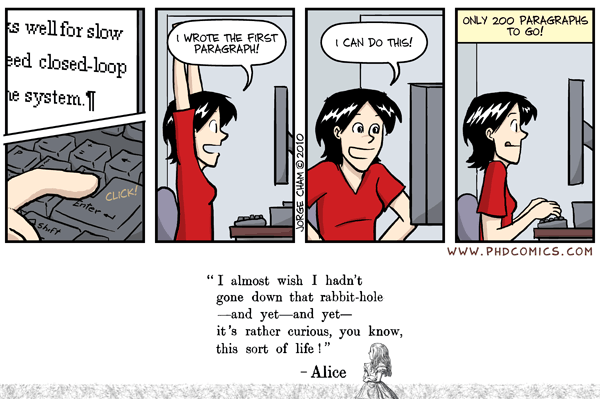
Link to PhD comics website (loving their work since two thousand and…let’s not go there)
-
You are currently browsing the archives for the personal category.
Nominated!

- Australian English Teachers
 9 members
A group for English teachers in Australia to discuss the books they are reading, and the books th...
Books we've read
View this group on Goodreads »
Share book reviews and ratings with Australian English Teachers, and even join a book club on Goodreads.
 Kelli McGraw

Recent Comments