Archive for category personal
National Day of Action for Public Education
There’s a lot at stake over the next few months in the countdown to the Gonski panel’s final advice on schools funding. That advice, and the Government’s response, could determine the long-term future of schooling across Australia and, in particular, the nature and quality of public schooling in this country. (J.F. McMorrow ‘Real Reform in Schools Funding’ paper Sept. 2011)
A wealth of material is available to learn more about the Gonski review into schools funding, including the paper quoted above. The review is due for release in December, and while the (one month!) period for submitting formal responses has closed, there is one last opportunity to have a say on the issue of schools funding.
I have written before about the Gonski Review, but am sorry to admit that I did not enter a submission when they were called for earlier in the year.
As luck would have it, however, the Australian Education Union has organised a special website for people like me (and maybe you) to lodge their view:
http://www.forourfuture.org.au/
It’s quick and easy to show your support for Public Education in Australia by signing the petition on the site. If you want to do more, you can join as a supporter to “tell us why investing more in public schools is so important”. Whichever you choose, you should do this TOMORROW, Tuesday 16th November, the National Day of Action for Public Education:
There has been very little public conversation about this issue in my circles – as Darcy Moore pointed out to Stephen Downes in October. I fear that many teachers that are passionate about Public Education are weary from years of arguing about equity, only to see nothing change. The approach of telling people how unfair things are just hasn’t worked so far. Explaining how big the funding gap really is hasn’t worked so far. Arguing that diverse student populations produce better educational outcomes than homogenous ones hasn’t worked so far. The idea that parents should be ‘free to choose’ is too appealing, and sounds too much like ‘common sense’. But, for those inclined to look beyond their own backyard, and to the society at large, it is clear to see the devastating impact that ‘school choice’ has had on the wider community. While we continue the charade of ‘meritocracy’, the current schools funding model has continued to deliver a system in which learning facilities and access to knowledge and social status can be bought by those with means. When that is the case, it’s hard not to enter the discourse of class wars, don’t you think?
This is not just about class wars, however. A summary of public views put forward collected by the Australian College of Educators observes that “Australia’s approach of providing funding as an entitlement to the independent sector is not the standard approach of most OECD countries”. And yet, this question of measuring Australia’s financial commitment to education against other OECD nations was seen to be largely absent from public debate.
As for me, I support a substantial increase in funding to public schools, and a narrowing of the resource gap between public and independent sectors. I do not support policies that position families with means as being entitled to more educational choice than others. Tonight I will be adding my voice to the For our Future website, and wishing for a future where the support, learning and success of all students is priority number one for politicians and citizens alike.
I hope you will join me.
PhD COMPLETE!
Posted by kmcg2375 in personal, reflections, research on October 27, 2011
Ah, the sweet sound of completion…
You are now reading the blog of someone who has completed their PhD thesis – as well as someone who has waited for examiner’s results, completed the required emendations, and had those emendations accepted!
Next stop: GRADUATION!
Because it’s not polite to ask someone how long they have taken to complete, it’s not something that gets talked about a lot. I started mine in 2003, which means that despite many deferred and part-time enrolled semesters, I’ve essentially been a research student for just over eight years.
Yes, you’re supposed to complete within four years. And everyone who signs up for one of these damned things thinks they’ll be able to make it…but not everyone does. In fact, only about 40% of students really reach that goal. There are a lot of factors that influence this: the nature of the candidate, candidature, discipline and institution all come into play. My story was one of running out of money after a few years and not having had enough done by then to carry me through the tough times that followed.
TIP: Full time teaching is NOT conducive to timely completion of a research degree. Well, it wasn’t for me, anyway!
So, in the end, was it worth it?
If it really was such a slog, and the research indicates that my experience is not that unique, would I do it again?
Yes. Yes, I would.
In the end, it is really clear that writing a thesis (a PhD dissertation is generally 80,000 – 100,000 words long) is the ultimate ‘research apprenticeship’. You learn (sometimes the hard way) to manage your time, to overcome writer’s block, to situate yourself within a field of expertise, and to write for an academic audience. You learn to be rigorous in your chosen research methods, and you learn how to discern the quality of others’ work. You learn to cast off doubt about using your own voice, for better or worse.
You also end up with a major piece of research that you can stand by, and put forward as your own – this becomes part of your currency in the academic world.
There were times when I thought I wouldn’t last the distance…without the support of my friends and family, I’m not sure if I would have. There were times when I was so far in ‘the cave’ that I was sure everyone I knew had given up on me ever coming out again! But they were very nice about that, and patient, and kind, and that made all the difference.
So, THANK YOU! Especially to people who read this blog and keep in contact with me online through Twitter and Facebook and the rest. The process of public reflection, knowing that people would notice if I gave up, was something that always helped to keep me motivated. That, and the idea of writing this very post to tell you all that I am FINALLY DONE.
x Kelli

Did you just realise you don’t know what the Gonski Review is?
NEVER FEAR! YOU CAN STILL SUBMIT A RESPONSE (until 30 September 2011)
Catch up on the story so far – the Gonski schools funding review has been through all of the boring phases, and we are now in the throws of watching various stakeholders campaign during these LAST CHANCE weeks for submission of public responses to the review.
Angelo Gavrielatos provides an excellent summary (from the AEU perspective) here:
And if, like me, you find it hard to find any information about how to submit a response online (funny that…) here is the link to the page you need:
http://www.deewr.gov.au/Schooling/ReviewofFunding/Pages/PaperCommissionedResearch.aspx
The panel invited submissions on the issues reflected in the Emerging Issues Paper between
16 December 2010 and 31 March 2011. This submission process has now closed.A Paper on Commissioned Research will also be released on 31 August 2011, along with four research reports. Submissions will be accepted until 30 September 2011.
Please note that all public submissions to the review panel will close on 30 September 2011.
The panel will release further details of its work through panel communiqués as the review progresses. Register online to have announcements and communiqués sent to you by email.
REVISION
ONTONOLGY
ASCETICS
DEONTONOLGY
TELEOLOGY
Revise.
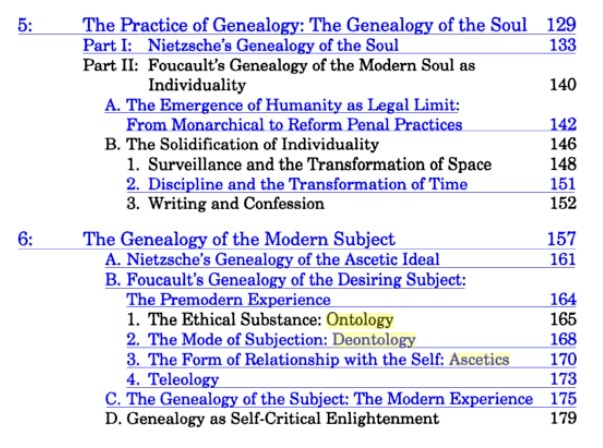
Foucault's Nietzschean genealogy: truth, power, and the subject By Michael Mahon
and…Heidegger paraphrashed: It is not that we first begin from an inner subjective sphere (a la Descartes) and from there go out to meet things in the world; rather, we are always already ‘outside’ among things. (Kisner, W. 2008: ‘The Fourfold Revisited’)
Sheesh. Philosophy. Any ideas anyone?
Use #etaq21c to ask me things tomorrow!
Posted by kmcg2375 in conferences, education, english, learning community, online tools, personal, social media, technology on August 19, 2011
More specifically, use #etaq21c to ask me questions about Digital Literacy and electronic text practices in English curriculum. The conference theme says it all: “English and Generation Next”
ETAQ’s Annual State Conference will be held atLourdes Hill College on Saturday 20 August. The theme is “English and Generation Next”.
The program will feature a keynote address by Professor Peter Holbrook from the University of Queensland’s School of English, Media Studies and Art History, a Q & A style panel session [that’s where I’m presenting!!], and a range of supporting workshops. Professor Holbrook’s address is entitled “Literature, Literacy, the Imagination, Freedom”.
So, if you are an English teacher, or if you are interested in digital texts and the future of the book, please, shoot some questions our way! You can post them here as a comment, but if you use Twitter then posting a comment or question there with the hashtag #etaq21c would Really Make My Day 🙂
I am soooo looking forward to this panel presentation! The full list of people in the panel session are:
- Professor Catherine Beavis (Griffith University and ETAQ Patron)
- Professor Peter Holbrook (University of Queensland)
- Kelli McGraw (Lecturer, QUT)
- Janina Drazek (Executive Director, Teaching and Learning, Education Queensland)
I’ll be talking about ‘acts of reading and writing’ and ‘digital pedagogy’.
Global Poetry Project
Posted by kmcg2375 in education, english, learning community, online tools, personal, social media on May 13, 2011
This tweet came across the screen tonight and I just thought: YES.

Now I’ve joined the Global Poetry Project Ning. I figured tonight was as good a time as any to post a poem in a new place and this one promises ‘a space for members to expand upon their cultural views through the writing and reading of poetry’.
I penned this poem last week. I’ve been reading The Hunger Games by Suzanne Collins and that’s where the title and some of the inspiration came from.

The project aims to provide “a safe and open atmosphere for all visitors and contributors alike” and has many student contributers. So if sharing your poems and reading the work of others in a supportive environment appeals to you, why not consider joining the project, friending me and adding a poem of your own!
Say Cheese

Does anyone else look at this picture and mostly see material for Lie To Me?
Learning Styles Don’t Exist
Posted by kmcg2375 in education, online tools, personal, university on April 8, 2011
I came to this interesting video via Tom Whitby on The Educator’s PLN, explaining the theory of learning styles and the relationship (or lack thereof) it has to helping students to learn something new.
I certainly remember doing quizes in class at high school and talking with teachers about my learning style score. I couldn’t remember what I was supposed to be though – I guessed language and visual based – so I went and did some online tests to find out. Here are my results for tests of Visual/Audio/Kinesthetic (VAK) style preferences:
From the University of South Dakota (2009):
you answered A-6 B-5 C-5
based on this info you are probably
a Visual
learner.
From Businessballs.com (learning and development resources) – simple test:
Visual = 9
Auditory = 3
Kinesthetic/Tactile = 1
Interestingly, taking the Gardener’s Multiple Intelligences quiz (again from Businessballs.com) I didn’t score so high on the ‘visual’, which I suspect may be conceived differently than in the VAK model:
| Intelligence type | your totals |
| Linguistic | 35 |
| Logical-Mathematical | 25 |
| Musical | 32 |
| Bodily-Kinesthetic | 24 |
| Spatial-Visual | 29 |
| Interpersonal | 34 |
| Intrapersonal | 31 |
So, I went back to searching for VAK learning style tests.
This one didn’t peg me as a visual learner. It also gave me some fancy numbers about how my scores matched up to the mean profiles for each style:
- Visual = 3 (correlations with mean profiles = -0.07)
Auditory = 6 (correlations with mean profiles = 0.56)
- Kinesthetic = 1 (correlations with mean profiles = -0.54)
Weird.
I suppose I should be less surprised then that I have ended up an English teacher that highly values multimodality 😛
Though, I never have put too much stock in quick, fr3e online quizes…
I’m going to show my class the You Tube clip next week. We’re about to talk about differentiation and I know that learning styles comes up every time!
Alain de Botton’s University of Twitter
Posted by kmcg2375 in books, education, personal, reflections, social media on March 20, 2011
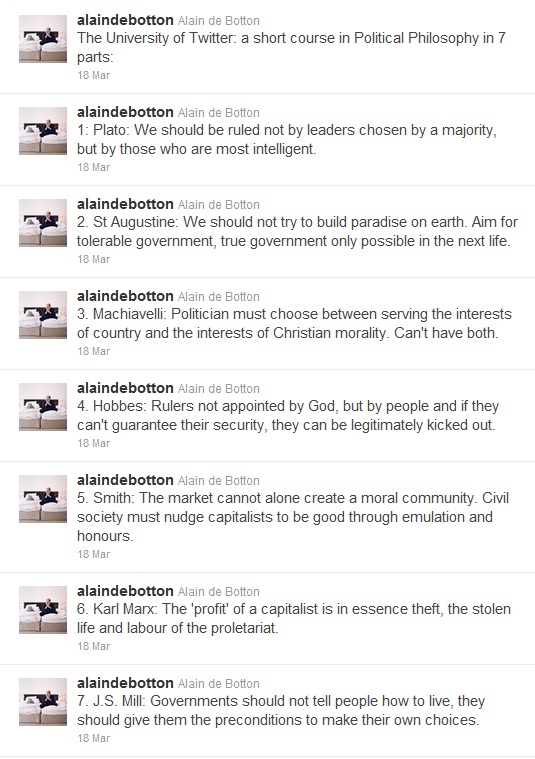
A delightful, insightful and helpful series of tweets on the 18th March from contemporary philosopher Alain de Botton.
I highly recommend his twitter feed, I find something helpful to me every time I visit. If you like that, you may want to check out the DVD or book of his series on Status Anxiety, another favourite of mine.
don’t put me in a box, man
Posted by kmcg2375 in education, personal, university on March 15, 2011
In honour of my wonderful students in English Curriculum Studies 1 who I suspect this week are getting a leeettle fed up with a seemingly endless web of theoretical models for curriculum and pedagogy.
But don’t worry, as Charlie would say, we are “winning“!
Peace!
Howard: Well, you know. About, me. I’m a free spirit, Vince.
Vince: Yeah?
Howard: Yeah I can’t be hemmed in. People try. They try to put me in a box, but I break free.
Vince: Who’s trying to put you in a box?
Howard: It’s the nature of me. It’s the nature of Howard Moon.
Vince: Who’s trying to put you in a box?
Howard: Well, people, you know. The Man.
Vince: Have you contacted the police about this?
Howard: No, “The Man”. You know what I’m talking about, yeah?
Vince: What are you on about?
Howard: People are always trying to put people in boxes.
Vince: No one’s trying to put you in a box. You’re the wrong size, for a start.
Howard: [sighing] Let’s forget about this conversation, okay?
Vince: How would you even get in a box?The Mighty Boosh, Series 1 Episode 8 ‘The Hitcher’
-
You are currently browsing the archives for the personal category.
Nominated!

- Australian English Teachers
 9 members
A group for English teachers in Australia to discuss the books they are reading, and the books th...
Books we've read
View this group on Goodreads »
Share book reviews and ratings with Australian English Teachers, and even join a book club on Goodreads.
 Kelli McGraw
Recent Comments