Archive for category learning community
Quick and dirty Eddies
Posted by kmcg2375 in education, learning community, online tools on December 2, 2011
Very conscious that the Edublog Award nominations are closing tonight, but stuck in a hotel with no WiFi and slighly tempremental devices…
Still, my moby is playing nice enough to let me post these – my three best favourite blogs, and a free tool that should be getting more Edu-love, imo:
Best School Administrator blog
Darcy Moore’s Blog
http://darcymoore.net/
Darcy continually puts forward ideas and resources that are either immediately of interest to me, or make their way into my orbit months (or years) later. Progressive, responsive and visionary Darcy – I’m sure i won’t be the only blogger to nominate him 🙂
Best teacher blog
Bianca Hewes
http://biancahewes.wordpress.com/
For her edupunk ethos, and her uber reflective practice, Bianca always gets my vote. Now she’s started an MEd. in edu research, making this a hot blog to watch for all things Project-based.
PBL ftw!
Best individual blog
Dean Groom
http://deangroom.wordpress.com/
Dean is doing some really sexy Games-based learning work. He shares on his blog, among other things, his powerful use of Minecraft to connect kids AND their parentals to meaningful and fun learning online. His posts always give me something to think about – sometimes to disagree with – and his generosity with knowledge and resources is an important factor in the growth of interst in GBL in Sydney and beyond.
Best free web tool
Polyvore
http://www.polyvore.com/#
At first glance this looks like a fashion website. But dig past the front page and you’ll discover a collage making tool with a vibrant community of users and a rich collection of ‘sets’ covering a wide range of highly creative art, literature and even interior design sets. Easy to use, highly addictive, 100% recommendable (as long as you can forgive the fashionista links to retail items…which any good critical user should be able to manage 😉 )
Now, off to submit my post link. I hope I made it in time!
Thank-you to every blogger i have read this year. While i was finishing my thesis I did fall a little out of the loop; i hope to be a better reader, and commenter, in 2012.
Good luck to my peeps, and may the odds be ever in your favour!
Mastery, risk-taking and play
Posted by kmcg2375 in education, learning community, research, video games on November 29, 2011
This post is a culmination of a week or so of talking about play-based education. If that’s its official term for it? I don’t know. I must declare my rookie status in this field, which means you should feel really free to jump into the comment s section below and school me on what I’ve missed!
Thanks to @malynmawby, @vormamim, @biancah80, and @benpaddlejones for their ideas via twitter and email. You can read more about @malynmawby ‘s experiences with play-based learning here, here and here.
Play-based Learning: Another PBL?
My current interest in project-based learning has also put me in contact with the terms challenge-based learning and problem-based learning.
Despite these terms being used fairly liberally (along with inquiry-based learning), I don’t seem to often come across material that explores the differences or similarities between these terms. I mean, I’m sure we could all take guesses about it, based on what we know about the words chosen; what is a project? what is a challenge? a problem? an inquiry?
Well, while you’re pondering it all, here is some more information to add to the learning theory soup.
States of Play
An overview of the elements of play presented by the National Institute for Play (based in California) outlines seven “patterns of play”:
- attunement play
- body play and movement
- object play
- social play (including ‘rough and tumble’ play and ‘celabratory’ play)
- imaginative and pretend play
- storytelling-narrative play
- transformative-integrative and creative play
And here is a really excellent TED Talk by Stewart Brown, who argues the physiological importance of play:
After listening to Stewart’s TED talk, the idea that I keep coming back to is this:
If the purpose is more important than the act of doing it, it’s probably not play. (Stewart Brown, TED Talk 2008, at ~6 mins)
Which begs the question: by trying to pin down a definition of ‘play-based learning’ to use in my curriculum theorising, am I contributing to WRECKING IT?
Play in the curriculum
In my quest for answers I came across some interesting material relating to motivation and mastery.
This puts me back into territory that is a little bit psych-y, and I know such approaches don’t always sit well with post-structuralist curriculum types like myself. But I resist that 😉
Writer and researcher Katherine Cushman lead a Practice Project for the non-profit group ‘What Kids Can Do’ (http://firesinthemind.org/about/) asking the question ‘what do kids already know about and do well?’.
When adults openly explore our genuine questions about getting to mastery—and include young people’s knowledge and experiences in that exploration—we model the expert’s habit of taking intellectual and creative risks. We demonstrate that we, too, always have things we need to understand better, and things we need to practice. We teach kids to approach any lack of understanding as a puzzle: stretching the limits of their competence, continually testing new possibilities and seeing how they work out. As they expand their knowledge and skills, young people, like us, will discover even more challenging puzzles they want to tackle—not just outside school, but as part of it. (K. Cushman, Fires in the Mind p.10)
In light of this, play strikes me as a form of ‘intellectual and creative risk taking’, essential to building the habits of mind and the resilience needed to seek out and tackle new puzzles.
Who is playing?
Concepts about transformative play have been utilised by the Quest Atlantis project, and a lot of my Tweeps are currently going bananas for Minecraft. These are rich sites and communities tapping into discourses about educational play.
However, I rarely hear any critical views about play or games, and I guess that’s what makes me itch to interrogate this field.
The reflexive dilemma
Listening to a talk by Julian Sefton-Green during his recent visit to QUT, I was conscious of the points he made about the field of ‘out of school learning’, which often involves elements of play.
His research has found distinctions between school and out-of-school learning tended to set up binaries that actually maintained the boundaries around ‘official’ curriculum, and other project and play based activities happening outside of schools (the binary of formal and non-formal learning, for example). His review of the literature showed how debate about not-school environments in the UK is often bound up with techno-utopianism and generalisations about the public school system.
In relation to this, he poses the ‘reflexive dilemma’ that we face in thinking about all of this. That is, the more we reflect on learning experiences, the more we formalise them. In our quest to ‘optimise’ all learning experiences, the learning is more carefully arranged and disciplined.
Which brings me right back to that TED talk – by naming ‘play based learning’ and trying to give play an official role in curriculum, do we run the risk of ruining play? Will the act of ‘doing play’ become just another ‘strategy’ for learning?
In short, how can we develop play as a habit of the mind without over thinking it and taking the fun out of the act of play? And, will defining the difference between all of the different PBLs etc help us in this endeavor, or just get in the way by drawing boundaries that don’t need to be there?

A transformative digital literacies pedagogy: Thomas (2011)
Posted by kmcg2375 in education, learning community, Lit_Review, online tools, research, social media, technology, university on November 17, 2011
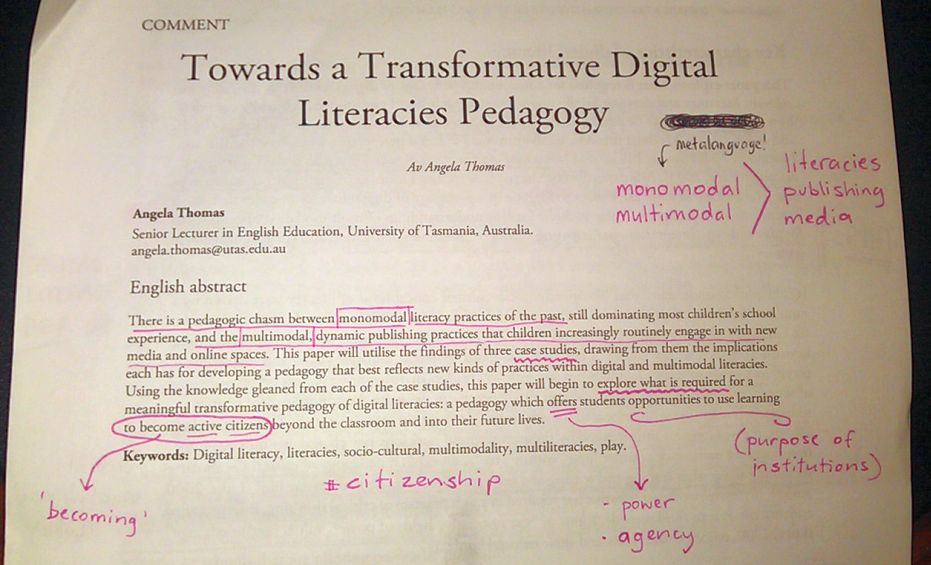
Thanks to @malynmawby @benpaddlejones and @Vormamim for engaging in tweety-chat today about play-based learning and transformational play.
There was an article that I wanted to post the full reference to – this one by Angela Thomas (@anyaixchel)
Thomas, A. (2011) Towards a transformational digital literacies pedagogy. Nordic Journal of Digital Literacy. Vol. 6 pp. 89-101
You can see the abstract for the paper with my own annotations, above.
In it she argues that there are:
a number of significant characteristics of digital literacy that are imperative to include in a pedagogy of digital literacy in order to make it a transformational pedagogy. These include: explicit understandings of multimodality, opportunities for play and experimentation, participating within communities of practice, and critical engagement with text.
I had picked this article up to read Angela’s findings about digital pedagogy, but it was a timely read. I am a big fan of the work of Paulo Freire, and of his work to empower communities through literacy. By bringing in Freire’s notion of ‘transformative pedagogies’ this article reaffirmed the need for critical, participatory and dialogic practices to be woven into the digital learning landscape.
I’d love to hear of other readings and resources along these lines, if you know of any…?
Next Stop: AERA! and AARE, and AATE…
Posted by kmcg2375 in conferences, education, english, learning community, research, university on October 31, 2011
When you have a research paper to present, choosing the right conference to take it to is important.
I have long been affiliated with the Australian Association for Research in Education (AARE). When I first started out as a postgrad student, I used to go to their conferences to present papers, and I even was elected as student rep. to the Executive Committee. I also had one of those awful experiences of being a small fish in a giant pond, and having only three people turn up for me to deliver my paper to. Devo’d…In the end I ultimately stopped being involved in AARE because I needed to narrow my focus and concentrate on English curriculum teaching and scholarship.
Since then I’ve been going to the annual conference of the Australian Association for Teachers of English (AATE) – every year since 2004! And this year is no exception – I’ll be in Melbourne for the AATE conference in December (will you?). Only, for the first time in awhile, I’ll be heading to the AARE conference too, in Hobart the week before. With more skills in networking under my belt, and a clearer direction for engaging with the ‘special interest groups’, I’m feeling really positive about reconnecting with AARE and sharing my PhD findings there.
For me though, as far as big, generalist conferences go, AARE was always plenty big enough – and having developed an instinct to narrow my scope rather than broaden it, I didn’t think I would ever attend the EVEN BIGGER, EVEN BROADER, international ‘annual meeting’ of the American Educational Research Association (AERA)…
But, attend it I am!
Both the paper and group session I submitted have been accepted to AERA 2012, which will be held in Vancouver in April next year:
Curriculum Change and Resistance: Challenges Identified During the Implementation of An Expansive State English Curriculum.
This paper presents the findings of a doctoral study that undertook a content analysis of a corpus of curriculum texts, news reports and case interviews with teachers during a period of curriculum change in the Australian state of New South Wales.
Producing the young citizen in texts of families, neighbourhoods and nations
This session critically analyses popular fiction, nonfiction and television texts for children and young people focusing on sexuality, sexual safety, bullying and heroism. Each of the selected texts can be understood as a pedagogical apparatus that works to instantiate children and young people as particular subjects and objects of knowledge. (with Gannon, Lampert, Bethune and Gonick)
So, let’s count ’em up: AATE and AARE in December; I already went to ALEA and IFTE earlier in the year; AERA in 2012.
That’s FIVE amazing conferences in 12 months!
And one BUSY girl 
Totally worth it 🙂
(By the way…’what’s with all the four letter acronyms starting with A’, I hear you ask? Tell me about it! Took the first year of my research degree to decipher this shiz! And the kind of ugly websites of AERA and AARE…you can tell all of their energy goes into research!)
EXCURSION!
Posted by kmcg2375 in education, english, learning community, university on August 22, 2011
I’m planning my first University excursion 😀
With my small class of six students studying their Grad. Dip. in Education (secondary English), I will be heading into Brisbane city to attend events that are part of the Global Poetics Tour:

Slam poets Jive, Ken and Mahogany will be slamming into Brisbane for the Australian Poetry Slam competition, which has its second Brisbane Heat on Friday 9th September. I think that’s the event we’ll be going to…although the Sunday event also looks pretty appealing: Black Star Tribute ‘Words or Whatever’ at the Black Star Cafe in West End.
I wonder what event my students will choose for the excursion – we make the selection in tomorrow’s tutorial!

Use #etaq21c to ask me things tomorrow!
Posted by kmcg2375 in conferences, education, english, learning community, online tools, personal, social media, technology on August 19, 2011
More specifically, use #etaq21c to ask me questions about Digital Literacy and electronic text practices in English curriculum. The conference theme says it all: “English and Generation Next”
ETAQ’s Annual State Conference will be held atLourdes Hill College on Saturday 20 August. The theme is “English and Generation Next”.
The program will feature a keynote address by Professor Peter Holbrook from the University of Queensland’s School of English, Media Studies and Art History, a Q & A style panel session [that’s where I’m presenting!!], and a range of supporting workshops. Professor Holbrook’s address is entitled “Literature, Literacy, the Imagination, Freedom”.
So, if you are an English teacher, or if you are interested in digital texts and the future of the book, please, shoot some questions our way! You can post them here as a comment, but if you use Twitter then posting a comment or question there with the hashtag #etaq21c would Really Make My Day 🙂
I am soooo looking forward to this panel presentation! The full list of people in the panel session are:
- Professor Catherine Beavis (Griffith University and ETAQ Patron)
- Professor Peter Holbrook (University of Queensland)
- Kelli McGraw (Lecturer, QUT)
- Janina Drazek (Executive Director, Teaching and Learning, Education Queensland)
I’ll be talking about ‘acts of reading and writing’ and ‘digital pedagogy’.
JOLT: Balancing Quality and Workload in Asynchronous Online Discussions
Posted by kmcg2375 in education, learning community, Lit_Review, online tools, research, social media, technology, university on August 17, 2011
Of interest to teachers struggling to keep up with online discussions with their students!
Goldman, Zvi (2011) ‘Balancing Quality and Workload in Asynchronous Online Discussions: A Win-Win Approach for Students and Instructors’. Journal of Online Learning and Teaching. 7:2 pp.313-323
ABSTRACT: The challenge addressed in this article is how to achieve a win-win balance between quality and workload for students and instructors participating in asynchronous online discussions. A Discussion Guideline document including minimum requirements and best practices was developed to address this need. The approach covers three phases: design and development, setting up expectations, and launch and management. The goals of the approach, based on a commitment shared by all full time and adjunct faculty, are high quality of education as well as retention of both students and qualified instructors.
Further explanation of the research challenge from the introduction: “When discussions are regarded as critical components of learning, and administered as such, they impose a significant workload on both students and instructors. In applicable programs targeting practitioner adults, discussion sessions, during which much of the evidence-based learning and experience sharing occur, can easily consume half the course workload (Goldman, 2010). The reality is that neither students nor instructors can afford to dedicate an unlimited amount of time to fulfill course requirements or teach a course. Therefore, as a matter of practicality, discussion sessions should be carefully implemented to balance pedagogic quality and workload for students and instructors alike.”
Foucault THAT.
Posted by kmcg2375 in books, education, english, learning community, Lit_Review, online tools, politics, reflections, research, social media, technology, university on July 28, 2011
I have a confession to make.
Lately, I’ve been cheating on my blog. (In a good way, I promise!)
A colleague at my university, Clare O’Farrell, has an established Ning that is home to members of the Poststructuralist Theory ‘Special Interest Group’ of AARE. Established it so well, in fact, that it is one of the few Nings I know of (along with the English Companion) that continued to have happy users after stupid-Ning made its stupid-serivce un-free. Hmph.
Anyway, I use my space and profile on the ‘Ed Theory Ning’ to brain-vomit about (on?) theory that I don’t understand yet.
And it’s proven #very illuminating.
Increasing my activity in various groups on the Ning has also proven fruitful. Particularly in the ‘Daily Writing Club’ (we have to do exactly as it says…!) and now also from browsing the ‘Foucault reading group’.
That’s where I was reminded to check out Clare’s actual blog, Refracted Input, which I hadn’t done for ages. This month she is discussing a quote by Foucault about ‘race and colonialism’, and in it I can see a relationship to contemporary discourses around changing technologies.
The term ‘folklore’ is nothing but a hypocrisy of the ‘civilised’ who won’t take part in the game, and who want to hide their refusal to make contact under the mantle of respect for the picturesque…
Man is irrevocably a stranger to dawn. It needed our colonial way of thinking to believe that man could have remained faithful to his beginnings and that there was any place in the world where he could encounter the essence of the ‘primitive’. (trans. Clare O’Farrell)Michel Foucault, (1994) [1963] ‘Veilleur de la nuit des hommes’ In Dits et Ecrits vol. I. Paris: Gallimard, p. 232.

You see, I’ve been worrying about the ethics of what could be seen as meddling with teachers or students who are comfotable in their print-material ways, trying to prod them along to explore new technologies. I have wondered, ‘am I being selfish?’, ‘what if they have it right?’, ‘what if I’m destroying something important?’, and ‘am I wrong to advocate for my view, should I just wait and see what happens instead?’. But then, Clare’s wise words:
One cannot buy into the romanticism of the primitive – which is assumed to be so much closer to pure truth and ‘nature’. Conversely one cannot make the colonial assumption that one civilisation or one period of history (now) is more advanced and more evolved than another.
That’s right. I don’t need to worry about whether I’ll ‘wreck’ anything, unless I’m thinking of the people I’m meddling with as OTHER. And I was using pronouns to construct myself in opposition to other through all those damn self-doubts. I don’t need to do that. FOUCAULT THAT!
*Sigh of relief*
NB: Clare also curates a website on Michel Foucault, which includes a glossary of KEY CONCEPTS and other wonderful gems (thanks Clare!).
Google+ by Molly Rocketboom
Posted by kmcg2375 in education, learning community, online tools, social media, technology on July 26, 2011
If you’re still not sure how Google+ fits into your existing world of Facebook and/or Twitter, let Molly of Rocketboom break it down for you. Approx 4.5 mins:
ETA mailout showdown and dates of state conferences
Posted by kmcg2375 in conferences, education, english, learning community on July 23, 2011
Living in Brisbane but being from Sydney, I am a member of both the NSW English Teachers Association and the English Teachers’ Association of Queensland.
The holiday break and a fresh term starting has brought mailouts from both associations my way.
This is a show-and-tell of what was in the respective packs.
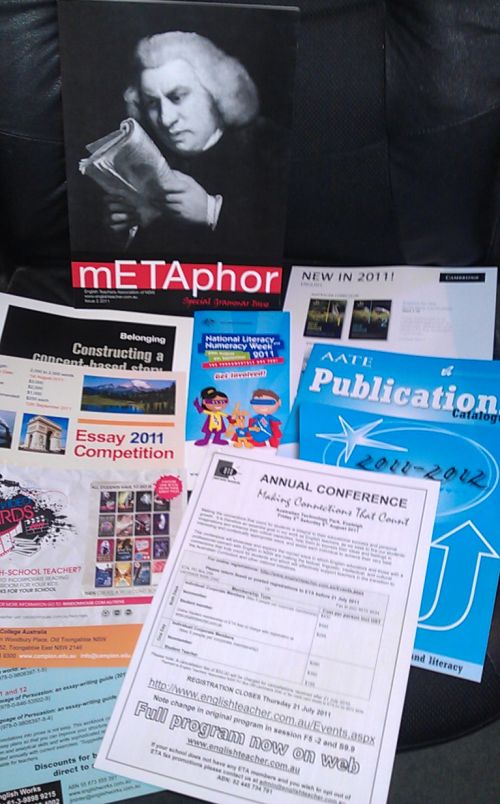
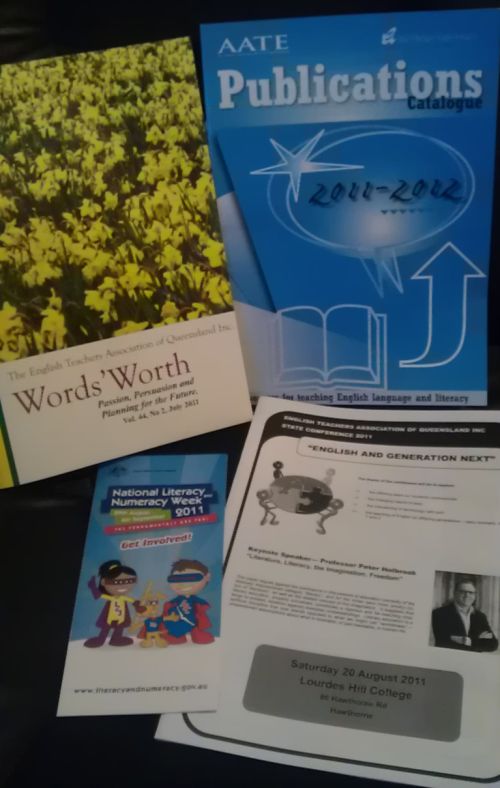
Both mailouts contained information about Literacy and Numeracy Week, which this year has as it’s theme ‘The Fundamentals are Fun!’ (hmmm, invoking fundamentalism to talk about literacy…looking forward to critiquing that), as well as a catalogue of publications available from the AATE Bookshop.
The impetus for each mailouot is sending members the newest issue of the association journal. While I like the style of the NSW journal mETAphor better (the ETAQ journal is full of Arial font and the cover design could be developed, imho), I have to say I am really satisfied with the content and tone of Words’Worth, and look forward to contributing some material myself in future. Unlike in NSW, ETAQ doesn’t have resources to pay contributors for their articles (yet), but nevertheless the collegial spirit in the association currently ensures a flow of material to sustain the publication.
Both associations also included their annual state conference program notices. Seems like August is the flavour of the month…of the month… (?)
Here is a comparison of the two conferences (I’ll be at ETAQ, but wish I could get down for the NSW one too, bummer!):
ETAQ State Conference: English and Generation Next
- Saturday 20th August 2011
- 8.15am – 5.00pm
- Lourdes Hill College, Hawthorne
- Cost to members: $143 (presenters $44; students and pensioners $66)
- Keynote speaker – Professor Peter Holbrook ‘Literature, Literacy, the Imagination, Freedom’
ETA (NSW) Annual Conference: Makinig Connections That Count
- Friday 5th & Saturday 6th August 2011
- 9am-4pm / 9.30am-3pm
- Australia Technology Park, Eveleigh
- Cost to members: $290 one-day / $430 two-day (presenters register free)
- Ken Watson Address – Dr Felicity Plunkett ‘Blood and Bone: An Anatomy of Wreading’
-
You are currently browsing the archives for the learning community category.
Nominated!

- Australian English Teachers
 9 members
A group for English teachers in Australia to discuss the books they are reading, and the books th...
Books we've read
View this group on Goodreads »
Share book reviews and ratings with Australian English Teachers, and even join a book club on Goodreads.
 Kelli McGraw
Recent Comments