Archive for category education
Why it doesn’t matter that NSW keeps losing the State of Origin…
…GO YOU GOOD THINGS!
NSW deals national curriculum a blow
Adam Bennett (Sydney Morning Herald) August 9, 2011
[NSW Education Minister] Mr Piccoli on Tuesday announced the state government would postpone the implementation of the national curriculum by 12 months because of a lack of commonwealth funding and uncertainty about the content.
NSW will now introduce the Australian curriculum in English, Maths, Science and History in 2014, with the planning phase beginning in 2013.
Mr Piccoli said that while the NSW government remained committed to the reforms, schools couldn’t prepare for its introduction in 2013 with funding issues still unresolved and the curriculum’s content not known.
“Schools needed to know in June of this year precisely the content of the national curriculum and to know that there were funds available for professional development,” he told reporters in Sydney.
“The final document won’t be signed off until at least the ministerial council meeting in October, and that simply does not give the schools in NSW and the more than 100,000 teachers the opportunity to receive the professional development, and to be in a position to implement the national curriculum in 2013.”
Thank you New South Wales for Standing Up and Putting Your Foot Down, while the rest of the educrats and Ministers around this country smile and nod and agree to bring in a curriculum overnight when they Quite Frankly Should Know Better.
That’s MY State of Origin!
Premier’s Reading Challenge QLD
I used to be on the book selection panel for the PRC in New South Wales…great to see it so well participated in in Queensland as well.
I wonder if I can get some posters for it sent to me to put up at Uni? It’s a shame – so many great programs like this get passed over by teachers each year who just don’t get reminded of the dates!
The Premier’s Reading Challenge is on again and the aim for 2011 is to top 75,000 student participants.
Children from Prep to Year 7 are encouraged to pick up a book and get reading between May 9 and August 27, with all who complete the challenge receiving a signed certificate by the Premier.
Schools can register online until May 27. Last year, 71,000 students completed the challenge, reading more than one million books.
The challenge for students from Prep to Year 2 is to read or experience 20 books, Years 3 and 4 to read 20 books and Years 5 to 7 to read 15 books between May 9 and August 26.
Guidelines, registration details and booklists are available on the Premier’s Reading Challenge website.
Finding Arthur Applebee
Posted by kmcg2375 in education, english, Lit_Review, research on July 31, 2011
It’s only now that I’m finalising my thesis that I’m finding the work of U.S. curriculum studies researcher Arthur Applebee.
His works include his first book Tradition and Reform in the Teaching of English: A History (1974) and the later Curriculum as Conversation (1996). These are focussed on reviewing the teaching of English in the United States, but the historical connections he makes are invaluable to all of us in the field.
Here’s a clip from Curriculum as Conversation:

Foucault THAT.
Posted by kmcg2375 in books, education, english, learning community, Lit_Review, online tools, politics, reflections, research, social media, technology, university on July 28, 2011
I have a confession to make.
Lately, I’ve been cheating on my blog. (In a good way, I promise!)
A colleague at my university, Clare O’Farrell, has an established Ning that is home to members of the Poststructuralist Theory ‘Special Interest Group’ of AARE. Established it so well, in fact, that it is one of the few Nings I know of (along with the English Companion) that continued to have happy users after stupid-Ning made its stupid-serivce un-free. Hmph.
Anyway, I use my space and profile on the ‘Ed Theory Ning’ to brain-vomit about (on?) theory that I don’t understand yet.
And it’s proven #very illuminating.
Increasing my activity in various groups on the Ning has also proven fruitful. Particularly in the ‘Daily Writing Club’ (we have to do exactly as it says…!) and now also from browsing the ‘Foucault reading group’.
That’s where I was reminded to check out Clare’s actual blog, Refracted Input, which I hadn’t done for ages. This month she is discussing a quote by Foucault about ‘race and colonialism’, and in it I can see a relationship to contemporary discourses around changing technologies.
The term ‘folklore’ is nothing but a hypocrisy of the ‘civilised’ who won’t take part in the game, and who want to hide their refusal to make contact under the mantle of respect for the picturesque…
Man is irrevocably a stranger to dawn. It needed our colonial way of thinking to believe that man could have remained faithful to his beginnings and that there was any place in the world where he could encounter the essence of the ‘primitive’. (trans. Clare O’Farrell)Michel Foucault, (1994) [1963] ‘Veilleur de la nuit des hommes’ In Dits et Ecrits vol. I. Paris: Gallimard, p. 232.

You see, I’ve been worrying about the ethics of what could be seen as meddling with teachers or students who are comfotable in their print-material ways, trying to prod them along to explore new technologies. I have wondered, ‘am I being selfish?’, ‘what if they have it right?’, ‘what if I’m destroying something important?’, and ‘am I wrong to advocate for my view, should I just wait and see what happens instead?’. But then, Clare’s wise words:
One cannot buy into the romanticism of the primitive – which is assumed to be so much closer to pure truth and ‘nature’. Conversely one cannot make the colonial assumption that one civilisation or one period of history (now) is more advanced and more evolved than another.
That’s right. I don’t need to worry about whether I’ll ‘wreck’ anything, unless I’m thinking of the people I’m meddling with as OTHER. And I was using pronouns to construct myself in opposition to other through all those damn self-doubts. I don’t need to do that. FOUCAULT THAT!
*Sigh of relief*
NB: Clare also curates a website on Michel Foucault, which includes a glossary of KEY CONCEPTS and other wonderful gems (thanks Clare!).
Google+ by Molly Rocketboom
Posted by kmcg2375 in education, learning community, online tools, social media, technology on July 26, 2011
If you’re still not sure how Google+ fits into your existing world of Facebook and/or Twitter, let Molly of Rocketboom break it down for you. Approx 4.5 mins:
ETA mailout showdown and dates of state conferences
Posted by kmcg2375 in conferences, education, english, learning community on July 23, 2011
Living in Brisbane but being from Sydney, I am a member of both the NSW English Teachers Association and the English Teachers’ Association of Queensland.
The holiday break and a fresh term starting has brought mailouts from both associations my way.
This is a show-and-tell of what was in the respective packs.
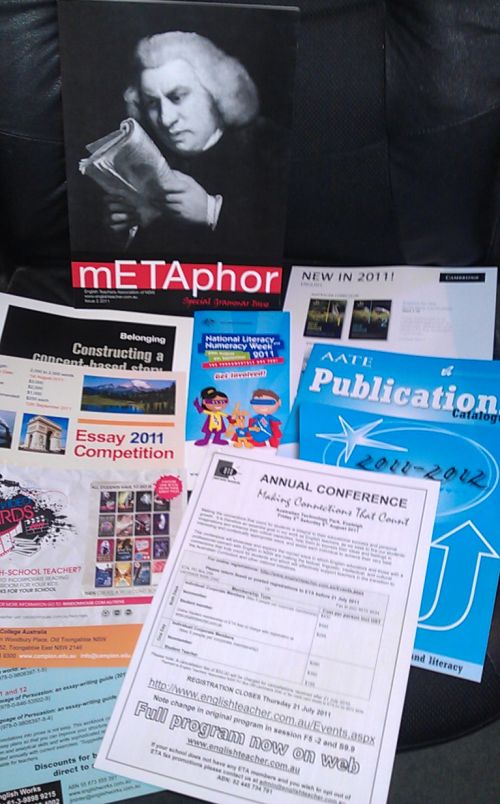
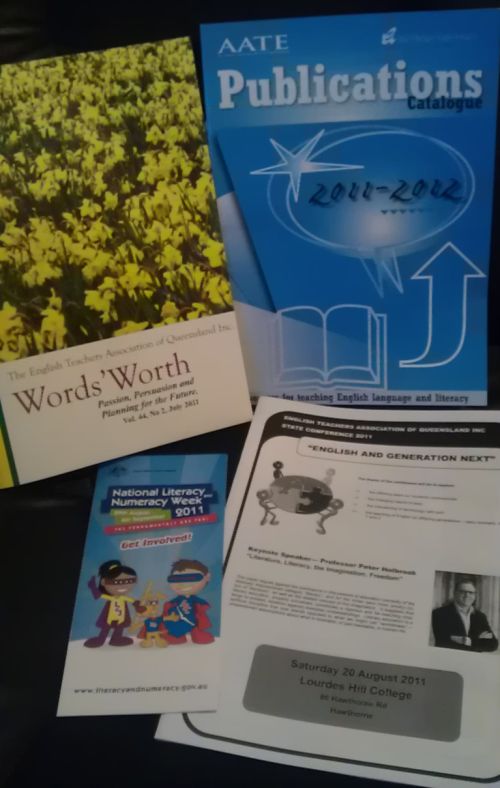
Both mailouts contained information about Literacy and Numeracy Week, which this year has as it’s theme ‘The Fundamentals are Fun!’ (hmmm, invoking fundamentalism to talk about literacy…looking forward to critiquing that), as well as a catalogue of publications available from the AATE Bookshop.
The impetus for each mailouot is sending members the newest issue of the association journal. While I like the style of the NSW journal mETAphor better (the ETAQ journal is full of Arial font and the cover design could be developed, imho), I have to say I am really satisfied with the content and tone of Words’Worth, and look forward to contributing some material myself in future. Unlike in NSW, ETAQ doesn’t have resources to pay contributors for their articles (yet), but nevertheless the collegial spirit in the association currently ensures a flow of material to sustain the publication.
Both associations also included their annual state conference program notices. Seems like August is the flavour of the month…of the month… (?)
Here is a comparison of the two conferences (I’ll be at ETAQ, but wish I could get down for the NSW one too, bummer!):
ETAQ State Conference: English and Generation Next
- Saturday 20th August 2011
- 8.15am – 5.00pm
- Lourdes Hill College, Hawthorne
- Cost to members: $143 (presenters $44; students and pensioners $66)
- Keynote speaker – Professor Peter Holbrook ‘Literature, Literacy, the Imagination, Freedom’
ETA (NSW) Annual Conference: Makinig Connections That Count
- Friday 5th & Saturday 6th August 2011
- 9am-4pm / 9.30am-3pm
- Australia Technology Park, Eveleigh
- Cost to members: $290 one-day / $430 two-day (presenters register free)
- Ken Watson Address – Dr Felicity Plunkett ‘Blood and Bone: An Anatomy of Wreading’
Me and my iPad: building new literacies
Posted by kmcg2375 in books, education, english, online tools, technology, university on July 23, 2011
I have to say, after just 10 days of owning an iPad, I am noticing some significant changes to my literacy practices – and being confronted by a range of literacy challenges!
I’ve solved the ‘where is Word’? problem – you can download apps, such as Pages, which costs about $10. I haven’t bought that yet because I want to try and do as much on free apps as I can before I get frustrated and am forced to buy (that’s what a school teacher on a tight budget would have to do).
Literacy lesson #1: There are no obvious ‘windows’ in this operating system. There is also no obvious place where you can see a directory of all your ‘files’. There are apps that are always on and you can look in on them any time.
But…how do I ‘save’ my work then? –> LITERACY OF STORING/SAVING AND BACKING UP DATA IN DIFFERENT PLATFORMS/OPERATING SYSTEMS?
Literacy lesson #2: Google docs can be used as a free word processing tool. I just open it in the web browser (Safari) and work from there.
But…when I’m not online I can’t access Google Docs. –> LITERACY OF ENSURING YOU CAN ACCESS YOUR MATERIALS AT POINT OF NEED?
Literacy lesson #3: I am LOVING using ‘Notes’. It’s an app that comes with the iPad. It works even when you are not online. The ‘what should I use to take notes in class/meetings?’ problem to me is solved with this. And because the only formatting available is the ability to leave empty lines and use capital letters, all of my focus is going into getting the ideas onto the page. None (at least much, much less) of my energy is going into design considerations. I never realised until formatting was taken away from me just how much thought I give to the design of a word document.
So…is that the difference between ‘writing’ and ‘word processing’? Or between ‘scribing’ and ‘writing’? or ‘notes’ and ‘documentation’? –> LITERACY OF WRITING FOR YOURSELF VERSUS FOR OTHERS? LITERACY OF FIRST DRAFTS (maybe “no Mary Jane, you can’t just do your draft in Word, because that’s your publishing platform and I don’t want you thinking about formatting your writing yet”. hmmm…)
Food for thought.
I should say, I have also wondered how much of this thinking is coming from using th iPad per se, or if it is the cumulation of being exposed to many new tools recently – a notebook computer, my Playstation and my Kindle had already got me thinking, but now it’s just all come to a head.
I’m thinking about this faster than I can write in-depth posts about it, but I hope these ideas and questions can launch some discussion!
Call for Papers: English in Australia 46.3
Posted by kmcg2375 in education, english, Lit_Review, research, university on July 17, 2011
CALL FOR PAPERS: THEMED ISSUE OF ENGLISH IN AUSTRALIA

A new English? More of the same? Or something still unknown? Past, present and future reflections on English teaching and new technologies
This special guest-edited issue is an opportunity to look back at the way English teachers have responded to the many iterations of ‘new’ media and to also grapple with how English teaching might respond to the here and now of our students’ increasingly digitally mediated lives, as well as looking forward to imagine the possibilities for English education. What are the challenges and opportunities presented by various forms of ‘new’ (and ‘old’) media, and by various ways of understanding the ‘new’? What things might need to change? What might be best left as it is? How might English teachers best respond to new and emerging digital texts and contexts?
We ask for contributions that share ways forward for powerful practice in English education, both in terms of the texts that might be studied and the curriculum work English teachers might do. Submissions might explore students’ relationship with multimodal texts and practices or examine digital learning environments and their connections with ‘traditional’ classroom spaces. They might explore new conceptual and theoretical ground or they may address issues of long concern for English teachers such as creativity, engagement and social justice. We are keen to receive classroom-based accounts and action or practitioner research or any other relevant studies conducted within professional contexts or as part of higher education research degrees.
Guest editors: Kelli McGraw (QUT) & Scott Bulfin (Monash)
Download the Call for Papers and guidelines for contributors.
The medium is the message
Posted by kmcg2375 in books, digital storytelling, education, english, Lit_Review, research, technology on June 30, 2011
“The medium is the message” is a phrase coined by Marshall McLuhan meaning that the form of a medium embeds itself in the message, creating a symbiotic relationship by which the medium influences how the message is perceived. (from Wikipedia)
The more I think about this issue of medium, the more unsatisfied I am with the way that medium of production is dealt with in the English curriculum.
While English teachers continue to be led by debate over the definition and role of Literature in English, and over the best way to teach language, questions of medium have been significantly sidelined.




It also seems clearer to me now why subjects like Drama and Media (content areas that technically sit under the umbrella of English, if you accept that English is a study of how meaning is made through language and texts) go off and take up their own space in many curriculum. It’s not just because those fields have their own traditions and pedagogies that need space, or because they have industries that create an economic drive for the subjects to continue. It’s also because those field require keen attention to production elements, including issues of medium.
Little wonder that Drama, which often deals with live performance of language, dies a slow death in English classrooms where the curriculum is still dominated by print literacy.
Little wonder that we still can reconcile the gulf between ‘literary’ and ‘digital/electronic’ texts in the Australian curriculum (medium is not a genre!)
To move anywhere with this line of thinking will require some careful thought about the overlap between the words:
- media as-in-the-artisitic-means-of-production and
- Media as-in-the-field-of-media-studies.
Thanks to carolyn for stimulating my thinking on this. Connecting the concept of medium back to the concept of narrative helped the penny drop today!
Challenges to developing a blended learning course
Posted by kmcg2375 in education, Lit_Review, online tools, research, social media, technology, university on June 17, 2011
This extract is from the article Development and Implementation of a “Blended” Teaching Course Environment in the most recent issue of JOLT:
Roadblocks/challenges to Developing a Blended Course
One of the biggest stumbling blocks to developing a blended course is the student fear factor. Many individuals in my class had never crafted a PowerPoint presentation, much less navigated in an online
discussion. Despite their familiarity with Web 2.0 tools like Facebook, MySpace, and instant messaging, the thought of being graded for online participation was somewhat threatening and intimidating. It was also difficult initially for students to understand the rationale for some assignments (such as Second Life). In future classes, more emphasis on business necessity, future usage, and SL current applications will be incorporated into the course pedagogy. Because there were many different types of assignments in this course (including group work, both on and off line), some students also expressed dissatisfaction with having to rely on team members. Use of the Team Agreement did however help to coalesce groups, and to give members a framework for expected behavior. Instructor feedback on the Team Agreement is essential in providing guidance regarding conflict resolution, assignment schedule, and interpersonal interaction among members.The blended model is a student-centered approach that allows the instructor to behave as a coach, a facilitator, and a cheerleader for his/her students. It is a way to let students lead in an environment in which they’re guided to success. In the words of Singh (2002, p. 476), “To be successful, blended [teaching]… needs to focus on combining the right delivery technologies to match the individual learning
objectives and transfer the appropriate knowledge and skills to the learner at the right time.”by Jacqueline Gilbert and Ricardo Flores-Zambada
Development and Implementation of a “Blended” Teaching Course Environment
Journal of Online Learning and Teaching, Vol. 7, No. 2, June 2011 pp. 244-260
This interests me because I have been considering including an assessment of online PLN participation in my unit next semester.
Given that this study found that “the thought of being graded for online participation was somewhat threatening and intimidating” for students, I’m going to avoid actually grading their participation per se. Rather, I’ve decided that students must show (in an assignment appendix) participation in their online PLN for the unit to achieve a Distinction (Grade ‘6’) or High Distinction (Grade ‘7’). That way, they either do it, or they don’t. They don’t have to feel anxious about quality.
Has anyone else done something similar to this? Making students demonstrate their PLN building? How can I do it – get them to attach a screen shot of three blog comments and five tweets? Would that suffice? Hmm…
-
You are currently browsing the archives for the education category.
Nominated!

- Australian English Teachers
 9 members
A group for English teachers in Australia to discuss the books they are reading, and the books th...
Books we've read
View this group on Goodreads »
Share book reviews and ratings with Australian English Teachers, and even join a book club on Goodreads.
 Kelli McGraw
Recent Comments