Macbeth
Just beginning a Year 11 unit on Macbeth (comparing Shakespeare’s play to a film version). Going through my resources I would have to say that I find the following three online resources provide all the material my students will need to supplement their reading:
- Royal Shakespeare Company resources for Macbeth, in particular the online play guide
- The No Fear Shakespeare ‘translation’ of Shakespeare’s play into modern English
- Notes on Macbeth from the new literature website Shmoop (still in Beta)
These sites don’t take a ‘cheat sheet’ approach to the play, but instead help students to cut through the language and think more deeply about the play in production, which in turn helps them to find meanng in the play. Are there any ‘must see’ sites that you would add? Of course all the big Shakespearean plays have a million online summaries, but would you add anything from those to my best of list above?
I would LOVE to get more adventurous and use Angela Thomas’ Second Life Virtual Macbeth island, but the machines at school would seriously not cope (on so many levels!) I might see later in the unit if the students would be willing to explore this from home.
Narrative and technology project
Posted by kmcg2375 in english, technology on March 27, 2009
The lesson sequence that I am working on for the New Technologies, New Stories project will see students working toward a Digital Storytelling assessment to explore ideas about what makes a good story. In particular they will be focussing on how images and audio elements can be combined to enhance meaning in narrative.
The Lessons:
Aimed at Stage 5 (years 9 and 10) this lesson sequence will see students analysing a range of fiction and non-fiction narrative texts to devise a set of class criteria for a ‘good story’. In my year 8 unit on Newspapers I teach students the criteria for ‘newsworthiness‘, but it occurred to me that I don’t teach any similar guidelines for ‘story-worthiness’. I wanted to design lessons that got students thinking about how to craft a story that is engaging to readers, and to demonstrate narrative skill across a range of modes.
Key Learning Ideas:
1. Writing stories that are more than a recount of events.
I often find that in Stage 5 students have learned a range of skills for building an effective narrative – they are well versed in character development and imagery, for example – but are still missing that ‘knack’ for writing a story that engages readers (and avoids clichés and stereotypes). In particular I have found my students struggle to move from narratives that describe a sequence of events to using symbolic and figurative representations in their work.
2. Using voice, image and written text to create narrative.
When making Digital Stories with Year 9 for the first time last year, I was struck that most either chose poor images to reflect their story, or lost any sense of story because the chosen images weren’t used to build a narrative. This was surprising – it hadn’t occurred to me that their choices in written imagery weren’t dull because of their writing, but because of their poor choice of imagery to reflect or contrast with the story. I’m hoping that asking students to focus on building a narrative using a range of modes will help them to focus on the meaning and ‘flow’ of their stories, not just the technical skills and tools required to tell them.
Texts:
Before (and while) students begin composing their own digital stories, they will be engaging with a range of texts to explore the question ‘what makes a good story’. To do this we will be:
- Reading the novel The Curious Incident of the Dog in the Nighttime by Mark Haddon
- Reading a range of picture books, including Fox and The Wolves in the Walls
- Watching a range of Digital Stories from the DigiTales website
- Watching my all time favourite TED Talk by David Griffin Photography connects us with the world
…I’d love to hear of any more suggestions for stories I could use with the students. As you can see I am lacking some good non-fiction and poetry texts.
Assessment
Students will make their own 2-3 minute Digital Story.
They must nominate 2-3 of the class developed criteria for ‘story-worthiness’ to showcase, and they will be peer assessed on how well they meet the nominated criteria.
Possible addition – Students transform their digital story into written form and write a reflection on the different language skills/tools needed to create the same narrative in different modes. Written stories could be stored on a class wiki, with digital versions uploaded as well.
New Technologies, New Stories
Posted by kmcg2375 in english, online tools, technology on March 24, 2009
I am feeling very invigorated after today’s briefing meeting for the New Technologies, New Stories project that is being run by the English folks over at the DET Curriculum Directorate.
And why wouldn’t I? The focus of the project is the development of teaching resources and lesson sequences to support the integration of ICT into English curriculum – right down my alley 🙂 What I love most about this is that the emphasis is on using ICT as a tool to enrich the curriculum that we are already familiar with, rather than treating technology as an ‘add-on’.
The other thing I love about this project is that we won’t be building resources for applying ICT generally, but instead we are targeting NARRATIVE, and exploring how ICT can be used to enrich the teaching of narrative. I believe English teachers are going to love this. I have run many a workshop now, intorducing general ICT and Web 2.0 tools, and teachers always leave feeling like they have learned someinteresting new things, but not neccessarily with a clear direction for applying their new skills. By placing the teaching of narrative first in this approach teachers will see a strong connection between the technology and the teaching that they already do.
I’ll post again soon with some notes about the sequence of lessons that I am planning for this project. In the meantime, does anyone want to add a comment about how they are using (or would like to use) technology in the teaching of narrative? I’d love to hear your thoughts.
New Resources Wiki
After tweeting with colleagues about which wiki site would be best to recommend to teachers (the jury is still out) I decided to have a look at wetpaint.com, a wiki site I hadn’t used at all before. The result: a brand spankin’ new wiki of my very own 🙂
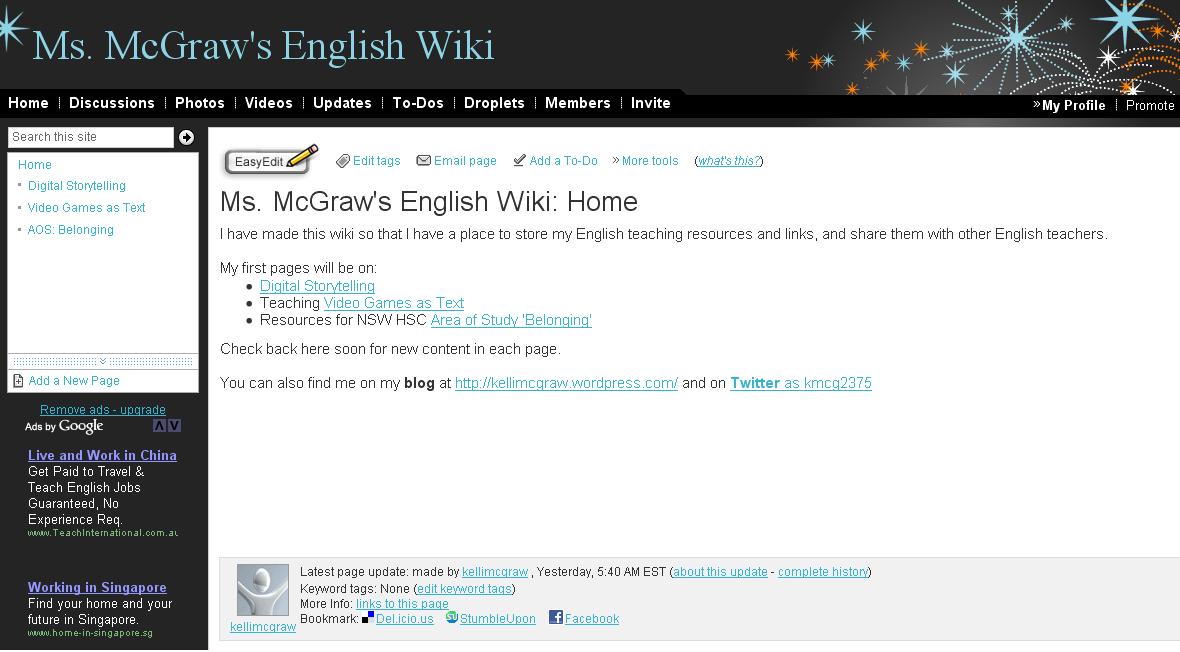


I made Ms. McGraw’s English Wiki so that I would have a place to share my English teaching resources, without using ‘pages’ on my blog. The old pages have been un-published, and a new blog page for Teaching Resources now directs readers over to the wiki.
If you have time to take a look, let me know what you think. So far I have transferred my blog resources on using digistories and video games to the wiki, and have added a page for the HSC AOS: Belonging as well.
Facebook continues to grow
Posted by kmcg2375 in online tools, random, social media on February 16, 2009
An article on the Inside Facebook blog reports that Facebook has grown to 175,000,000 active users with a growth rate of about 600,000 users a day in the past few weeks.
If Facebook were a country, it would now be the 6th most populous in the world.
Frankly I am not surprised. The pace at which people live their lives has dramatically increased, in the past decade especially. With many people living in a dual income household, or working second jobs, it’s hard to find time to ‘catch up’ with friends and family. For teachers the amount of time spent at home preparing lessons, marking work and maintaining their professional development can be a severe drain on your ‘home time’. Old ways of keeping in touch – hour long phone conversations, weekend visits, a night at the pub (eek – you mean I lose time tomorrow too!?) – are becoming rarer, and as a result there is so much pressure to make the most of time when you do see people IRL that the fun can be sucked right out of the experience.
When talking on the phone recently to a friend in the States (we normally use video call but the net was acting up) we found it very awkward at first trying to have a conversation without the benefit of the usual visual cues. There wasn’t even an avatar! And although we got used to it soon enough, it was easy to see why many people don’t relish using such cumbersome modes of communication anymore. Does this make us inherently selfish? Overly insular? I don’t know my own answer to that…yet.
What I must concede is that, for now, unless we want to miss out on ‘quality time’ with loved ones altogether, we will have to embrace (not reject!) these new modes of maintaining social connections. As we move towards re-defining our notion of what it means to have a ‘personal connection’, online communitcation will take on a more personal tone. And if this makes people feel more connected, isn’t this a good thing?
Why do we read?
A very insightful comment from one of my Year 10 students this week. Writing about what she likes about English (their first piece of blog homework) she writes:
I like reading because its like tv in your head! I think writing stories is very cool too because you can write about ANYTHING in the world, you can use your imagination and write wonderful stories.
English helps to get what’s inside of you, out.
From the mouths of babes, huh 🙂 In response to this, I’d like to share a quote that I recently found, by Mexican poet Octavio Paz:
Literature is the expression of a feeling of deprivation, a recourse against a sense of something missing. But the contrary is also true: language is what makes us human. It is a recourse against the meaningless noise and silence of nature and history.
Any other thoughts/quotation out there people could share on the question of why we read?
Edublogs blocked by DET
Posted by kmcg2375 in online tools, school, technology on February 11, 2009
Well, the NSW DET has finally gotten up to blocking the last place we had left to blog, edublogs. Along with everything else.
Any site that can be classified as a blog or wiki is blocked to students from years 6-10 at best – most are blocked for senior students too. The constant fear that we all now must live with of our students having any interaction *whatsoever* with the outside world lives on. Forget using edublogs, pbwiki, twitter, edmodo, wordpress…the list goes on.
Add to this the continued blocking of two of the most used/useful sites on the whole internet – Google apps and YouTube – and what is there left on the internet to use??
The DET released a new version of guidelines for creating blog sites in December 2008. Though it is hard to understand the point of this, when the sites are blocked anyway. Am I missing something here? And, while I understand the importance of ensuring student privacy, consider the following requirements included in the guidelines:
- All users must be registered and password protected to prevent anonymous contributions.
- All contributions are moderated by the Teacher Administrator before publication.
I can see where they are coming from. Honestly. But guidelines like this make it either untenable or just plain uncomfortable to use a blog with a class. Students who have problems signing up, logging on, or remembering a password will be disengaged with the blog and class management becomes a joke in blogging lessons where kids can’t get onto their blog. And moderating comments before they are published is just too much. This is like asking kids to run their classroom answers past you before they say them out loud!
Using online learning spaces provide students with opportunities to learn about cyberbullying and ‘netiquette’ – shielding students from online environments will not adequately prepare them for the world of work into which they will enter post-school. School rules, student welfare, and sound pedagogical practices are not abandoned in these online spaces – if anything, the transparency of these sites (your Principal, or your student’s parents, could decide to take a look at any time!) is more likely to promote professional practice.
Returning and some thoughts on the canon
Hello all; apologies for my patchy appearances in the bloggosphere and twittersphere lately. After a short trip to San Francisco over the holidays (which I would like to return to with some thoughts on at a later date) I am home, back at school, and about to get stuck into the hardest two months ever, probably, in my life – finishing my PhD thesis.
I was working on this today, adding to my ‘Background’ chapter with some more thoughts on the influence of the canon in English curriculum. In doing so I came across an article by Anne Waldron Neumann, “Should You Read Shakespeare?” (in Meanjin v.56, no.1, 1997: 17-25). It was an enjoyable read, covering all of the arguments for and against bothering to read Shakespeare. In particular I enjoyed the opening lines:
‘Should I read Shakespeare?’ So you probably ask yourself each morning as you stare at the mirror, toothbrush in hand. Or, if you do not, many older and possibly wiser heads are asking for you: ‘Should you read Shakespeare?’
United Airlines – lucky they don’t work for tips
You know when you’re going overseas and you get yourself all psyched for chilling out with drinks, snacks, and movies on demand? I know that’s how I was feeling when I got on my United Airlines flight to San Francisco last weekend. And because I was travelling alone, I was also kinda counting on being occupied with film and booze 😉
Alas, my United Airlines flight to San Francisco had NO on demand viewing, not even individual screens. I (and my neck) thought that kinda sucked, but it was even suckier when they had to reboot the system a few hours in, because the business class system was acting up. Grr. Yes, I could have read a book…only I didn’t take one, and anyway, my brain was too fried to focus on anything substantial (as is usually the case when you’ve had a few days of rushing around getting ready fr a trip O/S).
Add to that the $6 charge for alcoholic drinks (on a plane leaving from Australia!??). And announcements that they didn’t bother stopping the movie to make (but then again how much can you miss of such classic films as The sisterhood of the travelling pants 2?)
And honestly, their service was just not good. They didn’t give any information about what was in the meals, or what to fill out to get through customs…it really makes you appreciate the friendly folk at QANTAS.
At the end of the day though, how much can you complain when you are one of the people lucky enough to be taking a holiday overseas? Well, when you are paying thousands of dollars of your hard earned cash for something, about this much, I guess 🙂
And I am one of the lucky ones. My trip was just boring – this poor guy had his brand new didgeridoo smashed by United Airlines luggage handlers, who refuse to accept liability. My sympathies Allan!
7 Things You Don’t Need to Know About ME Meme
Darcy Moore tagged me for this meme. So, 7 things you don’t need to know about me are…
- My great, great, great, great, great grandfather on my mother’s side was Thomas Rose, and his family came to Australia on the Bellona in 1792 in a small group of the first free and independent settlers in Australia. Ever visit ‘Old Sydney Town’ on a school excursion? You would have taken a tour of Rose Cottage, where my ancestors lived.
- My husband and I got together on my 13th birthday, so turning 28 last month meant that we have now been together for 15 years already. He is the love of my life! We were born only 10 days apart (both stubborn/ambitious/travel-loving Sagittarius‘), went to the same school, and moved out together when we were 19 because we didn’t like spending so much time apart at Uni 🙂
- I grew up in a 3-bedroom fibro house in Cabramatta West, which we didn’t move out of until I was 17. We would often go back and visit it after we left – then one day I was driving with a friend and took her to see the house. It had been demolished days before, and there was just a bare patch of land left with a few bits of rubble. I cried…and cried…
- I was Dux of my Primary School, and Captain of my High School. I am finishing my PhD now, and it has made me swear off that particular brand of over-achieving forever.
- I was in high school during the grunge years, so bands ranking highly on my list of favourites are Nirvana, Green Day and Pearl Jam. I remember when Kurt died, and how important it was to so many of us.
- The first time I went overseas I was 20. It was to Scotland to visit family, and it was also the first time I saw snow. I played in it every day and never once got sick of it.
- I watch Neighbours. Religiously.
I am passing this meme to:
…and to my Drama class blog. They will have fun doing this when school goes back 🙂
Nominated!

- Australian English Teachers
 9 members
A group for English teachers in Australia to discuss the books they are reading, and the books th...
Books we've read
View this group on Goodreads »
Share book reviews and ratings with Australian English Teachers, and even join a book club on Goodreads.
 Kelli McGraw
Recent Comments