Defining ‘multimodal’
Reading the Draft Australian Curriculum for English (‘DACE’…?) I can see that confusion over the meaning of ‘multimodal’ text is about to cause English teachers some major problems.
My understanding is that when we say a text is ‘multimodal’, we mean that the audience participates in the text’s creation. This is the definition I would say that academics and practitioners in the field of English curriculum would use; consider this explanation by Anastopoulou, Baber & Sharples:
Multimodality is based on the use of sensory modalities by which humans receive information. These modalities could be tactile, visual, auditory, etc. It also requests the use of at least two response modalities to present information (e.g. verbal, manual activity). So, for example, in a multimodal interaction a user may receive information by vision and sound and respond by voice and touch. Multimodality could be compared with ‘unimodality’, which would be based on the use of one modality only to receive or present information (e.g. watching a multimedia presentation and responding by pressing keys).
…but that’s not the definition that ACARA are going with.
The definitional confusion between terms like multimodal, multimedia and media has been around for a while, and speaks to the significant changes in what is considered core content in English brought about by the rise in visual and especially digital texts. We are very familiar with the concept that language can be spoken, written or heard…but when it comes to texts that combine these modes, things are still a little muddled.
Please take a moment to check out, for example, the preface for the Year 7 section of the DACE (click the image below and get ready for your head to spin):

Year 7 English Content Preface
See what I mean?
In this Preface to the curriculum content descriptors multimodal texts seem to be pitted against texts that are ‘literary’ (which creates even more confusion as the definition of literary appears to change with each new use). I can appreciate that the ACARA curriculum writers have had to avoid using the word ‘text’ because of the political beat up the term has received in recent years from certain op-ed writers in certain newspapers. That is why this new curriculum has reverted to the more traditional term Literature – and it is because of this change that we are now supposed to say, it seems, ‘literary text’.
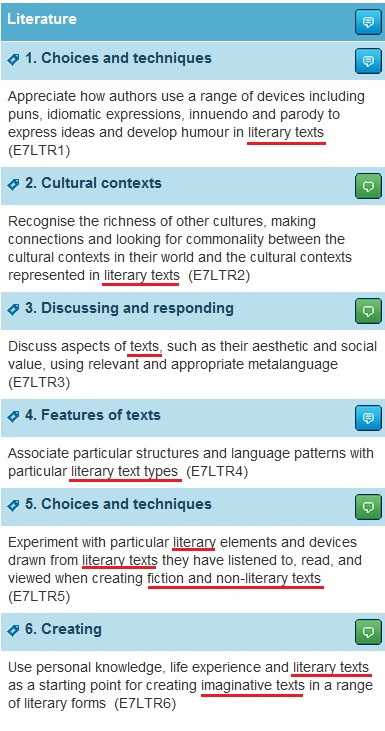
But now check out the etymological shenanigans that take place in the content descriptors of the Literature strand:
Year 7 - Literature
Oh brother. The constant reference to ‘literary texts’ is supposed to be a nod to the strand content being described as ‘Literature’. But this is ultimately VERY confusing, as ‘literary’ texts are separated from ‘non-literary’, digital’ and ‘multimodal’ texts in the Preface. There result is that there is no sense in this strand of multimodal texts being included.
The term ‘literary’ is also conflated with ‘fiction’, and what are really language elements are referred to as literary elements. In ‘Discussing and responding’ the term ‘text’ makes it in unscathed – which just goes to show that the word does make sense and can be used. The term ‘text’ is highly appropriate for collectively describing all works of language art, and recognises that the works we study can be written, spoken, aural, or a combination of these. The term ‘literary texts’ is stupidly redundant, but I’d be happy to get on with using it to placate the punters, if only it were used consistently and provided scope for the study of a broad range of texts! Which brings me back to multimodality…
In the NSW English syllabus, students engage in what we call a range of language modes. These are: speaking, writing, representing, listening, reading and viewing. So ‘multimodal’ could reasonably be taken to mean ‘using more than one language mode’. This would make film, picture books and digital stories (which use a combination of visual and written language) and many other forms of text multimodal. OK, I can work with that.
But another thing we do in NSW English 7-12 is differentiate between the activities of composing (which involves text ‘making’ or ‘creation’, not just ‘writing’) and responding (a broader term than ‘reading’ which encompasses the ‘reception’ of all kinds of text). These activities are viewed as always interrelated in some way, but I would say that it is only when text explicitly invites the audience to participate in the text (e.g. in video games, virtual reality, and participatory narratives such as Inanimate Alice) that the term multimodal should really be applied. If I’m going to give up the term ‘multimodal’ to the meaning of ‘using more than one language mode’, then I’m going to need a NEW WORD that I can use when I mean ‘texts that the audience helps to construct’.
Currently this recognition of interactivity, and of the interplay between responding and composing, is severely lacking in the DACE.
[ED: Angela Thomas has helped me to clarify my thinking around this, and suggests that students could refer to the ‘cline of interactivity‘ for texts that invite participation. My thoughts on multimodality have been developed here. June 2010]
If you are an English teacher and haven’t yet responded to the consultation on the Draft Australian Curriculum, I implore you to log on to the ACARA site and say something about these contradictory and frankly bizarre definitions. I can’t be the only one who feels like the curriculum writers just didn’t use a glossary!
Faced with the prospect of a shiny new curriculum that is supposed to be clarifying professional meanings and terminology for all teachers, students and parents across the nation, these definitional conflicts are something that must be sorted out before we go any further. Agreed?
Heeey Gecko!

One of the lovely things about the move to Queensland has been the geckos that reside in the area.
They mostly stake out lights on garden walls and house verandahs waiting for delicious insect feasts, but a couple have made it into the house as well:


Usually when they make it into the house I take them back outside. As a kid I often handled common fence skinks in the garden, so these little geckos don’t phase me (spiders are another story entirely). The main reason I take them outside is because I’m worried I will accidentally squash them or something if they stay inside! But yesterday another baby one turned up in the bathroom, and I’ve decided that it can stay.
Reading this forum it looks like droppings can also be a problem if you have lots of geckos, but right now it’s just the one. The forum also has lots of references to the pests and insects that geckos eat, so that is a bonus.
What do you think…to gecko or not to gecko? Does anyone else keep these critters hanging around indoors, or should I take it back outside like I did with the others?
They are said to symbolise regrowth and good luck, but perhaps they can manage these qualities from outside the house 😛
Parents – I invoke thy name!
(alternatively titled Well whaddya know, the moratorium paid off.)
In the wake of the moratorium on NAPLAN testing imposed by the AEU, claims about ‘what parents want’ were bandied around left, right and centre.
A quick look at the website for the P&C Federation in NSW directs you to a statement that made their position clear:
The Federation of Parents and Citizens Association strongly opposes the Australian Education Union’s ban on teachers conducting the NAPLAN testing to take place from 11th to the 13th May this year.
BINGO! But wait…read on:
Despite the Ministers assurances to the contrary, we see no evidence of a constructive and useful dialogue between the Government and the Teaching Unions. Our position has always been that the Government needs to be proactive in addressing the concerns of parents and teachers in how NAPLAN data is being used and presented to the public.
Parents as an integral part of the education process and as a stakeholder in educational outcomes demand to be included in future discussions.
So let me get this straight…
It is fine and dandy for the government, and the DET leadership, and the media, to invoke the desires of parents when it suits them i.e. to convince teachers to run NAPLAN.
But as far as the desire of parents to be included in decision making around the construction of the MySchool website…well, let’s not take things too far now.
The expectations and rights of parents as stakeholders in education are all to frequently invoked in such a selective manner.
Today’s decision by the AEU to lift the moratorium on NAPLAN testing follows:
an offer by the Education Minister Julia Gillard to form a working party of educational experts, including representatives of the AEU, to provide advice on the use of student performance data and other indicators of school effectiveness.
As an English teacher who values NAPLAN as a dignostic tool, who values the rights of parents as stakeholders, and who is also a staunch opponent of use of NAPLAN data on the MySchool website, I am relieved.
Parents and teachers belong on the same side of the fence, and the way in which politicians and media pundits were setting us against each other was atrocious.
The AEU said from the get-go that the ban would be lifted if the Federal government engaged in authentic consultation with teachers over the MySchool website and took measures to prevent the construction of league tables.
And so it has.
Thus endeth the NAPLAN fiasco of 2010.
Civilisation and culture
A recent post of Darcy’s got me thinking a bit more about the questions of ‘civilisation’ and ‘culture’, in particular about how these relate to my work as an English teacher.
One aspect of this is that the increase in use of technology has also brought an increase in people’s ability to create and publish their own texts. Notions of the importance of the traditional, western literary canon are being challenged. More and more students are approaching me, asking if I have read/seen/listened to a particular book/film/piece of music, and I am confounded. The 30 students sitting in front of me in the class are exposed to so much in their cultural world, and I have no hope of claiming expertise on such a diverse range of cultural artefacts.
This stands in contrast to some of the notions I had about being ‘cultured enough’ to be a ‘proper English teacher’ before I started university. I recall the summer holidays after year 12 when I found out I had gotten into a Bachelor of Education at Sydney University. I was going to be an English teacher – hooray! But there was also a dark side: now I was going to have to read friggin Lord of the Rings. And so I dutifully did. Later, in university, I also subjected myself to an entire box set of Jane Austen for the same reason – if I was going to be an English teacher, I was going to have to ‘know my stuff’.
Don’t get me wrong – I am glad for pushing myself to extend my reading to the English curriculum ‘canon’. It turned out that I loved Lord of the Rings (my how I had grown since year 9 when I hated The Hobbit with a passion) and reading it opened a whole new world for me, whetting my appetite for the entire Fantasy genre. A couple of the Austen’s were OK too – though Emma did become the first book that I ever didn’t finish (I’m a staunch book finisher) I was glad to discover that I didn’t care for pre-20th century stories about genteel English living, no matter how satirical they were intended to be. So, reading Austen taught me not to fear the canon, and not to feel inadequate in it’s shadow.
Now, this post is meandering a little, but bear with me…
The extracts that Darcy posted from Kenneth Clark‘s television series Civilisation included a few ideas that I found very useful for reflecting on my own growing understanding of the relationship between society and culture. In particular I noted these down:
Great works of art can be produced in barbarous societies – in fact, the very narrowness of primitive society gives their ornamental art a peculiar concentration and vitality.
Well, I certainly wouldn’t say that England in the 1800s was primitive! But could it be that people become besotted by this period of Literature because of its narrowness, because it is define-able and knowable? Because its concentration lends it a vitality that is found wanting in contemporary culture which is so diverse and dispersed? Is this also what makes Shakespeare so attractive?
We are not entering a new period of barbarism. The things that made the dark ages so dark [were] the isolation, the lack of mobility, the lack of curiosity, the hopelessness…
This is an astute observation, and one that could perhaps quell any fears that people may have about technology, postmodernism, cultural relativism or whatever [insert social ill of choice here] posing a threat to civilisation and culture. We live in a world that is more connected than ever before, and the growth in cultural production is surely an expression of our curiosity and willingness to engage with the world. This doesn’t mean we should hate the traditional canon. However…
One mustn’t overrate the culture of what used to be called ‘top people’ before the wars. They had charming manners, but they were as ignorant as swans…the members of a music group or an art group at a provincial university [today] would be ten times better informed, and more alert.
Now Clark is really speaking my language. Because, as I discovered when I made myself read explicitly canonical texts, I’m not the canon hater that I thought I was as a teenager. On the contrary, even though I didn’t enjoy reading Austen, I found great value and pleasure in developing my knowledge of the way texts that had been deemed ‘the best’ influenced culture that superseded it. And, as with Shakespeare, I now delight in researching and thinking about how texts reflect their social and political context (this makes me an excellent teacher of Advanced HSC Module B Critical study, in my very humble opinion).
The contribution I would like to make to this assemblage of interesting texts about civilisation is Alain de Botton’s book and documentary film about Status Anxiety. Here is the introduction to the documentary:
de Botton argues that increases in living standards have not increased our levels of happiness, due to our anxiety about our social status. To return to one last observation from Clark:
The children of [our] imagination are also the expressions of an ideal.
I believe that the current boom in the production of cultural artefacts expresses an ideal that can lead us away from status anxiety – where something like the literary canon is valued, but is knowledge of it is not misused as a demarcation of status. With a wider range of cultural expression being valued, our fears about being outed as ‘not knowing everything’ fade away as people recognise the impossibility, and folly, of this desire. I also am hopeful that our increasing tendency to engage with culture as produsers reflects a growth in ideals such as respect for diversity in creative expression and authentic engagement with community.
Of course, there is another angle that we could engage in here – there is a famous quote that I can’t remember, something about civilisation being measured by how well we look after the poor…if you made it to the end of this post 😉 and you know the one I mean, can you add it as a comment? In this vein I encourage readers to revisit a song from 1992 (a golden year for music!) where Mr Wendal serves as an example of the plight of the homeless:
Civilization, are we really civilized? Yes or no ?
Who are we to judge ?
When thousands of innocent men could be brutally enslaved
and killed over a racist grudge.Mr.Wendal has tried to warn us about our ways
but we don’t hear him talk…
…but that is food for a whole different post.
The nature of the beast
NAPLAN. MySchool. Data. Accountability. Planning.
Roger is bang on when he says that there are so many conundra in education.
But why? Is this really a result of ‘rank-and-file’ teachers unjustly mistrusting ‘the boss class’? Perhaps, in part.
But the problem we face in overcoming this is not as black-and-white as it seems. Historically schools have evolved to serve multiple functions in society, and it is these often competing functions that school leaders, edu-crats and politicians are faced with negotiating every day. This is a tricky business, and people will not always agree on what is being prioritised.
In my PhD research on the English curriculum I have explored Hunter’s genealogy of the major functions of schooling, and used this as a lens to reflect on the contradictions and challenges that are embedded in the HSC English syllabus. Hunter (1993) outlines the following functions of mass schooling in Australia:
Hunter rejects the notion that schools have ever served, or even aimed to serve, a singular, unified function in society. Rather, the various functions described above are contested and emphasised more or less at different points in history based on the political, cultural and economic imperatives of the time.
The idea that schools serve different functions is not controversial. What is important to recognise, however, is the importance of each of these functions, and the need to treat them as interrelated. Our role as educators cannot be to simply ‘back’ one function over another – for example, promoting individual expression and pastoral care while decrying the goals of skills and human capital development. Although these functions historically have come into competition, it is essential to recognise the important role that bureaucratic structures play in safeguarding equality within a social welfare state such as Australia.
In regards to NAPLAN, it is not the case that politicians want to crush individual expression in the pursuit of higher literacy standards. It is also not the case that teachers don’t care about skills development and resent regulative goals of ‘the boss class’ as a matter of principle.
What is worth considering, however, is this: what political, cultural and economic imperatives are reflected in the priorities set by the bureaucracy?
Despite reservations about standardised literacy and numeracy testing, teachers ultimately were asked to support ELLA/SNAP, and later NAPLAN, in good faith. The tests were framed as a diagnostic tool. Schools were dissuaded from ‘cramming’ for the tests, as this would negate its diagnostic capacity. We were promised that these tests were an example of schools fulfilling an essential bureaucratic function – ensuring that all students had equal access to diagnosis of their skills, and that resources could be allocated efficiently to areas of need.
The introduction of the MySchool website, however, betrays a warped set of priorities…the political, cultural and economic imperatives of publishing NAPLAN data as a means of measuring school success over-prioritises the regulative function of schooling. Orderliness and control emerge as the ultimate product when systems are put in place that construct and solidify school hierarchies, encouraging a consumer culture in schools where the discourse of ‘parent choice’ trumps the discourse of ‘school community building’.
I hate the MySchool website. Not because I don’t want parents to have access to information about schools, but because I believe that the information that is currently privileged does pose a destructive force to schooling functions that I hold dear. I believe that comparing schools based on test scores poses a serious neglect of the pastoral function of schooling – it is difficult to foster a caring and humane environment in school in which to grow and develop when your school is labelled as ‘failing’, and parents of ‘good’ students start shopping elsewhere. Likewise, in successful schools, staying on top of the ‘market’ can lead to undue pressure to succeed in external testing, and a neglect of student welfare and broader curriculum goals.
I fully support schools and teachers who will join the moratorium and refuse to deliver the NAPLAN test this year. Not because I don’t see the value of NAPLAN, but because as educators who oppose harmful government policy it is the only card we have to play in a system that gives teachers virtually no voice in the policy and structures they will have to work within.
It is a shame that teachers who oppose the MySchool website, and are prepared to take action despite political pressure, are often painted as ‘data-haters’, ‘parent-haters’ and ‘boss-haters’. They are none of these things. They are just people who feel out-and-out ignored by their political leaders and think that something bigger is at stake than missing a year of data.
Sir Ken Robinson FTW!
The first TED talk I ever watched was by Ken Robinson, and I was enthralled and moved to reconsider my own practice by his explanation of how schools work to kill creativity.
He now has a book out called Element . Thanks to Raman for posting a link to this five minute interview with Sir Ken about the new book and his views on standardized testing:
Tell me about it.
This is spot on. The Alice quote tops it off beautifully:
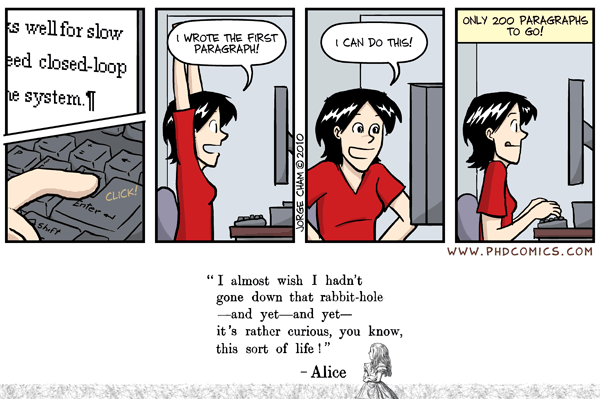
Link to PhD comics website (loving their work since two thousand and…let’s not go there)
The conversation continueth…
Posted by kmcg2375 in online tools, personal, school, social media, technology on March 21, 2010
I love it when Hiba says a few quick things!
I encourage you to read Hiba’s comment, and Troy and Melissa’s, in response to my last post. It is so important IMHO for us to be talking frankly, reflectively and supportively about the difficulties and fears that we/others have in regards to using technology in our teaching. Ignoring the problems will not make them go away!
I totally agree Hiba – using technology for the sake of it does not lead to effective teaching. And I think you’re right – this is bound to be the thing that Shaun has experienced. And yes, ‘too much of anything IS too much’. But…who decides what is too much?
“Just a few quick things” from me 😉
The end of your comment Hiba is very telling – you love and can see a clear use for OHPs, digital stories, twitter and youtube. Ok, but what about other teachers who don’t like these things? When they are told they ‘have to’ use them, won’t they have the same feelings as you expressed about other technology?
So: (1) teachers will best use what they know about and can see a use for, and (like all other pedagogical tools) each teacher will have their own style and ‘favourites’. I think this is OK, and a natural product of how we work.
BUT…
What do you do with teachers who are refusing/reluctant to learn new things? New tools? New ways of doing things? Is it good enough to just say ‘blogging is not a preferred teaching tool of mine’? Well, perhaps…but is it good enough to go wider than this and say ‘online learning is not a preferred teaching tool of mine.’? Er, NO. IMO this is tantamount to saying ‘I just don’t like doing group work’. Unlucky mate. Because:
(2) there are things that we know, for sure, things that are like fully researched and proven and everything about how collaborative learning enhances the learning experience, and about how online tools can facilitate this better than pen and paper work. This is not a matter of opinion, or personal style (though whether you use a wiki or a blog or a Ning or Moodle etc. certainly is).
AND…
I hear you about being too immersed in technology. I am a screen junkie, and have to constantly remind myself that not everyone is. I DO prefer to mark essays using track changes and comments in Word (it takes more time for me to negotiate the margins of someone’s handwritten essay than it does for me to just TYPE), but that’s just me. I don’t think that everyone needs to work this way. But I do think, at some point, you have a (dare I say) duty to expose students to this method of editing. This is especially important because:
(3) the distinction between ‘digital natives’ and ‘digital immigrants’ has been helpful, but is is not that black and white. Fact: not all kids have the kind of access to technology that you describe yourself as having – this is a class/SES/cultural issues that we MUST remain aware of. Another Fact: just because you use a lot of technology doesn’t mean that you can think critically about it, or apply it to new knowledge. Case in point – students’ PowerPoint presentations are generally REALLY AWFUL until they are taught how to apply skills of good public speaking, visual presentation, summarising, metalanguage/metathinking etc. How do you explain this phenomenon if it is true that ‘all young people already know about technology’? There’s a reason why English teachers teach novels, and don’t just say ‘go read it at home kids’.
FINALLY…
Back to the concept of ‘too much’. You know what else I think we use too much of? Workbooks. And writing notes off the board. And teacher talk. And homework (when it is not project and passion based, which I do like). But these practices are never questioned, never challenged, never stopped because people find them comfortable and familiar. And no-one notices when they are overdone because they are part of the traditional landscape of schooling, and because (most importantly I think) because this is how parents, and politicians, were taught and what they expect to see from kids’ classrooms.
My Head Teacher will get me in trouble if my kids don’t have a workbook, but no-one else gets in trouble for not having a blog!
So: (4) Let’s make sure we’re applying the ‘too much is too much’ rule across the board, and not just as an excuse/a reason for neglecting the new. If what we mean is ‘we haven’t had enough PD to use this right’ then by all means say that. But there are some things that would be good to drop out of our current practice to make room for the new.
One thing that we know about teaching is that no matter what you are taught to do, as a teacher you will instinctively model your practice on the teaching you received at school. Fighting against this instinct takes concentration, and learning about new practices and tools takes a lot of work. Because of this, teachers who are embracing technology are feeling increasingly overloaded and burnt out – this is the real problem that needs managing. In Hiba’s post I felt a real sense of fatigue, and I know how she feels because I have felt that way too. We teachers have to look after ourselves personally and adjust our level of change commitment as our energy ebbs and flows. People who yell and scream and try and force everyone to use technology all lesson, every lesson need to be more sensitive to change fatigue…but in return, teachers need to ‘man up’ when the energy does flow, and explore these new tools for refining their craft.
Without understanding and effort on both sides, the student will be the one who misses out.
A personal response to technology hating
Posted by kmcg2375 in english, online tools, personal, social media, technology on March 17, 2010
This is a post for my friend Shaun, but I hope it’s something you all can use.
Shaun is a top bloke. He’s an English teacher who has a deep passion for literature and from what I can tell a real knack for sharing this with his students. His students get great results at assessment time. He’s warm, funny, relatable and engaging.
But, in a brief chat about another blogger’s controversial anti-technology post, it was clear that Shaun was not enthusiastic about digital learning.
In fact, he despises it. And also has had such bad experiences that he now doesn’t trust teachers who use it.
So…what to say to my friend who is in the position of already being a great teacher getting great results?
How to convince him that digital learning is more than fancy icing on his otherwise tasty, filling and nutritional educational cake?
I thought that this task might call for a personal story.
ABOUT ME: I am an English teacher who has always loved English. As a child and teenager, reading was like breathing to me – not just ‘part of life’, but an urgent necessity. In school I excelled at debating, and public speaking. For my HSC I studied as much English as I could – 2 unit Related plus 3 unit English. I loved essay writing, adored my English teachers, and was in my element during teacher lectures that were accompanied by class discussion. My UAI was in the mid 90s. I was a successful English student.
MY CONFESSION: While all of the above is true, it is also true that in year 9, for the first time, I did not read our class novel The Wizard of Earthsea. The teacher never knew, and my grades were stellar. Same again in Year 11 with The Scarlet Letter. Same again in HSC 3 unit English with Shakespeare’s The Tempest. And…same again with about a third of the books I was supposed to read for my University English courses, though in that arena my grades weren’t stellar…just above average.
Why do I make these confessions, horrible as they are for an English teacher?
Because when Shaun tells me that his students are all engaged with their learning without the use of technology, I can tell you from experience that they aren’t. Not authentically. Sure, they may gaze up in awe as he speaks passionately about the wonder of Hamlet, and they might have the skill to assemble good essays by aping the points brought up in class discussion. But I guarantee you Shaun, you are teaching at least some people just like me – people who slip under the radar due to their genuine love of English and their skill in using language, but who have the potential to be far more active in their learning.
The other reason I make these confessions is because arguments trying to promote the adoption of technology are often made with reference to engaging low-ability or disinterested students. And I support those arguments whole-heartedly – I have seen students, especially in the junior years, really turn their attitude around (especially in regard to writing) because the fun side and familiarity of using computers gave them the confidence and motivation to complete some work.
It is so much harder to convince teachers of ‘successful’ students that anything needs to change.
But (and Shaun this is my final point I swear!) not only does digital learning have the potential to increase student engagement at all levels due to its inclination toward communicative and collaborative learning practices, but I truly believe that neglecting the development of students’ digital literacy means that as teachers we are neglecting one of our key roles – the preparation of students to participate and engage fully with society, present and future. Technology isn’t going away. And English teachers that say ‘digital literacy is not my job’ would do well to remind themselves of the times when English teachers used to say ‘visual literacy is not my job’.
Times change. Media changes. Language changes. We must make sure our students are equipped to cope with this.
I would be most grateful if people could add comments to this post with their own personal success stories from English classrooms that have embraced technology, either in content, pedagogy or assessment.
We will not convince technology haters to change by telling them they are wrong, when their experience is to the contrary. We must do it by showing that we know about some amazing, engaging and powerful tools for achieving the outcomes they value and desire
…and that not all teachers using technology are merely doing so to look cool and get promoted 😉
Poems to Share
I love The Red Room Company. I started working with them last year, team-teaching poetry workshops with my year 10 class with poet Lachlan Brown. They are a group that loves sharing poetry with students and encouraging poetry writing as much as they love poetry itself!
Just now I have bought one of their new poetry teaching products, a card set called Poems to Share:

“Red Room Co. have teamed up with designers Corban & Blair to produce a beautiful card set featuring forty poems by contemporary Australian writers, along with writing exercises to get things moving.”
Red Room’s educational products are simply gorgeous.
Check them out and I know you’ll be adding them to your English faculty wish-list!
Nominated!

- Australian English Teachers
 9 members
A group for English teachers in Australia to discuss the books they are reading, and the books th...
Books we've read
View this group on Goodreads »
Share book reviews and ratings with Australian English Teachers, and even join a book club on Goodreads.
 Kelli McGraw
Recent Comments