Hunting for twits
Posted by kmcg2375 in education, online tools, social media, technology, university on March 23, 2011
Of the roughly 85 students in my English Curriculum Studies unit, currently about 62 are following our class twitter account @CLB_018
No mean feat considering it is only week 4.
However, it is week 4 of a 9 week unit, meaning we’re almost half way done (eek! I still have so much to SAY!)
Aaaand, I’m aware that a small handful of those followers may be spamish.
So today I am embarking on a twit hunt – hunting through my list of followers to see who has not tweeted anything (many only joined for class and only follow the class profile). I’m going to DM each of them individually and privately to encourage them to participate.
Am I going overboard in doing this?
On one hand this looks exactly like the kind of time-consuming ‘tech monitoring’ that teachers often tell me they don’t like about teaching online.
On the other hand, I see it as analogous to checking students’ workbooks a few weeks in to term and pointing out their missing work. Is this something that University teachers see as beyond the scope of their ‘job’? I don’t.
But please – please – tell me if you think this is too much, or if this seems like a good strategy to you. Especially if you do something similar – did it work?
Change agents – Pirates vs Ninjas
Posted by kmcg2375 in education, social media, technology, university on March 22, 2011
I was prompted by Binaca today to look for an old post of mine on giving feedback to students. In my search I was delighted to find it had been almost exactly one year since I wrote this post about the tension caused by curriculum change, especially in regards to integrating ICTs:
Let’s make sure we’re applying the ‘too much is too much’ rule across the board, and not just as an excuse/a reason for neglecting the new. If what we mean is ‘we haven’t had enough PD to use this right’ then by all means say that. But there are some things that would be good to drop out of our current practice to make room for the new. One thing that we know about teaching is that no matter what you are taught to do, as a teacher you will instinctively model your practice on the teaching you received at school. Fighting against this instinct takes concentration, and learning about new practices and tools takes a lot of work. Because of this, teachers who are embracing technology are feeling increasingly overloaded and burnt out – this is the real problem that needs managing.
In a later post I tried to be more generative than reflective by reframing the process of change, suggesting that:
…as educational leaders, if we want to help people come to terms with change and embrace it, then we need to recognise and validate their desire to stick with ‘the known’…Recognising that people are resisting change because they feel disempowered helps us to employ methods that give power back.
These lines of thinking manifested in the lecture I gave today to preservice English teachers on how to navigate change amidst all of the ‘theories of text and response’ that they had learned so far.
You may be pleased (dismayed?) to watch how I liken the characteristics of change agents to either the NINJA or PIRATE side of the popular theoretical battle, Pirates vs Ninjas 😀
I think I am mostly pirate!
Stuff I believe
Posted by kmcg2375 in education, politics, reflections, social media on March 21, 2011
It was interesting to follow the tweets of @BiancaH80 and @durk94 tonight, as they discussed the school funding data available on the MySchool website.
To be honest, in the interests of keeping myself in a positive and generative work state of mind I’ve avoided looking at the new MySchool site at all (and no, I’m not going to hyperlink to it because I don’t think it deserves the traffic). Next week I’m going to have to though, so I can talk about it with my students in class.
ohmmmmmmm…
Even though I now work at a university, which involves striving for curriculum excellence in schools in every sector, I maintain my firm commitment to the social justice agenda of supporting public education.
However, government departments of education tend to be clunky, inefficient, wheel-reinventing institutions. I know, I used to work in one. And if I returned to teaching you’d find me back there.
But while funding and resource benchmarks are a large part of the problem, a widespread lack of willingness to consider radically shifting our models of curriculum ‘delivery’ prevents the construction of a meaningful way forward, in my opinion. The composition of the local student ‘community’ and its relationship to the related local ‘campus’ needs to be significantly rethought.
So I’m posting my tweets for tonight up here, just for the record. I’d be interested in hearing other people’s visions for the school campus of the future. Will there still be a distinction between ‘public’ and ‘private’?
I hope not.

Alain de Botton’s University of Twitter
Posted by kmcg2375 in books, education, personal, reflections, social media on March 20, 2011
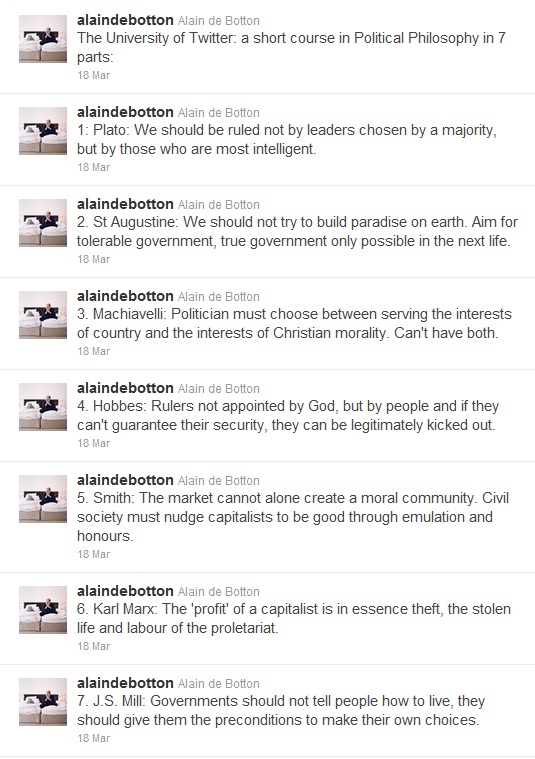
A delightful, insightful and helpful series of tweets on the 18th March from contemporary philosopher Alain de Botton.
I highly recommend his twitter feed, I find something helpful to me every time I visit. If you like that, you may want to check out the DVD or book of his series on Status Anxiety, another favourite of mine.
don’t put me in a box, man
Posted by kmcg2375 in education, personal, university on March 15, 2011
In honour of my wonderful students in English Curriculum Studies 1 who I suspect this week are getting a leeettle fed up with a seemingly endless web of theoretical models for curriculum and pedagogy.
But don’t worry, as Charlie would say, we are “winning“!
Peace!
Howard: Well, you know. About, me. I’m a free spirit, Vince.
Vince: Yeah?
Howard: Yeah I can’t be hemmed in. People try. They try to put me in a box, but I break free.
Vince: Who’s trying to put you in a box?
Howard: It’s the nature of me. It’s the nature of Howard Moon.
Vince: Who’s trying to put you in a box?
Howard: Well, people, you know. The Man.
Vince: Have you contacted the police about this?
Howard: No, “The Man”. You know what I’m talking about, yeah?
Vince: What are you on about?
Howard: People are always trying to put people in boxes.
Vince: No one’s trying to put you in a box. You’re the wrong size, for a start.
Howard: [sighing] Let’s forget about this conversation, okay?
Vince: How would you even get in a box?The Mighty Boosh, Series 1 Episode 8 ‘The Hitcher’
Women seal it with a kiss
Whether you liked the tone of Julia Gillard’s address to the US Congress or you thought it was an “unnecessary suck“, you can’t deny that she made some powerful statements. Her insistence that Trade = Jobs was a clear signal to Congress that a policy of trade with Australia would be of more benefit in the long run to the US economy than the protectionist farming subsidies that are currently under consideration.
The other powerful statement of course was the flaming red/orange (let’s call it vermilion?) jacket that she wore for the speech. It had such a visual impact, drawing the eye straight to her, guaranteeing she was the focus. It was so bright that it dulled the red in her own hair, and it also occurred to me that it was near enough to ‘Labor red’ to count as an attempt at branding.

Why am I so interested in Julia’s clothes?
I recently watched a TED Talk given by Madeleine Albright about being a woman and a diplomat. She told an excellent story about how and why she started using her jacket pins (or brooches) to symbolise her stance and attitude while she was Secretary of State. It’s a fascinating idea. On one hand of course so infuriating that women have to pay such close attention to their costume while men’s choices in business attire very rarely attracts a second glance. This only goes so far though – I guarantee that if a dude showed up to address congress in a bright red jacket, we’d be talking about it!
But the potential for using costume intentionally to codify our position or beliefs…I can’t say that I would rather we all wore grey suits cut from virtually the same cloth. And in this increasingly visual age isn’t it natural for us to increasingly draw on visual codes and conventions to communicate meaning?
If you haven’t come across Madeleine Albright’s talk before, I recommend it. It’s a 13 minute long interview and contains one of my new favourite quotes of all time:
There’s a special place in hell for women who don’t help each other.
Enjoy!
The English Teacher – Visual Rep.
Posted by kmcg2375 in education, english, online tools, university on March 6, 2011
In my English Curriculum Studies classes this week students should all be bringing in a bag containing five items that they think symbolise what they want to be as an English teacher. This activity is supposed to help stimulate discussion about discourses and people’s different philosophies of teaching. I’m going to do the activity too – so far I have a couple of ideas, but in the meantime I thought I would post this collage that I recently made as a visual representation of English teachers/teaching:

It was made using polyvore.com a favourite site of mine where you can make digital collages using ‘clippings’ from images on other sites. If you’ve never seen it then go check out some of the sets I’ve collected that I think could relate to the school curriculum – I hope it gets you thinking!
My Holga

This is the Holga camera that I picked up over the holiday in San Francisco, in an Urban Outfitters store. I bought it for $50USD – today I saw one in Typo in Brisbane for…$149.95! I’m so glad now I decided to impulse buy my little red Holga in January…
I first became interested in Holga photography when I saw photos that my friends were taking using apps on their phones. Apps such as Hipstamatic and Retro Camera allow you to use a range of cool ‘filters’ when snapping to give your pictures an antique feel. Here’s one that first caught my eye, which my friend Sarah took with Hipstamatic:

The story of the Holga camera is one that particularly caught my interest. From wikipedia:
The Holga camera was designed by T. M. Lee in 1981, and first appeared outside China in 1982 with its appearance in Hong Kong…The Holga was intended to provide an inexpensive mass-market camera for working-class Chinese in order to record family portraits and events.
Within a few years after the Holga’s introduction to foreign markets, some photographers began using the Holga for its surrealistic, impressionistic scenes for landscape, still life, portrait, and especially, street photography. These owners prized the Holga for its lack of precision, light leaks, and inexpensive qualities, which forced the photographer to concentrate on innovation and creative vision in place of increasingly expensive camera technology.
The most striking feature of the Holga and toy camera movement in general is the sense of counter cultre that is fostered through the rejection of digital photography technologies. Many users are adamant about this. Personally I like to swing both ways. The sheer novelty of taking a photo of someone and then telling them that no, they couldn’t see a preview of it on the screen (*shock*) made me an instant analogue camera convert. But waiting to develop whole rolls of film before I can work on an image…just for this reason I would never turn away from digital. That and the joys of super close up macro work.
Interestingly, when I went to develop the three rolls of film I had used, I found that only Big W develops film onsite anymore – Target, KMart and Camera House all send 35mm film away to get developed, usually to Melbourne which takes a week to come back. That can’t be encouraging for people trying to get into this wonderful technique/hobby 😦
I was really happy with the prints that came out of my first rolls of Holga photography. I used some hooks, string and mini pegs to make a disply for some of my favourites:

The Blender
Posted by kmcg2375 in education, technology, university on February 24, 2011
‘The Blender’ is the nickname for the Faculty of Education’s blended learning room at QUT, B.240
Our blended learning space is designed with six movable group hubs, each with an egg shaped table (really great design imo), movable chairs and a digital electronic workstation. There is also a store room containing a trolley of 20 laptops. Yesterday I went in to take some snaps:
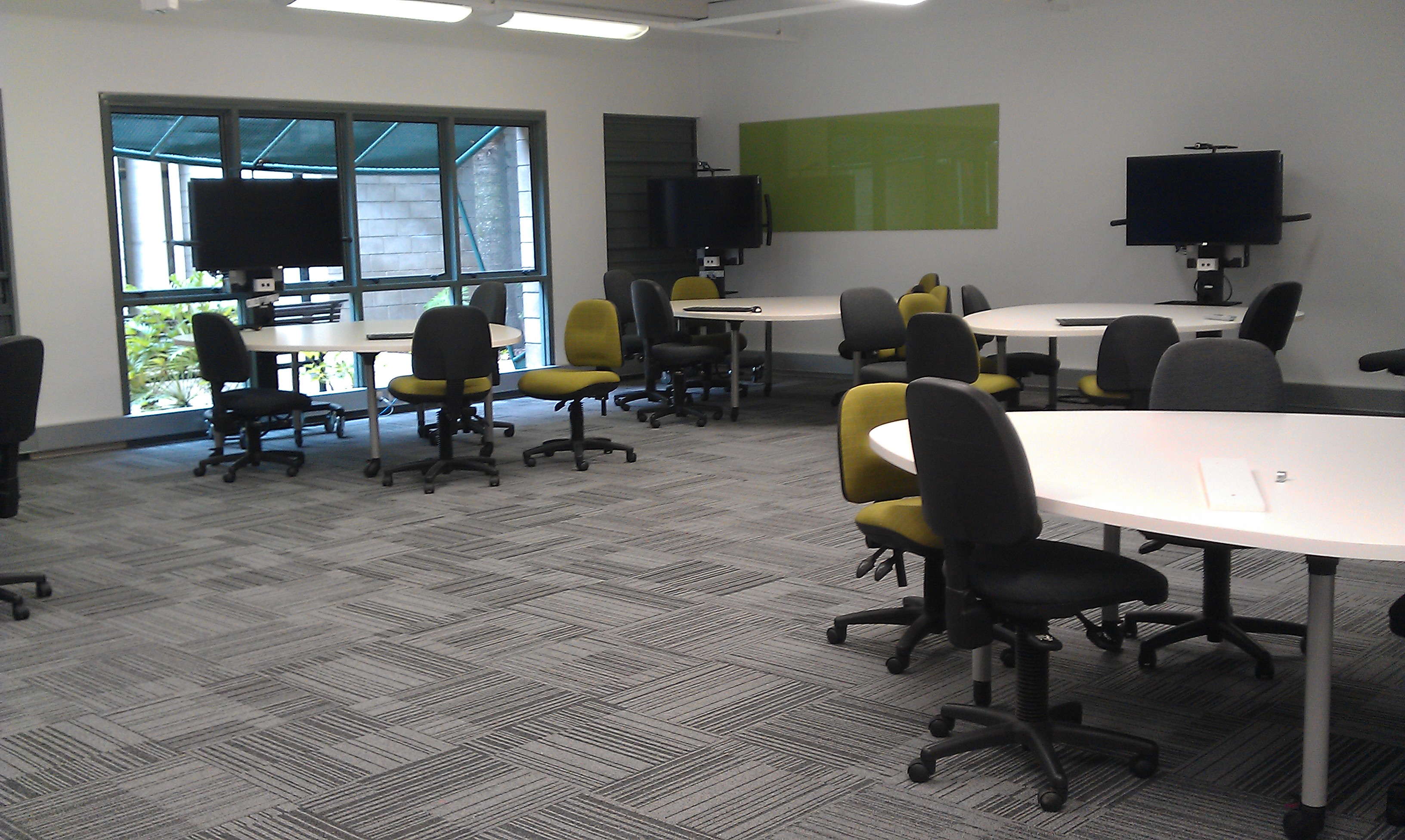


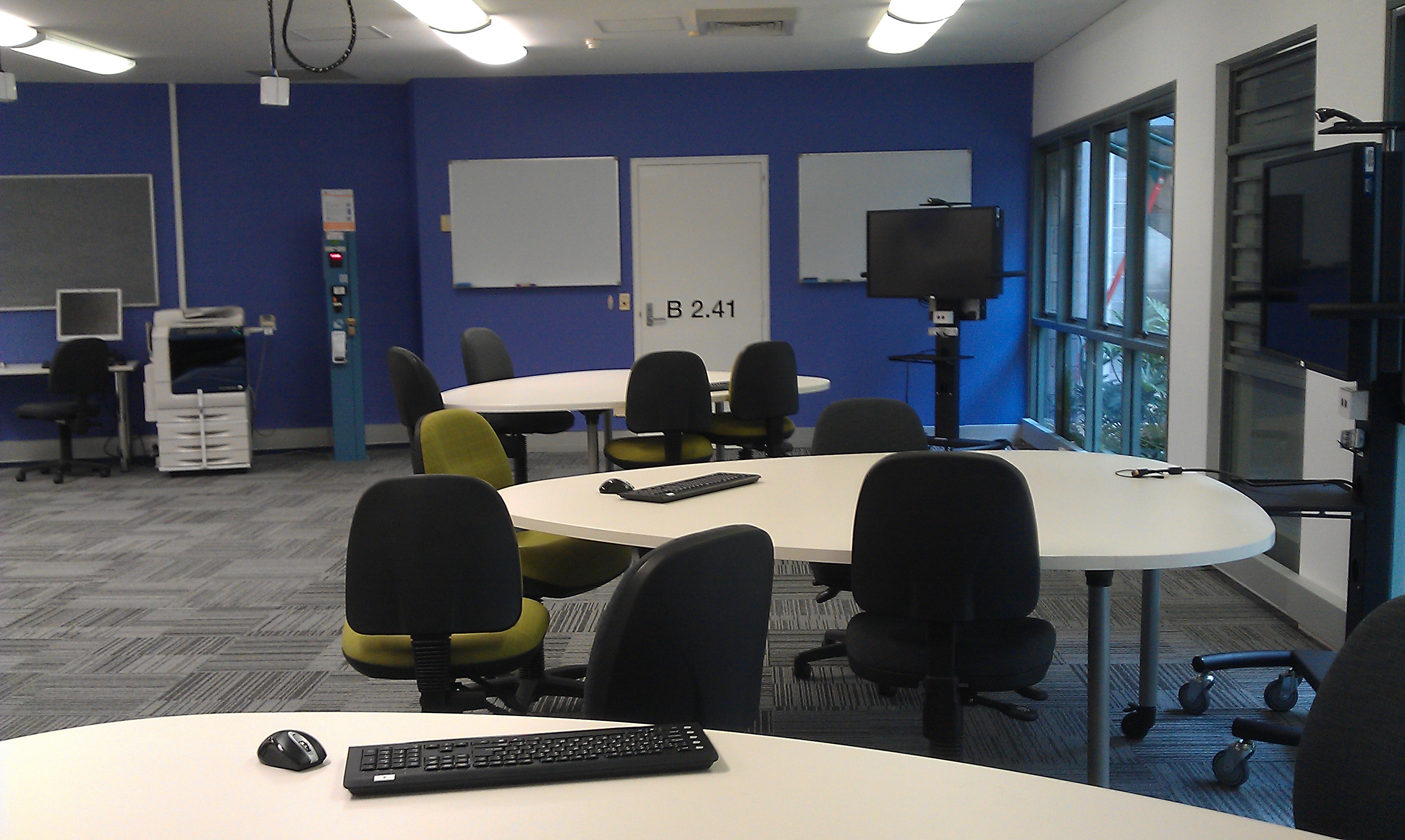
The question is: Will it Blend?
One of the features of blended learning is that it uses a mixture of synchronous and asynchronous instruction. To this end I have already created a unit blog and twitter account that will be used by activity groups in all lessons. Now comes the hard bit – how to change my pedagogy so that more than one thing can be going on in this room at once. This will involve considering:
- how I position myself in the room (which table do I sit at?)
- how to control group work noise (a struggle with year 9 anyway)
- how to create discrete ‘learning spaces’ (I want a cave and a campfire, but will work in a room shared by other teachers?)
- whether this room is as massive as it seems (the tables and chairs aren’t easily removed making the table/group setting an unavoidable focus).
My ideas so far include:
- students starting each tutorial at a table with their ‘reading group’ to reflect on the scholarly materials set for the week
- moving to whole class activity or teacher-lead discussion/screening (we could all come sit on the floor/roll our chairs into a theatre style for this)
- students all breaking away at some point into ‘activity groups’ (different to their ‘reading groups’) to engage in collaborative and connected learning activities
- having at all times a range of individual tasks (housed on the blog?) for students to work independently on (so no-one ends up sitting around doing nothing while one group member writes discussion notes on a blog etc.)
I love this room so much, and can see so much potential in it. I’d love to hear any ideas that other teachers have for using this space effectively…there’s a movie of the book already, lol:
My PLN: working with Bianca
Posted by kmcg2375 in education, online tools, personal, social media on February 21, 2011
Part of the re-vamp I’m undertaking of English Curriculum Studies 1 to ‘make it my own’ is to use the first tutorial as time to:
- get to know each other and form reading groups, and
- start the students building their online PLN, or personal learning network
I have also been picking the brain of my friend and colleague Bianca Hewes as I prepare materials on project based learning, or PBL.
Bianca is a key node in my personal learning network, and her thoughts, arguments and resource links pervade my personal learning environment – we follow each other on Twitter, read each others blogs and are connected as friends on Facebook. For me this illustrates two important elements I have found to be instrumental in building my PLN
- that learning happens everywhere (even in ‘personal’ spaces like Facebook)
- that a good learning environment is ‘personal’ in a very literal sense – friendly, generous and warm
It’s worth recording some of the building blocks of our collaboration thus far. I’ll pick up the thread where I saw Bianca’s tweeting away while she prepared English lessons for Term 1 at the end of the summer holiday and started asking questions, to which she replied:

I had heard about PBL, but hadn’t used it well so far myself. So I asked Bianca for some help because…well, that’s one of the lessons of this story really. She’s in my PLN. I know she’ll send me what she can, when she can. As a learner, I’ve had an opportunity to personally ask her though about what it is I want to know. And because I want to teach PBL, I know I need to learn more about it, and draw on the expertise of others:


SUCCESS! A willing expert!
To maximise Bianca’s willingness to let me pick her brain, I emailed her some more specific questions about what I wanted to learn:

Now Bianca is back at school and has preparing materials for her ‘Innovator’s Workshop’, while I’ve been busy working away on thesis corrections and planning the learning sequence for my English Curriculum Studies Unit CLB018. This has included making a blogging ‘hub’ for the tutorial groups to compliment the QUT Blackboard resources and a twitter account for unit related tweets. She’s created a Prezi with the information she would like to share about PBL with my class (yesss!) and now even if we don’t get a video interview or link of some sort as I had originally envisaged, I feel like I have enough material to move forward and teach this concept to my pre-service teachers.

Bianca’s Prezi includes a Common Craft video about personal learning networks, which links to the website for bie.org , so now I also have two killer links to refer people on to who are new to PBL. Are you? Why not watch the common craft video now, you’ve come this far:
So, THAT is the story of how having a PLN that you love and put energy into building pays back in spades.
If nothing else I hope that giving my students this path and these tools for expanding their personal learning environments will encourage them to look forward to learning again. If they read this post they will see that learning done well doesn’t limit itself to one space, one person, or one network. I won’t be able to teach them everything I think is important about English Curriculum in nine weeks, and that’s why equipping them with the motivation and capability to keep learning beyond week 9 is priority number one.
Thanks Bianca for being in my PLN and for being part of this story 🙂
Nominated!

- Australian English Teachers
 9 members
A group for English teachers in Australia to discuss the books they are reading, and the books th...
Books we've read
View this group on Goodreads »
Share book reviews and ratings with Australian English Teachers, and even join a book club on Goodreads.
 Kelli McGraw
Recent Comments