Archive for category technology
Challenges to developing a blended learning course
Posted by kmcg2375 in education, Lit_Review, online tools, research, social media, technology, university on June 17, 2011
This extract is from the article Development and Implementation of a “Blended” Teaching Course Environment in the most recent issue of JOLT:
Roadblocks/challenges to Developing a Blended Course
One of the biggest stumbling blocks to developing a blended course is the student fear factor. Many individuals in my class had never crafted a PowerPoint presentation, much less navigated in an online
discussion. Despite their familiarity with Web 2.0 tools like Facebook, MySpace, and instant messaging, the thought of being graded for online participation was somewhat threatening and intimidating. It was also difficult initially for students to understand the rationale for some assignments (such as Second Life). In future classes, more emphasis on business necessity, future usage, and SL current applications will be incorporated into the course pedagogy. Because there were many different types of assignments in this course (including group work, both on and off line), some students also expressed dissatisfaction with having to rely on team members. Use of the Team Agreement did however help to coalesce groups, and to give members a framework for expected behavior. Instructor feedback on the Team Agreement is essential in providing guidance regarding conflict resolution, assignment schedule, and interpersonal interaction among members.The blended model is a student-centered approach that allows the instructor to behave as a coach, a facilitator, and a cheerleader for his/her students. It is a way to let students lead in an environment in which they’re guided to success. In the words of Singh (2002, p. 476), “To be successful, blended [teaching]… needs to focus on combining the right delivery technologies to match the individual learning
objectives and transfer the appropriate knowledge and skills to the learner at the right time.”by Jacqueline Gilbert and Ricardo Flores-Zambada
Development and Implementation of a “Blended” Teaching Course Environment
Journal of Online Learning and Teaching, Vol. 7, No. 2, June 2011 pp. 244-260
This interests me because I have been considering including an assessment of online PLN participation in my unit next semester.
Given that this study found that “the thought of being graded for online participation was somewhat threatening and intimidating” for students, I’m going to avoid actually grading their participation per se. Rather, I’ve decided that students must show (in an assignment appendix) participation in their online PLN for the unit to achieve a Distinction (Grade ‘6’) or High Distinction (Grade ‘7’). That way, they either do it, or they don’t. They don’t have to feel anxious about quality.
Has anyone else done something similar to this? Making students demonstrate their PLN building? How can I do it – get them to attach a screen shot of three blog comments and five tweets? Would that suffice? Hmm…
Media – Definition
Posted by kmcg2375 in english, Lit_Review, social media, technology, university on June 8, 2011
Was looking for a good defintion for ‘medium’ in English and along the way have found my new go-to definition for media:
MEDIA as a word derives from the plural of Latin medium, meaning ‘middle’ or ‘between’ (hence ‘mediator’ as a ‘go-between’, also medieval, coined in the nineteenth century to label the age between the classical period and the Renaissance). From the early twentieth century, however, it has become increasingly common to talk of ‘the media’ (definite article and plural). The media thus understood mean two interrelated yet distinct things:
- those specifically modern technologies and modes of COMMUNICATION which enable people to communicate at a distance, characteristically through print (especially newspapers and magazines); the various telecommunications (‘tele-‘ comes from the Greek word for ‘far’, hence telegraph/’far-writing’, telephone/’far-sound’, television/’far-sight’), as well as film, video, cable, satellite and the Internet;
- by extension, the institutions which own and control these technologies as well as= the people who work for them (e.g, newspaper proprietors, TV and film companies, advertising agencies and governments, as well as reporters, camera operators, editors, producers, presenters, etc.).
Pope, R. (2002) The English Studies Book: An introduction to Language, Literature and Culture (2nd edition)Routledge, London. p.68
Chat to Hemingway 0.5
Posted by kmcg2375 in books, digital storytelling, english, learning community, technology, university on May 26, 2011
Having the best time right now chatting to Simon Groth’s chat bot.
Hemmingway 0.5 is a chat bot based on the character in the eponymous short story. You can chat to him about anything you like.
Simon is a real find. Made getting up today totally worth it!
Simon Groth is a writer and editor whose first two novels were shortlisted in the Queensland Premier’s Literary Awards and whose short fiction has been published in Australia and the United States. His co-edited collection Off The Record: 25 Years of Music Street Press (with Sean Sennett), was published in 2010.
Simon is the manager of if:book Australia, exploring digital futures for authors, readers, and publishers.
Do yourself a favour and go browse his site: http://simongroth.com/
At least go and chat to Hemmingway.
Evolution of storytelling
Posted by kmcg2375 in books, digital storytelling, english, social media, technology on May 25, 2011
I just came across this excellent illustration posted by Dan Sellars of the way that storytelling traditions have evlolved over time to reflect and utilise the technology available:
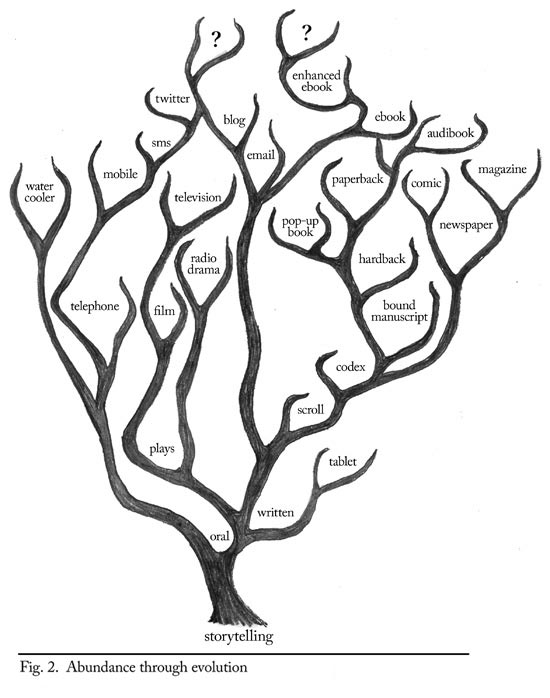
If you like that, you will no doubt also like another image he posted (in 2009) ‘Characters for an Epic Tale’. Check it out!
An Introduction to the CLDR Project
Posted by kmcg2375 in books, education, english, online tools, technology, university on May 3, 2011
Children’s Literature Digital Resources.
Australian schools can now access the full texts in this online resource.
Others can access the Auslit resource through university and other library databases.
The FOUR C’s
Posted by kmcg2375 in education, english, reflections, research, technology, university on March 30, 2011
We edu-tweeters often use the catchphrase ‘connect, collaborate, create’ to signal our pedagogical perspective.
But…what about this really important fourth C:
CRITICAL?
Surely this must become another essential C-word?
Motivation and Participation in Asynchronous Online Discussions
Posted by kmcg2375 in education, online tools, research, social media, technology, university on March 24, 2011
I was very interested to read the findings of Xie, Durrington and Yen (2011) published in the recently released issue of the Journal of Online Learning and Teaching. Given my current use of Twitter in my own university unit for preservice teachers, I was glad to read that others were also observing a relationship between participation in online asynchronous discussions and students’ level of motivation. I have reproduced their abstract here:
This study investigated the relationship between students’ motivation and their participation in asynchronous online discussions during a 16-week online course. Fifty-six students participated in
online discussion activities as a normal part of their classes. Their motivation for participating in online discussions was self-reported three times throughout the semester. The findings continue to
indicate that students’ motivation has a significant relationship with their participation in online discussion activities at time two and time three. Students’ perceived value, autonomy, competence,
and relatedness have different levels of impact on their online discussion behavior. This study also found that students’ intrinsic motivation and their perceived value of online discussions remained at a moderate-high level over time, although the perceived value had a significant drop from the midpoint to the end of the semester.Keywords: Asynchronous Online Discussion, Motivation, Distance Learning, Collaborative
Learning, Learning Community
Reading this article has motivated me to collect my own data in the next week of classes, to gather some initial responses from my own students. I look forward to hearing their views!
Hunting for twits
Posted by kmcg2375 in education, online tools, social media, technology, university on March 23, 2011
Of the roughly 85 students in my English Curriculum Studies unit, currently about 62 are following our class twitter account @CLB_018
No mean feat considering it is only week 4.
However, it is week 4 of a 9 week unit, meaning we’re almost half way done (eek! I still have so much to SAY!)
Aaaand, I’m aware that a small handful of those followers may be spamish.
So today I am embarking on a twit hunt – hunting through my list of followers to see who has not tweeted anything (many only joined for class and only follow the class profile). I’m going to DM each of them individually and privately to encourage them to participate.
Am I going overboard in doing this?
On one hand this looks exactly like the kind of time-consuming ‘tech monitoring’ that teachers often tell me they don’t like about teaching online.
On the other hand, I see it as analogous to checking students’ workbooks a few weeks in to term and pointing out their missing work. Is this something that University teachers see as beyond the scope of their ‘job’? I don’t.
But please – please – tell me if you think this is too much, or if this seems like a good strategy to you. Especially if you do something similar – did it work?
Change agents – Pirates vs Ninjas
Posted by kmcg2375 in education, social media, technology, university on March 22, 2011
I was prompted by Binaca today to look for an old post of mine on giving feedback to students. In my search I was delighted to find it had been almost exactly one year since I wrote this post about the tension caused by curriculum change, especially in regards to integrating ICTs:
Let’s make sure we’re applying the ‘too much is too much’ rule across the board, and not just as an excuse/a reason for neglecting the new. If what we mean is ‘we haven’t had enough PD to use this right’ then by all means say that. But there are some things that would be good to drop out of our current practice to make room for the new. One thing that we know about teaching is that no matter what you are taught to do, as a teacher you will instinctively model your practice on the teaching you received at school. Fighting against this instinct takes concentration, and learning about new practices and tools takes a lot of work. Because of this, teachers who are embracing technology are feeling increasingly overloaded and burnt out – this is the real problem that needs managing.
In a later post I tried to be more generative than reflective by reframing the process of change, suggesting that:
…as educational leaders, if we want to help people come to terms with change and embrace it, then we need to recognise and validate their desire to stick with ‘the known’…Recognising that people are resisting change because they feel disempowered helps us to employ methods that give power back.
These lines of thinking manifested in the lecture I gave today to preservice English teachers on how to navigate change amidst all of the ‘theories of text and response’ that they had learned so far.
You may be pleased (dismayed?) to watch how I liken the characteristics of change agents to either the NINJA or PIRATE side of the popular theoretical battle, Pirates vs Ninjas 😀
I think I am mostly pirate!
The Blender
Posted by kmcg2375 in education, technology, university on February 24, 2011
‘The Blender’ is the nickname for the Faculty of Education’s blended learning room at QUT, B.240
Our blended learning space is designed with six movable group hubs, each with an egg shaped table (really great design imo), movable chairs and a digital electronic workstation. There is also a store room containing a trolley of 20 laptops. Yesterday I went in to take some snaps:



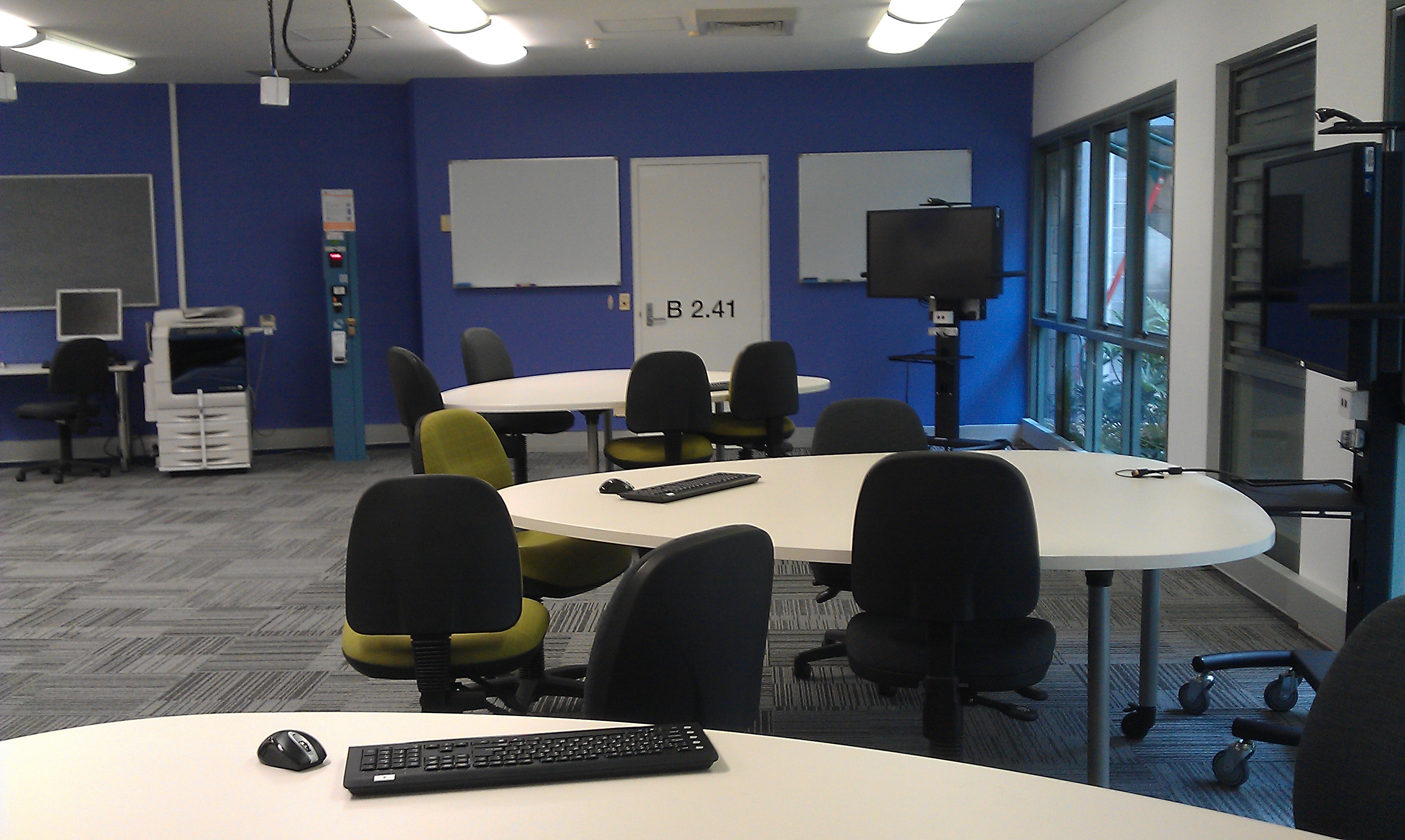
The question is: Will it Blend?
One of the features of blended learning is that it uses a mixture of synchronous and asynchronous instruction. To this end I have already created a unit blog and twitter account that will be used by activity groups in all lessons. Now comes the hard bit – how to change my pedagogy so that more than one thing can be going on in this room at once. This will involve considering:
- how I position myself in the room (which table do I sit at?)
- how to control group work noise (a struggle with year 9 anyway)
- how to create discrete ‘learning spaces’ (I want a cave and a campfire, but will work in a room shared by other teachers?)
- whether this room is as massive as it seems (the tables and chairs aren’t easily removed making the table/group setting an unavoidable focus).
My ideas so far include:
- students starting each tutorial at a table with their ‘reading group’ to reflect on the scholarly materials set for the week
- moving to whole class activity or teacher-lead discussion/screening (we could all come sit on the floor/roll our chairs into a theatre style for this)
- students all breaking away at some point into ‘activity groups’ (different to their ‘reading groups’) to engage in collaborative and connected learning activities
- having at all times a range of individual tasks (housed on the blog?) for students to work independently on (so no-one ends up sitting around doing nothing while one group member writes discussion notes on a blog etc.)
I love this room so much, and can see so much potential in it. I’d love to hear any ideas that other teachers have for using this space effectively…there’s a movie of the book already, lol:
-
You are currently browsing the archives for the technology category.
Nominated!

- Australian English Teachers
 9 members
A group for English teachers in Australia to discuss the books they are reading, and the books th...
Books we've read
View this group on Goodreads »
Share book reviews and ratings with Australian English Teachers, and even join a book club on Goodreads.
 Kelli McGraw
Recent Comments