Archive for category social media
This is why more English teachers should write a blog!
Posted by kmcg2375 in conferences, education, english, learning community, online tools, reflections, social media on October 7, 2012
English teachers who blog
I’ve just come home from the AATE 2012 national conference in Sydney. It was exceptionally energising to spend two whole days and nights talking face-to-face with people in my PLN, as well as getting to know my colleagues better and meet new people.
One of the sessions that I spoke in was a panel discussion on being a teacher that blogs. Here is a piccie of me with the other panellists @Darcy1968 and @BiancaH80 with our chair @melanne_k:
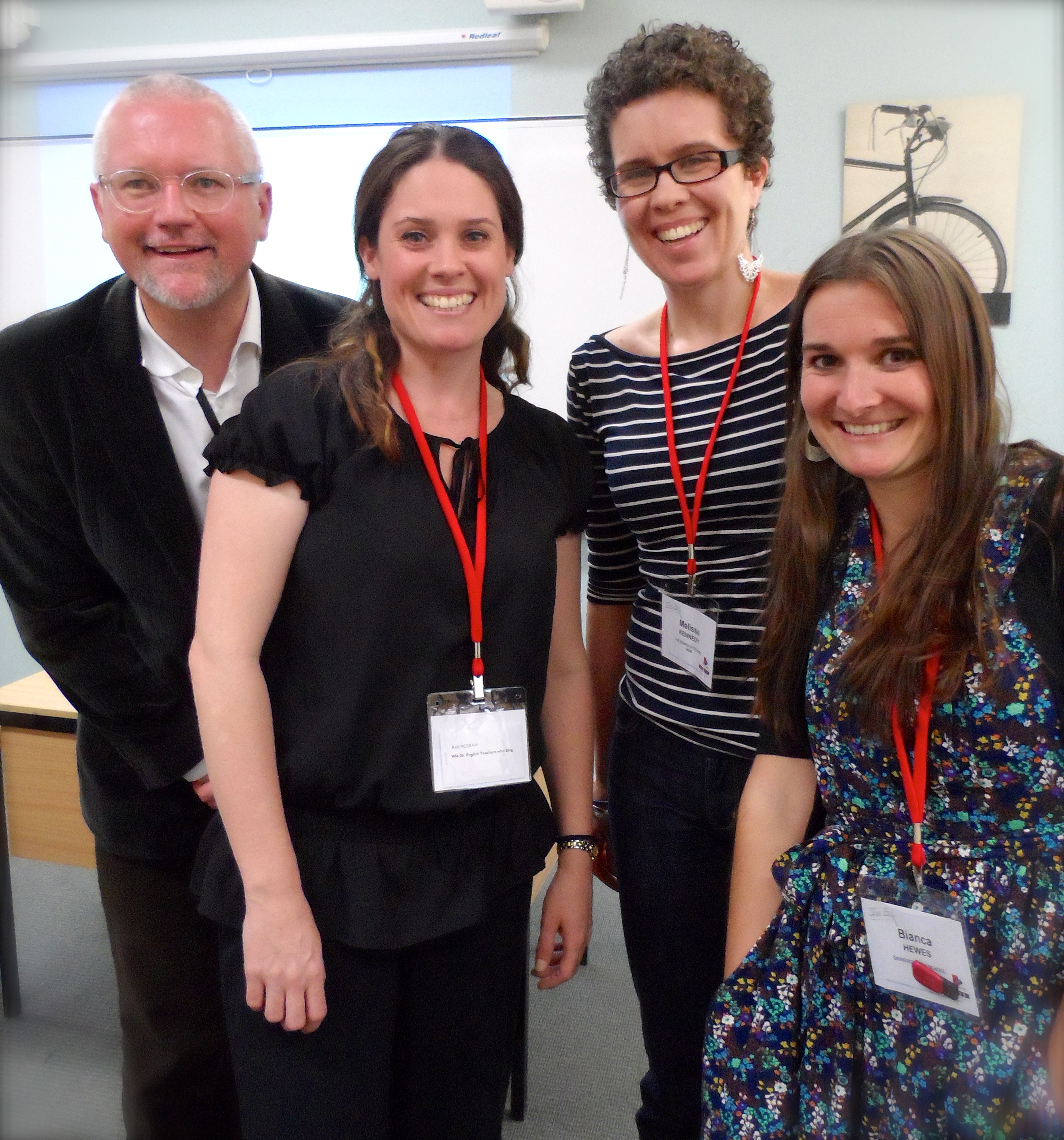
Darcy, Kelli, Melissa and Bianca
Why we need more voices online
There are so many things I would love to write a blog post about, based on ideas I heard or conversations I had at the AATE conference. BUT – I know I won’t get a chance to write about them all! So, the first reason that more teachers need to blog is to literally get more of these ideas recorded:
- Andrew Burn outlined a ‘3Cs’ model of media literacy – Cultural, Critical, Creative. How does this differ to other models of literacy (e.g. Green’s 3D model, Luke & Freebody’s 4 Resources model)?
- Bianca’s presentation on Project Based Learning emphasised the role of assessment. I have also found this to be very important, have others?
- Gillian Whitlock from UQ presented some really interesting ideas about humanitarian perspectives on literature and children’s writing. She showed refugee writing from Australia and artwork that had been created to memorialise the refugee journey. Definitely someone in Queensland to talk to or hear from again!
- The hashtag #5bells was used pretty successfully as a conference backchannel, I thought! What can we learn from this and how can we improve the experience for 2013 in Brisbane?
- Vivian (@vivimat78) did us all a big favour by collecting many of the #5bells tweets via storify…this is super helpful and valued, as hashtags are no longer searchable, after a time period, and we don’t want to lose all that great sharing!
- Vivian also coordinates the #ozengchat twitter chat and edmodo group. What relationship might exist in the future between AATE and #ozengchat? How can/do they support each other?
- We got to say so much to each other in real life (IRL)! Talking uses up soooo many characters! Face-to-face conversations are fun 🙂
- Hip Hop – OMG Adam Bradley was convincing. All the copies of his ‘anthology’ book sold out, and so many people left the keynote ready to exchange their cardigans for hoodies… In response I’ve started a Twitter list: trust-me-i-m-cool for teachers looking for Aussie Hip Hop links. One love!
- I found the closing keynote by Bill Green and Jane Mills to be quite problematic. I understand their point to be that linguistic frameworks have taken over the analysis of ‘the visual’, and that ‘cinephiles’ understand film in a much more ‘visceral’ way. I don’t agree. I think this contrast is weird, given the way I cry like a baby when reading some books, and (I believe) can successfully understand the moving image, thank-you-very-much. I usually love Bill’s stuff, but would rather have heard about his theories on ‘spatial literacy’ than be told English teachers are inadequate at teaching film…wrong crowd for that idea bill and jane, wrong crowd indeed.
I’m sure there is more, but these are the big ideas that I would ideally tackle in the next couple of months. Who will help me? (Will it be you?)
Don’t do it for me, do it for you!
In the panel that we did, quite a few people wanted to talk about how to get more people commenting on their posts. This is a good question, and our suggestions included:
- Comment on other people’s posts so that they come and visit your blog
- Let people know you have written a post by putting the URL up on Twitter (you’ll need an account)
- Use categories and tags wisely to help search engines find your post
However, I really do believe in the power of reflective writing for learning, and I encourage any new blogger to write posts for themselves as much as for an imaginary audience. It’s OK to talk to yourself here!
Think about it – how many times have you tried to convince a student to do a piece of reflective writing for homework, because you know the benefits it will have for their learning? Writing up your experiences on a blog can have the same benefit for you! The mere process of deciding “what will I publish information about this time?” will put you more in touch with the successes and obstacles in your practice, I really do believe this.
So that’s the second big reason. Start a blog for yourself, because if you haven’t yet, then I think you need to.
If you think you “can’t find time to write anything, ever”, then making time to do this will hopefully help you see ways to make time for other things too. And don’t worry – the blogging police aren’t going to arrest you if you don’t add anything for 3 months!
And because all good things come in threes…
The third reason why more English teachers should start a blog is because teachers who blog and share their resources are usually friendly, generous and just plain fun to hang out with.
And the more we share our work and resources, hopefully the more time we can put back in to spending quality time with our students, friends and families x
Voices from Elsewhere…
Posted by kmcg2375 in books, english, social media on August 31, 2012
I was recently directed to the Wheeler Centre website to take a look at the speeches and talks they had available to view and download.
Finding out about the Wheeler Centre was very interesting…did you know that Melbourne is one of UNESCO’s ‘Cities of Literature’? The Wheeler Centre was established to celebrate this:
Melbourne has a new kind of cultural institution. The Wheeler Centre – a centre dedicated to the discussion and practice of writing and ideas. Through a year-round programme of talks and lectures, readings and debates, we invite you to join the conversation.
Their slogan is ‘Books. Writing. Ideas.’
Isn’t that wonderful?
It wasn’t long before I found a resource that drew me straight in – I am a big fan of Nam Le’s collected short stories in The Boat and even set the book on our ETAQ Book Club list this year!
If you also like books, writing and ideas, please enjoy this 10 minute talk by Nam Le, on the theme ‘Voices from elsewhere’:

Why English teachers join professional associations
Posted by kmcg2375 in education, english, learning community, social media on August 26, 2012
In 2010 the English Teachers Association (NSW, Australia) celebrated 50 years of operation and service to members.
A DVD was released to members, with reflections from past and present ETA leaders. It is an excellent record of the history of the association and provides invaluable insights for new teachers!
I was surfing YouTube when I found that the ETA had uploaded the first section from the DVD onto the web. Here it is, roughly 8 minutes, on a range of teachers’ first involvement with the ETA:
My Pinterest Boards (and why I’m bothering to make some)
Posted by kmcg2375 in education, learning community, online tools, social media, university on July 16, 2012
For the first half of this year it seemed like all anyone was asking me was ‘do you have Pinterest?’
All throughout semester one, when I asked students about Twitter or Facebook or Tumblr, I was guaranteed to get a few voices around the room crying ‘Pinterest!’
It sounded like a cool tool. A virtual pinboard – just make a board on a topic or ‘interest’ (ahhhh… pin + interest = ‘pinterest’!), then add images and videos to it. Always a fan of putting posters on my bedroom wall, covering my school folder with pictures under contact paper, and putting stickers on random bits of stuff, this highly visual curation tool has always sounded promising to me.
I had made the decision in semester one, however, to steer clear of Pinterest. This choice was purely motivated by my fear of taking up another addictive web tool … the first semester of this year was just too busy already to attempt trying new things.
Some questions have also flown around over time about the ethics and copyright implications of re-pinning images without permission, and I confess this made me wary.
THIS SEMESTER, however, I am pinning!
My most promising board so far is the one I have made to collect links for the unit ‘Culture studies: Indigenous education’ (EDB007):

http://pinterest.com/kmcg2375/indigenous-studies/
I hope to engage students in my two tutorials by sharing the board with them and inviting them to explore the links I’ve collected/curated.
Of course, I could have chosen to share my links in other ways, but they all have their drawbacks:
- on a handout (which is not hyperlinked)
- in a Blackboard/LMS post (students hate and avoid Blackboard)
- using social bookmark sharing e.g. delicious (so far unsuccessful; students don’t use/engage)
My hope is that the visual nature of Pinterest, and the ability to browse it socially and on mobile devices, will entice a few students to explore the links I’ve found.
As far as the image copyright issue is concerned, I think I’ll just wait and see if any of these organisations complains, eh? I have done my best to attribute the images, that’s all I can say.
Last word:
This slide presentation by Joe Murphy (@libraryfuture) was really helpful for me:
Joe makes this observation:
“Pinterest succeeds at the juncture of the major online and content trends of:
- self curation
- image engagement and sharing
- visual search/discovery
- and social discovery”
In addition, points made in these slides about the potential of Pinterest to expand community engagement and open up services to diverse clients made me even more eager to try using this service as a teaching resource.
Here’s hoping my bid to invoke some ‘cool’ in my classroom pays off!
Pecha kucha at the first #TMBrisbane
Posted by kmcg2375 in conferences, education, learning community, online tools, social media on March 2, 2012

I really enjoyed meeting new people and hearing them share their work yesterday at the first TeachMeet in Brisbane.
Steve Box (@wholeboxndice) hosted the TeachMeet at Moreton Bay Boys College (thanks Steve!):

TeachMeet Brisbane
I presented a 7 minute pecha kucha on how to construct ‘fair’ assessment when using project-based learning (PBL).
My presentation included shout-outs to @BiancaH80 @malynmawby @Vormamim and @benpaddlesjones who are some of the wonderful people that have tweeted around ideas with me on my PBL journey. It was the first time I presented a pecha kucha and adhered strictly to all the rules! Making cards to help me stick to the topic helped a lot (something I haven’t done since school tbh):
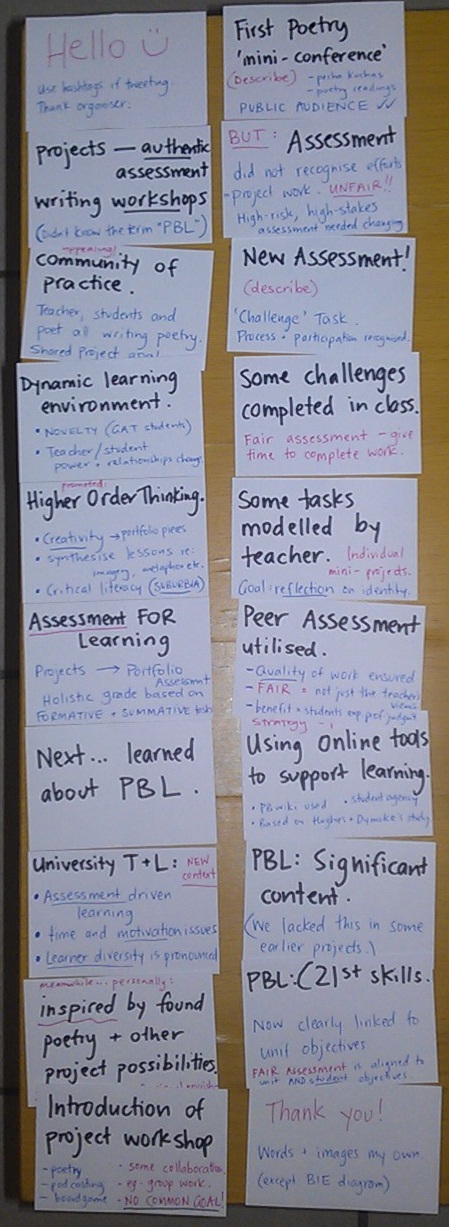
Actual palm cards - old school!
If you’d like to check them out I’ve put the slides up on slideshare. I hope that showing these resources helps future TeachMeeters plan their Pecha Kuchas – I loved the mode of presenting and highly recommend it!
Congratulations to TeachMeet Sydney on their WORLD RECORD ATTEMPT tonight! I hope the next #TMBrisbane event at the State Library of Queensland will be able to be video streamed online like #TMSydney was tonight, I had a ball watching along and tweeting with everyone from home 🙂
TeachMeet Brisbane
Posted by kmcg2375 in conferences, education, learning community, social media, technology on January 23, 2012
During 2011 a range of TeachMeets were held throughout Sydney. A central wiki was set up to coordinate the events and the hashtag #TMSydney ran hot during the meets.
The events were great successes, described by participants as welcoming, supporting and positive. This is not surprising, when you consider that the ethos behind the event is that it is strictly free professional development run ‘for teachers, by teachers’. What I thought was most attractive about the TeachMeet structure was the short presentations – either a 2 minute ‘nano-presentation or a 7 minute micro-presentation (or Pecha Kucha). It sounds like an ideal way to hear a little bit from a lot of people.
You can therefore imagine how stoked I was to hear that someone was organising the first ever TeachMeet in BRISBANE!
#TMBrisbane
TEACHMEET BRISBANE will be held from 4-6pm at Moreton Bay Boys’ College on Thursday 1st March 2012.
If you would like to register or get more information, you can visit and join the TMBrisbane wiki: http://tmbrisbane.wikispaces.com/
Of course, I was so excited to see the event come to Brissie that I had to volunteer to present. It will also be a great chance for me to refine my pecha kucha style!
(I also look forward to the #TMBrisbane hastag drawing together more of the Brisbane edu-community)
Pass it on
If you would like to be involved in TeachMeet Brisbane, or to support the event, take a look at the flyer available for download on the wiki.
In the Twittershpere you can participate in the backchannel from anywhere (not just Brisbane!) on March 1st by adding #TMBrisbane to your tweets.
Finally, this video about TeachMeets made for Sydney West is a great one to pass around to folk who are new to the TeachMeet concept…enjoy!
A transformative digital literacies pedagogy: Thomas (2011)
Posted by kmcg2375 in education, learning community, Lit_Review, online tools, research, social media, technology, university on November 17, 2011
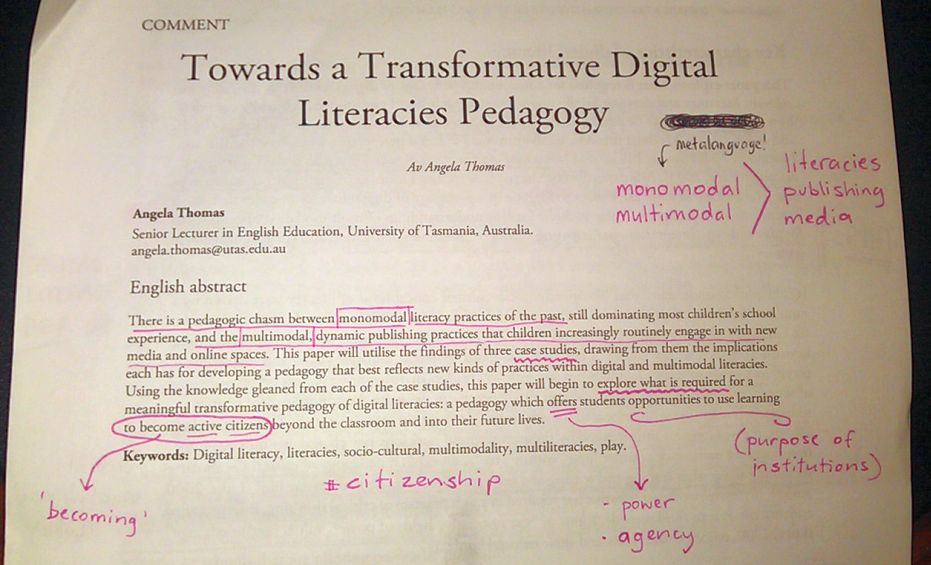
Thanks to @malynmawby @benpaddlejones and @Vormamim for engaging in tweety-chat today about play-based learning and transformational play.
There was an article that I wanted to post the full reference to – this one by Angela Thomas (@anyaixchel)
Thomas, A. (2011) Towards a transformational digital literacies pedagogy. Nordic Journal of Digital Literacy. Vol. 6 pp. 89-101
You can see the abstract for the paper with my own annotations, above.
In it she argues that there are:
a number of significant characteristics of digital literacy that are imperative to include in a pedagogy of digital literacy in order to make it a transformational pedagogy. These include: explicit understandings of multimodality, opportunities for play and experimentation, participating within communities of practice, and critical engagement with text.
I had picked this article up to read Angela’s findings about digital pedagogy, but it was a timely read. I am a big fan of the work of Paulo Freire, and of his work to empower communities through literacy. By bringing in Freire’s notion of ‘transformative pedagogies’ this article reaffirmed the need for critical, participatory and dialogic practices to be woven into the digital learning landscape.
I’d love to hear of other readings and resources along these lines, if you know of any…?
Use #etaq21c to ask me things tomorrow!
Posted by kmcg2375 in conferences, education, english, learning community, online tools, personal, social media, technology on August 19, 2011
More specifically, use #etaq21c to ask me questions about Digital Literacy and electronic text practices in English curriculum. The conference theme says it all: “English and Generation Next”
ETAQ’s Annual State Conference will be held atLourdes Hill College on Saturday 20 August. The theme is “English and Generation Next”.
The program will feature a keynote address by Professor Peter Holbrook from the University of Queensland’s School of English, Media Studies and Art History, a Q & A style panel session [that’s where I’m presenting!!], and a range of supporting workshops. Professor Holbrook’s address is entitled “Literature, Literacy, the Imagination, Freedom”.
So, if you are an English teacher, or if you are interested in digital texts and the future of the book, please, shoot some questions our way! You can post them here as a comment, but if you use Twitter then posting a comment or question there with the hashtag #etaq21c would Really Make My Day 🙂
I am soooo looking forward to this panel presentation! The full list of people in the panel session are:
- Professor Catherine Beavis (Griffith University and ETAQ Patron)
- Professor Peter Holbrook (University of Queensland)
- Kelli McGraw (Lecturer, QUT)
- Janina Drazek (Executive Director, Teaching and Learning, Education Queensland)
I’ll be talking about ‘acts of reading and writing’ and ‘digital pedagogy’.
JOLT: Balancing Quality and Workload in Asynchronous Online Discussions
Posted by kmcg2375 in education, learning community, Lit_Review, online tools, research, social media, technology, university on August 17, 2011
Of interest to teachers struggling to keep up with online discussions with their students!
Goldman, Zvi (2011) ‘Balancing Quality and Workload in Asynchronous Online Discussions: A Win-Win Approach for Students and Instructors’. Journal of Online Learning and Teaching. 7:2 pp.313-323
ABSTRACT: The challenge addressed in this article is how to achieve a win-win balance between quality and workload for students and instructors participating in asynchronous online discussions. A Discussion Guideline document including minimum requirements and best practices was developed to address this need. The approach covers three phases: design and development, setting up expectations, and launch and management. The goals of the approach, based on a commitment shared by all full time and adjunct faculty, are high quality of education as well as retention of both students and qualified instructors.
Further explanation of the research challenge from the introduction: “When discussions are regarded as critical components of learning, and administered as such, they impose a significant workload on both students and instructors. In applicable programs targeting practitioner adults, discussion sessions, during which much of the evidence-based learning and experience sharing occur, can easily consume half the course workload (Goldman, 2010). The reality is that neither students nor instructors can afford to dedicate an unlimited amount of time to fulfill course requirements or teach a course. Therefore, as a matter of practicality, discussion sessions should be carefully implemented to balance pedagogic quality and workload for students and instructors alike.”
Foucault THAT.
Posted by kmcg2375 in books, education, english, learning community, Lit_Review, online tools, politics, reflections, research, social media, technology, university on July 28, 2011
I have a confession to make.
Lately, I’ve been cheating on my blog. (In a good way, I promise!)
A colleague at my university, Clare O’Farrell, has an established Ning that is home to members of the Poststructuralist Theory ‘Special Interest Group’ of AARE. Established it so well, in fact, that it is one of the few Nings I know of (along with the English Companion) that continued to have happy users after stupid-Ning made its stupid-serivce un-free. Hmph.
Anyway, I use my space and profile on the ‘Ed Theory Ning’ to brain-vomit about (on?) theory that I don’t understand yet.
And it’s proven #very illuminating.
Increasing my activity in various groups on the Ning has also proven fruitful. Particularly in the ‘Daily Writing Club’ (we have to do exactly as it says…!) and now also from browsing the ‘Foucault reading group’.
That’s where I was reminded to check out Clare’s actual blog, Refracted Input, which I hadn’t done for ages. This month she is discussing a quote by Foucault about ‘race and colonialism’, and in it I can see a relationship to contemporary discourses around changing technologies.
The term ‘folklore’ is nothing but a hypocrisy of the ‘civilised’ who won’t take part in the game, and who want to hide their refusal to make contact under the mantle of respect for the picturesque…
Man is irrevocably a stranger to dawn. It needed our colonial way of thinking to believe that man could have remained faithful to his beginnings and that there was any place in the world where he could encounter the essence of the ‘primitive’. (trans. Clare O’Farrell)Michel Foucault, (1994) [1963] ‘Veilleur de la nuit des hommes’ In Dits et Ecrits vol. I. Paris: Gallimard, p. 232.

You see, I’ve been worrying about the ethics of what could be seen as meddling with teachers or students who are comfotable in their print-material ways, trying to prod them along to explore new technologies. I have wondered, ‘am I being selfish?’, ‘what if they have it right?’, ‘what if I’m destroying something important?’, and ‘am I wrong to advocate for my view, should I just wait and see what happens instead?’. But then, Clare’s wise words:
One cannot buy into the romanticism of the primitive – which is assumed to be so much closer to pure truth and ‘nature’. Conversely one cannot make the colonial assumption that one civilisation or one period of history (now) is more advanced and more evolved than another.
That’s right. I don’t need to worry about whether I’ll ‘wreck’ anything, unless I’m thinking of the people I’m meddling with as OTHER. And I was using pronouns to construct myself in opposition to other through all those damn self-doubts. I don’t need to do that. FOUCAULT THAT!
*Sigh of relief*
NB: Clare also curates a website on Michel Foucault, which includes a glossary of KEY CONCEPTS and other wonderful gems (thanks Clare!).
-
You are currently browsing the archives for the social media category.
Nominated!

- Australian English Teachers
 9 members
A group for English teachers in Australia to discuss the books they are reading, and the books th...
Books we've read
View this group on Goodreads »
Share book reviews and ratings with Australian English Teachers, and even join a book club on Goodreads.
 Kelli McGraw
Recent Comments