Archive for category english
Don’t delay – get involved NSW
Without a strong response from English teachers about what they like and don’t like about the Draft Australian Curriculum, the chances of it changing are slim to none.
Here are the details of consultation and information meetings happening in NSW in the coming month.
Remember, consultation ends in May, so make sure you respond as an individual, as a faculty, as a school, or as part of the profession through these meetings to make sure your voice is heard.
Because come 2011, it’ll be too late to argue.
NSW English Teachers’ Association consultation meetings:
Saturday 20th March 9.30am – 3.30pm
- Sydney: Seminar Rooms, DET Curriculum Directorate.
- Armidale: Armidale High School
- Border: Albury High School
- Orange District: Canobolas High School
- Peel Valley: Quirindi High School
- Wagga: Wagga Wagga High School
http://www.englishteacher.com.au/downloads/FlyerNCK10Consult.pdf
NSW BOS consultation meetings:
- 9 March – Campbelltown Golf Club
- 16 March – Tara Anglican School
- 11 March – UNE Tamworth Centre
- 15 March – Trinity Catholic College Senior Campus Goulburn
- 18 March – [VIDEOCONFERENCE] State Government Offices Wollongong
http://www.boardofstudies.nsw.edu.au/australian-curriculum/
NSW DET online consultation forums:
Videoconferences held at various locations from 4pm-6pm
ACARA will also be running a Public Information Session for New South Wales on:
Thursday 25 March 6pm – 7:30pm
Venue is TBA, but most likely will be in Sydney.
Why I fight for my curriculum
Posted by kmcg2375 in english, technology on March 4, 2010
Some interesting conversations have converged for (on?) me this week following the release of the draft Australian Curriculum. Discussions with Roger Pryor and Jan Green through tweets and blog posts about the power of social networks and leadership have challenged me to be more optimistic about what will happen in classrooms after the launch of the National Curriculum.
Roger and Jan are both advocates of leadership models where participative (loose) practices within the school can mediate the directive (tight) policy environment and accountability systems within which we work. In a post to her blog Jan describes being filled with confidence for the future of students because of the powerful and passionate debate about national curriculum taking place between education professionals through social networks. On this point I certainly agree. In this brave new world of federal curriculum control strong leaders and their PLNs will be key in influencing the spread of new ideas and practices.
But optimism about curriculum enactment is not enough for me.
Tonight I have been re-reading a paper by Colin Lankshear that identifies dominant meanings of literacy and related reform proposals, and I would like to quote him here at some length:
The meanings of literacy in educational reform discourse and their associated modes of “doing and being around texts” are both informed by and intended to inform ideals and practices of literacy much more generally. They are also intended to permeate larger “social ways of doing and being” – such as being workers, citizens, parents, consumers, and members of organisations – that are mediated by texts.
…Hence, investigating meanings of literacy in educational reform proposals also involves asking what (and whose) perspectives, priorities, and world views prevail within them.
…Reform proposals are like scripts, frames, or “cultural models.” They encode values intended to change people and social practices – and which will change people and practices to a greater or lesser extent depending on how fully they get implemented in practice.
…The key question here is: what kids of “visions” for life, people, and practices more generally, are encoded in these scripts?
Lankshear is discussing literacy here, which for me is apt as it is the English curriculum that is of most concern to me. But his observations about educational reform apply to all curriculum areas.
Just a few days on from the release of the draft Australian Curriculum for English, my biggest problem with its “vision” for English is the constraint of new literacies. Even if we were to accept the (100 year old) notion of Language, Literature and Literacy being divorced as separate ‘strands’, the lack of reference to explicit spoken and visual ‘skills’ in the Language strand is a gross neglect in this curriculum reform. This is without doubt a reaction to conservative media hype about ‘dumbed down’ curriculum, and a pandering to parent-voters who will feel reassured by a ‘back to basics’, ‘3Rs’ approach to teaching English.
While I too am hopeful that schools will be able to implement this curriculum in meaningful, ‘loose’ ways, it simply isn’t good enough to stand back and let through a script that, as Lankshear insists, will change people and practices, in such a retrograde way. English teachers have fought long and hard for rich and generative definitions of literacy, and of what it means to understand and create meaning in a wide range of texts.
*sigh*
What are we going to do?
The Australian Curriculum for English
As we have already heard from our trusty newspapers (who magically had obtained copies prior to release) we have much to look forward to in the Australian Curriculum for English:
The curriculum takes a more traditional view of literature than has been apparent in some states in the past decade or so. – Justine Ferrari in The Australian 27 Feb
Senior educationists believe the new curriculum for students in kindergarten to Year 10, due to come into force next year, has been infiltrated by fringe lobby groups seeking to include issues such as multiculturalism, indigenous rights, ethical behaviour and sustainable living. – Joe Hildebrand & Bruce McDougall in Daily Tele 27 Feb
GRAMMAR will be front and centre of the federal government’s new national English curriculum. – Stephanie Pealting in SMH 28 Feb
AUSTRALIA’s new national school curriculum is to be unveiled today in a long overdue recognition of the need to return the three Rs to the classroom. – Editorial in The Herald Sun 28 Feb
Though, we already knew all this earlier in the week from Julia Gillard’s address to the National Press Club.
ALL states and territories will be forced to follow a set program for teaching reading under the first national English curriculum, which stipulates the letters, sounds and words students must learn in each year of school. – Justine Ferrari in The Australian 25 Feb
Education Minister Julia Gillard told the National Press Club yesterday that, for the first time, grammar would be taught at all levels of school and parents would have a chance to comment directly on what their children would learn. – Scott Hannaford in The Canberra Times 25 Feb
Actually, we have known that this was coming ever since the release of the National Curriculum Shaping Paper [PDF link] back in May 2009. The Shape of the Australian Curriculum: English paper proposed that K-10 curriculum in English be organised around three interrelated strands:
- Language: The Language strand involves the development of a coherent, dynamic and evolving body of knowledge about the English language and how it works.
- Literature: Students learn to interpret, appreciate, evaluate and create literary texts such as narrative, poetry, prose, plays, film and multimodal texts, in spoken, print and digital/online contexts.
- Literacy: Students apply their English skills and knowledge to read, view, speak, listen to, write and create a growing repertoire of texts.
The separation of these strands sure is nice and neat. Cute even…the alliteration could appeal to some English teachers.
But while these separate strands might be neat, they have resulted in precisely what English teachers feared: a regression to a 100 year old teaching approach that divorces the learning of the mechanics of ‘language’ from the learning of the feelings, values and ideas it represents. We’re trying to teach communicators, not copy-typists! But, predictably, here are some of the content descriptors for what students must learn from the Language strand of the 7-10 curriculum for English:
- Resources for creating cohesive texts including identifying reference items, the use of substitution and ellipsis, relationships between vocabulary items, and the role of text connectives (Year 7)
- Understanding spelling rules including origins, word endings, Greek and Latin roots, base words, suffixes, prefixes, spelling patterns and generalisations (Year 7)
- Sentences can consist of a number of independent and dependent clauses combined in a variety of ways (Year 8 )
- Purpose of devices used by authors including symbolism, analogy and allusion (Year 8 )
- Language can be multi-layered, resulting in varying interpretations (Year 9) (…a bit late to learn this?)
- Information can be condensed by collapsing a clause into a noun phrase (nominalisation) (Year 9)
- Different perspectives can be introduced by citing the words and views of others
- Construction of multimodal and digital texts involves knowledge of visual grammar (Year 10) (visual literacy…finally!)
Developing skills in reading and writing is something that I value, that English teachers universally value. But skills such as spelling, grammar and syntax should be taught as means of building a student’s own representational world, rather than as ends in themselves.
Without a clear pedagogical direction that guides teachers to embed language learning within quality literacy and literature teaching, as well as differentiate language learning for students reading at different levels, the Australian English Curriculum will doom countless future students to exercises in disconnected rote learning and grammar drills. Will your child be one of them?
Visit the ACARA website for information on how to submit your views. Have your say about the experience you want your children and students to have by responding during the consultation period from 1 March 2010 to the end of May 2010.
Ten rules for writing fiction
I came across this link today – it is one of the best articles I have ever seen about writing fiction.
Inspired by Elmore Leonard’s 10 Rules of Writing, The Guardian newspaper asked authors for their personal rules for writing. The rules often apply not just to writing long novels, but also to writing short stories…some of the rules are hilarious, and some are applicable to life in general, not just to writing! (Make sure you click through to the second part of the article as well – loads more ‘rules’)
I would love to do an activity with these – perhaps a jigsaw group activity, or something where students were given a random selection to read and discuss. They could make a poster of their favourite rule/s for the classroom wall. They could form their own sets of rules…
Here are some of the rules that I like best:
- Forget the boring old dictum “write about what you know”. Instead, seek out an unknown yet knowable area of experience that’s going to enhance your understanding of the world and write about that. – Rose Tremain
- Do keep a thesaurus, but in the shed at the back of the garden or behind the fridge, somewhere that demands travel or effort. Chances are the words that come into your head will do fine, eg “horse”, “ran”, “said”. – Roddy Doyle
- Take a pencil to write with on aeroplanes. Pens leak. But if the pencil breaks, you can’t sharpen it on the plane, because you can’t take knives with you. Therefore: take two pencils. – Margaret Atwood
- Description is hard. Remember that all description is an opinion about the world. Find a place to stand. – Anne Enright
- Marry somebody you love and who thinks you being a writer’s a good idea. – Richard Ford
- The reader is a friend, not an adversary, not a spectator. – Jonathan Franzen
- Never complain of being misunderstood. You can choose to be understood, or you can choose not to. – David Hare
- The nearest I have to a rule is a Post-it on the wall in front of my desk saying “Faire et se taire” (Flaubert), which I translate for myself as “Shut up and get on with it.” – Helen Simpson
- Remember writing doesn’t love you. It doesn’t care. Nevertheless, it can behave with remarkable generosity. Speak well of it, encourage others, pass it on. – Al Kennedy
Love it 😀 Good writing IS hard work, and students need to understand this if they want to refine their abilities. It can also be a lonely task, solitary and isolating, and remembering that there is a whole community of writers out there, bunkered down at their desks and struggling to keep themselves in check, is a comfort.
Do English teachers hate going to the movies?
How many times have you been asked this question? It might have also sounded like this:
“Miss, has being an English teacher, like, killed every book for you?”
“Do you end up analysing every scene in a movie all the time?”
“Honey, can’t you just enjoy the story?” 😉
Re-reading through Jack Thompson’s first chapter in Reconstructing Literature Teaching I have just found the best answer ever to these questions! Thompson quotes Selden (1985, p.3):
Readers may believe that theories and concepts will only deaden the spontaneity of their response to literary works. They may forget that ‘spontaneous’ discourse about literature is unconsciously dependent on the theorising of older generations. Their talk of ‘feeling’, ‘imagination’, ‘genius’, ‘sincerity’ and ‘reality’ is full of dead theory which is sanctified by time and has become part of the language of common sense.
Wonderful, huh? I couldn’t have said it better myself. ‘Dead theory’…I’m gonna use that one!
My English faculty Moodle
Posted by kmcg2375 in english, technology on February 3, 2010
I’ve been working on my faculty Moodle course this past week at my high school, and wanted to share some of what we are doing in English. I’d love some critique, and ideas for what has worked well in other English faculties specifically.
I have set our faculty area of the Moodle up with the following courses:
- Year 7 English
- Year 8 English
- Year 9 English
- Year 10 English
- Standard English Prelim
- Advanced English Prelim
- Standard English HSC
- Advanced English HSC
- English Extension 1 Prelim
- English Extension 1 HSC
- English Extension 2 HSC
- Fundamentals of English (Years 11-12)
Each course is set to topics view, and begins with 2-4 topics that are relevant to the entire course. For example, in the Year 10 course:
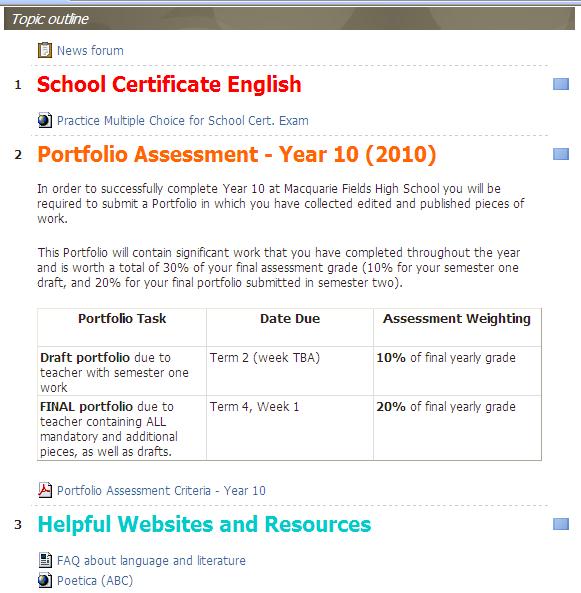
Underneath the general course information topics, each class has been given a topic area – individual teachers will maintain their own class topic area, adding information and resources throughout the year. Here is an example of one Year 7 teacher’s class information:

Am I on the right track here? I didn’t want to make a whole course for each class – too cumbersome. And I’m setting up class ‘groups’ in each course now. Has anyone else had experience with this? Any advice?
Bush Slam (ABC)
Bush Slam, a great resource for teaching Australian poetry is available now for free download (for a limited time) from the ABC website:
http://www.abc.net.au/tv/bushslam/video.htm
Bush Slam puts poets and poetry in motion across Australia to discover the true spirit of the country.
Our host H.G. Nelson (Greig Pickhaver) is at the wheel of the Bush Slam bus, each week taking two very different poets to explore a rural community and meet its people. Each is given just three days to capture the heart of the town in verse – and then the tricky bit, to perform their work before the locals in a live head-to-head poetry slam for a thumbs-up or a thumbs-down!
Together, their writing covers a vast spectrum of styles, from bush poetry, to country, to hip hop.
Episodes 1-4 (of 6) can currently be downloaded as WMV or MP4 files. Enjoy!
Electronic Poetry
I found this great site full of creative writing resources (languageisavirus.com), which includes a range of electronic poetry kits. You can choose from poets such as ee cummings and Jack Kerouac – I chose Sylvia Plath, and here is the poem that I made:

I also recommend the poetry, slam poetry and spoken word videos that are housed on the site.
Hit Refresh!
Posted by kmcg2375 in conferences, english, online tools, social media, technology on December 4, 2009
Last weekend I attended the English Teachers’ Association Annual Conference in NSW, which was held at the University of NSW on Friday 27th and Saturday 28th of November. The conference theme was ‘Hit Refresh!’, so it was apt that this was the first conference we have run that had an officially constructed online aspect, using both Ning and Twitter to engage presenters and participants in discussion and networking before, after, and behind the scenes of the conference.
This (longish) post is a report I wrote on the success of these online tools at the conference.

Many educators by now have heard of ‘blogs’, ‘wikis’, and learning management systems such as Moodle, and hopefully we are fast approaching a time where the these strange names and terms are accepted as useful (rather than childish) jargon. In the meantime, jokes about the ‘Ning-nang-nong’ and Twitter users being ‘twits’ will abound. But while these tools might sound goofy, they are anything but.
Ning.com is an online tool that is fast gaining popularity with educators. It combines many other features for writing and connecting online – such as being able to have a personal profile page, make ‘friends’ with other members of the Ning, write blog entries, add to discussion forums, and join sub-groups – and for that reason the term Ning was coined to describe the NetworkING that occurs on the site. For our conference we created a Ning a few months ahead of the conference (http://etaconf09.ning.com/), set up all of our conference workshops, presentation, keynotes and plenaries as ‘events’, invited presenters (first, then later, people who had registered for the conference)…and waited.
The response was slow but sure. Before the conference had even started we had 70 people who had joined as members of the Ning. ETA committee members and presenters who were keen to explore the Ning started adding discussions and material right away. New presenters felt welcomed and included in the lead up to conference, and could ask questions and establish contacts with others before arriving on the big day. On the Thursday before the conference, the number of members had grown to 130. Many more joined up during and following the conference, and the count currently stands at 230 members. Some presenters used the Ning directly in their workshops, getting participants to add their own questions, ideas and resources. Many people were glad to have an easy way of contacting and keeping in contact with other members, and as many people did upload information about themselves, including a photo to their profile, there was a definite sense of familiarity and closeness at the ‘real life’ conference between Ning users.
As well as establishing a conference Ning, the micro-blogging service Twitter.com was used to ‘tweet’ short, 140 character updates from the conference, in particular from the Saturday morning panel on National Curriculum. This allowed attendees to create a ‘backchannel’ at the conference, communicating with others from around the globe, as well as other members at the conference, about events as they happened. Before the conference I blogged a description of a backchannel, which was used at the conference to explain the concept.
As this was our first attempt at using a backchannel, we decided not to display the tweets live on a big screen behind the speakers – though this is something that is occurring frequently now at many conferences that use a backchannel. For our own, and the speakers’ peace of mind, Darcy Moore and I fielded questions and comments that came in via Twitter at the same time as chairing the panel and the real-life questions from bodies inside the auditorium, and integrated these into the plenary. The response was very positive, and people (speakers included) only seemed disappointed that we didn’t display the tweets on the big screen!
So, next year we are bound to do this again, with the screen on live display. Using technology this way can be risky of course, as there is far less control being exercised when members can publish their unfettered thoughts for all to see. But the benefits of this far outweigh the risk, and the message from members was ‘bring it on!’
Increasingly, educators are connecting online in very powerful ways. This includes English teachers. As online tools become easier to use to connect, communicate and collaborate with colleagues they are being seen as more of a joy (and a time saver) than a chore. I heartily encourage other professional associations to consider adopting online elements for future conferences and events, and would be happy to share ideas and advice with anyone who is going in that direction.
Anyone else care to share their experiences or tips?
English Teachers: Waving, not Drowning
Posted by kmcg2375 in english, online tools, technology on December 2, 2009

I have Google Wave!
Well, I’ve had it for a week now, but have had no-one to play with in it (on it?), so effectively I didn’t have it at all.
But now I have Wave buddies 🙂 And so the messing around begins!
I’m joined by fellow English teachers and Tweeps Bianca (@BiancaH80), Julie (@JulBain), Darcy (@Darcy1968) and soon also Troy (@TroyM7).
The Negative Nancy in me is screaming “Don’t bother! They’re never gonna let you use anything this USEFUL in school anyway (because lewd images and pervy old people COULD be on a Wave too – QUICK EVERYONE, HIDE THE KIDS!)”. But after using it for not very long at all, you just know that this is one of those things that is going to have a big impact on how we ‘do’ activities, lessons, even school. Web 2.0 tools have opened up a whole new world of collaborative working and creating, but the way Google Wave uses in-text editing, integration of images and video, real-time editing (you can see each other type!) and, perhaps most excitingly, playback (so you can see additions and comments appear in the order they were added)…it just has oodles of potential that I am only just comprehending. And best – it’s really FUN to use!
Just now, I have started a collaborative poem with my English teaching ‘Wavers’ – I wrote in a couple of lines, and hopefully others will add and we’ll see how it goes. (I would love ideas for other English-y activities/tasks for us teachers to trial on a Wave, if you have any?)
Maybe this is what I find the most fun – getting to try old activities in new ways by testing them on myself!
Or, is it the real feeling of a ‘playground’ that I’m getting by making a collaborative Wave with my peers?
All I know is that tonight, with Twitter AND Wave going bananas, I felt like a teen on MSN or something! My PLN just got so much more…personal. I wonder if the novelty is going to wear off?
-
You are currently browsing the archives for the english category.
Nominated!

- Australian English Teachers
 9 members
A group for English teachers in Australia to discuss the books they are reading, and the books th...
Books we've read
View this group on Goodreads »
Share book reviews and ratings with Australian English Teachers, and even join a book club on Goodreads.
 Kelli McGraw
Recent Comments