Archive for category education
Next Stop: AERA! and AARE, and AATE…
Posted by kmcg2375 in conferences, education, english, learning community, research, university on October 31, 2011
When you have a research paper to present, choosing the right conference to take it to is important.
I have long been affiliated with the Australian Association for Research in Education (AARE). When I first started out as a postgrad student, I used to go to their conferences to present papers, and I even was elected as student rep. to the Executive Committee. I also had one of those awful experiences of being a small fish in a giant pond, and having only three people turn up for me to deliver my paper to. Devo’d…In the end I ultimately stopped being involved in AARE because I needed to narrow my focus and concentrate on English curriculum teaching and scholarship.
Since then I’ve been going to the annual conference of the Australian Association for Teachers of English (AATE) – every year since 2004! And this year is no exception – I’ll be in Melbourne for the AATE conference in December (will you?). Only, for the first time in awhile, I’ll be heading to the AARE conference too, in Hobart the week before. With more skills in networking under my belt, and a clearer direction for engaging with the ‘special interest groups’, I’m feeling really positive about reconnecting with AARE and sharing my PhD findings there.
For me though, as far as big, generalist conferences go, AARE was always plenty big enough – and having developed an instinct to narrow my scope rather than broaden it, I didn’t think I would ever attend the EVEN BIGGER, EVEN BROADER, international ‘annual meeting’ of the American Educational Research Association (AERA)…
But, attend it I am!
Both the paper and group session I submitted have been accepted to AERA 2012, which will be held in Vancouver in April next year:
Curriculum Change and Resistance: Challenges Identified During the Implementation of An Expansive State English Curriculum.
This paper presents the findings of a doctoral study that undertook a content analysis of a corpus of curriculum texts, news reports and case interviews with teachers during a period of curriculum change in the Australian state of New South Wales.
Producing the young citizen in texts of families, neighbourhoods and nations
This session critically analyses popular fiction, nonfiction and television texts for children and young people focusing on sexuality, sexual safety, bullying and heroism. Each of the selected texts can be understood as a pedagogical apparatus that works to instantiate children and young people as particular subjects and objects of knowledge. (with Gannon, Lampert, Bethune and Gonick)
So, let’s count ’em up: AATE and AARE in December; I already went to ALEA and IFTE earlier in the year; AERA in 2012.
That’s FIVE amazing conferences in 12 months!
And one BUSY girl 
Totally worth it 🙂
(By the way…’what’s with all the four letter acronyms starting with A’, I hear you ask? Tell me about it! Took the first year of my research degree to decipher this shiz! And the kind of ugly websites of AERA and AARE…you can tell all of their energy goes into research!)
I’m a public school teacher and I vote
I’ve been reading Darcy Moore’s series of posts about the Gonski Review, which recently concluded and posed this question:
How much data do we need to tell us that a well-educated, motivated teacher in an appropriately funded, resourced and supported school, freed from bureaucratic regulation, can give students what they need?
Darcy makes some excellent points about the resourcing of schools that is needed for a ‘high equity, high quality’ schooling system in Australia.
I want to add to these today simply by reminding people that Public schooling – the kind that is provided for free to all young people in Australia – is an institution that is particularly worth fighting for in this time of change.
While Public schooling often suffers at the hands of bureaucratic micro-management and ill-conceived Government initiatives, this is a scenario that can change.
What WILL NOT CHANGE, unless there is a drastic shift in the proportion of funding provided to Public schools (not just the amount), is the cultural hierarchy of schooling in Australia that sees greater choice and opportunity for those young people whose parents can afford it.
I went to a public school. There were never enough material resources, never enough flexibility…but I know other schools that had it worse.
I’ve seen the inside of the ELITE Private schools in NSW, Queensland and Victoria. There is no excuse for sustaining a system that provides some children with tennis courts, cricket pitches and drama theatres, when teachers at other local schools are penny-pinching to buy more whiteboard markers.

Your school has boats?
It is disturbing to see people speaking in hushed tones around the issue of the Gonski Review, seemingly frightened to suggest that IT’S NOT ALRIGHT for some families to buy their way into status and social advantage. And I don’t care to hear about people who “really are supporting a middle class family, working three jobs to afford the school fees”.
What gives a family the right to withdraw and segregate their children from the social fabric that others are relying on for the project of “diversity” to actually work?

Gated School Communities
Of course I will always be committed to working at University and through Professional Associations to help prepare and develop excellent English teachers to work in every school sector…but, as a school teacher, I will only ever work in the PUBLIC sector. I will not teach in other sectors; they can’t buy my labour. So, if you find yourself wondering whether Public schools really are worth fighting for, in this day and age, know this:
TEACHERS THAT ARE LOYAL TO PUBLIC SCHOOLS STILL EXIST.
PARENTS THAT BELIEVE IN PUBLIC SCHOOLS STILL EXIST.
STUDENTS THAT LOVE THEIR PUBLIC SCHOOL GRADUATE EVERY YEAR.
WE ALL VOTE.
…AND WE ARE ONLY GETTING MORE RESILIENT AND DETERMINED.
Did you just realise you don’t know what the Gonski Review is?
NEVER FEAR! YOU CAN STILL SUBMIT A RESPONSE (until 30 September 2011)
Catch up on the story so far – the Gonski schools funding review has been through all of the boring phases, and we are now in the throws of watching various stakeholders campaign during these LAST CHANCE weeks for submission of public responses to the review.
Angelo Gavrielatos provides an excellent summary (from the AEU perspective) here:
And if, like me, you find it hard to find any information about how to submit a response online (funny that…) here is the link to the page you need:
http://www.deewr.gov.au/Schooling/ReviewofFunding/Pages/PaperCommissionedResearch.aspx
The panel invited submissions on the issues reflected in the Emerging Issues Paper between
16 December 2010 and 31 March 2011. This submission process has now closed.A Paper on Commissioned Research will also be released on 31 August 2011, along with four research reports. Submissions will be accepted until 30 September 2011.
Please note that all public submissions to the review panel will close on 30 September 2011.
The panel will release further details of its work through panel communiqués as the review progresses. Register online to have announcements and communiqués sent to you by email.
REVISION
ONTONOLGY
ASCETICS
DEONTONOLGY
TELEOLOGY
Revise.
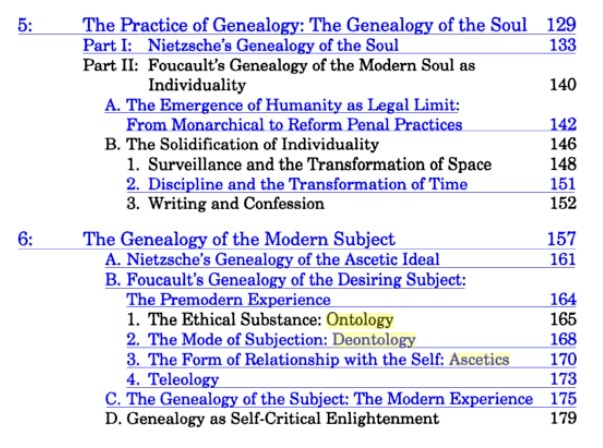
Foucault's Nietzschean genealogy: truth, power, and the subject By Michael Mahon
and…Heidegger paraphrashed: It is not that we first begin from an inner subjective sphere (a la Descartes) and from there go out to meet things in the world; rather, we are always already ‘outside’ among things. (Kisner, W. 2008: ‘The Fourfold Revisited’)
Sheesh. Philosophy. Any ideas anyone?
Pedagogy or assessment – what comes first in PBL?
Posted by kmcg2375 in education, reflections, research, university on September 5, 2011
So many things to blog about at the moment…transmedia and transliteracy, the Gonski review of school funding…but in the thick of Semester 2 teaching I find myself inexorably drawn back to curriculum studies.
And goddess, please bless Bianca for coming through with a new blog post about Project Based Learning (PBL) to stimulate my thinking this week!
I have been trying to work out how to formally incorporate PBL into the structure of my unit English Curriculum Studies 1. This week I think I have a solution, which I’ll outline below. But first, to answer Bianca’s question: when I proposed this structure in a comment on her blog she asked:
Did you design the assessments or the pedagogy first?
And that question, RIGHT THERE, is our chicken and egg, am I right?
 Because, as Bianca rightly points out, school teachers find it very challenging to engage in “inherent ‘assessment for learning’ within the rigid ‘assessment of learning’ framework already in place”. So, while it might seem logical that your pedagogy will determine your assessment, the ‘reality’ of teaching and learning puts this possibility beyond reach for most.
For some schools their ‘rigid assessment of learning framework’ is tied to NAPLAN exams, for others it is focussed more on Year 12 exit credentials. And in schools that claim not to be driven by external assessments, rigid assessment frameworks can still be constructed by Heads of Department (or others) who seek to place multiple additional constraints on teachers’ planning (e.g. “you MUST have a half yearly exam!”, “every Year 9 class must write an essay in term 1”)
The curriculum places constraints on assessment and pedagogy too, and I could start talking about the Australian Curriculum here. Instead I’ll show you what I built for the university semester context, and try to answer Bianca’s question from there.
Here is the draft outline for my unit in 2012:
- Weeks 1-4 focus: Inquiry based learning (assessment = critical/reflective essay) assessment as learning
- Weeks 5-7 focus: Project based learning (assessment = project + review of pedagogy used in class project) assessment for learning
- Weeks 8-9 focus: Challenge based learning (assessment = make lesson plans for English) assessment of learning
I can safely say that for this unit, I started with the assessment. Literally, I have adopted an existing unit with existing assessment pieces that take at least 6 months to get formally changed. So, while I have been tweaking each assessment piece each semester, I’ve been teaching it for 18 months now and a full overhaul of the structure is now needed to fully incorporate PBL and other constructivist approaches.
Beyond that initial point of departure though, I have oscillated between a pedagogy focus and an assessment focus each time I plan and change something in the unit.
I would say my major points of development around pedagogy and assessment were:
- Reviewing the balance of assessment FOR learning and OF learning in the existing unit. In the university context it is only possible to mandate summative assessment…so I had to reconsider my approach to build a learning environment where the learning process was valued.
- Reviewing the first summative assessment, which was a critical essay, gave me the idea to make the relevance or ‘connectedness’ of the opening weeks of the unit more apparent. Students now do a range of inquiry-based activities to help them engage in the scholarly material, motivated by the need to interrogate their own perspective.
- Activities planned for the first few weeks of the unit were redesigned around a new assessment that focussed on the students personal teaching philosophy. This increased the potential of the assessment to be FOR learning, I thought.
- Teaching the new opening to the unit was really affirming, but showed up the weaknesses in the pedagogy of weeks 5-7. A PBL approach was therefore introduced to ‘liven up’ this part of the unit. This coincides with the time in semester when students begin having heaps of assignments due, and I felt they needed a pedagogical experience that was less ‘intense’, and enjoyable enough to get them through the ‘hump weeks’!
- The PBL appraoch worked really well, but the students put a lot of work in that wasn’t rewarded in assignment grades. So I am now redesigning assignment 2 to include ‘project participation’ criteria so students can get their work on this counted in their final grade.
- aaand…MOST recently: because the final assessment of creating alesson plans really has proven a ‘challenge’, I’m going to use this to explore Challenge based learning. I see this as being the same as Project based learning, but where the outcome does not have to be presentation to an audience. Instead, the project outcome must ‘meet the challenge’. Think Mythbusters 🙂
You can see how thinking about assessment and pedagogy are totally bound together – thinking about one always raises questions for the other. Or, it should!
I’m still searching for material that can explain the realtionship between Inquiry, Project and Challenge based learning. I’ve tried to use them here in a complementary way, but tbh it’s been tough to find sources that relate the approaches to one another. I started off this process thinking they were slightly interchangable. Now I can see that each one is informed by a respect for ‘learning by doing’, but has its own unique flavour. But are these three the only three? Do they sit in a hierarchy of some kind? Are there other ‘Something-B-Ls’ out there that I don’t know about??
Who knows.
If you do, please add a comment! (I hope this helps someone out there!)
Apathy and politics: Omar Musa @MWF
In this week’s episode of Q&A (from the Melbourne Writer’s Festival) there was some interesting discussion about young people and apathy in politics.
I was especially glad to head from Omar Musa, an award winning Australian slam poet who my students recently brought to my attention. An extract from the episode transcript follows; the full episode can currently be viewed on the ABC website (http://www.abc.net.au/tv/qanda/txt/s3299482.htm):
OMAR MUSA: I can’t speak for previous generations but when I talk for my generation, I see a lot of selfishness. I see a lot of materialism. I see a lot of superficiality and I think that’s something that we should all be – as artists we should all speak up against. I mean I think people have enjoyed such a good standard of living for so long in Australia, that – all right there’s – from the way I see it, there’s two different types of apathetic people in Australia. There are those who are apathetic because they feel that the government is not properly representing them and that they have no alternative choice and then there are those who are apathetic because they feel so entitled to this prosperity that we have that they can’t feel any sense of compassion to those who are vulnerable and, you know, I think that’s something we need to interrogate as a society, you know. I just see that there are problems in this society. I mean I’m proud to be Australian but, you know, as someone who is patriotic, I feel that it’s my responsibility to criticise and to ask these sort of questions about our past. Why is a dog whistle – always, you know, it invariably works in Australian politics. I mean a pugilistic wing nut like, you know, Tony Abbott almost won the last election by using the dog whistle when most people don’t even like the guy, you know. And so why is it that that sort of stuff works.
TONY JONES: In that same poem, My Generation, you talk about witnessing Prime Ministers slain, hush coups in the halls of parliament house. I mean does that sort of taint your view of politics, when you see something like that happen?
OMAR MUSA: Yeah, definitely. I mean it’s got to a point where it feels like it’s a choice between the devil and deep blue sea, you know. You’ve got this pugilistic knob head on one side and then you’ve got this sort of gutless wonder on the other and so I understand that – the young lady that asked the first question, I understand that feeling of apathy but I guess it’s times like this when it’s more necessary than ever to speak up and to question these sort of things.
These sentiments were followed by some very stirring words by Afghani activist and writer of A Woman Among Warlords Malalai Joya including the insistance that
The silence of the good people is worse than the action of the bad people.
I wonder what role I will play in the grand scheme of de-apathising the ‘youth of today’, including my own generation? Surely the answer must lie in art, like Omar’s poetry, and in active protest, like Malalai’s…not just in retweeting exclamations of outrage and sharing witty remarks about news articles on Facebook? Not that I’d be without those things mind you 😉
EXCURSION!
Posted by kmcg2375 in education, english, learning community, university on August 22, 2011
I’m planning my first University excursion 😀
With my small class of six students studying their Grad. Dip. in Education (secondary English), I will be heading into Brisbane city to attend events that are part of the Global Poetics Tour:

Slam poets Jive, Ken and Mahogany will be slamming into Brisbane for the Australian Poetry Slam competition, which has its second Brisbane Heat on Friday 9th September. I think that’s the event we’ll be going to…although the Sunday event also looks pretty appealing: Black Star Tribute ‘Words or Whatever’ at the Black Star Cafe in West End.
I wonder what event my students will choose for the excursion – we make the selection in tomorrow’s tutorial!

Use #etaq21c to ask me things tomorrow!
Posted by kmcg2375 in conferences, education, english, learning community, online tools, personal, social media, technology on August 19, 2011
More specifically, use #etaq21c to ask me questions about Digital Literacy and electronic text practices in English curriculum. The conference theme says it all: “English and Generation Next”
ETAQ’s Annual State Conference will be held atLourdes Hill College on Saturday 20 August. The theme is “English and Generation Next”.
The program will feature a keynote address by Professor Peter Holbrook from the University of Queensland’s School of English, Media Studies and Art History, a Q & A style panel session [that’s where I’m presenting!!], and a range of supporting workshops. Professor Holbrook’s address is entitled “Literature, Literacy, the Imagination, Freedom”.
So, if you are an English teacher, or if you are interested in digital texts and the future of the book, please, shoot some questions our way! You can post them here as a comment, but if you use Twitter then posting a comment or question there with the hashtag #etaq21c would Really Make My Day 🙂
I am soooo looking forward to this panel presentation! The full list of people in the panel session are:
- Professor Catherine Beavis (Griffith University and ETAQ Patron)
- Professor Peter Holbrook (University of Queensland)
- Kelli McGraw (Lecturer, QUT)
- Janina Drazek (Executive Director, Teaching and Learning, Education Queensland)
I’ll be talking about ‘acts of reading and writing’ and ‘digital pedagogy’.
JOLT: Balancing Quality and Workload in Asynchronous Online Discussions
Posted by kmcg2375 in education, learning community, Lit_Review, online tools, research, social media, technology, university on August 17, 2011
Of interest to teachers struggling to keep up with online discussions with their students!
Goldman, Zvi (2011) ‘Balancing Quality and Workload in Asynchronous Online Discussions: A Win-Win Approach for Students and Instructors’. Journal of Online Learning and Teaching. 7:2 pp.313-323
ABSTRACT: The challenge addressed in this article is how to achieve a win-win balance between quality and workload for students and instructors participating in asynchronous online discussions. A Discussion Guideline document including minimum requirements and best practices was developed to address this need. The approach covers three phases: design and development, setting up expectations, and launch and management. The goals of the approach, based on a commitment shared by all full time and adjunct faculty, are high quality of education as well as retention of both students and qualified instructors.
Further explanation of the research challenge from the introduction: “When discussions are regarded as critical components of learning, and administered as such, they impose a significant workload on both students and instructors. In applicable programs targeting practitioner adults, discussion sessions, during which much of the evidence-based learning and experience sharing occur, can easily consume half the course workload (Goldman, 2010). The reality is that neither students nor instructors can afford to dedicate an unlimited amount of time to fulfill course requirements or teach a course. Therefore, as a matter of practicality, discussion sessions should be carefully implemented to balance pedagogic quality and workload for students and instructors alike.”
Gamification and Behaviourism
Posted by kmcg2375 in education, politics, research, technology, video games on August 12, 2011
I dig gamification. I also dig Games Based Learning (GBL).
But sometimes when I’m watching these concepts get promoted, big alarms go off in my head.
Take a look at this list of some key elements of gamification:
- Points
- Badges
- Levels
- Challenges
- Leaderboards
- Rewards
- Onboarding
Doesn’t this remind you of anything? Add that together with our enthusiastic embrace of digital and electronic teaching, and the ‘games & machines’ motif becomes really familiar. I’m thinking Skinner, and Behaviourism, and Pavlov’s dog…which means that we need to think about the ethics of gamification, stat.
-
You are currently browsing the archives for the education category.
Nominated!

- Australian English Teachers
 9 members
A group for English teachers in Australia to discuss the books they are reading, and the books th...
Books we've read
View this group on Goodreads »
Share book reviews and ratings with Australian English Teachers, and even join a book club on Goodreads.
 Kelli McGraw
Recent Comments