Archive for category education
What Giroux said…
Posted by kmcg2375 in conferences, education, politics on April 16, 2012
…in his address at the launch of the Werklund Foundation Center for Youth Leadership Education in Calgary.
Before coming to the 2012 AERA conference I had the absolute pleasure of attending the Inaugural International Youth Studies Congress at the University of Calgary.
As well as hearing from distinguishes scholars, teachers and students on issues relating to youth studies, the major highlight for me (and tbh, the carrot that helped me decide to attend in the first place), was the keynote address by Henry Giroux.
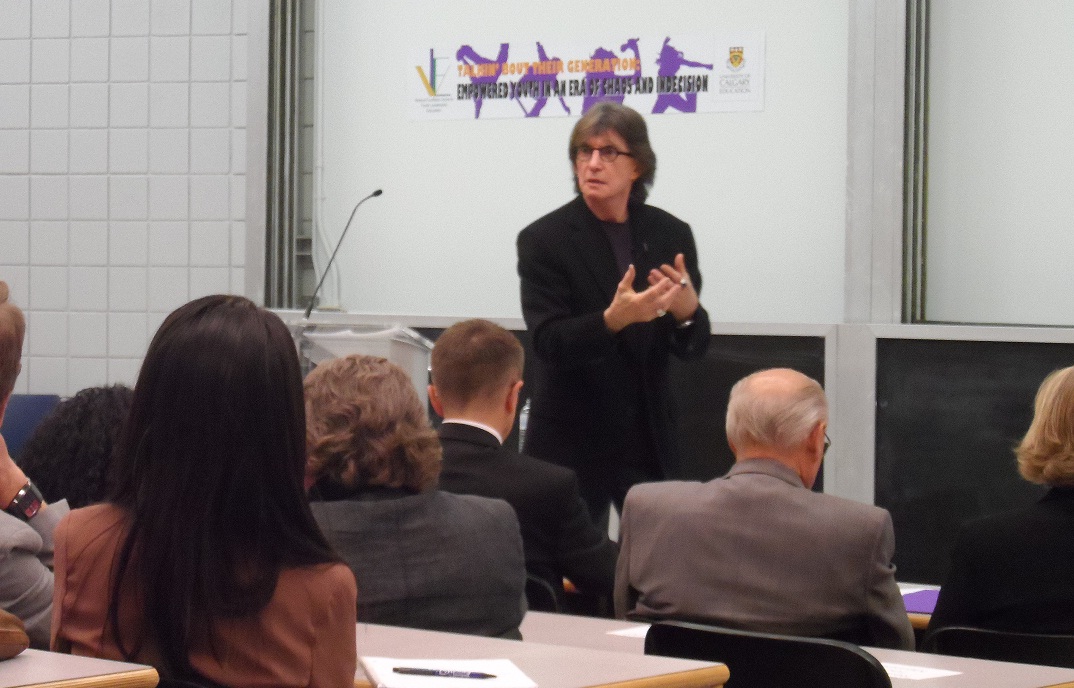
#whatgirouxlookslike
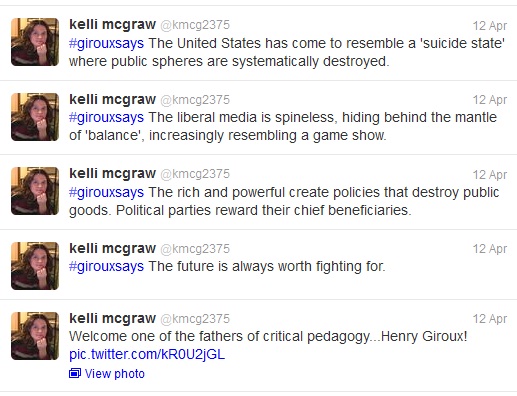
If you consider yourself a ‘radical’ educator and have not yet read Giroux’s work, I highly recommend it! He is doubly awesome in my book, given his commitment to getting his scholarly thoughts out into the wider-read public domain. I thought it very fitting, therefore, that I should tweet the ideas from his talk that stood out most for me.
You can read the gist of his talk in this op-ed article: The ‘Suicidal State’ and the War on Youth.
(NB: I accidentally tweeted the term ‘suicide state’ instead of ‘suicidal state’. Oops…)
I used the hashtag #girouxsays to mark the tweets…given the fickle, temporal life cycle of hashtag searches, I’ve collected them all here for y/our convenience and later reference:


A big shout out to Shirley Steinberg, the Werklund Foundation Chair in Youth Leadership Education, for hosting this inaugural event. She’s kind of a big deal in the fields of #radical_education #freire_project #critical_pedagogy – loved hearing more about this work! (my radical itch was in need of a scratch…)
Finding my Threshold Concepts
Posted by kmcg2375 in education, learning community, reflections, research, university on April 4, 2012
This semester I have been engaing in the final cycle of my teaching and learning action research project – part of what I do here at QUT as an ‘Early Career Academic’.
‘Constructing a community of practice in English Curriculum Studies 1 – online and offline’
Action research cycle:
- Planning and fact-finding: 2010, semester 2
- Phase 1 action: 2011, semester 1
- Phase 2 action: 2011, semester 2
- Phase 3 action: 2012, semester 1
- Report findings: 2012, semester 2
The buzz term for how to ‘do’ curriculum planning here at uni is constructive alignment. Anyone else having to use this term?
Basically, constructive alignment is what you do when you make sure your assessment tasks match your learning objectives, and that your lesson materials feed into this productively. (OK, so I slipped the word ‘productively’ in just there…can you tell I’m living in Queensland? Productive pedagogies, anyone?)
So, the first two phases of my action research have been all about getting the assessments to work for me and my unit, English Curriculum Studies 1. I inherited a bunch of learning objectives when I took on coordination of this unit, but in the end I found that the assessment tasks weren’t engaging students in the ways I knew could happen. In the ways I was sure could happen, anyway. All of the assessment pieces have now been modified or replaced (not allowed to change the learning objectives) and things are aligning much more constructively…
The last piece in the puzzle that I was really hoping to nut out in this third cycle is the establishment of threshold concepts for this unit.
A ‘threshold concept’ is the kind of concept that, once learned, cannot be unlearned. Once we grasp a piece of threshold knowledge, we pass over a barrier into new territory, where everything is seen anew with different eyes.
In the (bazillion) Powerpoint presentations I sat through last year as a new academic, I picked up the importance of using a few well-chosen threshold concepts to drive a unit of work. For teachers like me that prefer to use project-based and inquiry-based learning approaches, having a set of threshold concepts in mind that you want students to ‘get’ by the end of the experience looks to be an excellent anchor for lesson planning. Although these concepts are related to the official learning objectives of the unit, they do serve a different kind of function…and I really want to settle on what mine are!
Until this week I was still struggling to come up with suitable concepts.
But now, I struggle NO MORE!
I have been working on a summary video for students to watch at the half-way point in semester, while I am away at a conference. In the video I want to recap the main points learned from weeks 1-5 of the unit. The process of trying to identify what the ‘big ideas’ were amongst all of the super important stuff we learned wasn’t easy. But the process of having to present the ideas to my students (not just to my academic review panel at the end of this year…!) has really helped.
Which I guess just goes to show that even teachers need an authentic audience for their work.
Trying to keep the video short (under 5 minutes) also forced my hand – left to my own devices, I’m sure I could find plenty of threshold concepts, but you only need a few. The wording of what I’ve chosen isn’t quite right yet, but these are the six big points I have chosen:
- Your personal teacher identity is unique and reflects your personal experience, but will inevitably draw on many established philosophies and practices.
- In ‘English’ we study: semiotics, text and context.
- Language codes and conventions are socially constructed.
- Verbal/linguistic language is just one semiotic ‘code’; we also learn/teach audio, visual, spatial and gestural language.
- Literacy involves more than code breaking – we also make meaning, use texts functionally, and critique texts.
- Multiliteracies pedagogies are currently favoured in English curriculum theory.
I suspect this is still too many for 6 weeks, but there you go. We’ll see. Once I’ve finished the video I’ll post it up here on the blog. I still have to add the narration, but most of the images are in. I’m using Movie Maker and Audacity as my tools of the trade…I hope the students have time to watch the bloody thing! But even if they don’t, I’m glad I went through this process and am happy that I’ve found some threshold concepts to settle on, for now. And, with any luck, a shiny new resource at the end I can be proud of. Fingers crossed!
Pecha kucha at the first #TMBrisbane
Posted by kmcg2375 in conferences, education, learning community, online tools, social media on March 2, 2012

I really enjoyed meeting new people and hearing them share their work yesterday at the first TeachMeet in Brisbane.
Steve Box (@wholeboxndice) hosted the TeachMeet at Moreton Bay Boys College (thanks Steve!):

TeachMeet Brisbane
I presented a 7 minute pecha kucha on how to construct ‘fair’ assessment when using project-based learning (PBL).
My presentation included shout-outs to @BiancaH80 @malynmawby @Vormamim and @benpaddlesjones who are some of the wonderful people that have tweeted around ideas with me on my PBL journey. It was the first time I presented a pecha kucha and adhered strictly to all the rules! Making cards to help me stick to the topic helped a lot (something I haven’t done since school tbh):
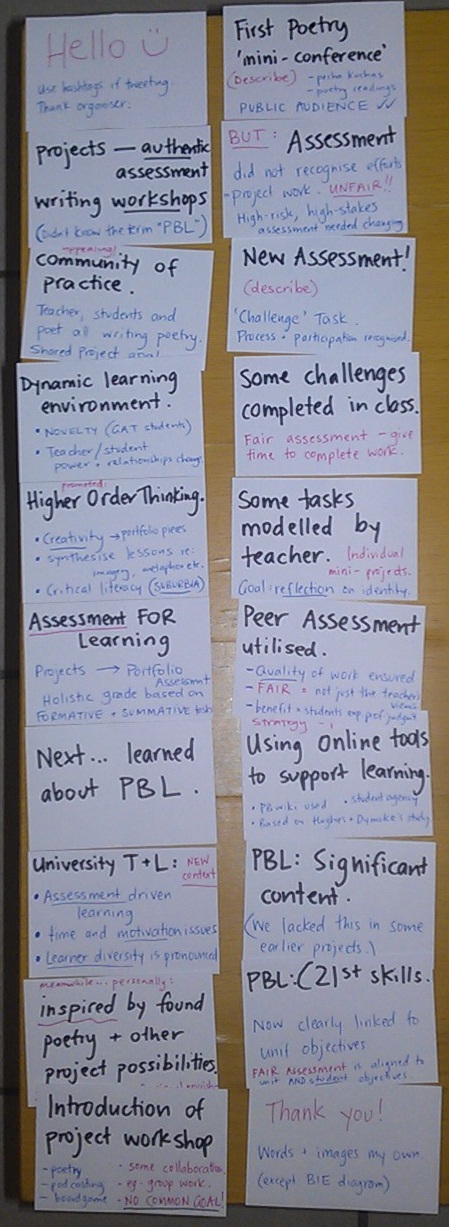
Actual palm cards - old school!
If you’d like to check them out I’ve put the slides up on slideshare. I hope that showing these resources helps future TeachMeeters plan their Pecha Kuchas – I loved the mode of presenting and highly recommend it!
Congratulations to TeachMeet Sydney on their WORLD RECORD ATTEMPT tonight! I hope the next #TMBrisbane event at the State Library of Queensland will be able to be video streamed online like #TMSydney was tonight, I had a ball watching along and tweeting with everyone from home 🙂
TeachMeet Brisbane
Posted by kmcg2375 in conferences, education, learning community, social media, technology on January 23, 2012
During 2011 a range of TeachMeets were held throughout Sydney. A central wiki was set up to coordinate the events and the hashtag #TMSydney ran hot during the meets.
The events were great successes, described by participants as welcoming, supporting and positive. This is not surprising, when you consider that the ethos behind the event is that it is strictly free professional development run ‘for teachers, by teachers’. What I thought was most attractive about the TeachMeet structure was the short presentations – either a 2 minute ‘nano-presentation or a 7 minute micro-presentation (or Pecha Kucha). It sounds like an ideal way to hear a little bit from a lot of people.
You can therefore imagine how stoked I was to hear that someone was organising the first ever TeachMeet in BRISBANE!
#TMBrisbane
TEACHMEET BRISBANE will be held from 4-6pm at Moreton Bay Boys’ College on Thursday 1st March 2012.
If you would like to register or get more information, you can visit and join the TMBrisbane wiki: http://tmbrisbane.wikispaces.com/
Of course, I was so excited to see the event come to Brissie that I had to volunteer to present. It will also be a great chance for me to refine my pecha kucha style!
(I also look forward to the #TMBrisbane hastag drawing together more of the Brisbane edu-community)
Pass it on
If you would like to be involved in TeachMeet Brisbane, or to support the event, take a look at the flyer available for download on the wiki.
In the Twittershpere you can participate in the backchannel from anywhere (not just Brisbane!) on March 1st by adding #TMBrisbane to your tweets.
Finally, this video about TeachMeets made for Sydney West is a great one to pass around to folk who are new to the TeachMeet concept…enjoy!
Quick and dirty Eddies
Posted by kmcg2375 in education, learning community, online tools on December 2, 2011
Very conscious that the Edublog Award nominations are closing tonight, but stuck in a hotel with no WiFi and slighly tempremental devices…
Still, my moby is playing nice enough to let me post these – my three best favourite blogs, and a free tool that should be getting more Edu-love, imo:
Best School Administrator blog
Darcy Moore’s Blog
http://darcymoore.net/
Darcy continually puts forward ideas and resources that are either immediately of interest to me, or make their way into my orbit months (or years) later. Progressive, responsive and visionary Darcy – I’m sure i won’t be the only blogger to nominate him 🙂
Best teacher blog
Bianca Hewes
http://biancahewes.wordpress.com/
For her edupunk ethos, and her uber reflective practice, Bianca always gets my vote. Now she’s started an MEd. in edu research, making this a hot blog to watch for all things Project-based.
PBL ftw!
Best individual blog
Dean Groom
http://deangroom.wordpress.com/
Dean is doing some really sexy Games-based learning work. He shares on his blog, among other things, his powerful use of Minecraft to connect kids AND their parentals to meaningful and fun learning online. His posts always give me something to think about – sometimes to disagree with – and his generosity with knowledge and resources is an important factor in the growth of interst in GBL in Sydney and beyond.
Best free web tool
Polyvore
http://www.polyvore.com/#
At first glance this looks like a fashion website. But dig past the front page and you’ll discover a collage making tool with a vibrant community of users and a rich collection of ‘sets’ covering a wide range of highly creative art, literature and even interior design sets. Easy to use, highly addictive, 100% recommendable (as long as you can forgive the fashionista links to retail items…which any good critical user should be able to manage 😉 )
Now, off to submit my post link. I hope I made it in time!
Thank-you to every blogger i have read this year. While i was finishing my thesis I did fall a little out of the loop; i hope to be a better reader, and commenter, in 2012.
Good luck to my peeps, and may the odds be ever in your favour!
Mastery, risk-taking and play
Posted by kmcg2375 in education, learning community, research, video games on November 29, 2011
This post is a culmination of a week or so of talking about play-based education. If that’s its official term for it? I don’t know. I must declare my rookie status in this field, which means you should feel really free to jump into the comment s section below and school me on what I’ve missed!
Thanks to @malynmawby, @vormamim, @biancah80, and @benpaddlejones for their ideas via twitter and email. You can read more about @malynmawby ‘s experiences with play-based learning here, here and here.
Play-based Learning: Another PBL?
My current interest in project-based learning has also put me in contact with the terms challenge-based learning and problem-based learning.
Despite these terms being used fairly liberally (along with inquiry-based learning), I don’t seem to often come across material that explores the differences or similarities between these terms. I mean, I’m sure we could all take guesses about it, based on what we know about the words chosen; what is a project? what is a challenge? a problem? an inquiry?
Well, while you’re pondering it all, here is some more information to add to the learning theory soup.
States of Play
An overview of the elements of play presented by the National Institute for Play (based in California) outlines seven “patterns of play”:
- attunement play
- body play and movement
- object play
- social play (including ‘rough and tumble’ play and ‘celabratory’ play)
- imaginative and pretend play
- storytelling-narrative play
- transformative-integrative and creative play
And here is a really excellent TED Talk by Stewart Brown, who argues the physiological importance of play:
After listening to Stewart’s TED talk, the idea that I keep coming back to is this:
If the purpose is more important than the act of doing it, it’s probably not play. (Stewart Brown, TED Talk 2008, at ~6 mins)
Which begs the question: by trying to pin down a definition of ‘play-based learning’ to use in my curriculum theorising, am I contributing to WRECKING IT?
Play in the curriculum
In my quest for answers I came across some interesting material relating to motivation and mastery.
This puts me back into territory that is a little bit psych-y, and I know such approaches don’t always sit well with post-structuralist curriculum types like myself. But I resist that 😉
Writer and researcher Katherine Cushman lead a Practice Project for the non-profit group ‘What Kids Can Do’ (http://firesinthemind.org/about/) asking the question ‘what do kids already know about and do well?’.
When adults openly explore our genuine questions about getting to mastery—and include young people’s knowledge and experiences in that exploration—we model the expert’s habit of taking intellectual and creative risks. We demonstrate that we, too, always have things we need to understand better, and things we need to practice. We teach kids to approach any lack of understanding as a puzzle: stretching the limits of their competence, continually testing new possibilities and seeing how they work out. As they expand their knowledge and skills, young people, like us, will discover even more challenging puzzles they want to tackle—not just outside school, but as part of it. (K. Cushman, Fires in the Mind p.10)
In light of this, play strikes me as a form of ‘intellectual and creative risk taking’, essential to building the habits of mind and the resilience needed to seek out and tackle new puzzles.
Who is playing?
Concepts about transformative play have been utilised by the Quest Atlantis project, and a lot of my Tweeps are currently going bananas for Minecraft. These are rich sites and communities tapping into discourses about educational play.
However, I rarely hear any critical views about play or games, and I guess that’s what makes me itch to interrogate this field.
The reflexive dilemma
Listening to a talk by Julian Sefton-Green during his recent visit to QUT, I was conscious of the points he made about the field of ‘out of school learning’, which often involves elements of play.
His research has found distinctions between school and out-of-school learning tended to set up binaries that actually maintained the boundaries around ‘official’ curriculum, and other project and play based activities happening outside of schools (the binary of formal and non-formal learning, for example). His review of the literature showed how debate about not-school environments in the UK is often bound up with techno-utopianism and generalisations about the public school system.
In relation to this, he poses the ‘reflexive dilemma’ that we face in thinking about all of this. That is, the more we reflect on learning experiences, the more we formalise them. In our quest to ‘optimise’ all learning experiences, the learning is more carefully arranged and disciplined.
Which brings me right back to that TED talk – by naming ‘play based learning’ and trying to give play an official role in curriculum, do we run the risk of ruining play? Will the act of ‘doing play’ become just another ‘strategy’ for learning?
In short, how can we develop play as a habit of the mind without over thinking it and taking the fun out of the act of play? And, will defining the difference between all of the different PBLs etc help us in this endeavor, or just get in the way by drawing boundaries that don’t need to be there?

A transformative digital literacies pedagogy: Thomas (2011)
Posted by kmcg2375 in education, learning community, Lit_Review, online tools, research, social media, technology, university on November 17, 2011
Thanks to @malynmawby @benpaddlejones and @Vormamim for engaging in tweety-chat today about play-based learning and transformational play.
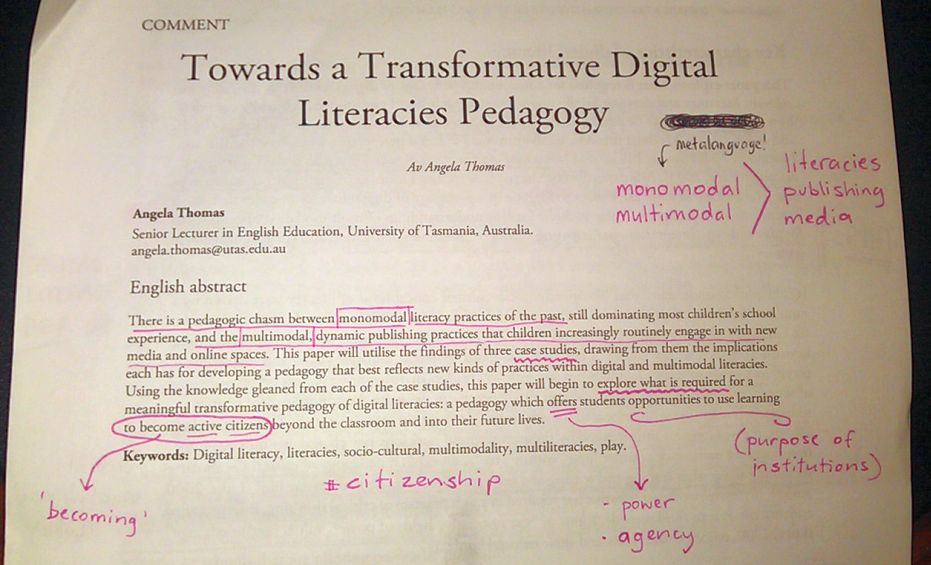
There was an article that I wanted to post the full reference to – this one by Angela Thomas (@anyaixchel)
Thomas, A. (2011) Towards a transformational digital literacies pedagogy. Nordic Journal of Digital Literacy. Vol. 6 pp. 89-101
You can see the abstract for the paper with my own annotations, above.
In it she argues that there are:
a number of significant characteristics of digital literacy that are imperative to include in a pedagogy of digital literacy in order to make it a transformational pedagogy. These include: explicit understandings of multimodality, opportunities for play and experimentation, participating within communities of practice, and critical engagement with text.
I had picked this article up to read Angela’s findings about digital pedagogy, but it was a timely read. I am a big fan of the work of Paulo Freire, and of his work to empower communities through literacy. By bringing in Freire’s notion of ‘transformative pedagogies’ this article reaffirmed the need for critical, participatory and dialogic practices to be woven into the digital learning landscape.
I’d love to hear of other readings and resources along these lines, if you know of any…?
Dear Mr Gonski
The biggest review of schools funding in over 30 years is almost over.
I was number 5126 to join the For our Future website tonight.
Here’s what I wrote in my message to the Gonski review panel:
There can be no serious attempt to argue that the current education system in Australia is socially just. With the exercising of ‘choice’ in education increasingly being seen as a feature of responsible parenting the provision of education is becoming even more stratified.
Government policy has been instrumental in encouraging the allowance of parental ‘choice’, giving parents ability to seek the school that will provide the greatest level of ‘excellence’ for their child. A need to invest in excellence based on the manufactured concern about the decline in standards in public education has meant an increase in Government funding of private schools to enable more parents to have the option of ‘choosing’ a private education for their children. This has led to the creation of a dualistic, market oriented education system, where public and private schools compete for enrolments and for Government funding, and ideas about what an ‘excellent’ education really consists of are distorted in order to lure ‘consumers’.
Despite public perception, it is not my belief however that a private education is a ‘better’ education, or that education in specialist schools such as selective or performing arts schools is more beneficial to the students who attend them. In fact inequity in education is diminishing the educational experience of these students by creating schools that lack diversity and encouraging social reproduction. It is not just a matter of the ‘poor local public schools’ being at a disadvantage because of lack of resources, funding and staff, but ALL students being disadvantaged by a curriculum that is too narrow and largely exam driven, and which therefore cannot develop fully the talents and capacities of many students.
It is largely the marketisation of the education system that has resulted in competition between schools, which lowers the standard of educational experience for all. The idea that schools should be striving for ‘excellence’ and the threat of falling enrolments and possible school closure if schools do not demonstrate themselves as achieving this ‘excellence’, has led to a dramatic rise in focus on NAPLAN results and Year 12 exit credentials, and exaggerated interest in comparing schools’ performance. The result is a decrease in the ability of ALL schools to provide a holistic, democratic and inclusive curriculum that caters to the needs of individual students and values diversity.
It is for these reasons that I argue the need for a substantial increase in funding to public schools, as well as a radical reduction in the proportion of funds made available to non-government schools in future funding models.
I was taught in public schools, and I have been a public school teacher. There are many of us out there who are loyal to the democratic values of public education, and will not falter in our support of this system. Please invest in us – we won’t let you down.
Write your own note, or just use the form letter provided online to send your own message today via the For our Future website: http://forourfuture.org.au/
Before it’s too late, join parents, teachers and principals from around Australia and send a final message to the head of the review, Mr David Gonski, about the importance of investing more in our public schools.
National Day of Action for Public Education
There’s a lot at stake over the next few months in the countdown to the Gonski panel’s final advice on schools funding. That advice, and the Government’s response, could determine the long-term future of schooling across Australia and, in particular, the nature and quality of public schooling in this country. (J.F. McMorrow ‘Real Reform in Schools Funding’ paper Sept. 2011)
A wealth of material is available to learn more about the Gonski review into schools funding, including the paper quoted above. The review is due for release in December, and while the (one month!) period for submitting formal responses has closed, there is one last opportunity to have a say on the issue of schools funding.
I have written before about the Gonski Review, but am sorry to admit that I did not enter a submission when they were called for earlier in the year.
As luck would have it, however, the Australian Education Union has organised a special website for people like me (and maybe you) to lodge their view:
http://www.forourfuture.org.au/
It’s quick and easy to show your support for Public Education in Australia by signing the petition on the site. If you want to do more, you can join as a supporter to “tell us why investing more in public schools is so important”. Whichever you choose, you should do this TOMORROW, Tuesday 16th November, the National Day of Action for Public Education:
There has been very little public conversation about this issue in my circles – as Darcy Moore pointed out to Stephen Downes in October. I fear that many teachers that are passionate about Public Education are weary from years of arguing about equity, only to see nothing change. The approach of telling people how unfair things are just hasn’t worked so far. Explaining how big the funding gap really is hasn’t worked so far. Arguing that diverse student populations produce better educational outcomes than homogenous ones hasn’t worked so far. The idea that parents should be ‘free to choose’ is too appealing, and sounds too much like ‘common sense’. But, for those inclined to look beyond their own backyard, and to the society at large, it is clear to see the devastating impact that ‘school choice’ has had on the wider community. While we continue the charade of ‘meritocracy’, the current schools funding model has continued to deliver a system in which learning facilities and access to knowledge and social status can be bought by those with means. When that is the case, it’s hard not to enter the discourse of class wars, don’t you think?
This is not just about class wars, however. A summary of public views put forward collected by the Australian College of Educators observes that “Australia’s approach of providing funding as an entitlement to the independent sector is not the standard approach of most OECD countries”. And yet, this question of measuring Australia’s financial commitment to education against other OECD nations was seen to be largely absent from public debate.
As for me, I support a substantial increase in funding to public schools, and a narrowing of the resource gap between public and independent sectors. I do not support policies that position families with means as being entitled to more educational choice than others. Tonight I will be adding my voice to the For our Future website, and wishing for a future where the support, learning and success of all students is priority number one for politicians and citizens alike.
I hope you will join me.
Guest Post: ‘I Have A Dream that the HSC Will End’
- Post to celebrate completion of my PhD: CHECK.
- Post with an update on my upcoming conference papers: CHECK.
So…where to next?
As fate had it, this decision was made for me, with the arrival of a piece of student writing in my inbox.
The author of the piece is a recently graduated HSC student, one whom I had the pleasure of teaching year 8 English, and coaching for debating 🙂 This is him counting down the days until the end of his exams:

I invite you to read his work (below), which he has given me permission to reproduce (along with his picture) in this post. Oriniginally published as a Facebook post on October 28th, it is a re-writing of Martin Luther King Jr.’s famous I Have a Dream speech, which has been adapted to make a satirical commentary on the HSC. It comes with a mild language warning (c’mon; it’s satire!), and is a brilliant example of a ‘textual intervention’.
I’m very proud to feature it here as my first ‘guest post’!:
*****
I Have A Dream that the HSC Will End
By B. Wylie
I am happy to join with you today in what will go down in history as the greatest demonstration for freedom in the history of our state.
Two score years ago, an a*shole bureaucrat, in whose symbolic shadow we stand today, created the Higher School Certificate. This momentous decree came as a great source of pain and suffering to millions of NSW students who were about to be seared in the flames of withering injustice. It came as a sorrowful dusk which signalled the beginning of their long night of academic captivity.
But fourty four years later, the student still is not free. Fourty four years later, the life of the student is still sadly crippled by the manacles of standardised testing and the chains of rankings. Fourty four years later, the student lives on a lonely island of studying in the midst of a vast ocean of facebook updates. Fourty four years later, the student is still languished in the rooms of NSW high schools and finds himself an exile in his own class. And so we’ve come here today to dramatise a shameful condition.
In a sense we’ve come to this facebook note to cash a check. Read the rest of this entry »
-
You are currently browsing the archives for the education category.
Nominated!

- Australian English Teachers
 9 members
A group for English teachers in Australia to discuss the books they are reading, and the books th...
Books we've read
View this group on Goodreads »
Share book reviews and ratings with Australian English Teachers, and even join a book club on Goodreads.
 Kelli McGraw
Recent Comments