Archive for category conferences
Use #etaq21c to ask me things tomorrow!
Posted by kmcg2375 in conferences, education, english, learning community, online tools, personal, social media, technology on August 19, 2011
More specifically, use #etaq21c to ask me questions about Digital Literacy and electronic text practices in English curriculum. The conference theme says it all: “English and Generation Next”
ETAQ’s Annual State Conference will be held atLourdes Hill College on Saturday 20 August. The theme is “English and Generation Next”.
The program will feature a keynote address by Professor Peter Holbrook from the University of Queensland’s School of English, Media Studies and Art History, a Q & A style panel session [that’s where I’m presenting!!], and a range of supporting workshops. Professor Holbrook’s address is entitled “Literature, Literacy, the Imagination, Freedom”.
So, if you are an English teacher, or if you are interested in digital texts and the future of the book, please, shoot some questions our way! You can post them here as a comment, but if you use Twitter then posting a comment or question there with the hashtag #etaq21c would Really Make My Day 🙂
I am soooo looking forward to this panel presentation! The full list of people in the panel session are:
- Professor Catherine Beavis (Griffith University and ETAQ Patron)
- Professor Peter Holbrook (University of Queensland)
- Kelli McGraw (Lecturer, QUT)
- Janina Drazek (Executive Director, Teaching and Learning, Education Queensland)
I’ll be talking about ‘acts of reading and writing’ and ‘digital pedagogy’.
ETA mailout showdown and dates of state conferences
Posted by kmcg2375 in conferences, education, english, learning community on July 23, 2011
Living in Brisbane but being from Sydney, I am a member of both the NSW English Teachers Association and the English Teachers’ Association of Queensland.
The holiday break and a fresh term starting has brought mailouts from both associations my way.
This is a show-and-tell of what was in the respective packs.
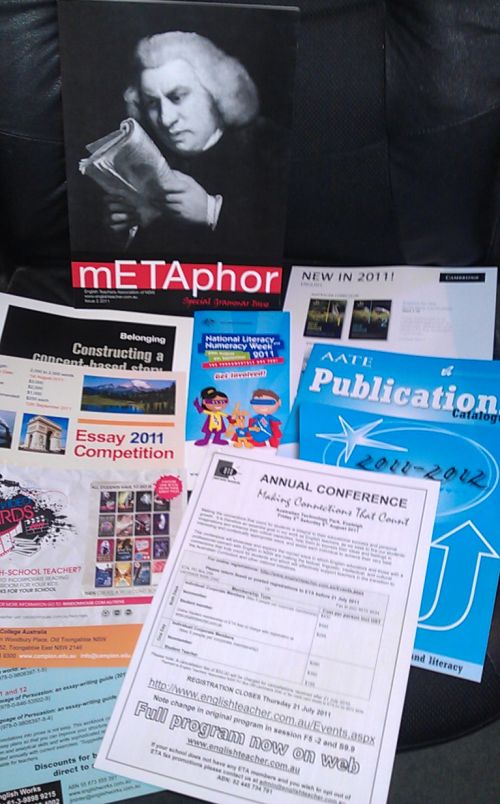
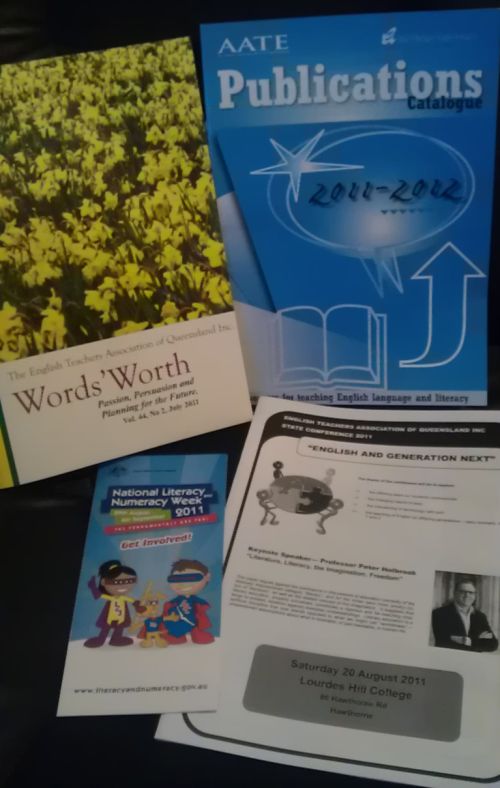
Both mailouts contained information about Literacy and Numeracy Week, which this year has as it’s theme ‘The Fundamentals are Fun!’ (hmmm, invoking fundamentalism to talk about literacy…looking forward to critiquing that), as well as a catalogue of publications available from the AATE Bookshop.
The impetus for each mailouot is sending members the newest issue of the association journal. While I like the style of the NSW journal mETAphor better (the ETAQ journal is full of Arial font and the cover design could be developed, imho), I have to say I am really satisfied with the content and tone of Words’Worth, and look forward to contributing some material myself in future. Unlike in NSW, ETAQ doesn’t have resources to pay contributors for their articles (yet), but nevertheless the collegial spirit in the association currently ensures a flow of material to sustain the publication.
Both associations also included their annual state conference program notices. Seems like August is the flavour of the month…of the month… (?)
Here is a comparison of the two conferences (I’ll be at ETAQ, but wish I could get down for the NSW one too, bummer!):
ETAQ State Conference: English and Generation Next
- Saturday 20th August 2011
- 8.15am – 5.00pm
- Lourdes Hill College, Hawthorne
- Cost to members: $143 (presenters $44; students and pensioners $66)
- Keynote speaker – Professor Peter Holbrook ‘Literature, Literacy, the Imagination, Freedom’
ETA (NSW) Annual Conference: Makinig Connections That Count
- Friday 5th & Saturday 6th August 2011
- 9am-4pm / 9.30am-3pm
- Australia Technology Park, Eveleigh
- Cost to members: $290 one-day / $430 two-day (presenters register free)
- Ken Watson Address – Dr Felicity Plunkett ‘Blood and Bone: An Anatomy of Wreading’
Queer as folk: my ALEA conference paper
Posted by kmcg2375 in conferences, education, english on January 30, 2011
Anyone who has attended the AATE/ALEA national conference in the last…well, many years, might have noticed this year that ALEA and AATE have gone separate conference ways – ALEA in July and AATE in December.
There are a range of practical reasons for this, but for me it highlights some common territory between English and Literacy teachers that has perhaps been assumed over the years. After all, when we go to these conferences aren’t the Literacy teachers invariably Primary school teachers? Are English teachers really Literacy teachers at all? To what extent to we belong ‘at each others conferences’?
So I have put in a proposal to deliver a 30 minute paper on the topic: Queer as folk: The English and Literacy teacher divide
The title purposefully invokes queer discourse in questioning the way we use labels in constructing our identity.
I’m hoping to stir up some controversy with this one – hope it gets accepted!

IFTE Conference Seminar 2011
Posted by kmcg2375 in conferences, education, english, university on December 2, 2010
In April 2011 the International Federation for the Teaching of English is holding its triennial conference in Auckland, New Zealand.
I’ve proposed the following seminar – fingers crossed it’s something they want to see!
The English teacher-practitioner: Re-writing our role
This seminar will weave together two strands of reflection on the nature of English teachers’ work. On one hand the nature of assessment in English will be considered, with a critical exploration of the relationship between standardised assessment and teachers’ capacity to positively engage in providing formative feedback. A central question that participants will be asked to reflect on is ‘how can we reconceptualise our role as a co-practitioner in the classroom and consequently find more enjoyment in the marking process?’ The second line of reflection will be a recount of my own journey to seek an antidote to the processes of ‘school writing’ and recommendations for avenues that other English teachers can explore to stimulate their own creativity and willingness to see themselves as a practitioner as well as a teacher of others.
English teachers: would you want to come to this? If you came along, what would you be expecting/hoping to hear about?

AATE Annual Conference 2010
Posted by kmcg2375 in conferences, english, research on June 4, 2010
The full program for this years annual conference for English teachers in Australia can be found at:
http://www.englishliteracyconference.com.au/index.php?id=48&year=10
The conference is on this year in Perth from 4-7 July. I’ll be presenting a paper on the Monday about National Curriculum, based on my PhD research on curriculum change:
Getting comfy with the ‘new’: What we can expect to feel about curriculum change.
The National Curriculum will bring with it a host of challenges and problems that may leave us grieving for our familiar local curriculum. What can we expect to feel in this time of change? And what will the effects of this be on our beliefs, our pedagogy and our practice? How much of what we are already doing, really, are teachers expecting to be able to carry forward? It seems this point in curriculum history is an ideal spot for us to revisit and revise our curriculum philosophies, as well as our beliefs about the purpose and goal of teaching English.
Reflecting on the findings of my PhD research into the changes and innovations of the 1999 HSC English syllabus in NSW, in this paper I consider the processes by which teachers have coped with change. What is likely to make us uncomfortable in the National Curriculum for English? What have we already shown in NSW that we fear? The audience will be invited to consider their own philosophies, and begin preparing for change.
The 2011 conference will take place in Melbourne (in December), and the 2012 conference sees the conference returning to Sydney (in October).
Hit Refresh!
Posted by kmcg2375 in conferences, english, online tools, social media, technology on December 4, 2009
Last weekend I attended the English Teachers’ Association Annual Conference in NSW, which was held at the University of NSW on Friday 27th and Saturday 28th of November. The conference theme was ‘Hit Refresh!’, so it was apt that this was the first conference we have run that had an officially constructed online aspect, using both Ning and Twitter to engage presenters and participants in discussion and networking before, after, and behind the scenes of the conference.
This (longish) post is a report I wrote on the success of these online tools at the conference.

Many educators by now have heard of ‘blogs’, ‘wikis’, and learning management systems such as Moodle, and hopefully we are fast approaching a time where the these strange names and terms are accepted as useful (rather than childish) jargon. In the meantime, jokes about the ‘Ning-nang-nong’ and Twitter users being ‘twits’ will abound. But while these tools might sound goofy, they are anything but.
Ning.com is an online tool that is fast gaining popularity with educators. It combines many other features for writing and connecting online – such as being able to have a personal profile page, make ‘friends’ with other members of the Ning, write blog entries, add to discussion forums, and join sub-groups – and for that reason the term Ning was coined to describe the NetworkING that occurs on the site. For our conference we created a Ning a few months ahead of the conference (http://etaconf09.ning.com/), set up all of our conference workshops, presentation, keynotes and plenaries as ‘events’, invited presenters (first, then later, people who had registered for the conference)…and waited.
The response was slow but sure. Before the conference had even started we had 70 people who had joined as members of the Ning. ETA committee members and presenters who were keen to explore the Ning started adding discussions and material right away. New presenters felt welcomed and included in the lead up to conference, and could ask questions and establish contacts with others before arriving on the big day. On the Thursday before the conference, the number of members had grown to 130. Many more joined up during and following the conference, and the count currently stands at 230 members. Some presenters used the Ning directly in their workshops, getting participants to add their own questions, ideas and resources. Many people were glad to have an easy way of contacting and keeping in contact with other members, and as many people did upload information about themselves, including a photo to their profile, there was a definite sense of familiarity and closeness at the ‘real life’ conference between Ning users.
As well as establishing a conference Ning, the micro-blogging service Twitter.com was used to ‘tweet’ short, 140 character updates from the conference, in particular from the Saturday morning panel on National Curriculum. This allowed attendees to create a ‘backchannel’ at the conference, communicating with others from around the globe, as well as other members at the conference, about events as they happened. Before the conference I blogged a description of a backchannel, which was used at the conference to explain the concept.
As this was our first attempt at using a backchannel, we decided not to display the tweets live on a big screen behind the speakers – though this is something that is occurring frequently now at many conferences that use a backchannel. For our own, and the speakers’ peace of mind, Darcy Moore and I fielded questions and comments that came in via Twitter at the same time as chairing the panel and the real-life questions from bodies inside the auditorium, and integrated these into the plenary. The response was very positive, and people (speakers included) only seemed disappointed that we didn’t display the tweets on the big screen!
So, next year we are bound to do this again, with the screen on live display. Using technology this way can be risky of course, as there is far less control being exercised when members can publish their unfettered thoughts for all to see. But the benefits of this far outweigh the risk, and the message from members was ‘bring it on!’
Increasingly, educators are connecting online in very powerful ways. This includes English teachers. As online tools become easier to use to connect, communicate and collaborate with colleagues they are being seen as more of a joy (and a time saver) than a chore. I heartily encourage other professional associations to consider adopting online elements for future conferences and events, and would be happy to share ideas and advice with anyone who is going in that direction.
Anyone else care to share their experiences or tips?
ETA Conference: The Backchannel
Posted by kmcg2375 in conferences, english, online tools, social media, technology on November 26, 2009
Friday morning will see Darcy and I braving the stage prior to the opening of the annual English Teachers’ Association conference ‘Hit Refresh‘.
Why?
Because for this ETA conference, for the first time, the conference is going web 2.0 – we’re stepping up the interaction, participation, and networking by providing some seriously cool online spaces for teachers to wet their toes in, and hopefully also dive right in to! So, we’ll be getting up (in our awesome Twitter t-shirts 😉 ) to show the folks at the conference how to get involved in communicating with others, and how to use the backchannel.
What is a ‘backchannel’?
You know when you’re sitting, watching a keynote or presentation, and if you know the person in the next seat you might make the odd remark in their ear? Well, a backchannel is like doing this on a mass scale – it’s like having a silent ‘channel’ on in the background for anyone who wants to make comments or ask questions that the rest of the audience can see, and if they want, silently respond to.
It’s like passing notes for grown-ups. Ones that you know the teacher can read too if they so choose (so you can be critical, but must also be polite!)
From wikipedia:
The term “backchannel” generally refers to online conversation about the topic or the speaker
…it is the practice of using networked computers to maintain a real-time online conversation alongside live spoken remarks.
What are we using?
The most effective way of paticipating in a live backchannel during the conference is to join Twitter, and post short 140-character messages called ‘tweets’. Anyone who ‘follows’ you can see your comment or question – and some people might also respond.
Do I have to have a lot of followers for this to work?
(or ‘yikes! but I’m not that famous yet!’)
If you are new to Twitter, never fear. If you tag your tweet with the ‘hashtag‘ ETAConf09, then the comment that you tweet will also be seen by anyone who has searched for that tag – not just the people who follow you. This means that even if you have NO FOLLOWERS, you can add to the backchannel discussion, and people can tweet responses to you. Here is an example:
Wow! I thought Kelli and Darcy did a great job explaining the backchannel! #ETAConf09
To which another user might reply:
Does anyone know where I can find the video they showed at the start? #ETAConf09
You see the potential here? And it’s easy!
What’s this I hear about a conference ‘Ning’?
‘Ning’ is the cute name that the people over at Ning.com made up to describe their online site that is used for NetworkING. It’s a very easy site to use, and a great way to introduce yourself to online learning if you haven’t already.
ETA members (all of you – whether you are physically at the conference or not) can join the ETA conference Ning and add comments and questions there too. Darcy and I will be monitoring the Ning as well, and it is another place that a kind of backchannel will likely spring up. It’s probably less likely that this will happen during the sessions though. I imagine a lot of people will be logging into our Ning on Friday and Saturday night, and for awhile after the conference, to send comments to friends, colleagues and presenters, and to share ideas and resources.
For the most effective participation in a LIVE backchannel, I seriously recommend you use Twitter.
Any questions?
If you have any questions, you can post them here as a comment, or ask them on Twitter. You can find and follow me at http://twitter.com/kmcg2375, or Darcy at http://twitter.com/Darcy1968
See you in the Twitterverse!
AGQTP Action Research
Posted by kmcg2375 in conferences, online tools, research, school on December 2, 2008
Today was the final day of our participation in this year’s AGQTP project – the end of year presentations in Sydney. The project focussed on linking our collegial support program to school-based action research in the area of Element 5 of the NSW Institute of Teachers Professional Standards.
Element 5: Teachers create and maintain safe and challenging learning environments through the use of classroom management skills.
I’ve uploaded my workshop slides on slideshare. If you were at my presentation, or have any questions about the project, please leave me a comment!
Podcasting
Posted by kmcg2375 in conferences, online tools on November 30, 2008
One of the tools I didn’t get up to in the Online Pedagogy workshop at ETA conference was podcasting.
For those after some information:
- A podcast is an audio (sometimes also video) recording that can be downloaded, ‘streamed’ and subscribed to by users.
- The word originally was a blend of the words ‘iPod’ and ‘Broadcast’, but they can actually be used anywhere (not just iPods!), so now the word stands for ‘Personal On Demand broadCAST’
- I use Audacity to record my podcasts. It is free, and very easy to use – you just need a microphone plugged into your computer.
- Download Audacity here.
- Watch a tutorial for Audacity on YouTube here. (There are lots of different tutorials on YouTube for Audacity, as well as other programs you can search for)
- And I use PodBean (www.podbean.com) to put my podcasts up on the web. It is like a blog, but for your podcasts.
I also heard that podOmatic is a good site for podcasting. It looks like you can record straight on to the podOmatic website, cutting out the need to use Audacity. Persoanlly, I like to use Audacity first, so that I have the sounds file saved on my own computer. This means it is backed up, I can use it without being online, and if you wanted to you could even get the files put up on your school website or intranet (one day I plan to actually do this!)
Online Pedagogy
Posted by kmcg2375 in conferences, online tools on November 28, 2008
In today’s conference workshop I will be exploring four important issues relating to learning and teaching strategies for using online tools:
- How the purpose of your site relates to its form
- The intended teacher-student dynamic online
- Students and internet safety
- Getting students involved and monitoring contributions
Please respond with comments to this post if you have any questions, information or anecdotes from your own teaching context.
(DET Interim Guidelines for using blogs and wikis)
(from the ETA Annual Conference @ UNSW )
-
You are currently browsing the archives for the conferences category.
Nominated!

- Australian English Teachers
 9 members
A group for English teachers in Australia to discuss the books they are reading, and the books th...
Books we've read
View this group on Goodreads »
Share book reviews and ratings with Australian English Teachers, and even join a book club on Goodreads.
 Kelli McGraw
Recent Comments