Posts Tagged HSC
Voices from Elsewhere…
Posted by kmcg2375 in books, english, social media on August 31, 2012
I was recently directed to the Wheeler Centre website to take a look at the speeches and talks they had available to view and download.
Finding out about the Wheeler Centre was very interesting…did you know that Melbourne is one of UNESCO’s ‘Cities of Literature’? The Wheeler Centre was established to celebrate this:
Melbourne has a new kind of cultural institution. The Wheeler Centre – a centre dedicated to the discussion and practice of writing and ideas. Through a year-round programme of talks and lectures, readings and debates, we invite you to join the conversation.
Their slogan is ‘Books. Writing. Ideas.’
Isn’t that wonderful?
It wasn’t long before I found a resource that drew me straight in – I am a big fan of Nam Le’s collected short stories in The Boat and even set the book on our ETAQ Book Club list this year!
If you also like books, writing and ideas, please enjoy this 10 minute talk by Nam Le, on the theme ‘Voices from elsewhere’:

Guest Post: ‘I Have A Dream that the HSC Will End’
- Post to celebrate completion of my PhD: CHECK.
- Post with an update on my upcoming conference papers: CHECK.
So…where to next?
As fate had it, this decision was made for me, with the arrival of a piece of student writing in my inbox.
The author of the piece is a recently graduated HSC student, one whom I had the pleasure of teaching year 8 English, and coaching for debating 🙂 This is him counting down the days until the end of his exams:

I invite you to read his work (below), which he has given me permission to reproduce (along with his picture) in this post. Oriniginally published as a Facebook post on October 28th, it is a re-writing of Martin Luther King Jr.’s famous I Have a Dream speech, which has been adapted to make a satirical commentary on the HSC. It comes with a mild language warning (c’mon; it’s satire!), and is a brilliant example of a ‘textual intervention’.
I’m very proud to feature it here as my first ‘guest post’!:
*****
I Have A Dream that the HSC Will End
By B. Wylie
I am happy to join with you today in what will go down in history as the greatest demonstration for freedom in the history of our state.
Two score years ago, an a*shole bureaucrat, in whose symbolic shadow we stand today, created the Higher School Certificate. This momentous decree came as a great source of pain and suffering to millions of NSW students who were about to be seared in the flames of withering injustice. It came as a sorrowful dusk which signalled the beginning of their long night of academic captivity.
But fourty four years later, the student still is not free. Fourty four years later, the life of the student is still sadly crippled by the manacles of standardised testing and the chains of rankings. Fourty four years later, the student lives on a lonely island of studying in the midst of a vast ocean of facebook updates. Fourty four years later, the student is still languished in the rooms of NSW high schools and finds himself an exile in his own class. And so we’ve come here today to dramatise a shameful condition.
In a sense we’ve come to this facebook note to cash a check. Read the rest of this entry »
The HSC again. and again.
Posted by kmcg2375 in education, HSC, reflections, school on December 16, 2010
In NSW yesterday Year 12 school leavers got their HSC results back. And again, we reflect.
so-and-so got x amount of Band 6s this year…should I teach more like them?
my kids didn’t go as well as they had hoped…did I fail them?
there were some great successes at our school…what pressures will this bring next year?
The dizzying heights…the devastating lows.





I’m sure this post / these tweets should have some ‘IMHO’s peppered through them, but stuff it – the HSC is an evil device.
I’m so proud of every HSC student who got through the year, and was beyond excited for my ex-students who got the results they sought (I always will be). Motivation, goals, mastery, achievement, I believe in them all. But the HSC provides them too sparingly, for students and their teachers.
And now it’s time for recovery. again.
Congratulations one and all – bring on 2011…
Good News Day
This front page made me smile so much yesterday I broke my usual rule and bought The Australian:

PRIVATE SCHOOLS’ FURY OVER MYSCHOOL WEBSITE
Turns out the poor buggers have found some inaccuracies in the way their finances are reported. It makes it look like they are getting paid WAY too much money for the services they provide, or something totally unbelievable like that.
I say: suck it. Where were you last year when NSW public school teachers and unions were the only ones out there willing to put their neck on the line to criticise the MySchool website? Sitting quietly on their hands and calling us whingers, that’s where.
STATE REJECTS PM’s CURRICULUM AS SUBSTANDARD
Which state you ask? Oh, that’d be NSW. Again. As far as I can see, the only state with the balls to take a stand against ACARA. Again.
Now, I realise full well that teachers in every state and territory think that their curriculum is ‘the best’. But that’s not what this is actually about. This is not just about some east-coast superiority complex. This is about (in the case of English, at least) the inadequacy of the curriculum on offer.
I love my new home in Queensland, but for sheer determination to kick against the pricks, I am proud to say ‘go the Blues!’ On National Curriculum issues, NSW is proving well and truly to be the big sister of Australia – she might not always be right, but at least she’s brave enough to fight for what she thinks is right (inaccurate newspaper reporting be damned).
SIDDLE BLOWS ENGLAND AWAY WITH HATTRICK
OK, so any real Australian knows that this was the only real story of the day.
If you don’t know what a hattrick in cricket is, it’s when a bowler gets three batsmen out in a row. It’s very hard to do. Since the start of the Ashes in 1877 there have only been eight other hattricks, making Siddle’s the ninth. And it was his birthday!
What a good news day!
HSC English
For anyone wondering how Year 12 HSC students in NSW feel about high stakes external exams as a measure of their learning in English this year:

Sorry, I can’t confirm which school it came from…
(PS: Good luck studying for Paper 2 my dears!)
HSC English: Standard or Advanced?
Does your school offer both Standard and Advanced English courses for the HSC? How about ESL? Extension courses? If not – why not?
This is a question that has been debated over the past couple of days via email between members of the NSW English Teachers’ Association.
One member asked: Do you think it is wise to only offer the Advanced course to students? His school leaders have been advised that this will lead to higher ATAR scores for students at the school.
Here are some of the responses that were given via email in support of offering a diverse range of courses:
“The emotional pressure on students to learn (=compete and achieve) at an Advanced level was very detrimental in the schools I observed [that had decided to take away the option for Standard English]. Students’ self concept was very low for the bottom achievers in the Advanced stream, where in schools that also run Standard these kids might still perform lower, but they do so with the knowledge that they are in a different, less ‘academic’ course. Or, they find themselves at the top of the Standard course, and their self concept goes up. Offering Advanced-only also limits your capacity to differentiate learning for students, and it builds a distorted sense of entitlement and expectation among parents.”
“I have been discouraging some students who want to do Advanced. Last year when I arrived there seenmed to be some students who really should have taken Standard. Advanced can be soul destroying for them and can impede the progress of others.”
“I was also put under pressure [to increase] value-added – they argue that it is better for everyone to do Advanced because scaling boosts poor Advanced marks above good Standard marks and there may be an infinitesimally better uni ranking as a result. Whether this is actually the case or not is difficult to accurately gauge – there seems to be a lot of numerical flim-flam in the value-adding business. What is clear, however, is that students who struggle in Advanced and then withdraw from discussions and activities they feel are beyond them engage much more readily in Standard classes and find themselves enjoying English – heaven forfend!”
“I remember this type of pressure being applied at a previous school of mine – with the result of good Standard students being forced to do Advanced. That type of auditor-driven statistical analysis does not take into account the different kind of intellectual demands required to be a success in Advanced. At my current school, we have scaled back our Advanced classes because there were a number of students who were not suited to the contextual and researching demands of the Advanced syllabus – they were also not motivated readers”
Comments like these about student welfare were reinforced by teachers who had marked HSC English scripts and saw the outcome at the other end:
“Anyone who has marked Advanced will know there are many students out there who really should not have sat the course and would have been better off in Standard, where they would have had a much better opportunity to show what they knew and understood.”
“From the point of view of Advanced HSC marking, as many of you will have experienced, it is becoming more frequent to see that “poor child” who should have been advised to do Standard, often in the middle of a bundle of very competent students.”
Some teachers were in favour of pushing the Advanced course, and gave a mixture of pedagogical and statistical reasons for this:
“There is an ongoing debate about this in schools around mine. The pressure in schools is to achieve better than state mean and this can be easily achieved by encouraging students to do Standard rather than Advanced… I believe this is anti educational and think any student who is interested should have the opportunity to do the more interesting and challenging Advanced course. In terms of value added, this does us no favours [to push students into the Standard course]. Have a look at the difference in the curves for Advanced and Standard on the value added graph. Again I could easily make the actual course results look better by encouraging more students to do Standard and indeed have at times been pressured to do so. If you run the Advanced students against the overall English Value Added curve you get a different picture, however.”
“Our students do seem to get a strong sense of achievement from doing Advanced and actually engage well with texts which have not much relationship to their lives and experience. I agree that the Standard course is difficult since it is so language based and that is what students have trouble with…We don’t not offer Standard because it is too easy, but because our students can and do gain a great deal from the Advanced course and they value it. Or is it their parents? It just seems a pity that it is much more difficult to get very high marks in Standard than Advanced but it is historic. Remember why we brought in the common strand in the first place?”
Other teachers had arguments that spoke to the benefits of or need for the Standard course:
“What we have done is to present the challenges of the Advanced course to Year 10, outlining exactly the demands. We have also challenged Advanced students in Year 11 to consider seriously the demands of the course. This has meant many more “borderline” students have chosen Standard, either at the end of Year 10 or the end of the Preliminary course. As a result, we have had excellent Standard results from students who either deliberately chose to do Standard, or changed at the end of Preliminary when they struggled in the Advanced. The end result in those cases were very happy students and parents.”
“We certainly could not omit Standard from our curriculum, and fortunately, we are also able to maintain a more academic focus by running one advanced class. I hope that by doing that, we are meeting the diverse learning needs of the type of students who attend a school such as ours. I know this is not the same issue – but spare a thought for the large number of country schools who are struggling to offer courses and to do that, both Standard and Advanced are offered in the same room, sometimes with both 11 and 12 together as well. That is the only way their wide range of learning needs (for just a small number) can be met – either that, or Advanced is not offered at all.”
The role of school administrators in balancing the need for high results against student welfare and quality learning was also raised:
“Perhaps some school administrators need to be reminded of such determiners for course choice as “needs, interests and abilities of students”- not to mention their health and well-being. When there is a significant percentage of boarders these factors are particularly critical.”
“I think the whole debate is disgusting because no-one is talking about what we think students should know; i.e. education. Instead the whole debate seems to be about what puts the school in a better light statistically. Let’s worry about what our students should learn and where they are at, not what looks better for our school. How has this abominable shift in what teachers are thinking happened? Well we all know the answer to that: and the answer is not the National Curriculum.”
“It has been interesting to see two distinct problems emerge from this question and also dispiriting that in both cases it is all about perceived numerical and statistical success, with anti-educational ‘solutions’ imposed on English faculties from above.”
The debate itself was in fact surprising to some:
“Coming from an area of the state that is maybe too far in the bush, I have never realised that this would be an issue. I know that some schools, for very good reasons such as being selective, have none or very few Standard students, and that is just a given, but I would have thought that the majority of schools in the state would not fall into that category. I guess that might be blissful lack of knowledge or awareness on my part!”
I’d (we all!) be interested to hear how other schools and English faculties are approaching this question.
When I put the question out to Twitter this afternoon, this is what tweeple had to say:
“I think English should be an elective course. If they haven’t got it by year 10 why go further?”
“Really? [that not all states have mandatory English] so only NSW is dumb enough to think senior english is for all.”
“I think students should be allowed to go with what interests them – as long as they understand the possible implications 4 ATAR”
“NO! [to only offering Advanced]…particularly for gender focused classes, does the fact 45 marks are the same Area Of Study matter?”
“Imagine a male, studying Chem, bio, physics, a couple of Maths subjects, Standard English is perfect…”
“What about the kids doing 2 VET, ITP, PE, Industrial tech, do they need standard English?”
“Eng so much more than writing essays 4 exams. Lets push boundaries so studs fall in love with English”
“I know pressure of getting good results! Would like to think we can make results gr8 via love of learning. Combine both 4 synergy”
How do you decide what HSC Engish courses to run and who gets to do them??
Down with written exams!
Posted by kmcg2375 in school, technology on January 15, 2010
I want to marry this opinion piece and have its babies.
In UK paper The Independent yesterday, Brandon Robshaw writes that It’s time to ditch written exams for students and go digital. I couldn’t agree more, if for no other reason than:
It seems obvious, but is seldom remarked, that students are being obliged to do something that they never do or need to do in real life: write with a pen for two or three hours non-stop.
To be honest, I don’t even care if exams don’t go digital…but putting an end to pen-and-paper exams must surely become a priority as the skills of extended handwriting and unaided recall of extensive amounts of facts go the way of the dinosaurs.
Robshaw argues that a computerised examination system would not only “be far kinder to students, it would also be far more useful, requiring them to employ a skill that is used outside the exam hall.” Amen to that. The most salient point for me, however, is not the usual evangelising about digital learning. In my experience, while many teachers can be convinced of the benefits of using digital technologies, the reality of poor funding and resources at both the school and system level make this utopia seem like a distant dream. Or, at best, an unholy uphill battle and minefield of ‘teething problems’ that we’re just too tired to contemplate.
No, for me the point that really needs to drive this campaign is that as extended handwritten work becomes more and more antiquated, the continued use of pen-and-paper exams becomes an increasing barrier to learning, as well as a significant equity issue. Fact:
no one writes at their best in an unfamiliar medium.
How can we, in good conscience, continue to set our students up for failure in this way? If we know that students are not going to do their best in a written exam, why do we persist with them? Especially when the impact is going to be felt most heavily by students with already low literacy skills. It’s no exaggeration to say that
Change can’t come too soon. The present system is akin to forcing candidates to write on slates with chalk, or chip away at stone tablets with chisels.
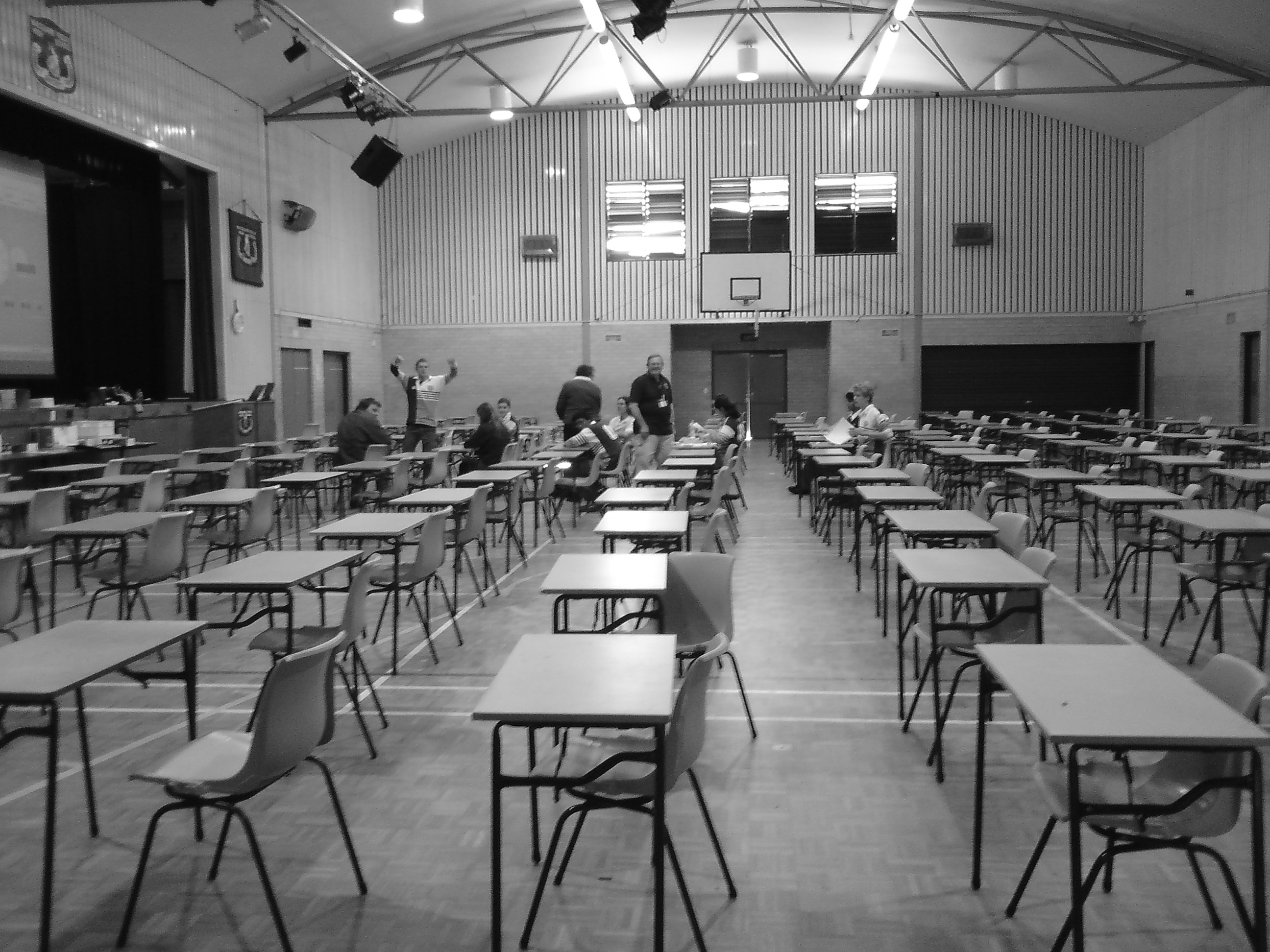
Thanks to @principalspage for the link to this article. It made my day!
Jeannie Baker: Belonging exhibition
The work of Jeannie Baker, a British-Australian children’s author and artist, is well known by Australian children. In a special exhibition at Casula Powerhouse this summer, collages from her award winning picture book, Belonging, will be on display for people of all ages to enjoy. Rsvp for the opening or for more info on public programs, click here.
I just love the book Belonging by Jeannie Baker, and am really keen to go along to this exhibition of her collages – I might even try and get to a collage workshop!

Belonging
I think this picture book, and its companion book Window would make excellent pieces of related material for the HSC Area of Study ‘Belonging’. Has anyone else seen this book? What do you think? Here is a brief description of the book from Jeannie Baker’s website:
An alienating city street gradually becomes a place to call home. Little by little, baby Tracy grows. She and her neighbours begin to rescue their street. Together, children and adults plant grass and trees and bushes in the empty spaces. They paint murals over old graffiti. They stop the cars. Everything begins to blossom.
‘Belonging’ explores the re-greening of the city: the role of community, the empowerment of people and the significance of children, family and neighbourhood in changing their urban environment. The streets gradually become places for safe children’s play, and community activity and places for nature and wonder.
Proposed HSC changes
I cannot stress enough the importance of responding to the NSW Board of Studies proposed changes to HSC examinations and school assessment.
When you look at what they are proposing, it’s hard to see how they can possibly be genuine about their aim of “reducing unnecessary stress and workload for students and teachers”.
The 8-page Background Paper is an easy read, and explains the general changes that are proposed for all HSC courses:
- A mandated number of FOUR in-school assessment tasks for each 2 unit course
- How the BOS thinks that running LESS assessment (making each task worth MORE) is beyond me. Schools will get around this by making tasks bigger and more involved, perhaps by running ‘one’ task with multiple ‘parts’.
- If you plan to have one assessment for AOS, and another three for the three Modules…where does the Trial fit?
- A removal of the limits of how much in-school assessment can come from test and exam tasks (!!)
- This is OUTRAGEOUS. It will certainly lead to schools assigning a greater weighting of marks to exam-type tasks. At the Forums I have been to on the proposed changes, BOS reps argue (with a straight face) that they don’t think schools would want to do more exams…how naive.
- Each 2 unit course to have a single 3 hour exam including 10 mins reading/planning time
- Obviously this is a big change for English. What is going to be cut out of our exam to make it fit? The logical answer is that creative writing (at least) will disappear entirely.
- Why not just make the 10 mins reading time extra? This policy is blatantly linked to a cost-cutting agenda, not to reducing student stress!
- Advice will be provided on expected length (number of pages etc.) of written exam responses
- This looks oppressive, but BOS have argued this is only intended to stop those 30 page exam responses…which is OK by me as long as students aren’t heavily penalised for going a little over any prscribed length.
- A review of specifications to reduce the amount of time spent on major projects and performances
- Wow! Lucky students! I think this is great, only…does this mean that the BOS will also be LOWERING THE STANDARDS? Students currently work hard on major projects because the acheivement descriptors require it for students to get a Band 5 or 6.
- What would make more sense is lowering the number of units that students had to study from 10 to 8, and giving them free periods at school for project work.
- School assessment to be based on clusters of outcomes, NOT on topics (e.g. Area of Study, Modules)
- This is ridiculous. This is clearly how they think they can get away with reducing the number of assessment tasks to FOUR. To assess how well a student has understood an elective, you need to assess that elective. Unless the BOS want to change the syllabus…hmm, seems they are subversively trying to do just that.
- Written exams to contain a mix of ‘objective response’, ‘short response’ and ‘extended response’ items
- Multiple choice questions in Stage 6 English? In an exam that’s worth 50% of their mark? Of the mark they are using to try and get into Uni?? Don’t make me slap you.
The BOS has provided a feedback form for people and organisations to respond to these proposals. The consultation period has been extended to the 28th October, and I encourage English teachers to send in their feedback!
The implications of these changes for English are huge. For those of you wondering how on earth we would fit our current two paper/four hour exam into a single three hour exam, here are the Board’s specific proposals for Advanced English (specific proposals for all of the courses can be found here).
Screen Australia Digital Resources – Belonging
For those who are hunting around for resources to use next term with the new HSC Area of Study ‘Belonging’, you might want to head over to the Screen Australia Digital Learning resource finder. If you search for ‘Belonging’ you will find a number of film clips relating to the concept of Belonging.
Each clip also has a short set of classroom activities written by members of the English Teachers’ Association (including yours truly!) to get you started with your lessons on Belonging 😉
My favourite is the story of Cuc Lam’s Suitcase. It will be an especially relevant text to model with students studying The Joy Luck Club – I also used it this year, as it sat really well with Skrzynecki’s poetry for ‘the Journey’.
Nominated!

- Australian English Teachers
 9 members
A group for English teachers in Australia to discuss the books they are reading, and the books th...
Books we've read
View this group on Goodreads »
Share book reviews and ratings with Australian English Teachers, and even join a book club on Goodreads.
 Kelli McGraw
Recent Comments