Posts Tagged assessment
How to inspire passion #edchat
Working from home has made it easier to participate in the weekly #edchat on Twitter – the topic today was how to discover student passion.
An interesting chat I had with @joe_bower and @monk51295 was about the use of grades in assessing student learning, and how they work to kill student passion. Joe makes an excellent argument on his blog for abolishing grading – a form of assessment he believes is obsolete and archaic. I couldn’t agree more.
Grading student work using reductive labels such as an A-E scale, or a mark out of 10 or 20, just doesn’t do the job that anyone wants it to. Parents (well, most of them) seem to think they want this kind of measure, and yet when it comes to parent-teacher conference evening the first question I am usually asked is along the lines of “so, what does a ‘C’ mean?”
In NSW Australia it is now mandatory for schools to report to parents using an ‘easy to understand’, ‘jargon free’ A-E scale. The purpose? To allow teachers to report student academic achievements at any point in time using clear standards. So, what does a ‘C’ mean? Well, it means that the student’s achievement is sound; that they “have a sound knowledge and understanding of the main areas of content and has achieved an adequate level of competence in the processes and skills.” (Parent: “so, what does ‘achieved an adequate level of competence’ mean??”…and here we are, back at square one…)
NSW schools have the option of using the grade labels (A-E), or they can use the corresponding descriptors:
- A = ‘Outstanding’
- B = ‘High’
- C = ‘Sound’
- D = ‘Basic’
- E = ‘Limited’
I was absolutely dismayed when I started teaching at my school to find they had wholly and solely adopted the A-E grade system, even though the use of the letter grades wasn’t mandatory. While I recognise that faux-descriptions like ‘High’ or ‘Basic’ aren’t much better, at least they are somewhat descriptive. The ideological baggage alone attached to A-E grades is enough to poison parents’ understanding of student reports – using these terms in my experience transports parents right back into their own school experience, and instills an instictive kind of dread. Parents who were ‘C’ students in school now apologise for their ‘average-ness’ in semester interviews. And parents who were ‘A’ students seem puzzled that their spawn have not exhibited their genetically inherited excellence.
The problem with this is, as an English teacher, I truly believe that the way in which we engage with texts in todays classrooms is so much more complex than in the past, that comparing a ‘B’ grade from the 1970s to a ‘B’ grade in a NSW English classroom today is like comparing apples to oranges. Yet it is this historical understanding of grades that we draw on when we offer them to parents as a ‘clear standard’.
In my teaching I have taken a pragmatic approach to grading student work, and I tend to use a combination of grading individual outcomes on a tick-a-box scale, following this with comments. My faculty insists that I allocate a grade to any common assessment tasks, but for most assessments I can withhold this from students and just record it in my markbook. Here is an example of the feedback sheet I use in our Year 7 Debating assessment task – syllabus outcomes are rephrased to connect with what students have learned to do, and an overall grade can easily be calculated by looking at which column got the bulk of the ticks:
debating task assessment marking criteria (download PDF – feel free to use!)
One thing I know I don’t do enough of is getting students to explicitly reflect on their progress, and this is something I worked on a lot last year. In a post on his leadership blog @dan__rockwell explains that a sense of making progress is the greatest motivator of all. Unlike grades (which act as ‘carrot and stick’ motivators), giving students a sense that they are making progress can really inspire them to learn and move forward. A practice I would like to start in my classes is to give students the assessment feedback sheet at the start of the unit and get them to fill it in with what they would get before participating in the lessons. They could then compare this to my eventual feedback (and/or their own self-assessment using the same sheet) to guage their progress.
It seems obvious to me that this is more valuable than knowing you got a ‘C’.
Joe suggests in his blog that when an organization has some policy or rule that simply desn’t allow you to always to the right thing, then professional acts of subversion are called upon. Refusing to grade student work is one way of subverting the archaic A-E grade system in NSW. Refusing to conduct NAPLAN exams this year in light of their use in the MySchool website would be another example (but I wonder how many of us will put our money where our mouths are on that one?)
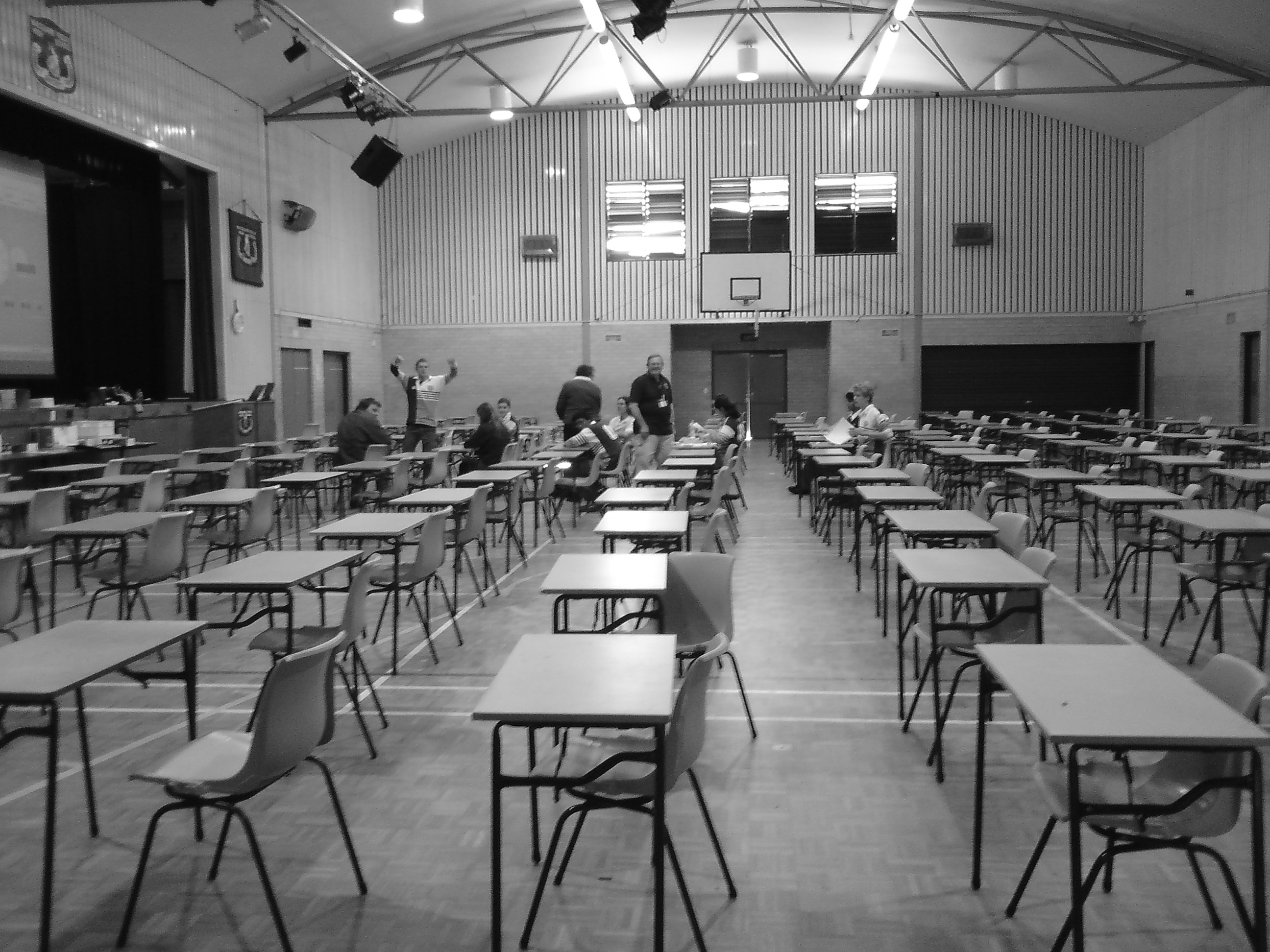
Down with written exams!
Posted by kmcg2375 in school, technology on January 15, 2010
I want to marry this opinion piece and have its babies.
In UK paper The Independent yesterday, Brandon Robshaw writes that It’s time to ditch written exams for students and go digital. I couldn’t agree more, if for no other reason than:
It seems obvious, but is seldom remarked, that students are being obliged to do something that they never do or need to do in real life: write with a pen for two or three hours non-stop.
To be honest, I don’t even care if exams don’t go digital…but putting an end to pen-and-paper exams must surely become a priority as the skills of extended handwriting and unaided recall of extensive amounts of facts go the way of the dinosaurs.
Robshaw argues that a computerised examination system would not only “be far kinder to students, it would also be far more useful, requiring them to employ a skill that is used outside the exam hall.” Amen to that. The most salient point for me, however, is not the usual evangelising about digital learning. In my experience, while many teachers can be convinced of the benefits of using digital technologies, the reality of poor funding and resources at both the school and system level make this utopia seem like a distant dream. Or, at best, an unholy uphill battle and minefield of ‘teething problems’ that we’re just too tired to contemplate.
No, for me the point that really needs to drive this campaign is that as extended handwritten work becomes more and more antiquated, the continued use of pen-and-paper exams becomes an increasing barrier to learning, as well as a significant equity issue. Fact:
no one writes at their best in an unfamiliar medium.
How can we, in good conscience, continue to set our students up for failure in this way? If we know that students are not going to do their best in a written exam, why do we persist with them? Especially when the impact is going to be felt most heavily by students with already low literacy skills. It’s no exaggeration to say that
Change can’t come too soon. The present system is akin to forcing candidates to write on slates with chalk, or chip away at stone tablets with chisels.
Thanks to @principalspage for the link to this article. It made my day!
Nominated!

- Australian English Teachers
 9 members
A group for English teachers in Australia to discuss the books they are reading, and the books th...
Books we've read
View this group on Goodreads »
Share book reviews and ratings with Australian English Teachers, and even join a book club on Goodreads.
 Kelli McGraw
Recent Comments