Archive for category technology
Bookfuturism
Posted by kmcg2375 in books, english, technology on February 19, 2011
I was very interested late last year to learn the term bookfuturism.
And I think I may be a bookfuturist.
It was a link from Kirsty Burow that first put me onto this.


Kirsty declares herself a ‘bookfuturist and book lover’ in her Twitter bio, and her pro-digital musings were refreshing coming from someone in the publishing industry (UQP), most of whom I have found to be die-hard bookservatives.
‘Bookservatives’ and ‘technofuturists’ are pitted against each other in Tim Carmondy’s Bookfuturist Manifesto, the post that had first influenced Burow.
In light of this weeks big news story about Australian book stores Borders and Angus and Robertson going into receivership and the simplistic ‘video killed the radio star’ style beat up about how iPads and Kindles are essentially to blame for putting Tim Winton out of business (anyone else notice the journos struggle to find another popular Aussie author to cite?) it’s worth remembering that radio is still around. Why? Because people still want it…the same is the case with books. Books are not analogous to vinyl records, a technology made difficult to sustain as it requires a specific machine to play it. As long as people have eyes, the paperback will be a difficult technology to eradicate.
(By the way, is anyone else having a Meg Ryan in You’ve Got Mail kind of moment? When big book store chains take over the book buying market by using their size to buy big, slash prices, and force themselves right in front of our face in every major shopping mall, I do find it hard to muster sympathy when they are pushed right back out by that same market…)
This afternoon Assistant Treasurer Bill Shorten has rejected calls for a review of Australia’s book importation regime, which is well and good for those arguing that this protects Australian authors. But where does this leave book lovers…and book futurists? For those who do delight in bookshop browsing, is it just a matter of time before the inability of industry to adapt to a BOOKS ARE ONLY THE BEGINNING climate of reading leads to more book store closures?
Publishers, readers, book sellers, authors, teachers, librarians…your thoughts?
Teaching Inanimate Alice
Posted by kmcg2375 in english, technology on January 29, 2011

I was delighted today to discover that I have been featured as today’s iTeacher on the Inanimate Alice Facebook page 😀

(oh yeah…cool factor = one million!)
My use of Inanimate Alice as a text in the English classroom was part of a wider unit for junior high school on ‘Narrative’ where multimodality was also being introduced as a concept.
Last year I showed Episode 1 of Alice to my tutorial groups of pre-service English teachers. The quality of the text blew their mind. I chose to show it on a large screen and some students took turns at coming up to control the interactive parts of the story. At the end they spoke to the class about how they felt about the added layer of participation in the text – they enjoyed it, though some confessed they had mixed feelings about the text at first as my explanation had resounded with childhood memories of choose-your-own-adventure style books, a genre they had come to look upon as formulaic and contrived. All found Alice to be anything but.
Viewing the story as a class was a powerful way to communicate the potential of opening the English classroom to texts that shake up our notions of genre and text type (rather than rote teaching students how to classify forms and features). It also refocussed our attention on the powerful role of storytelling in life and left everyone feeling inspired to seek out ‘better texts’ and ‘more cutting-edge material’ for their future English lessons.
This year I’ll be showing Alice again, but in smaller groups this time for a more intimate experience. I’d love to hear from any teachers who have seen any of the Episodes – have you had a chance to use them in class at all? What potential does a text like this hold, do you think?

2010 in review
Posted by kmcg2375 in online tools, reflections, technology on January 19, 2011
I wonder if the popularity of my top five reflects audience interest in curriculum issues, or the hot-ness of topics such as ‘HSC’ and ‘multimodal’ (due to its appearance in the English National Curriculum)?
Either way, thanks for reading in 2010 😀
The stats helper monkeys at WordPress.com mulled over how this blog did in 2010, and here’s a high level summary of its overall blog health:

The Blog-Health-o-Meter™ reads Wow.
Crunchy numbers
A Boeing 747-400 passenger jet can hold 416 passengers. This blog was viewed about 12,000 times in 2010. That’s about 29 full 747s.
In 2010, there were 71 new posts, growing the total archive of this blog to 181 posts. There were 41 pictures uploaded, taking up a total of 16mb. That’s about 3 pictures per month.
The busiest day of the year was January 24th with 189 views. The most popular post that day was Choice based on what now?.
Where did they come from?
The top referring sites in 2010 were twitter.com, facebook.com, google.com.au, eduleader.org, and Google Reader.
Some visitors came searching, mostly for kelli mcgraw, julia gillard, multimodal text definition, multimodal, and multimodal texts definition.
Attractions in 2010
These are the posts and pages that got the most views in 2010.
Choice based on what now? January 2010
37 comments
Defining ‘multimodal’ May 2010
13 comments
The Australian Curriculum for English March 2010
10 comments
HSC English: Standard or Advanced? March 2010
11 comments
5 reasons why HSC and ATAR scores make the angels cry December 2009
12 comments
I got the one with the bigger gee-bees!
Posted by kmcg2375 in personal, technology on December 22, 2010
Remember this video that was going around awhile ago?
“It has an app that will build you an island…”
“…It’s 3G, and has the Wi-Fi’s”
Well when I eventually did get my hands on a really cool iPod touch to play with on the wi-fis, I got to really wanting to upgrade my phone. I will always love my Sony Ericsson c902, it took some great pictures for me, and even survived being whisked out of a moving car window onto a highway near Yass while I was taking snapshots of a duststorm.

(this was after the worst/best of the storm…the phone survived, alas the memory card did not…)
After playing around on new touchy-screen phone technology though, it’s just a bit weird going ‘back’ to ‘just a phone’. With my portable device and all my wi-fis, I can read the internet and still hang out with my family instead of being cooped up in my study. That’s what sold me.
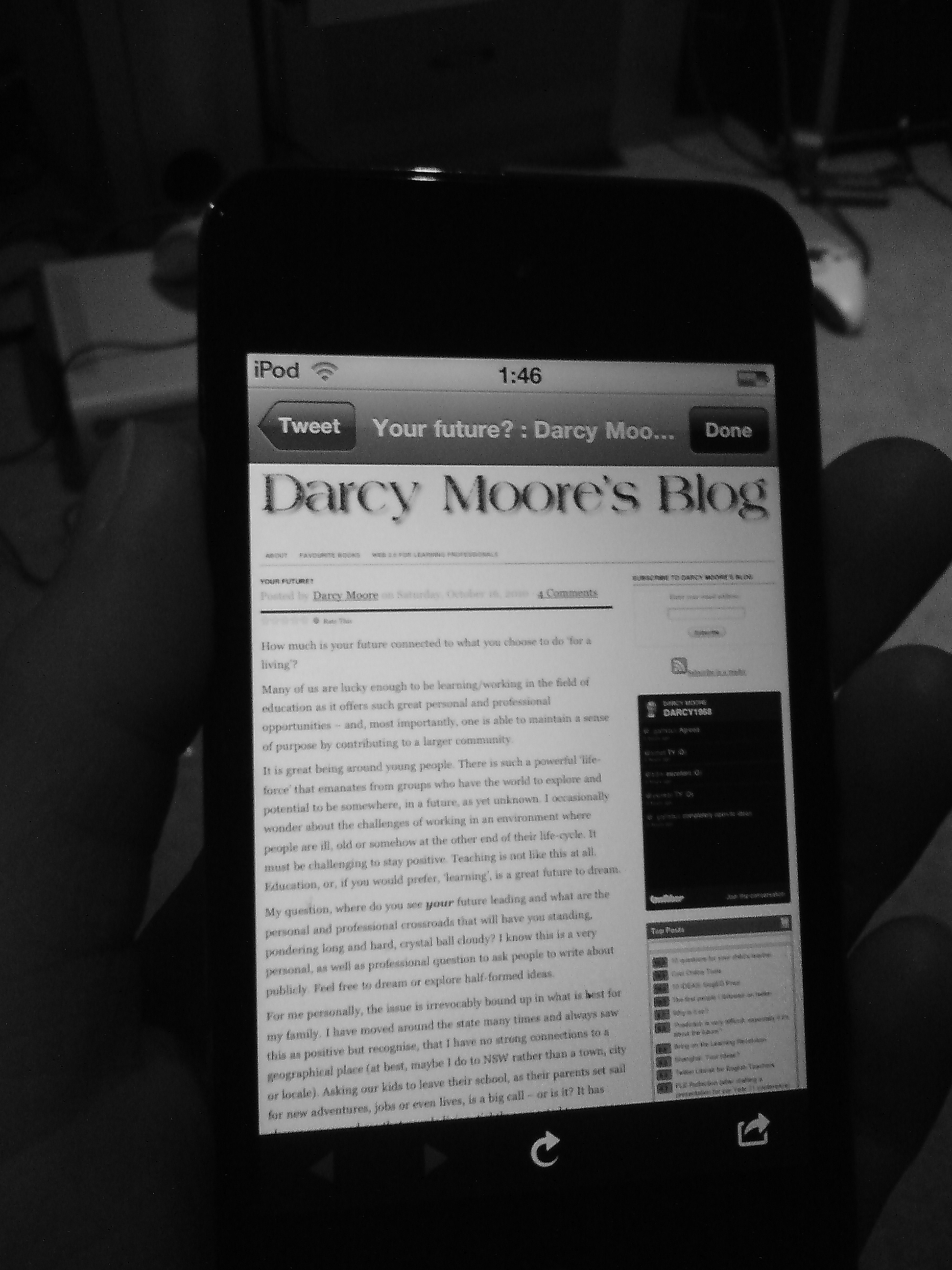
So after a long, long time of waiting, and of being jealous of OPP (other people’s phones) today, as a Happy Birthday to me present from my lovely husband, I went to pick up my new toy: a HTC Desire HD

I’m still in the swooshing-the-screen-around phase, but I already feel 10 times more organised with all this calendar and emailage at my fingertips. Now to get it travel ready, with my music and things…isn’t out-of-the-box day the best? 😀
The shape of the Arts curriculum
Posted by kmcg2375 in education, english, social media, technology, video games on October 14, 2010
For those who have yet to check it out, the draft shape paper for the Australian Curriculum for the Arts is now available on the ACARA website.
Given that up here in Queensland the school subject ‘Media Arts’ is separate to the subject ‘English’, I thought it would be an interesting exercise to intervene in the text and see if I couldn’t just find the crossover between the two subjects.
It wasn’t hard.
2.3.3 Defining Media Arts
Media ArtsEnglish is the creative use of communications technologies to tell stories and explore concepts for diverse purposes and audiences. MediaLanguage artists represent personal, social and cultural realities using platforms such as prose fiction, poetry, dramatic performances, television, film, video, newspapers, magazines, radio,video games, the worldwide web and mobile media. Produced and received in diverse contexts, these communication forms are important sources of information, entertainment, persuasion and education and are significant cultural industries in Australian society. Digital technologies have expanded the role that mediatexts play in every Australian’s family, leisure, social, educational and working lives. Media ArtsEnglish explores the diverse artistic, creative, social and institutional factors that shape communication and contribute to the formation of identities. Through Media ArtsEnglish, individuals and groups participate in, experiment with and interpret the rich culture and communications practices that surround them.
As I spend more time in Queensland I find myself having to wrestle with my identity as an English teacher because of this overlap with Media Arts. It’s not that media texts don’t still feature in the English curriculum – they do. But the culture here is that, while student might study visual language and analyse some/increasingly visual/multimodal texts in English, it’s Media Arts you have to go to if you want to make anything serious.
On one hand, it’s like Media Arts teachers get to do a lot of the fun stuff, which kind of sucks if you’re an English teacher from New South Wales!
But on the other hand, I have to admit, compared the rigour in the Media Arts curriculum up here…well, I have to admit that as an English teacher I always seemed to run out of time to ‘do the fun stuff’ anyway (do you know how LONG it takes for students to rehearse and record their own 10 minute version of Act I of Romeo and Juliet? Fricken ages!) And it would be nice, for just a short while, not to have to feel like I am dragging my English colleagues kicking and screaming toward increased multimodal study…now if I need to find a like minded media teacher, I can just go and, well, find one.
Leaving aside the ‘are knowledge silos good or bad’ debate, what thoughts do people have about the picture I’m painting here? NSW people, if you came up to the sunshine state would you want to specialise in English, or Media Arts?
Reframing Change
Posted by kmcg2375 in education, online tools, reflections, school, social media, technology on July 12, 2010
- Why do some people embrace change quickly, while others are slower to make changes to their practices or perspectives?
- What comfort (and convenience) is there in sticking with the known, the familiar, the expected?
- Can leaders of change persuade people who are slow, and even resistant to change, through enthusiasm alone?
- Is it enough to lead by example?
I want to suggest that, as educational leaders, if we want to help people come to terms with change and embrace it, then we need to recognise and validate their desire to stick with ‘the known’. Roger Pryor’s latest post makes some excellent points about ‘leading from behind’ and developing the leadership capacity of others. I think this is one of the significant hurdles – just as we find in our classrooms it is sometimes necessary to hang back while the students discover things for themselves, people can be empowered by discovering their capacity to change. Recognising that people are resisting change because they feel disempowered helps us to employ methods that give power back. This is a win-win solution.
But what other barriers are there to change that could similarly be ‘diagnosed’ and therefore turned around?
When a teacher tells me that they don’t want to use any online teaching tools because they are ‘too tired’ or ‘too busy’, one reaction I feel is frustration. Does this teacher think that I don’t get tired? That I am not busy?? I manage to find time to change my practice because I see it as a high priority.
The problem with this line of thinking is twofold. Firstly, I’m expecting someone else to have the same energy levels as me, without really questioning whether they do. Secondly, I’m asking someone to accept a shift to online teaching as a priority, when perhaps their professional priorities lie elsewhere. Perhaps they are really struggling with face-to-face classroom management. Perhaps they are consumed by essay marking.
So, one way forward is to find ways to align our priorities.
By this I don’t mean that other teachers should change their priorities to match mine! But, I might set aside my initial frustration to consider ways in which I can create professional learning that satisfies both of our priorities. One teacher I worked with gained confidence in marking essays after I showed her how to use track changes and commenting in Word…this also served the purpose of increasing her confidence with technology. Our priorities were aligned!
However is it also possible that sometimes, just sometimes, we are expecting too much? We also need to recognise that people only have so much energy to give.
Another way forward then, is to find ways of giving people the energy to change.
Teacher burnout is an increasingly widespread phenomenon. And yet, when I expect others to adopt new practices on the grounds that ‘I was able to do it’, I am refusing to validate them as a human being outside of the world of work. This might fly in the corporate world, but in the education system I would like to think this is outside of our philosophical remit.
One way that I generate energy to learn more about technology and the online world is to engage in digital practices that nourish me, personally. For me it’s sharing my (budding) artwork, making digital collages, reading with my Kindle, and connecting with friends in a purely social capacity via Facebook. I get professional nourishment from a lot of places too, but I’m not talking about that.
For some people getting a thirst for technology comes when they make their first Skype call, or make photo albums on iPhoto. For many people, the social connection provided by Facebook has been the big thing to ‘draw them in’ and increase their digital literacy (one of the reasons why, although Facebook has turned evil, I have a real problem with the tech elite bagging it out unreservedly).
Fun generates energy. Fun lures people into engagement.
So, if the diagnosis is a lack of energy, it might be worthwhile exploring how to restore people’s capacity to engage through play.
These are just a couple of example that I have been forming up. Aligning (not replacing) priorities, and restoring energy through fun and play.
As we continue to make new inroads with people who have typically resisted change, I really believe it is time to develop more sophisticated models than ‘lead by example’. That was phase one. Now we are getting a critical mass of people out there willing to lead by example…where can we move to next to stimulate change and support the changers?
How Real Media Misses The Point Of Social Media
Posted by kmcg2375 in online tools, reflections, social media, technology on July 11, 2010
As you could glean from my last post, I’ve become a little sensitive to social media zealots who seem determined to paint everyone who is wary/concerned/resistant to social media as merely being scared, whimpy individuals.
This is not to say that very good points do not continue to be made in favour of using social media.
Consider this article reproduced for Business Insider: How “Real” Media Misses the Point of Social Media written by Lisa Barone from Outspoken Media.
Barone makes a point that many of us using social media tools would make:
“The risks to exposing yourself to your customers and community aren’t nearly as severe as you may think; and the rewards are huge.”
However, she also sums up one of the best pieces of advice I would give about using social media:
“If you’re going to be a big boy and swim, and benefit from, these waters you have to be able to take it.”
These two mantras pretty much sum up the bulk of what I have seen going around in terms of the pros and cons of harnessing social media (in my context, to develop my PLN, as opposed to using it as a marketing tool etc.) However, the rhetoric that I often see invoked when a social media convert comes across a social media resistor is that the resistor is just ‘too old-fashioned’, ‘afraid of computers’, ‘non-reflective’, ‘too scared to share’ (and by extension, even ‘selfish’), or ‘a luddite’.
In my last post I suggested some other issues that, in my mind, are not currently being considered in enough depth, and which the ‘social media resistors’ are perhaps finding it hard to articulate because of their lack of familiarity with the technology. Interestingly, most people I would have expected to drop a comment were nowhere to be found…although it is school holidays, to be fair 😉
I suspect that discussions around how power is wielded within an identity-rich online PLE (Personal Learning Environment, consisting in part of social networking spaces like Twitter and Facebook) are difficult to have without putting noses out of joint. However, I also think that being open about how we construct and project our identities will be a test of whether we are ‘for real’ about connecting and collaborating in a democratic and generative way.
We can’t afford to be blind to reproductions of unhealthy practice in this brave new (connected, public) world.
Some ‘big’ questions we might have to ask
Posted by kmcg2375 in online tools, reflections, research, social media, technology on July 2, 2010
Well, it is Friday afternoon, and for many teachers holidays are in session, so we might as well get this reflection party started eh?
Seriously, I have been having some possibly paradigm altering thoughts, about social networking in particular. If you dig this scene, please read on!
- Networks that are ‘free and open’ (i.e. Twitter, Facebook) seem democratic, because everyone can ‘have their say’. But what power plays are still at work? What NEW power plays are we constructing that we’re going to have to undo/amend/atone for later?
- Social networks enable fast and efficient communication. But if you can publish your thoughts too fast, without reflection, is the noise that this generates worth the pay off? We are evangelistic about the benefits…but are we ignoring the costs (the drain on our own limited energy and focus in particular as we act as information filters)?
- Networks are being constructed (thinking especially of the Facebook issue here…but anything with an avatar and a bio could be seen to go down this road) that invite identity construction. We post photos, preferences, ideas, affiliations…identity capital (?) But are we muddying the waters of constructing a generative PLN when our communications are so entwined with our personal identity construction?
- Are the ‘big players’ – the people with many followers – throwing around their identity capital? Or are they using a cutting edge technology to be leaders?
- Are ‘great minds’ being devoured as they try to stay on top of the network (with the best of intentions – wanting to share and be open with others) and lead others? At what point are we no longer ‘paying it forward’, and just ‘forwarding’…or, ‘paying it back’. My online PLN has helped me to develop in so many ways…am I indebted to it? Am I obliged to stay and lead it? How can I nourish my own development?
- As a reflective practitioner, am I generating too much out put, and not getting enough input? Am I making/hearing thoughts…or just noise?
Honestly folks, I don’t know where this is all going. But yes, after some consideration, I decided to write a blog post about it. Because no matter where this line of thinking ends up, I highly doubt it will dull my appreciation of irony.
*grins*
Happy holidays!
The conversation continueth…
Posted by kmcg2375 in online tools, personal, school, social media, technology on March 21, 2010
I love it when Hiba says a few quick things!
I encourage you to read Hiba’s comment, and Troy and Melissa’s, in response to my last post. It is so important IMHO for us to be talking frankly, reflectively and supportively about the difficulties and fears that we/others have in regards to using technology in our teaching. Ignoring the problems will not make them go away!
I totally agree Hiba – using technology for the sake of it does not lead to effective teaching. And I think you’re right – this is bound to be the thing that Shaun has experienced. And yes, ‘too much of anything IS too much’. But…who decides what is too much?
“Just a few quick things” from me 😉
The end of your comment Hiba is very telling – you love and can see a clear use for OHPs, digital stories, twitter and youtube. Ok, but what about other teachers who don’t like these things? When they are told they ‘have to’ use them, won’t they have the same feelings as you expressed about other technology?
So: (1) teachers will best use what they know about and can see a use for, and (like all other pedagogical tools) each teacher will have their own style and ‘favourites’. I think this is OK, and a natural product of how we work.
BUT…
What do you do with teachers who are refusing/reluctant to learn new things? New tools? New ways of doing things? Is it good enough to just say ‘blogging is not a preferred teaching tool of mine’? Well, perhaps…but is it good enough to go wider than this and say ‘online learning is not a preferred teaching tool of mine.’? Er, NO. IMO this is tantamount to saying ‘I just don’t like doing group work’. Unlucky mate. Because:
(2) there are things that we know, for sure, things that are like fully researched and proven and everything about how collaborative learning enhances the learning experience, and about how online tools can facilitate this better than pen and paper work. This is not a matter of opinion, or personal style (though whether you use a wiki or a blog or a Ning or Moodle etc. certainly is).
AND…
I hear you about being too immersed in technology. I am a screen junkie, and have to constantly remind myself that not everyone is. I DO prefer to mark essays using track changes and comments in Word (it takes more time for me to negotiate the margins of someone’s handwritten essay than it does for me to just TYPE), but that’s just me. I don’t think that everyone needs to work this way. But I do think, at some point, you have a (dare I say) duty to expose students to this method of editing. This is especially important because:
(3) the distinction between ‘digital natives’ and ‘digital immigrants’ has been helpful, but is is not that black and white. Fact: not all kids have the kind of access to technology that you describe yourself as having – this is a class/SES/cultural issues that we MUST remain aware of. Another Fact: just because you use a lot of technology doesn’t mean that you can think critically about it, or apply it to new knowledge. Case in point – students’ PowerPoint presentations are generally REALLY AWFUL until they are taught how to apply skills of good public speaking, visual presentation, summarising, metalanguage/metathinking etc. How do you explain this phenomenon if it is true that ‘all young people already know about technology’? There’s a reason why English teachers teach novels, and don’t just say ‘go read it at home kids’.
FINALLY…
Back to the concept of ‘too much’. You know what else I think we use too much of? Workbooks. And writing notes off the board. And teacher talk. And homework (when it is not project and passion based, which I do like). But these practices are never questioned, never challenged, never stopped because people find them comfortable and familiar. And no-one notices when they are overdone because they are part of the traditional landscape of schooling, and because (most importantly I think) because this is how parents, and politicians, were taught and what they expect to see from kids’ classrooms.
My Head Teacher will get me in trouble if my kids don’t have a workbook, but no-one else gets in trouble for not having a blog!
So: (4) Let’s make sure we’re applying the ‘too much is too much’ rule across the board, and not just as an excuse/a reason for neglecting the new. If what we mean is ‘we haven’t had enough PD to use this right’ then by all means say that. But there are some things that would be good to drop out of our current practice to make room for the new.
One thing that we know about teaching is that no matter what you are taught to do, as a teacher you will instinctively model your practice on the teaching you received at school. Fighting against this instinct takes concentration, and learning about new practices and tools takes a lot of work. Because of this, teachers who are embracing technology are feeling increasingly overloaded and burnt out – this is the real problem that needs managing. In Hiba’s post I felt a real sense of fatigue, and I know how she feels because I have felt that way too. We teachers have to look after ourselves personally and adjust our level of change commitment as our energy ebbs and flows. People who yell and scream and try and force everyone to use technology all lesson, every lesson need to be more sensitive to change fatigue…but in return, teachers need to ‘man up’ when the energy does flow, and explore these new tools for refining their craft.
Without understanding and effort on both sides, the student will be the one who misses out.
A personal response to technology hating
Posted by kmcg2375 in english, online tools, personal, social media, technology on March 17, 2010
This is a post for my friend Shaun, but I hope it’s something you all can use.
Shaun is a top bloke. He’s an English teacher who has a deep passion for literature and from what I can tell a real knack for sharing this with his students. His students get great results at assessment time. He’s warm, funny, relatable and engaging.
But, in a brief chat about another blogger’s controversial anti-technology post, it was clear that Shaun was not enthusiastic about digital learning.
In fact, he despises it. And also has had such bad experiences that he now doesn’t trust teachers who use it.
So…what to say to my friend who is in the position of already being a great teacher getting great results?
How to convince him that digital learning is more than fancy icing on his otherwise tasty, filling and nutritional educational cake?
I thought that this task might call for a personal story.
ABOUT ME: I am an English teacher who has always loved English. As a child and teenager, reading was like breathing to me – not just ‘part of life’, but an urgent necessity. In school I excelled at debating, and public speaking. For my HSC I studied as much English as I could – 2 unit Related plus 3 unit English. I loved essay writing, adored my English teachers, and was in my element during teacher lectures that were accompanied by class discussion. My UAI was in the mid 90s. I was a successful English student.
MY CONFESSION: While all of the above is true, it is also true that in year 9, for the first time, I did not read our class novel The Wizard of Earthsea. The teacher never knew, and my grades were stellar. Same again in Year 11 with The Scarlet Letter. Same again in HSC 3 unit English with Shakespeare’s The Tempest. And…same again with about a third of the books I was supposed to read for my University English courses, though in that arena my grades weren’t stellar…just above average.
Why do I make these confessions, horrible as they are for an English teacher?
Because when Shaun tells me that his students are all engaged with their learning without the use of technology, I can tell you from experience that they aren’t. Not authentically. Sure, they may gaze up in awe as he speaks passionately about the wonder of Hamlet, and they might have the skill to assemble good essays by aping the points brought up in class discussion. But I guarantee you Shaun, you are teaching at least some people just like me – people who slip under the radar due to their genuine love of English and their skill in using language, but who have the potential to be far more active in their learning.
The other reason I make these confessions is because arguments trying to promote the adoption of technology are often made with reference to engaging low-ability or disinterested students. And I support those arguments whole-heartedly – I have seen students, especially in the junior years, really turn their attitude around (especially in regard to writing) because the fun side and familiarity of using computers gave them the confidence and motivation to complete some work.
It is so much harder to convince teachers of ‘successful’ students that anything needs to change.
But (and Shaun this is my final point I swear!) not only does digital learning have the potential to increase student engagement at all levels due to its inclination toward communicative and collaborative learning practices, but I truly believe that neglecting the development of students’ digital literacy means that as teachers we are neglecting one of our key roles – the preparation of students to participate and engage fully with society, present and future. Technology isn’t going away. And English teachers that say ‘digital literacy is not my job’ would do well to remind themselves of the times when English teachers used to say ‘visual literacy is not my job’.
Times change. Media changes. Language changes. We must make sure our students are equipped to cope with this.
I would be most grateful if people could add comments to this post with their own personal success stories from English classrooms that have embraced technology, either in content, pedagogy or assessment.
We will not convince technology haters to change by telling them they are wrong, when their experience is to the contrary. We must do it by showing that we know about some amazing, engaging and powerful tools for achieving the outcomes they value and desire
…and that not all teachers using technology are merely doing so to look cool and get promoted 😉
-
You are currently browsing the archives for the technology category.
Nominated!

- Australian English Teachers
 9 members
A group for English teachers in Australia to discuss the books they are reading, and the books th...
Books we've read
View this group on Goodreads »
Share book reviews and ratings with Australian English Teachers, and even join a book club on Goodreads.
 Kelli McGraw
Recent Comments