Archive for category reflections
2011
Posted by kmcg2375 in online tools, personal, reflections on January 17, 2011
Back from San Francisco and trying to muster a direction for blogging…is it too late to flag closure of 2010? I thought this Facebook app was pretty cool:

*sigh* I’m expecting to need a different approach to online communication this year as email and social networking become more closely aligned with my ‘work’ than with reflection and dialogue. What that means in reality…stay tuned!
The HSC again. and again.
Posted by kmcg2375 in education, HSC, reflections, school on December 16, 2010
In NSW yesterday Year 12 school leavers got their HSC results back. And again, we reflect.
so-and-so got x amount of Band 6s this year…should I teach more like them?
my kids didn’t go as well as they had hoped…did I fail them?
there were some great successes at our school…what pressures will this bring next year?
The dizzying heights…the devastating lows.





I’m sure this post / these tweets should have some ‘IMHO’s peppered through them, but stuff it – the HSC is an evil device.
I’m so proud of every HSC student who got through the year, and was beyond excited for my ex-students who got the results they sought (I always will be). Motivation, goals, mastery, achievement, I believe in them all. But the HSC provides them too sparingly, for students and their teachers.
And now it’s time for recovery. again.
Congratulations one and all – bring on 2011…
So, what do you actually do?
Posted by kmcg2375 in reflections, university on November 21, 2010
Recently I’ve had explain to more and more people what I do in my job as a University Lecturer.
This is tough, because no matter how much I try to jazz it up, until I get another ‘big research project’ that I can talk about, the description just sounds like ‘oh, you know – reading and stuff’. And ‘my head is like a giant computer that mostly knows about teaching English’ just sounds a bit loony.
Up until last week I was still in teaching time. This made life easier – I could describe giving lectures and grading essays. But now that I’m on the research clock…well, things are a whole lot less defined.
I saw a great summary in a faculty email today of the three core criteria comprising our definition of research activity:
- publications,
- HDR supervision,
- research grants/consultancies.
That’s a nice list to use I guess. And given that I don’t have any students to supervise yet, or any research grants, I guess that leaves me with publishing over the summer.
So, in terms of what that means I will do with my actual time? With the actual minutes of my day?
Looks like I am up against a lot of computer time, more self-directed learning, lots of getting to know journals in the field, and reassembling bits of old writing into new hopefully interesting things to read…so much to do and so little to talk about, in short. But, so far, I still love it.
I wonder if my blog will get boring?
I wonder if I’ll need glasses soon?

Too Much Reading
Valedictorian Speaks Out Against Schooling
Posted by kmcg2375 in education, random, reflections on October 7, 2010
I just loved every minute of watching this Valedictory speech by Erica Goldson:
The full transcript can be read at her blog.
One of my favourite section from the speech is this:
School is not all that it can be. Right now, it is a place for most people to determine that their goal is to get out as soon as possible.
I am now accomplishing that goal. I am graduating. I should look at this as a positive experience, especially being at the top of my class. However, in retrospect, I cannot say that I am any more intelligent than my peers. I can attest that I am only the best at doing what I am told and working the system. Yet, here I stand, and I am supposed to be proud that I have completed this period of indoctrination. I will leave in the fall to go on to the next phase expected of me, in order to receive a paper document that certifies that I am capable of work. But I contest that I am a human being, a thinker, an adventurer – not a worker. A worker is someone who is trapped within repetition – a slave of the system set up before him. But now, I have successfully shown that I was the best slave. I did what I was told to the extreme. While others sat in class and doodled to later become great artists, I sat in class to take notes and become a great test-taker. While others would come to class without their homework done because they were reading about an interest of theirs, I never missed an assignment. While others were creating music and writing lyrics, I decided to do extra credit, even though I never needed it. So, I wonder, why did I even want this position? Sure, I earned it, but what will come of it? When I leave educational institutionalism, will I be successful or forever lost? I have no clue about what I want to do with my life; I have no interests because I saw every subject of study as work, and I excelled at every subject just for the purpose of excelling, not learning. And quite frankly, now I’m scared.
‘I have successfully shown that I was the best slave. I did what I was told to the extreme.’
Powerful stuff Erica. Definitely worth a watch!
Writers on writing
Posted by kmcg2375 in books, english, random, reflections on September 28, 2010
I’m just choosing some quotes about the writing process to put into an English course book chapter on identity and storytelling. Some corkers out there! Here are a few that struck a chord with me, but which I suspect are a bit too terrifying to introduce to 7th graders 😉
- Writing is turning one’s worst moments into money. (J. P. Donleavy)
- As for me, this is my story: I worked and was tortured. You know what it means to compose? No, thank God, you do not! I believe you have never written to order, by the yard, and have never experienced that hellish torture. (Fyodor Dostoevsky)
- I love deadlines. I like the whooshing sound they make as they fly by. (Douglas Adams)
- Remarks are not literature. (Gertrude Stein)
- The misuse of language induces evil in the soul. (Socrates)
- There’s no such thing as writer’s block. That was invented by people in California who couldn’t write. (Terry Pratchett)
- Any magazine-cover hack can splash paint around wildly and call it a nightmare, or a witches sabbath or a portrait of the devil; but only a great painter can make such a thing really scare or ring true. That’s because only a real artist knows the anatomy of the terrible, or the physiology of fear. (H. P. Lovecraft)
- You can approach the act of writing with nervousness, excitement, hopefulness, or even despair – the sense that you can never completely put on the page what’s in your mind and heart. You can come to the act with your fists clenched and your eyes narrowed, ready to kick ass and take down names. You can come to it because you want a girl to marry you or because you want to change the world. Come to it any way but lightly. Let me say it again: you must not come lightly to the blank page. (Stephen King)
- Poetry is not a career, but a mug’s game. No honest poet can ever feel quite sure of the permanent value of what he has written, he may have wasted his time and messed up his life for nothing. (T.S. Eliot)
So: ‘torture’, ‘evil’, ‘hack’, ‘nervousness’…’a mug’s game’. Yep, that seems about right!
Thesis complete!
Posted by kmcg2375 in personal, reflections, research on August 26, 2010

Today I took my finished PhD thesis to the printer to get bound for examination 😀
This is an awesome, wonderful, terrific day!
Big hugs and love to everyone who supported me in finishing the beast. I could never have done it alone xo
Thesis-ing (final days)
Posted by kmcg2375 in personal, reflections, research on August 24, 2010
I just want to put it out there, for anyone who was wondering:
Writing a PhD thesis is hard.
(like, seriously, fcuking hard.)
I have just 2 days left until I have to take this puppy to get printed and bound for examination.
I feel like my brain is going to explode.
Far out, I’d better turn out to be seriously smart after this!
See you on the dark side of the moon, people xx

Insubordination
Posted by kmcg2375 in education, reflections on August 11, 2010
This tweet caught my eye today:
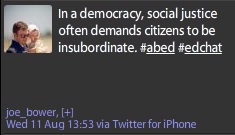
It caught my eye because I have been musing on this observation made by Jan, a high school Principal on Twitter last week:
We work within a system. Of course there are systemic priorities. That is the reality of any workplace IMHO.
I wanted to flag this because I think both of these tweets are right, but this is a problematic standpoint as ‘working within a system’ and ‘being insubordinate’ are tricky agendas to keep in balance.
There has been much promotion recently amongst NSW DET leaders of adopting a ‘Tight-Loose-Tight’ model of working in schools. It’s a model I support, and I think it provides a really terrific framework for teachers and school leaders (and system bureaucrats) to work on common ground without constantly arguing about, say, NAPLAN. By accepting policy and product requirements we can get on with developing the ‘Loose’ area – the bit where we actually teach in the classroom using different and divergent strategies that are relevant and engaging and meet the needs of our personal teaching style, our individual students and our local school context.
However, recently I have definitely felt that critical comments made by teachers about ‘the system’ are being taken personally by leaders who are higher up the chain and see this as either a personal attack or an undermining of their innovative work in planning their school. A few weeks ago I wondered if the answer is that we need a more realistic paradigm for collaborating with the people who ultimately are our ‘boss’. But to tell you the truth, I find that idea quite dispiriting. I hate having to mind my p’s and q’s…it’s why I decided NOT to go into politics!
I don’t have much to say about this today, but perhaps you do?
How can we show our leaders the love (and our commitment to common goals) while maintaining a healthy level of insubordination?
NB: I’m talking very NSWDET here, but I’ve found a similar conundrum working with people on development of the National Curriculum…it’s tough to authentically engage in developing something so prescribed-from-above when your gut reaction is to kick against the pricks. Conversely, it’s tough to promote engagement with the resulting best-case-scenario product to people that I in turn lead when they want to fight against it too!
Reframing Change
Posted by kmcg2375 in education, online tools, reflections, school, social media, technology on July 12, 2010
- Why do some people embrace change quickly, while others are slower to make changes to their practices or perspectives?
- What comfort (and convenience) is there in sticking with the known, the familiar, the expected?
- Can leaders of change persuade people who are slow, and even resistant to change, through enthusiasm alone?
- Is it enough to lead by example?
I want to suggest that, as educational leaders, if we want to help people come to terms with change and embrace it, then we need to recognise and validate their desire to stick with ‘the known’. Roger Pryor’s latest post makes some excellent points about ‘leading from behind’ and developing the leadership capacity of others. I think this is one of the significant hurdles – just as we find in our classrooms it is sometimes necessary to hang back while the students discover things for themselves, people can be empowered by discovering their capacity to change. Recognising that people are resisting change because they feel disempowered helps us to employ methods that give power back. This is a win-win solution.
But what other barriers are there to change that could similarly be ‘diagnosed’ and therefore turned around?
When a teacher tells me that they don’t want to use any online teaching tools because they are ‘too tired’ or ‘too busy’, one reaction I feel is frustration. Does this teacher think that I don’t get tired? That I am not busy?? I manage to find time to change my practice because I see it as a high priority.
The problem with this line of thinking is twofold. Firstly, I’m expecting someone else to have the same energy levels as me, without really questioning whether they do. Secondly, I’m asking someone to accept a shift to online teaching as a priority, when perhaps their professional priorities lie elsewhere. Perhaps they are really struggling with face-to-face classroom management. Perhaps they are consumed by essay marking.
So, one way forward is to find ways to align our priorities.
By this I don’t mean that other teachers should change their priorities to match mine! But, I might set aside my initial frustration to consider ways in which I can create professional learning that satisfies both of our priorities. One teacher I worked with gained confidence in marking essays after I showed her how to use track changes and commenting in Word…this also served the purpose of increasing her confidence with technology. Our priorities were aligned!
However is it also possible that sometimes, just sometimes, we are expecting too much? We also need to recognise that people only have so much energy to give.
Another way forward then, is to find ways of giving people the energy to change.
Teacher burnout is an increasingly widespread phenomenon. And yet, when I expect others to adopt new practices on the grounds that ‘I was able to do it’, I am refusing to validate them as a human being outside of the world of work. This might fly in the corporate world, but in the education system I would like to think this is outside of our philosophical remit.
One way that I generate energy to learn more about technology and the online world is to engage in digital practices that nourish me, personally. For me it’s sharing my (budding) artwork, making digital collages, reading with my Kindle, and connecting with friends in a purely social capacity via Facebook. I get professional nourishment from a lot of places too, but I’m not talking about that.
For some people getting a thirst for technology comes when they make their first Skype call, or make photo albums on iPhoto. For many people, the social connection provided by Facebook has been the big thing to ‘draw them in’ and increase their digital literacy (one of the reasons why, although Facebook has turned evil, I have a real problem with the tech elite bagging it out unreservedly).
Fun generates energy. Fun lures people into engagement.
So, if the diagnosis is a lack of energy, it might be worthwhile exploring how to restore people’s capacity to engage through play.
These are just a couple of example that I have been forming up. Aligning (not replacing) priorities, and restoring energy through fun and play.
As we continue to make new inroads with people who have typically resisted change, I really believe it is time to develop more sophisticated models than ‘lead by example’. That was phase one. Now we are getting a critical mass of people out there willing to lead by example…where can we move to next to stimulate change and support the changers?
How Real Media Misses The Point Of Social Media
Posted by kmcg2375 in online tools, reflections, social media, technology on July 11, 2010
As you could glean from my last post, I’ve become a little sensitive to social media zealots who seem determined to paint everyone who is wary/concerned/resistant to social media as merely being scared, whimpy individuals.
This is not to say that very good points do not continue to be made in favour of using social media.
Consider this article reproduced for Business Insider: How “Real” Media Misses the Point of Social Media written by Lisa Barone from Outspoken Media.
Barone makes a point that many of us using social media tools would make:
“The risks to exposing yourself to your customers and community aren’t nearly as severe as you may think; and the rewards are huge.”
However, she also sums up one of the best pieces of advice I would give about using social media:
“If you’re going to be a big boy and swim, and benefit from, these waters you have to be able to take it.”
These two mantras pretty much sum up the bulk of what I have seen going around in terms of the pros and cons of harnessing social media (in my context, to develop my PLN, as opposed to using it as a marketing tool etc.) However, the rhetoric that I often see invoked when a social media convert comes across a social media resistor is that the resistor is just ‘too old-fashioned’, ‘afraid of computers’, ‘non-reflective’, ‘too scared to share’ (and by extension, even ‘selfish’), or ‘a luddite’.
In my last post I suggested some other issues that, in my mind, are not currently being considered in enough depth, and which the ‘social media resistors’ are perhaps finding it hard to articulate because of their lack of familiarity with the technology. Interestingly, most people I would have expected to drop a comment were nowhere to be found…although it is school holidays, to be fair 😉
I suspect that discussions around how power is wielded within an identity-rich online PLE (Personal Learning Environment, consisting in part of social networking spaces like Twitter and Facebook) are difficult to have without putting noses out of joint. However, I also think that being open about how we construct and project our identities will be a test of whether we are ‘for real’ about connecting and collaborating in a democratic and generative way.
We can’t afford to be blind to reproductions of unhealthy practice in this brave new (connected, public) world.
-
You are currently browsing the archives for the reflections category.
Nominated!

- Australian English Teachers
 9 members
A group for English teachers in Australia to discuss the books they are reading, and the books th...
Books we've read
View this group on Goodreads »
Share book reviews and ratings with Australian English Teachers, and even join a book club on Goodreads.
 Kelli McGraw
Recent Comments