Archive for category learning community
Building up my Pinterest resources
Posted by kmcg2375 in education, learning community, online tools, social media, university on December 8, 2012
I wrote a little while ago about my venturing into the world of Pinterest. My first board was a collection of images and links relating to ‘Indigenous Studies‘.
This post is just an update on what else I’ve been pinning that other teachers might like to check out.

English teaching – Pinterest board
On my board for English teaching I have links to professional associations, related groups and institutions, magazines and journals, classroom resources for English, and other stuff I think an English teacher might like.
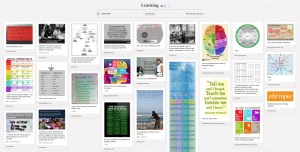
Pinterest board – Learning
When I started finding resources for learning in general that weren’t specifically about English, I created this board for pins about Learning. There are some especially good things up to re-pin from Edutopia and Edudemic.

Pinterest board – Brisbane
Finally, so that this post isn’t ALL work and no play, here is a link to the board I use to collect links to cool things to see and do in Brisbane. This board is great for when people come up here to visit, it means we always have a good list of things to do and see 🙂
If you’ve never used Pinterest before…
- Don’t stress out about missing out. I don’t see it as one of those “you absolutely GOTTA have an account!” tools. Anyone can go and browse my Pinterest boards, which I’ve invested time in because I like to curate, and also because I think my students enjoy the visual layout of links they would otherwise ignore in a reading list.
- My ‘addiction’ (read – compulsion to add pins!) to this tool waned after about four weeks, but I still find myself coming back to it and liking it five months after signing up.
- If you do decide after reading this post to go and make some Pinterest pin boards, ENJOY! I’ve really dug finding new resources this way, as well as thinking more carefully about how an icon or image ‘pin’ can represent an idea, association or resource.
Student blog posts – please comment on one if you can!
Posted by kmcg2375 in education, learning community, online tools, social media, university on October 11, 2012

CC-licensed Flickr image by mrsdkrebs
This semester I have been leading a group of future Teacher Librarians through the Masters of Ed. unit ‘Youth, popular culture and texts‘.
For their second assignment they have to contribute to a group learning blog.
Here are links to blog posts from each of the SIX student blog groups that I will be charged with assessing at the end of October:
- Group M: http://jeanetteki.edublogs.org/2012/10/01/tv-shows-i-loved-growing-up-by-gina-mcpherson/
- Group C: http://cln647groupc.edublogs.org/sample-page/
- Group G: http://shellnye.edublogs.org/2012/09/16/successfully-logged-in-to-blog/
- Group R: http://whatishotandwhatisnot.edublogs.org/2012/10/10/gaming-as-learning/
- Group A: http://kpak.edublogs.org/2012/10/03/putting-the-social-into-reading/
- Group W: http://walwoowar.edublogs.org/2012/09/13/is-this-popular-culture-text/
I would be really grateful if folks could click through to any of these and drop a comment!
For many students in this unit it is their first attempt at adding to a blog like this – an extra comment here and there will make a big difference to their experience.
Thanks in advance 🙂
This is why more English teachers should write a blog!
Posted by kmcg2375 in conferences, education, english, learning community, online tools, reflections, social media on October 7, 2012
English teachers who blog
I’ve just come home from the AATE 2012 national conference in Sydney. It was exceptionally energising to spend two whole days and nights talking face-to-face with people in my PLN, as well as getting to know my colleagues better and meet new people.
One of the sessions that I spoke in was a panel discussion on being a teacher that blogs. Here is a piccie of me with the other panellists @Darcy1968 and @BiancaH80 with our chair @melanne_k:
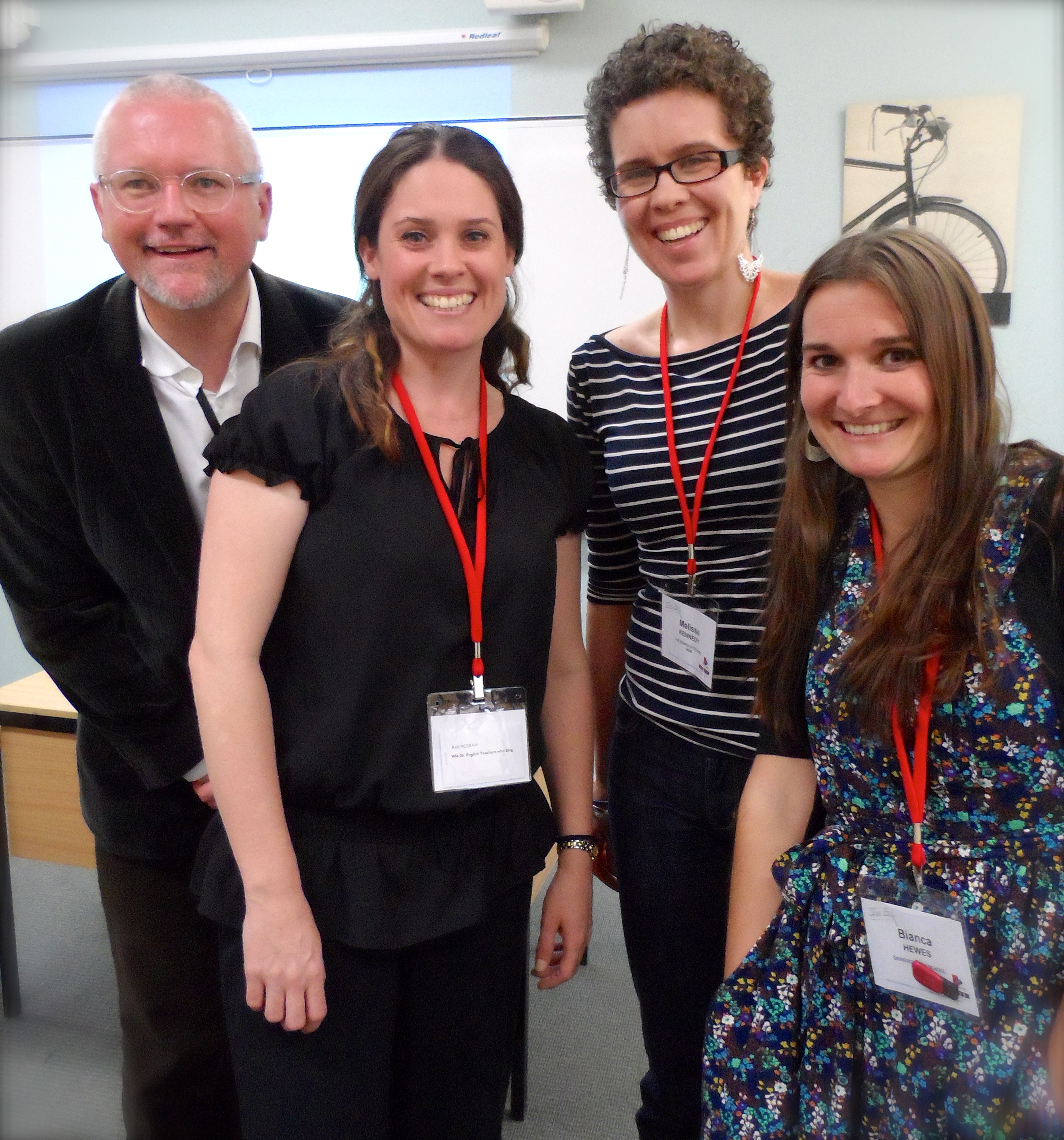
Darcy, Kelli, Melissa and Bianca
Why we need more voices online
There are so many things I would love to write a blog post about, based on ideas I heard or conversations I had at the AATE conference. BUT – I know I won’t get a chance to write about them all! So, the first reason that more teachers need to blog is to literally get more of these ideas recorded:
- Andrew Burn outlined a ‘3Cs’ model of media literacy – Cultural, Critical, Creative. How does this differ to other models of literacy (e.g. Green’s 3D model, Luke & Freebody’s 4 Resources model)?
- Bianca’s presentation on Project Based Learning emphasised the role of assessment. I have also found this to be very important, have others?
- Gillian Whitlock from UQ presented some really interesting ideas about humanitarian perspectives on literature and children’s writing. She showed refugee writing from Australia and artwork that had been created to memorialise the refugee journey. Definitely someone in Queensland to talk to or hear from again!
- The hashtag #5bells was used pretty successfully as a conference backchannel, I thought! What can we learn from this and how can we improve the experience for 2013 in Brisbane?
- Vivian (@vivimat78) did us all a big favour by collecting many of the #5bells tweets via storify…this is super helpful and valued, as hashtags are no longer searchable, after a time period, and we don’t want to lose all that great sharing!
- Vivian also coordinates the #ozengchat twitter chat and edmodo group. What relationship might exist in the future between AATE and #ozengchat? How can/do they support each other?
- We got to say so much to each other in real life (IRL)! Talking uses up soooo many characters! Face-to-face conversations are fun 🙂
- Hip Hop – OMG Adam Bradley was convincing. All the copies of his ‘anthology’ book sold out, and so many people left the keynote ready to exchange their cardigans for hoodies… In response I’ve started a Twitter list: trust-me-i-m-cool for teachers looking for Aussie Hip Hop links. One love!
- I found the closing keynote by Bill Green and Jane Mills to be quite problematic. I understand their point to be that linguistic frameworks have taken over the analysis of ‘the visual’, and that ‘cinephiles’ understand film in a much more ‘visceral’ way. I don’t agree. I think this contrast is weird, given the way I cry like a baby when reading some books, and (I believe) can successfully understand the moving image, thank-you-very-much. I usually love Bill’s stuff, but would rather have heard about his theories on ‘spatial literacy’ than be told English teachers are inadequate at teaching film…wrong crowd for that idea bill and jane, wrong crowd indeed.
I’m sure there is more, but these are the big ideas that I would ideally tackle in the next couple of months. Who will help me? (Will it be you?)
Don’t do it for me, do it for you!
In the panel that we did, quite a few people wanted to talk about how to get more people commenting on their posts. This is a good question, and our suggestions included:
- Comment on other people’s posts so that they come and visit your blog
- Let people know you have written a post by putting the URL up on Twitter (you’ll need an account)
- Use categories and tags wisely to help search engines find your post
However, I really do believe in the power of reflective writing for learning, and I encourage any new blogger to write posts for themselves as much as for an imaginary audience. It’s OK to talk to yourself here!
Think about it – how many times have you tried to convince a student to do a piece of reflective writing for homework, because you know the benefits it will have for their learning? Writing up your experiences on a blog can have the same benefit for you! The mere process of deciding “what will I publish information about this time?” will put you more in touch with the successes and obstacles in your practice, I really do believe this.
So that’s the second big reason. Start a blog for yourself, because if you haven’t yet, then I think you need to.
If you think you “can’t find time to write anything, ever”, then making time to do this will hopefully help you see ways to make time for other things too. And don’t worry – the blogging police aren’t going to arrest you if you don’t add anything for 3 months!
And because all good things come in threes…
The third reason why more English teachers should start a blog is because teachers who blog and share their resources are usually friendly, generous and just plain fun to hang out with.
And the more we share our work and resources, hopefully the more time we can put back in to spending quality time with our students, friends and families x
Why English teachers join professional associations
Posted by kmcg2375 in education, english, learning community, social media on August 26, 2012
In 2010 the English Teachers Association (NSW, Australia) celebrated 50 years of operation and service to members.
A DVD was released to members, with reflections from past and present ETA leaders. It is an excellent record of the history of the association and provides invaluable insights for new teachers!
I was surfing YouTube when I found that the ETA had uploaded the first section from the DVD onto the web. Here it is, roughly 8 minutes, on a range of teachers’ first involvement with the ETA:
My Pinterest Boards (and why I’m bothering to make some)
Posted by kmcg2375 in education, learning community, online tools, social media, university on July 16, 2012
For the first half of this year it seemed like all anyone was asking me was ‘do you have Pinterest?’
All throughout semester one, when I asked students about Twitter or Facebook or Tumblr, I was guaranteed to get a few voices around the room crying ‘Pinterest!’
It sounded like a cool tool. A virtual pinboard – just make a board on a topic or ‘interest’ (ahhhh… pin + interest = ‘pinterest’!), then add images and videos to it. Always a fan of putting posters on my bedroom wall, covering my school folder with pictures under contact paper, and putting stickers on random bits of stuff, this highly visual curation tool has always sounded promising to me.
I had made the decision in semester one, however, to steer clear of Pinterest. This choice was purely motivated by my fear of taking up another addictive web tool … the first semester of this year was just too busy already to attempt trying new things.
Some questions have also flown around over time about the ethics and copyright implications of re-pinning images without permission, and I confess this made me wary.
THIS SEMESTER, however, I am pinning!
My most promising board so far is the one I have made to collect links for the unit ‘Culture studies: Indigenous education’ (EDB007):

http://pinterest.com/kmcg2375/indigenous-studies/
I hope to engage students in my two tutorials by sharing the board with them and inviting them to explore the links I’ve collected/curated.
Of course, I could have chosen to share my links in other ways, but they all have their drawbacks:
- on a handout (which is not hyperlinked)
- in a Blackboard/LMS post (students hate and avoid Blackboard)
- using social bookmark sharing e.g. delicious (so far unsuccessful; students don’t use/engage)
My hope is that the visual nature of Pinterest, and the ability to browse it socially and on mobile devices, will entice a few students to explore the links I’ve found.
As far as the image copyright issue is concerned, I think I’ll just wait and see if any of these organisations complains, eh? I have done my best to attribute the images, that’s all I can say.
Last word:
This slide presentation by Joe Murphy (@libraryfuture) was really helpful for me:
Joe makes this observation:
“Pinterest succeeds at the juncture of the major online and content trends of:
- self curation
- image engagement and sharing
- visual search/discovery
- and social discovery”
In addition, points made in these slides about the potential of Pinterest to expand community engagement and open up services to diverse clients made me even more eager to try using this service as a teaching resource.
Here’s hoping my bid to invoke some ‘cool’ in my classroom pays off!
AATE / ALEA 2013 National Conference
Posted by kmcg2375 in conferences, education, english, learning community on June 18, 2012
This year in Sydney, as with last year in Melbourne, AATE and ALEA are holding separate national conferences.
Despite promises to myself earlier this year to go to less conferences, I’ll be heading along to both 🙂
The ALEA National Conference, which is about to be held in Sydney from 6-9 July, has already sold out all available places (Well done to Lisa Kervin, the conference convenor!) I’ll be sticking my head in on the last day of this conference to hand out promotional material our conference in Brisbane…it’s hand over time, baby!
The AATE National Conference will be held a little later this year, from 3-4 October. I’ll be there with Five Bells on, presenting a workshop with Bianca Hewes on ‘Success, obstacles and ethics in online teaching’ as well as on a panel about teacher blogging. I’ll be joined on the panel by the likes of Bianca, Troy and Darcy, so you know it’s going to be a power-session; not to be missed!
Once these two conferences are wrapped up, it’s next stop: Brisbane 2013!
Our website won’t go live until after the hand over in July, but there is a Facebook page you can like and Twitter profile you can follow:
Facebook: http://www.facebook.com/englishliteracyconference
Twitter: https://twitter.com/#!/EngLit2013
We’re working like crazy to get the Call for Papers and everything else ready for the launch, but here’s a sneak preview of things to come:

…will I see you in Brisbane in 2013?
QWC: Letter Writing Club
Posted by kmcg2375 in learning community, random on May 8, 2012
In my search this semester to find local resources to support English teachers, I came across the Queensland Writers Centre (http://www.qwc.asn.au/).
Truth told, I had already come across the QWC last year, when I was learning about IF:Book Australia (http://www.futureofthebook.org.au/). Finding out more about the QWC was something I had been meaning to do for awhile!
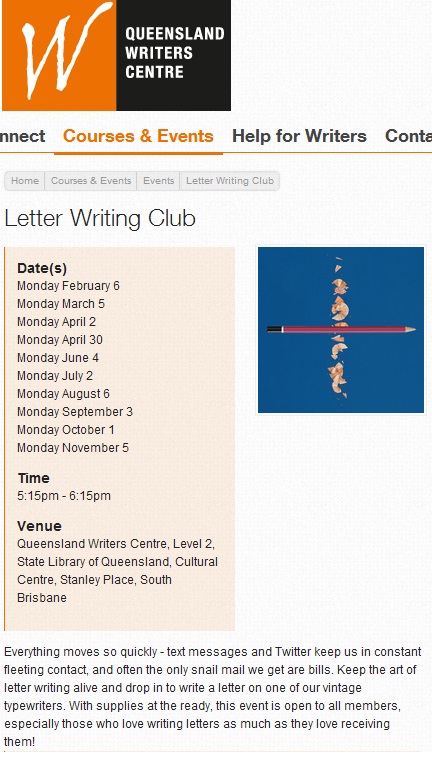
So it was serendipitous that I came across a notice about the ‘Letter Writing Club’ that is being run throughout 2012 by the Queensland Writers Centre. On the first Monday of most months, members of the public can participate in the club for free. Paper, quills, old typewriters and other devices are made available for people to write letters … this is the whole point of the club.
Isn’t that great?
Here is the information from their website – I hope to get along to at least one of these!
Finding my Threshold Concepts
Posted by kmcg2375 in education, learning community, reflections, research, university on April 4, 2012
This semester I have been engaing in the final cycle of my teaching and learning action research project – part of what I do here at QUT as an ‘Early Career Academic’.
‘Constructing a community of practice in English Curriculum Studies 1 – online and offline’
Action research cycle:
- Planning and fact-finding: 2010, semester 2
- Phase 1 action: 2011, semester 1
- Phase 2 action: 2011, semester 2
- Phase 3 action: 2012, semester 1
- Report findings: 2012, semester 2
The buzz term for how to ‘do’ curriculum planning here at uni is constructive alignment. Anyone else having to use this term?
Basically, constructive alignment is what you do when you make sure your assessment tasks match your learning objectives, and that your lesson materials feed into this productively. (OK, so I slipped the word ‘productively’ in just there…can you tell I’m living in Queensland? Productive pedagogies, anyone?)
So, the first two phases of my action research have been all about getting the assessments to work for me and my unit, English Curriculum Studies 1. I inherited a bunch of learning objectives when I took on coordination of this unit, but in the end I found that the assessment tasks weren’t engaging students in the ways I knew could happen. In the ways I was sure could happen, anyway. All of the assessment pieces have now been modified or replaced (not allowed to change the learning objectives) and things are aligning much more constructively…
The last piece in the puzzle that I was really hoping to nut out in this third cycle is the establishment of threshold concepts for this unit.
A ‘threshold concept’ is the kind of concept that, once learned, cannot be unlearned. Once we grasp a piece of threshold knowledge, we pass over a barrier into new territory, where everything is seen anew with different eyes.
In the (bazillion) Powerpoint presentations I sat through last year as a new academic, I picked up the importance of using a few well-chosen threshold concepts to drive a unit of work. For teachers like me that prefer to use project-based and inquiry-based learning approaches, having a set of threshold concepts in mind that you want students to ‘get’ by the end of the experience looks to be an excellent anchor for lesson planning. Although these concepts are related to the official learning objectives of the unit, they do serve a different kind of function…and I really want to settle on what mine are!
Until this week I was still struggling to come up with suitable concepts.
But now, I struggle NO MORE!
I have been working on a summary video for students to watch at the half-way point in semester, while I am away at a conference. In the video I want to recap the main points learned from weeks 1-5 of the unit. The process of trying to identify what the ‘big ideas’ were amongst all of the super important stuff we learned wasn’t easy. But the process of having to present the ideas to my students (not just to my academic review panel at the end of this year…!) has really helped.
Which I guess just goes to show that even teachers need an authentic audience for their work.
Trying to keep the video short (under 5 minutes) also forced my hand – left to my own devices, I’m sure I could find plenty of threshold concepts, but you only need a few. The wording of what I’ve chosen isn’t quite right yet, but these are the six big points I have chosen:
- Your personal teacher identity is unique and reflects your personal experience, but will inevitably draw on many established philosophies and practices.
- In ‘English’ we study: semiotics, text and context.
- Language codes and conventions are socially constructed.
- Verbal/linguistic language is just one semiotic ‘code’; we also learn/teach audio, visual, spatial and gestural language.
- Literacy involves more than code breaking – we also make meaning, use texts functionally, and critique texts.
- Multiliteracies pedagogies are currently favoured in English curriculum theory.
I suspect this is still too many for 6 weeks, but there you go. We’ll see. Once I’ve finished the video I’ll post it up here on the blog. I still have to add the narration, but most of the images are in. I’m using Movie Maker and Audacity as my tools of the trade…I hope the students have time to watch the bloody thing! But even if they don’t, I’m glad I went through this process and am happy that I’ve found some threshold concepts to settle on, for now. And, with any luck, a shiny new resource at the end I can be proud of. Fingers crossed!
Pecha kucha at the first #TMBrisbane
Posted by kmcg2375 in conferences, education, learning community, online tools, social media on March 2, 2012

I really enjoyed meeting new people and hearing them share their work yesterday at the first TeachMeet in Brisbane.
Steve Box (@wholeboxndice) hosted the TeachMeet at Moreton Bay Boys College (thanks Steve!):

TeachMeet Brisbane
I presented a 7 minute pecha kucha on how to construct ‘fair’ assessment when using project-based learning (PBL).
My presentation included shout-outs to @BiancaH80 @malynmawby @Vormamim and @benpaddlesjones who are some of the wonderful people that have tweeted around ideas with me on my PBL journey. It was the first time I presented a pecha kucha and adhered strictly to all the rules! Making cards to help me stick to the topic helped a lot (something I haven’t done since school tbh):
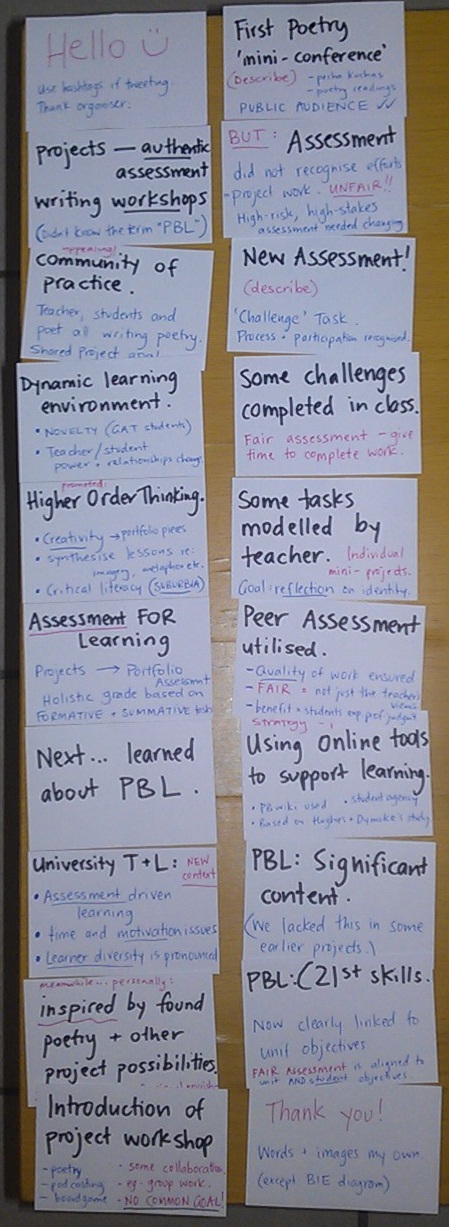
Actual palm cards - old school!
If you’d like to check them out I’ve put the slides up on slideshare. I hope that showing these resources helps future TeachMeeters plan their Pecha Kuchas – I loved the mode of presenting and highly recommend it!
Congratulations to TeachMeet Sydney on their WORLD RECORD ATTEMPT tonight! I hope the next #TMBrisbane event at the State Library of Queensland will be able to be video streamed online like #TMSydney was tonight, I had a ball watching along and tweeting with everyone from home 🙂
TeachMeet Brisbane
Posted by kmcg2375 in conferences, education, learning community, social media, technology on January 23, 2012
During 2011 a range of TeachMeets were held throughout Sydney. A central wiki was set up to coordinate the events and the hashtag #TMSydney ran hot during the meets.
The events were great successes, described by participants as welcoming, supporting and positive. This is not surprising, when you consider that the ethos behind the event is that it is strictly free professional development run ‘for teachers, by teachers’. What I thought was most attractive about the TeachMeet structure was the short presentations – either a 2 minute ‘nano-presentation or a 7 minute micro-presentation (or Pecha Kucha). It sounds like an ideal way to hear a little bit from a lot of people.
You can therefore imagine how stoked I was to hear that someone was organising the first ever TeachMeet in BRISBANE!
#TMBrisbane
TEACHMEET BRISBANE will be held from 4-6pm at Moreton Bay Boys’ College on Thursday 1st March 2012.
If you would like to register or get more information, you can visit and join the TMBrisbane wiki: http://tmbrisbane.wikispaces.com/
Of course, I was so excited to see the event come to Brissie that I had to volunteer to present. It will also be a great chance for me to refine my pecha kucha style!
(I also look forward to the #TMBrisbane hastag drawing together more of the Brisbane edu-community)
Pass it on
If you would like to be involved in TeachMeet Brisbane, or to support the event, take a look at the flyer available for download on the wiki.
In the Twittershpere you can participate in the backchannel from anywhere (not just Brisbane!) on March 1st by adding #TMBrisbane to your tweets.
Finally, this video about TeachMeets made for Sydney West is a great one to pass around to folk who are new to the TeachMeet concept…enjoy!
-
You are currently browsing the archives for the learning community category.
Nominated!

- Australian English Teachers
 9 members
A group for English teachers in Australia to discuss the books they are reading, and the books th...
Books we've read
View this group on Goodreads »
Share book reviews and ratings with Australian English Teachers, and even join a book club on Goodreads.
 Kelli McGraw
Recent Comments