Archive for category english
New Technologies, New Stories
Posted by kmcg2375 in english, online tools, technology on March 24, 2009
I am feeling very invigorated after today’s briefing meeting for the New Technologies, New Stories project that is being run by the English folks over at the DET Curriculum Directorate.
And why wouldn’t I? The focus of the project is the development of teaching resources and lesson sequences to support the integration of ICT into English curriculum – right down my alley 🙂 What I love most about this is that the emphasis is on using ICT as a tool to enrich the curriculum that we are already familiar with, rather than treating technology as an ‘add-on’.
The other thing I love about this project is that we won’t be building resources for applying ICT generally, but instead we are targeting NARRATIVE, and exploring how ICT can be used to enrich the teaching of narrative. I believe English teachers are going to love this. I have run many a workshop now, intorducing general ICT and Web 2.0 tools, and teachers always leave feeling like they have learned someinteresting new things, but not neccessarily with a clear direction for applying their new skills. By placing the teaching of narrative first in this approach teachers will see a strong connection between the technology and the teaching that they already do.
I’ll post again soon with some notes about the sequence of lessons that I am planning for this project. In the meantime, does anyone want to add a comment about how they are using (or would like to use) technology in the teaching of narrative? I’d love to hear your thoughts.
New Resources Wiki
After tweeting with colleagues about which wiki site would be best to recommend to teachers (the jury is still out) I decided to have a look at wetpaint.com, a wiki site I hadn’t used at all before. The result: a brand spankin’ new wiki of my very own 🙂
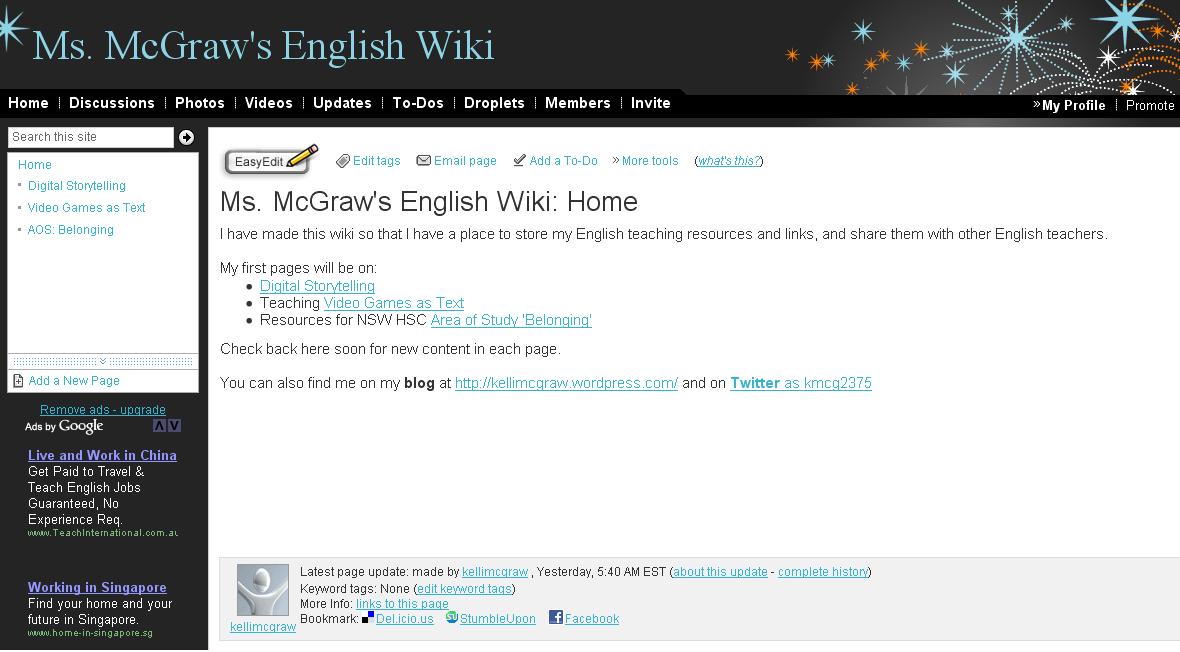


I made Ms. McGraw’s English Wiki so that I would have a place to share my English teaching resources, without using ‘pages’ on my blog. The old pages have been un-published, and a new blog page for Teaching Resources now directs readers over to the wiki.
If you have time to take a look, let me know what you think. So far I have transferred my blog resources on using digistories and video games to the wiki, and have added a page for the HSC AOS: Belonging as well.
Why do we read?
A very insightful comment from one of my Year 10 students this week. Writing about what she likes about English (their first piece of blog homework) she writes:
I like reading because its like tv in your head! I think writing stories is very cool too because you can write about ANYTHING in the world, you can use your imagination and write wonderful stories.
English helps to get what’s inside of you, out.
From the mouths of babes, huh 🙂 In response to this, I’d like to share a quote that I recently found, by Mexican poet Octavio Paz:
Literature is the expression of a feeling of deprivation, a recourse against a sense of something missing. But the contrary is also true: language is what makes us human. It is a recourse against the meaningless noise and silence of nature and history.
Any other thoughts/quotation out there people could share on the question of why we read?
Returning and some thoughts on the canon
Hello all; apologies for my patchy appearances in the bloggosphere and twittersphere lately. After a short trip to San Francisco over the holidays (which I would like to return to with some thoughts on at a later date) I am home, back at school, and about to get stuck into the hardest two months ever, probably, in my life – finishing my PhD thesis.
I was working on this today, adding to my ‘Background’ chapter with some more thoughts on the influence of the canon in English curriculum. In doing so I came across an article by Anne Waldron Neumann, “Should You Read Shakespeare?” (in Meanjin v.56, no.1, 1997: 17-25). It was an enjoyable read, covering all of the arguments for and against bothering to read Shakespeare. In particular I enjoyed the opening lines:
‘Should I read Shakespeare?’ So you probably ask yourself each morning as you stare at the mirror, toothbrush in hand. Or, if you do not, many older and possibly wiser heads are asking for you: ‘Should you read Shakespeare?’
Shakespeare Searched
Posted by kmcg2375 in english, online tools on December 30, 2008
Thanks to @heyjudeonline for the link to a site called Shakespeare Searched. The database is helped by the Folger Shakespeare Library, and you can use it to search for words or themes by play or by character. You can search within plays, or search through all of the Bards works.
Here is an image from my screen after searching for Macbeth, then browsing through quotes containing the word traitor:

Jeannie Baker: Belonging exhibition
The work of Jeannie Baker, a British-Australian children’s author and artist, is well known by Australian children. In a special exhibition at Casula Powerhouse this summer, collages from her award winning picture book, Belonging, will be on display for people of all ages to enjoy. Rsvp for the opening or for more info on public programs, click here.
I just love the book Belonging by Jeannie Baker, and am really keen to go along to this exhibition of her collages – I might even try and get to a collage workshop!

Belonging
I think this picture book, and its companion book Window would make excellent pieces of related material for the HSC Area of Study ‘Belonging’. Has anyone else seen this book? What do you think? Here is a brief description of the book from Jeannie Baker’s website:
An alienating city street gradually becomes a place to call home. Little by little, baby Tracy grows. She and her neighbours begin to rescue their street. Together, children and adults plant grass and trees and bushes in the empty spaces. They paint murals over old graffiti. They stop the cars. Everything begins to blossom.
‘Belonging’ explores the re-greening of the city: the role of community, the empowerment of people and the significance of children, family and neighbourhood in changing their urban environment. The streets gradually become places for safe children’s play, and community activity and places for nature and wonder.
Proposed HSC changes
I cannot stress enough the importance of responding to the NSW Board of Studies proposed changes to HSC examinations and school assessment.
When you look at what they are proposing, it’s hard to see how they can possibly be genuine about their aim of “reducing unnecessary stress and workload for students and teachers”.
The 8-page Background Paper is an easy read, and explains the general changes that are proposed for all HSC courses:
- A mandated number of FOUR in-school assessment tasks for each 2 unit course
- How the BOS thinks that running LESS assessment (making each task worth MORE) is beyond me. Schools will get around this by making tasks bigger and more involved, perhaps by running ‘one’ task with multiple ‘parts’.
- If you plan to have one assessment for AOS, and another three for the three Modules…where does the Trial fit?
- A removal of the limits of how much in-school assessment can come from test and exam tasks (!!)
- This is OUTRAGEOUS. It will certainly lead to schools assigning a greater weighting of marks to exam-type tasks. At the Forums I have been to on the proposed changes, BOS reps argue (with a straight face) that they don’t think schools would want to do more exams…how naive.
- Each 2 unit course to have a single 3 hour exam including 10 mins reading/planning time
- Obviously this is a big change for English. What is going to be cut out of our exam to make it fit? The logical answer is that creative writing (at least) will disappear entirely.
- Why not just make the 10 mins reading time extra? This policy is blatantly linked to a cost-cutting agenda, not to reducing student stress!
- Advice will be provided on expected length (number of pages etc.) of written exam responses
- This looks oppressive, but BOS have argued this is only intended to stop those 30 page exam responses…which is OK by me as long as students aren’t heavily penalised for going a little over any prscribed length.
- A review of specifications to reduce the amount of time spent on major projects and performances
- Wow! Lucky students! I think this is great, only…does this mean that the BOS will also be LOWERING THE STANDARDS? Students currently work hard on major projects because the acheivement descriptors require it for students to get a Band 5 or 6.
- What would make more sense is lowering the number of units that students had to study from 10 to 8, and giving them free periods at school for project work.
- School assessment to be based on clusters of outcomes, NOT on topics (e.g. Area of Study, Modules)
- This is ridiculous. This is clearly how they think they can get away with reducing the number of assessment tasks to FOUR. To assess how well a student has understood an elective, you need to assess that elective. Unless the BOS want to change the syllabus…hmm, seems they are subversively trying to do just that.
- Written exams to contain a mix of ‘objective response’, ‘short response’ and ‘extended response’ items
- Multiple choice questions in Stage 6 English? In an exam that’s worth 50% of their mark? Of the mark they are using to try and get into Uni?? Don’t make me slap you.
The BOS has provided a feedback form for people and organisations to respond to these proposals. The consultation period has been extended to the 28th October, and I encourage English teachers to send in their feedback!
The implications of these changes for English are huge. For those of you wondering how on earth we would fit our current two paper/four hour exam into a single three hour exam, here are the Board’s specific proposals for Advanced English (specific proposals for all of the courses can be found here).
Screen Australia Digital Resources – Belonging
For those who are hunting around for resources to use next term with the new HSC Area of Study ‘Belonging’, you might want to head over to the Screen Australia Digital Learning resource finder. If you search for ‘Belonging’ you will find a number of film clips relating to the concept of Belonging.
Each clip also has a short set of classroom activities written by members of the English Teachers’ Association (including yours truly!) to get you started with your lessons on Belonging 😉
My favourite is the story of Cuc Lam’s Suitcase. It will be an especially relevant text to model with students studying The Joy Luck Club – I also used it this year, as it sat really well with Skrzynecki’s poetry for ‘the Journey’.
NSW syllabus gets some good press!
Thank you David Dale, for your refreshing column in this week’s Who We Are column in the Sun Herald “Better living through English”.
Dale describes his reading of the NSW 7-10 English syllabus, and finds “that it doesn’t just give students tools for communicating clearly in adult life, but it actually wants to turn them into decent people.” He also was surprised to find such a high level of rigour in the syllabus, observing that in contrast: “In my day, the teacher was happy if you left school able to quote a bit of Shakespeare and tell the difference between a metaphor and a simile.”
One element that Dale praised especially was the fact that English is “not just about books any more. The syllabus uses the word ‘text’ to cover movies, TV shows, articles, books, plays and even video games.”
This column made such a nice change from the usual (misinformed) bile that we see from the likes of Donnelly and Devine. Nice to start the teaching break on a positive note…it sure has been awhile!
Miranda Devine is a Hack
Miranda Devine writes in the SMH today that English teachers have lost the plot, and criticises the English Teachers’ Association for hating books, plays and poems, and language in general really.
Hmmm. I wonder, what is more likely…
- That English teachers hate books, OR that they think students need to know how to understand and create spoken and visual language as well?
- That English teachers hate books, OR that they LOVE books, as well as films, poems, webpages, plays and TV shows?
- That English teachers hate Australian books, OR that they LOVE Australian books…AND films, poems, webpages, plays and TV shows!?
- That English teachers don’t want students to read books anymore, OR that they LOVE it when students read books, but don’t want politicians and journalists dictating when and where books are used in their teaching program?
Devine quotes author Sophie Masson, who believes that English teachers have a “subconscious hate and envy of writers” – this is of course why we all hate books, and are hell-bent on destroying LIT-RIT-YOOR for students today.
Masson is also quoted (as speaking on behalf of all English teachers), because some teachers have told her at writing workshops that the HSC is too hard. Devine describes with horror that “there is a huge burden on [teachers] to comply with curriculum rules and what has to be accomplished in a year.” Well, yes. I agree – but this has less to do with having to teach ‘theory’, and more to do with what we are forced to cram into the HSC year because politicians insist on setting the bar so high to protect the reputation of NSW’s ‘world class curriculum’! If parents want an easier HSC, they need to tell the politicians…they will get my support, but Devine is likely to slam them in the SMH for want to ‘dumb down’ they syllabus…
Speaking of dumbing down, Devine also quotes her mate Big Kev Donnolly, who along with Devine perhaps has a subconscious hate and envy of good English teachers who sees any attempt to teach spoken or visual language as “social activism”. At what point will the Sydney Morning Herald stop giving air to journos that are so out of touch??
If the English curriculum only covered written language – books, poems and plays – it would be a very disengaging subject indeed, not to mention totally irrelevant in our contemporary world. Miranda Devine is of the opinion that ‘words are words’ whether in a book or on a screen. How utterly ignorant. If Miranda Devine is serious about encouraging a love of language (as I truly believe she is, in her own misguided way) she would be better off getting behind English teachers who want to teach MORE language forms, not LESS.
The ETA’s response to the Board of Studies’ proposal to ‘Strengthen Australian Literature’ actually argues the following:
- ETA members do not believe that there is any need to impose further restrictions on professional choice and judgement than those that are already in English syllabuses.
- ETA members believe that any definition of ‘Australian’ needs to see Australia in a global context , and to take account of Indigenous and multicultural perspectives.
- ETA members feel strongly that a definition of literature with a restriction to the print medium is imprudent, reductive, short-sighted and, most importantly, undermines the integrity of current English syllabuses.
- ETA members believe that the amendments to the K-6 English syllabus do not provide the richness of direction required for non-specialist English teachers particularly in the areas of what could constitute literature and the kinds of creative responses it may inspire. They also think that teacher professionalism needs to be acknowledged by specifying their involvement in the development of recommended text lists.
- Members are particularly concerned at the narrowing of the definition of literature in the syllabus [to mean only print texts – books, poems and plays] and believe that strengthening the inclusions in the syllabus restricts the capacity of teachers to effectively support weaker students.
-
You are currently browsing the archives for the english category.
Nominated!

- Australian English Teachers
 9 members
A group for English teachers in Australia to discuss the books they are reading, and the books th...
Books we've read
View this group on Goodreads »
Share book reviews and ratings with Australian English Teachers, and even join a book club on Goodreads.
 Kelli McGraw
Recent Comments