Archive for category education
charlieissocoollike
I just went to post information about the latest ACARA update, including the video message from Prof. Barry McGaw, but it wasn’t working out.
In the meantime, I found this Youtube channel, which I highly recommend – it’s funny, if you like that sort of thing. Guaranteed more interesting than the ACARA update imho…
I watched a few episodes, including this one, which I’m posting in light of my own soon to be 30-ness:
I am like so cool.
Best teacher movies of all time
Posted by kmcg2375 in education, university on September 25, 2010
I have always wanted to design a pre-service teaching unit based around a reflection on a range of ‘teacher movies’.
We all know the kind: teacher finds themselves out of their depth, but then struggles against the establishment and/or personal odds to overcome adversity and transform the futures of a group of wonderful young people we come to know and love. Oh, and there’s usually some kind of tragedy, you know, to make a point.
Here in no particular order are my top five teacher movies of all time:
- Dangerous Minds (starring Mchelle Pfeiffer)
- Dead Poet’s Society (starring Robin Williams)
- The Breakfast Club (the John Hughes classic)
- Mr Holland’s Opus (starring Richard Dreyfuss)
- Coach Carter (starring Samuel L Jackson)
It would be a great unit: 10 weeks, 5 movies, 1 week watch the film and set readings, next week do a critical analysis. It would draw in sociology, philosophy, productive pedagogy, and some psychology too, especially around theories of motivation.
Hands up who wants to do my course!
Are there other movies you would suggest?
PS: I spy with my little eye…students from QUT checking out my blog!
Hello, and welcome 😀 Please feel free to add comments on any post. There is also a ‘blogroll’ on the right of the screen where you can find links to other blogs that I have liked to read.
Blogging is a great way to share your ideas with others, but also to process your own experience and support your reflective practice.
Insubordination
Posted by kmcg2375 in education, reflections on August 11, 2010
This tweet caught my eye today:
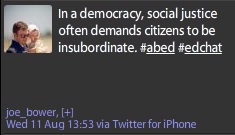
It caught my eye because I have been musing on this observation made by Jan, a high school Principal on Twitter last week:
We work within a system. Of course there are systemic priorities. That is the reality of any workplace IMHO.
I wanted to flag this because I think both of these tweets are right, but this is a problematic standpoint as ‘working within a system’ and ‘being insubordinate’ are tricky agendas to keep in balance.
There has been much promotion recently amongst NSW DET leaders of adopting a ‘Tight-Loose-Tight’ model of working in schools. It’s a model I support, and I think it provides a really terrific framework for teachers and school leaders (and system bureaucrats) to work on common ground without constantly arguing about, say, NAPLAN. By accepting policy and product requirements we can get on with developing the ‘Loose’ area – the bit where we actually teach in the classroom using different and divergent strategies that are relevant and engaging and meet the needs of our personal teaching style, our individual students and our local school context.
However, recently I have definitely felt that critical comments made by teachers about ‘the system’ are being taken personally by leaders who are higher up the chain and see this as either a personal attack or an undermining of their innovative work in planning their school. A few weeks ago I wondered if the answer is that we need a more realistic paradigm for collaborating with the people who ultimately are our ‘boss’. But to tell you the truth, I find that idea quite dispiriting. I hate having to mind my p’s and q’s…it’s why I decided NOT to go into politics!
I don’t have much to say about this today, but perhaps you do?
How can we show our leaders the love (and our commitment to common goals) while maintaining a healthy level of insubordination?
NB: I’m talking very NSWDET here, but I’ve found a similar conundrum working with people on development of the National Curriculum…it’s tough to authentically engage in developing something so prescribed-from-above when your gut reaction is to kick against the pricks. Conversely, it’s tough to promote engagement with the resulting best-case-scenario product to people that I in turn lead when they want to fight against it too!
Student Choice
Posted by kmcg2375 in education, university on August 9, 2010
An interesting TED talk by Sheena Iyengar on The Art of Choosing:
After talking with some pre-service teachers today about what ‘choice and voice’ means in the classroom, I thought it was very timely to record these points made by Sheena:
It is a mistake to assume that everyone thrives under the pressure of choosing alone.
In reality, many choices are between things that are not that much different. The value of choicedepends on our ability to perceive differencesbetween the options.
When someone can’t see how one choice is unlike another, or when there are too many choices to compare and contrast, the process of choosing can beconfusing and frustrating. Instead of making better choices, webecome overwhelmed by choice,sometimes even afraid of it. Choice no longer offers opportunities, but imposes constraints. It’s not a marker of liberation, but of suffocation by meaningless minutiae. In other words, choice can develop into the very opposite of everything it represents in America when it is thrust upon thosewho are insufficiently prepared for it.
Teach. Everywhere.
Posted by kmcg2375 in education, personal, university on July 22, 2010
And so ends my first week of full time University teaching.
Man, how I love teaching.
I mean, I love researching too. But nothing – nothing – beats the buzz that you get from that act of ‘luring people in’ to a new area of knowledge, getting them excited about it, showing them new ways of thinking.
Anyone who says that teaching isn’t an art form is dead wrong. This week, teaching again after about 9 months off, I felt like a rusty ballerina! There were some stumbles, and my fitness is down. But the dance…it’s addictive. And the vulnerability you feel when you do it is part of the buzz.
A big shout out to all the staff and students in the School of Cultural and Language Studies in Education at QUT who have helped me feel so welcome 🙂 You rock!
Collaborating with the Boss
Posted by kmcg2375 in education, online tools, school, social media on July 20, 2010
My budding questions around how power operates in social networks and how networking constructs our identity are still on my mind.
I suggested in one post that the reality of using social media (“If you’re going to be a big boy and swim, and benefit from, these waters you have to be able to take it.”) means that teachers, who are often not in positions of power, need to be mindful of how they construct their identity online, and stop being naive about the ‘glorious, open sharing’ promised by social media being consequence-free.
These ideas were not met well by some. I suspect that such comments sound like an attack on ‘the boss class’. But this is an exact example of the very thing I’m talking about. It’s hard to discuss online practices without taking it personally if you think you are being criticised, because we invest our identities in what we do and say online.
So, I tried to take my thinking in a different direction, and came up with some generative ideas about how school leaders can better support teacher change by more specifically ‘diagnosing’ the reasons for resistance. People liked this. I liked this. And it’s a line of thinking that I know I’ll follow up.
But it doesn’t really speak to the original issue.
That’s why I’ve gone for a nice, clear, provocative title for this post. And I hope people will not take it personally (as so many people in my PLN are bosses!) when I say that there are real problems with inviting staff collaboration if you don’t have a plan for how to cope with dissent.
We can say that we ‘encourage dissent’ until the cows come home. We can say that disagreement is generative. Sometimes these things hold true.
But what support structures, what strategies, need to be in place for this to succeed, for all involved? (<– this is the generative part that I hope people will think about and engage with)
And what are the costs of making your identity known online if you are a dissenter?
When I write online, I do so in good faith – in the spirit of sharing my ideas and resources. I’d like to think I’m open to criticism, and change. But can someone like the NSWDET Director General afford to do so? Surely not – he is limited in what he can share because of his role, and so it should be. What about a school principal? As the most powerful ambassador for their school, there are limitations on what they can say too. What about classroom teachers? They are incredibly vulnerable to misinterpretation and misrepresentation, and as the lowest on the professional pecking order, the easiest to impose consequences on.
Please don’t misunderstand this post as undermining social networks – that’s not what I’m trying to do. And please don’t take the absence of all the usual ‘good news’ stories about how developing an online PLN increases professional development and sense of contentedness as a sign that I don’t fully support all of the wonderful work that is going on out there on Twitter, Yammer etc.
But I think we need to come clean about the need to tighten up our approach to professional discussion in the online world.
Because at the end of the day, if you are a ‘boss’ and you ask people to share ideas and collaborate with you (online or in real life), you are giving up some of your power. And things are going to get complicated if/when you find yourself having to reign that in.
NB: anonymous comments are welcome.
Reframing Change
Posted by kmcg2375 in education, online tools, reflections, school, social media, technology on July 12, 2010
- Why do some people embrace change quickly, while others are slower to make changes to their practices or perspectives?
- What comfort (and convenience) is there in sticking with the known, the familiar, the expected?
- Can leaders of change persuade people who are slow, and even resistant to change, through enthusiasm alone?
- Is it enough to lead by example?
I want to suggest that, as educational leaders, if we want to help people come to terms with change and embrace it, then we need to recognise and validate their desire to stick with ‘the known’. Roger Pryor’s latest post makes some excellent points about ‘leading from behind’ and developing the leadership capacity of others. I think this is one of the significant hurdles – just as we find in our classrooms it is sometimes necessary to hang back while the students discover things for themselves, people can be empowered by discovering their capacity to change. Recognising that people are resisting change because they feel disempowered helps us to employ methods that give power back. This is a win-win solution.
But what other barriers are there to change that could similarly be ‘diagnosed’ and therefore turned around?
When a teacher tells me that they don’t want to use any online teaching tools because they are ‘too tired’ or ‘too busy’, one reaction I feel is frustration. Does this teacher think that I don’t get tired? That I am not busy?? I manage to find time to change my practice because I see it as a high priority.
The problem with this line of thinking is twofold. Firstly, I’m expecting someone else to have the same energy levels as me, without really questioning whether they do. Secondly, I’m asking someone to accept a shift to online teaching as a priority, when perhaps their professional priorities lie elsewhere. Perhaps they are really struggling with face-to-face classroom management. Perhaps they are consumed by essay marking.
So, one way forward is to find ways to align our priorities.
By this I don’t mean that other teachers should change their priorities to match mine! But, I might set aside my initial frustration to consider ways in which I can create professional learning that satisfies both of our priorities. One teacher I worked with gained confidence in marking essays after I showed her how to use track changes and commenting in Word…this also served the purpose of increasing her confidence with technology. Our priorities were aligned!
However is it also possible that sometimes, just sometimes, we are expecting too much? We also need to recognise that people only have so much energy to give.
Another way forward then, is to find ways of giving people the energy to change.
Teacher burnout is an increasingly widespread phenomenon. And yet, when I expect others to adopt new practices on the grounds that ‘I was able to do it’, I am refusing to validate them as a human being outside of the world of work. This might fly in the corporate world, but in the education system I would like to think this is outside of our philosophical remit.
One way that I generate energy to learn more about technology and the online world is to engage in digital practices that nourish me, personally. For me it’s sharing my (budding) artwork, making digital collages, reading with my Kindle, and connecting with friends in a purely social capacity via Facebook. I get professional nourishment from a lot of places too, but I’m not talking about that.
For some people getting a thirst for technology comes when they make their first Skype call, or make photo albums on iPhoto. For many people, the social connection provided by Facebook has been the big thing to ‘draw them in’ and increase their digital literacy (one of the reasons why, although Facebook has turned evil, I have a real problem with the tech elite bagging it out unreservedly).
Fun generates energy. Fun lures people into engagement.
So, if the diagnosis is a lack of energy, it might be worthwhile exploring how to restore people’s capacity to engage through play.
These are just a couple of example that I have been forming up. Aligning (not replacing) priorities, and restoring energy through fun and play.
As we continue to make new inroads with people who have typically resisted change, I really believe it is time to develop more sophisticated models than ‘lead by example’. That was phase one. Now we are getting a critical mass of people out there willing to lead by example…where can we move to next to stimulate change and support the changers?
Nine Visions for Citizens and Soldiers
Official footage of students from Macquarie Fields High School reading their poetic response to Governer Lachlan Macquarie’s inaugural (1810) speech:
It is really great to finally see this footage. Sean and Natalie read so well! Well done to the entire ‘Live Poet’s Society’ at MFHS, and a big shout out to Lachlan and the Red Room Company for providing the school with this opportunity. Thanks guys!
What Teachers Want
What Teachers Want: Better Teacher Management (A Grattan Report)
Evaluating the work of teachers and developing their teaching skills is a key part of improving the quality of teaching. However, an OECD survey reveals that teacher evaluation and development in Australia is poor and amongst the worst in the developed world.
Watch this 2-minute video summary of the report, or read the full report in this PDF.
I am hopeful that regulatory bodies such as the NSW Institute of Teachers and Teaching Australia (now AITSL) can play a part in improving this situation.
-
You are currently browsing the archives for the education category.
Nominated!

- Australian English Teachers
 9 members
A group for English teachers in Australia to discuss the books they are reading, and the books th...
Books we've read
View this group on Goodreads »
Share book reviews and ratings with Australian English Teachers, and even join a book club on Goodreads.
 Kelli McGraw
Recent Comments